Malaysia Property News is a free resource website sharing Daily Property News & information about Property in Malaysia, which related to, Property Market, Property Investment, Commercial Property , Hot Properties Malaysia, Real Estate, Retail Shop, Business Park, Condominium Malaysia, Terraces & Apartment Malaysia, Houses, Residence, Resort and many more.

Friday, August 20, 2010

PKNS plans more projects

SELANGOR State Development Corp (PKNS) hopes to achieve at least 85 per cent of the RM750 million sales targeted by the year-end.

To date, PKNS has made RM360 million sales. Last year, its sales amounted to RM390 million.

"We are optimistic of achieving at least 85 per cent of the sales target based on the number of projects we have launched this year," PKNS deputy general manager (administration and development) Md Nasir Md Arshad said in Shah Alam, Selangor.

There are more than 50 housing projects being developed by PKNS currently. It has launched 38 so far this year.

The agency plans to launch at least two more after the festive season in Alam Nusantara in Setia Alam and Puncak Tropika in Section 9 Shah Alam.

PKNS is one of the key sponsors for the Selangor Lifestyle and Property Expo 2010 (Selpex 2010), which will be held at the SACC Convention Centre on October 29-31.

The inaugural expo is expected to attract some 30,000 visitors.

More than 100 exhibitors are expected for the three-day expo comprising property developers, financial institutions and interior designers as well as those in the business of home decor items, landscaping, and travel and holiday packages.

Md Nasir said PKNS hopes to generate some RM7 million sales during the expo, with the help of several incentives.

"Due to the overwhelming response we received when we offered incentives at other showcases, we decided to continue with the offerings during Selpex 2010, and will continue to offer them until the year-end," he added.

The incentives include waivers of stamp duty and legal fees, rebates of up to RM10,000, 24 months defect liability period and easy installment schedule for the 10 per cent downpayment.

By Business Times

Kwong Hing buys Menara Pan Global


Property developer and manager Kwong Hing Group pays an estimated RM160 million for the 38-storey building in Jalan Puncak, off Jalan P. Ramlee

Property developer and manager Kwong Hing Group has bought Menara Pan Global, located within the Golden Triangle, for an estimated RM160 million from PanGlobal Bhd, sources say.

Menara Pan Global, a 38-storey building in Jalan Puncak, off Jalan P. Ramlee, houses 18 levels of office space with a total built-up of 400,000 sq ft.

The 18-year-old building also houses nine levels of hotel suites operated by Pacific Regency, while another eight levels have a total of 420 parking bays.

A source told Business Times that Kwong Hing paid a deposit for the purchase last week.

The group, whose prized assets includes Wisma Hamzah Kwong Hing in Lebuh Ampang, now has assets valued at RM600 million.

An official from Kwong Hing declined to comment when contacted.

It is understood that Kwong Hing may invest further to upgrade both the office space and suites to better compete with offices in the Golden Triangle.

The office lots are said to have 70 per cent tenancy.

Similarly, Kwong Hing will do some work on the 153-suite Pacific Regency, famous for its rooftop Luna bar, to improve its average room rate.

This purchase will see the group venturing for the first time into the hospitality sector.

A source said that the management team and the staff of Pacific Regency will be maintained where possible.

However, the name of the building could change.

It is understood that the sale forms part of PanGlobal's restructuring exercise. The company was delisted from Bursa Malaysia in July last year.

The Kwong Hing group's properties include Wisma KH in Jalan Sultan Ismail, Plaza Pengkalan in Jalan Ipoh and Wisma Fui Chui in Jalan Cheng Lok.

It also owns shopping centres along Jalan Tuanku Abdul Rahman and Jalan Petaling and Bangunan HSBC in Medan Tuanku.

By Business Times

Majuperak in tie-up to develop Perak land

KUALA LUMPUR: Majuperak Holdings Bhd announced that its wholly-owned subsidiary, Syarikat Majuperak Bhd, will jointly develop 184ha in Batu Gajah, Perak, with Xtreme New Sdn Bhd.

A memorandum of understanding to facilitate the joint development was executed on Aug 18 and both parties had agreed that a joint-venture agreement would be signed in three months, it told Bursa Malaysia.

By Bernama

Hua Yang to raise up to RM100mil

KUALA LUMPUR: Property developer Hua Yang Bhd is to undertake a fundraising exercise next year to raise between RM50mil and RM100mil which will be used for land acquisition.

“We are exploring a few options such as a bond or rights issuance,” chief operating officer Ho Wen Yan said after its AGM yesterday. (Ho Wen Yan succeeds his uncle Ho Mook Leong as CEO today, according to an announcement to Bursa.)

At present, Hua Yang’s gearing level was 0.3 times and its financial position remained comfortable.

By Bernama

Thursday, August 19, 2010

High-end houses by Seri Alam soon

PASIR GUDANG: Seri Alam Properties Sdn Bhd, a wholly-owned subsidiary of UMLand Bhd, will launch its high-end residential properties at Bandar Seri Alam starting next year.

General manager Mohd Noor Abdul Salam said the company would allocate 202.34ha at the ongoing township project for the high-end homes.

He said the properties would include double-storey cluster and semi-detached houses and bungalows priced from RM450,000.

“The demand for high-end properties in Johor Baru is on the uptrend, especially with Iskandar Malaysia progressing well,’’ he said.


Tan Cher Puk (left) and Mohd Noor Abdul Salam at the showhouse of Bluebell @ Garden Residency in Bandar Seri Alam

Noor was speaking to StarBiz at the launch of the company’s double-storey link houses, Bluebell @ Garden Residency, by Johor Jaya state assemblyman Tan Cher Puk recently.

Pasir Gudang is one of the five flagship development zones under the Eastern Gate Development of Iskandar. Other zones are Johor Baru City Centre, Nusajaya, Western Gate Development and Senai-Skudai.

Noor said the entry-level prices for high-end properties in Pasir Gudang were still much lower compared with those in Nusajaya.

“There are many ongoing and planned infrastructure projects for Pasir Gudang and this will help improve connectivity,’’ he said.

The ongoing projects include Coastal Highway linking Pasir Gudang via Permas Jaya second bridge and phase two Senai-Pasir Gudang-Desaru Expressway.

In the pipeline are the integrated transport system which will consist of light rail transit lines from Pasir Gudang to Johor Baru and Nusajaya and the extension of mass rapid transit line from Singapore to Pasir Gudang.

Noor said the “City of Knowledge” status given by Iskandar Regional Development Authority to Bandar Seri Alam would boost the township’s image.

Masterskill University College of Health Sciences Universiti Kuala Lumpur and Universiti Teknologi Mara would set up branch campuses in the township. This is expected to create a student population of 40,000.

Bandar Seri Alam covers 1,347.60ha, of which 60% has been developed into 10,000 mixed properties. The remaining 540ha will keep the company busy for the next 10 to 15 years.

By The Star

DNP to expand outlets, existing brands


DNP Holdings Bhd, which has 56 retail outlets carrying high-street labels like Dorothy Perkins and Top Man, plans to add another 20 to 30 similar outlets over the next three years.

General manager Lee Kong Beng said the company is likely to stick to the Klang Valley, Penang and Johor for the expansion.

"The plan is to expand our existing brands and we may bring in one or two new brands next year," he told Business Times.

The company, via its retail arm DNP Clothing Sdn Bhd, also holds the Malaysian franchise for other well-known clothing labels like Warehouse, Karen Millen, Pumpkin Patch, Diva and Canali.

It is set to open its first "Uniqlo" outlet in Malaysia in November at the Farenheit 88, formerly known as KL Plaza in Kuala Lumpur.

DNP's parent, Wing Tai Asia Group, also has other franchises and it may capitalise on that to bring new fashion labels to Malaysia, Lee said.

On its property division, DNP's Impiana Commercial Hub in Bukit Mertajam on mainland Penang is set to be launched in September or October.

Sprawled over 20 hectares, the commercial development is set to house a Tesco hypermarket, food and beverage outlets, a medical centre, a budget hotel and a dedicated area for electrical and electronics shopping.

DNP reported a net profit of RM53.2 million for the year to June 30 2010, which is almost four times what it made in 2009, as it made more money from its property and trading businesses.

Its revenue jumped by more than a third to RM354.3 million.

By Business Times

US wants new housing finance framework

WASHINGTON: The US government’s role in housing finance should undergo “fundamental change,” but it should still provide some guarantees in the mortgage market, said Treasury Secretary Timothy Geithner.

Setting the stage for what promises to be a long debate about fixing Fannie Mae and Freddie Mac, Geithner convened a conference of housing industry leaders and heard a range of ideas about reforms for the US$10.7 trillion mortgage market.

Almost two years after the government seized Fannie and Freddie to save them from collapse, there is a widely held view that reform is needed, but the agreement ends there.

“It’s safe to say there’s no clear consensus yet on how best to design a new system. But this administration will side with those who want fundamental change,” Geithner said.


Timothy Geithner … ‘This administration will side with those who want fundamental change.’ — AFP

Fannie and Freddie – recipients of US$150bil in taxpayer bailout money since being taken over by the Bush administration in 2008 – pose a vexing policy challenge to the Obama administration as November elections approach.

The firms’ pursuit of growth and profits helped precipitate the financial crisis of 2007 to 2009, but their vast resources also helped minimise its impact.

And since their takeover, the two have only become more prominent in the market.

Together, the two companies and the Federal Housing Administration now back 90% of new US home mortgages.

“We will not support returning Fannie and Freddie to the role they played before conservatorship, where they took market share from private competitors while enjoying the perception of government support,” Geithner said. “We will not support a return to the system where private gains are subsidised by taxpayer losses.”

But Geithner backed some government guarantee for mortgages and US support for housing more broadly, setting early limits on the reform discussion.

“There is a strong case to be made for a carefully designed guarantee,” he said. “The challenge is to make sure that any government guarantee is priced to cover the risk of losses, and structured to minimise taxpayer exposure.”

As the administration worked to draft a housing overhaul by January, the key question, Geithner said, would not be whether government has a role to play in supporting the mortgage market and the “American dream” of home ownership.

In Geithner’s view, government has a key role since private markets, as shown in the 2007 to 2009 credit crunch, “left to their own devices, find it hard to resolve financial crises.”

The conference, including some of the mortgage sector’s top lenders and investors, was billed as a “listening session” to help the administration develop its overhaul plan. It comes amid signs of persistent weakness in housing markets – an issue that could weigh on voters headed to the polls in November, especially in Florida and California.

Housing starts nationwide rose in July from a downwardly revised level in June, but the pace of new construction was much weaker than forecast and permits for future building fell to their lowest level in more than a year, according to a US Commerce Department report on Tuesday.

A Deutsche Bank study looked at mortgage delinquency rates in the country’s 435 congressional districts, all of which are up for grabs in November.

More than 15% of mortgages were delinquent by 90 days or more in 60 of those districts, with Florida and California accounting for 44 of them.

The average US congressional district had more than 9% of its mortgages delinquent by 90 days or more – over two and a half times the delinquency rate on Election Day in 2008.

Bill Gross, co-founder of Pacific Investment Management Co, which operates the world’s biggest bond fund, told the conference the administration should move quickly on a new refinancing programme for current mortgages backed by Fannie and Freddie. — Reuters

The US economy was approaching a “cul-de-sac” unless a positive fiscal stimulus came soon, he said.

By Reuters

Wednesday, August 18, 2010

Penang property mart set to boom


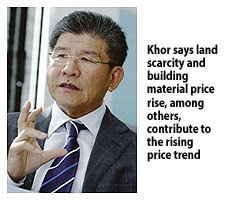
The Penang property market is expected to enter a boom cycle as there are signs of a gradual price rise due to land scarcity in prime areas.

Hunza Properties Bhd (HPB) executive chairman Datuk Khor Teng Tong yesterday said land scarcity, teamed with a hike in building material prices and labour costs, have contributed to this trend.

"Going forward, the shortfall in supply of properties cannot be addressed and overcome in the short-term.

"This will lead to a situation where supply is unable to meet demand and further contribute to the increasing trend in property prices," he told an analyst briefing in Penang when announcing the company's 2010 fiscal results.

For its financial year ended June 30, HPB recorded revenues of RM258.7 million and profit after tax of RM50.9 million.

The figures reflect an increase of 172 per cent on revenues and 84 per cent on profit after tax respectively compared with the preceding financial year.

HPB benefited from stronger sales in fiscal 2010.

"Construction works on the two residential towers of our Gurney Paragon project in Pulau Tikus have also been progressing well, thus contributing to higher revenue and attributable profit on percentage of work done," he added.

On the construction progress of the sea-fronting RM450 million Gurney Paragon project, which comprises a residential development, an office block and shopping mall, Khor said:

"It has sped up with its superstructure completed up to its top, the 43rd-storey, and this makes Gurney Paragon the tallest condominium in Penang.

"As the demand for high-end property in Penang remains high, we expect a further increase in property price, thus making the outlook for the property market very positive.

"Due to these reasons, HPB expects a stronger performance for the 2011 financial year," he added.

Gurney Paragon has attracted both local and foreign interest, its developers say, with condominium buyers from 20 countries so far.

Of the total 220 units launched, Khor said 130 units with a sales value of RM242 million have been sold as of June 30. The shopping mall is due to start operations in early 2012.

By Business Times

Tuesday, August 17, 2010

Mapletree plans US$928mil Japan property fund

TOKYO: Mapletree Investments, a real estate firm wholly-owned by Singapore state investor Temasek Holdings, plans to launch a Japan property fund of around 80 billion yen (US$928mil) this year in a bid to expand in the country’s property sector ahead of its rivals.

The new fund, with 30 billion yen of equity, will invest in business-related properties such as data centres, research and development facilities, and office buildings just outside central Tokyo and other big cities, Terence Heng, general manager of Mapletree Investments Japan, told Reuters in an interview.

“We need to get ideal properties now. It’s likely to become difficult to see those attractive deals if we miss the chance now ... The opportunity window is open for a year or two, or even shorter period than that,” he said.

Mapletree, which opened its Japan office in 2007, has been ramping up its investment in Japanese logistics facilities mainly for its Mapletree Logistic Trust, which owns warehouses and other industrial properties across Asia.

In Japan, the Singaporean company manages 12 properties, mostly logistics assets, worth 60 billion yen. But it aims to more than triple this to 200 billion yen in the next two to three years before competition heats up in the market, Heng said.

”We should proactively buy properties if they are good,” he said.

By Reuters

PNB primed for KL Golden buys


Permodalan National is looking at acquiring B grade (commercial buildings) with potential and sell them to PNB's real estate investment trust, Amanah Harta Tanah PNB.

Permodalan National Bhd's (PNB) asset management unit is in talks to buy commercial buildings in the heart of Kuala Lumpur as it seeks to provide assets for its property trust.

PNB Commercial Sdn Bhd, which has RM1 billion of assets, plans to buy properties in the Golden Triangle area, improve their performance and sell them to PNB's real estate investment trust (REIT), Amanah Harta Tanah PNB.

"We have identified a few buildings within the Golden Triangle. We are looking at the feasibility and evaluating the target assets," PNB Commercial chief executive officer Datuk Mohamed Marzuk Basir said.

However, there is no set allocation or fund for these acquisitions.

When the study is completed, it will be presented to the board to decide on the acquisitions.

"We are looking at B grade (commercial building) with potential," Mohamed told Business Times in an interview.

"We will take an underperforming asset and then nurture it to a respectable yield level within three to five years," he said.

These buildings typically have about 100,000 sq ft to 150,000 sq ft nett lettable area.

PNB Commercial currently manages 19 assets. Out of this, 11 are owned and managed by PNB Commercial, while the remaining eight are managed for PNB.

Apart from office buildings, assets under its management include retail and hospitality properties.

For the time being, it is not looking at expanding its retail or hospitality portfolio but only enhancing its existing assets.

By Business Times

Monday, August 16, 2010

Dijaya to launch Danga Bay project by Dec

DIJAYA Corp Bhd will launch phase one of Tropicana City@ Danga Bay, its RM3.8 billion integrated waterfront flagship project in Johor by December this year, its chief said.

Phase one will feature some 700 units of upper middle serviced apartments in three blocks, worth RM600 million or more than RM600 per sq ft each, managing director Datuk Tong Kien Onn said.

"We hope to start construction by December and realise the units block by block. Piling works have been completed. We are confident of the project," Tong said in an interview with Business Times in Kuala Lumpur recently.

Dijaya is developing 14.8ha of prime waterfront land at Danga Bay in Johor Baru over the next 10-12 years with Iskandar Water Front Sdn Bhd (IWSB).
Goldhill Quest Sdn Bhd - a 60:40 joint-venture between Nagasari Cerdas Sdn Bhd (a Dijaya unit), and Global Corp Development Bhd (owned by IWSB) - bought the land from Danga Bay Sdn Bhd for RM308 million or RM190 per sq ft.

It is one of the biggest private land deals since the inception of Iskandar Malaysia in 2006, where it is located.

Goldhill plans to build a retail street mall, office towers and residences, SoHo (small office/home office) and a four- or five-star hotel.

"We are still working out the components. The project will be similar to the Mid Valley development. But our mall will be different as it will focus on food and entertainment," Tong said.

Tong said Dijaya is targeting homeowners, expatriates and investors from Asia Pacific and Europe.

He said there will be spillover from Singapore with the opening of Resorts World Sentosa and The Marina Sands resort, where each have said they will employ more than 35,000 people when the projects are fully completed.

"We expect many of the staff to be relocated to Johor. Singapore expects 10 million additional tourists a year and we hope to ride on that with the opening of a four- or five-star hotel within our development.

"We may look at international operators like Starwood or Ritz Carlton Group to run the hotel. Nothing is on the cards yet as the hotel will be developed at a later stage," Tong said.

Dijaya, known for its flagship Tropicana Golf and Country Resort development in Petaling Jaya, has RM290 million cash in hand which it will partly use to start the development, Tong said.

"We will look at bank loans but we are expecting the project to be self-financing later," he said.

By Business Times

Dijaya banks on Iskandar factor

JOHOR BARU: Dijaya Corp Bhd is banking on the long term development of Iskandar Malaysia as the main draw in attracting interest to its Danga Bay project here.

Group chief executive officer Tan Sri Danny Tan Chee Sing said apart from the project’s location on prime waterfront land, Johor’s proximity to Singapore would be another selling point.

“The timing is right for us to come to Iskandar in view of the good progress taking place in the economic growth corridor since its launch,’’ he said on Aug 10 at the signing of a sale and purchase agreement for two parcels of land totalling almost 15 ha in Danga Bay worth RM308mil.

The plots of land were acquired by Goldhill Quest Sdn Bhd - a 60:40 joint venture between Nagasari Cerdas Sdn Bhd (a wholly-owned subsidiary of Dijaya Corp) and Global Corporate Development Sdn Bhd, which is 100% owned by Iskandar Waterfront Sdn Bhd (IWSB).

Tan represented Dijaya at the event while IWSB was represented by its chairman Johar Salim Yahaya.

The signing ceremony was witnessed by Johor Mentri Besar Datuk Abdul Ghani Othman.

The joint venture company will develop the land which has a gross development value of RM3.8bil over the next 12 years.

Tan said the components of the integrated waterfront development project would include a stand-alone retail mall, four and five-star hotel towers and serviced apartments blocks.

“The project is likely to be known as Tropicana @ Danga Bay, after our flagship Tropicana Golf and Country Resort in Petaling Jaya,’’ he said.

By The Star

Saturday, August 14, 2010

There’s a price to pay for convenience

Rising house prices show that residential properties have become the “hottest” pick for investors who are flushed with cash and believe investing in a tangible asset is a good investment choice.

Although it may seem that the property market is on a “wholesale revaluation exercise” with prices climbing across-the-board, it is actually not so.

A check in the newspapers’ classified pages under the “houses for sale” column show that the price hikes are location centric. There is always a price to pay for convenience and living close to mature neighbourhoods with good basic amenities and infrastructure.

If one cares to check around, there are still many affordably priced (RM300,000 to RM400,000) new or second-hand houses out there, but one must be prepared to stay further away from the “conveniences”.

I believe there are various reasons why people invest in property over other investment instruments. The property market’s tenacity in withstanding the global financial crisis must have converted many sceptics to build up their investment portfolio with property assets.

Malaysians’ penchant to save has translated into lots of liquidity available for investment. Savvy investors will invest their money in instruments that will offer good returns over cost and risk.

The prevailing low savings interest rate and the under performing equity market are some of the “push” factors that are promoting property investment.

While these financial instruments are still affected by the external uncertainties in the US and Europe, property investments are very much locally-driven and has proven to be a reliable asset class.

The value of Malaysian properties, both houses and shop lots in good locations, have sustained very well so far and there have been more upsides than downsides.

The quick rebound of the property market in Singapore and Hong Kong may also have contributed to a resurgence in property buying here.

There is also pent-up demand for properties as some people who have procrastinated on signing on the dotted line previously have decided to do so now after seeing the market’s ability to withstand the tough times.

Supply has been slow to catch up after widespread project deferments by developers in 2008. New project launches have just resumed towards the later part of last year.

The high demand over supply has naturally resulted in housing prices escalating in various parts of Kuala Lumpur and the Klang Valley. Penang is also another hot property market where prices have come close to Kuala Lumpur levels and still climbing.

This is a good opportunity for less well known developers with reasonably sized land bank to build affordably priced homes to woo buyers.

One way developers can do this is to come up with products that allow buyers the flexibility to decide their own house built-up and layout plan, just like in the “Sims” computer game.

Instead of the “one-size-fits-all” model that is the norm now, it will be a value added service to buyers if there are various sizes and layout plans to choose from.

Some families have elderly folks and it would be more practical to have at least one or two bedrooms downstairs for a double-storey house.

I have heard mothers of teenage children staying in 2½-storey to three-storey houses complaining that they are “cut off” from what their children are up to these days. They yearn for “the closeness” of their single-storey or double-storey houses.

Large central parks would be another huge selling point as residents would like to unwind and relax in the open environment.

At the end of the day, all stakeholders must do their part to ensure the property market continues to be sustainable.

Developers should be more pro-active and ensure they take the necessary steps to “tune in” to their customers’ needs and ensure more timely launches to meet rising demand.

Buyers also have the responsibility to be prudent and not to over-commit themselves or default on their loans.

Deputy news editor Angie Ng thinks it is a good idea for relatives or friends, who want to stay close to each other, to pool their resources to buy a nice piece of land and turn it into a nice housing enclave.

By The Star (by Angie Ng)

CapitaLand’s Malaysian success

Last month, Prime Minister Datuk Seri Najib Tun Razak told Johor Umno branch leaders not to be emotional or parochial about Singapore investments.

For years, there has been this unhappiness about Singapore’s presence in the state, from the day tourists to corporate investors.

The fact remains that Johor – and the country – need the dollars, be it US or Singapore dollars, or any other foreign currency, for that matter.

Singapore’s business involvement in Malaysia can best be seen in the sprawling interest of CapitaLand Ltd, Southeast Asia’s largest property developer.

The company is also part of Temasek Holdings, the investment arm of the Singapore government. While CapitaLand is most bullish about its investments in China, it also upbeat about the region.

CapitaLand’s presence in Malaysia has been significant over the last 10 years.

In this relatively short time, CapitaLand has successfully branded itself in the Malaysia property scene.

Among its first condominium projects in Malaysia was Suasana Sentral, a 400-unit project built in partnership with Malaysian Resources Corp Bhd in 2001, when the Malaysian government was promoting Brickfields as a transport hub.

Since then, there have been various other projects. Says property consultancy Knight Frank MD Eric Ooi: “It was between 2002 and 2007 that the group became very aggressive in the Malaysian property scene. Its foray into the vicinity of the Petronas Twin Towers started with Marc Residences in 2002. It was already working on its branding then.”

Marc Residences was the third project to be launched after Stonor Park and Dua.

“They entered the high-end condominium segment because they saw pent-up demand for these condominiums. From their experience in Singapore, they saw the potential of that location and the demand for such high-end modern living, which Kuala Lumpur had never seen before,” says Ooi.

CapitaLand has since gone into quite a number of residential developments.

Among them Hamsphire Residences (with Zelan Bhd), Kiaraville and Tiffany by i-Zen (Ireka Corp Bhd) and Zehn Bukit Pantai (a joint venture with the landowners), to name a few. All of them are high-rise residentials. Its latest project is Seni Mont’Kiara (also with Ireka).

Successful branding

CapitaLand also has interest in UM Land Bhd, which is involved in township development in Johor.

Says Paul Khong, executive director of Richard Ellis Sdn Bhd: “CapitaLand has successfully branded itself in Malaysia, which is why other developers are keen to co-brand with them today.

“The name CapitaLand comes with a premium, and many Malaysians understand that,” says Khong.

CapitaLand’s presence in the commercial sector in Malaysia is through Quill Capita Trust (QCT), a real estate investment trust listed on the Main Market of Bursa Malaysia.

Currently, QCT has assets totalling about RM788.4mil, comprising 10 commercial properties in Cyberjaya, Kuala Lumpur, Shah Alam, Petaling Jaya and Penang.

CapitaLand is also involved in serviced residences through The Ascott Ltd, one of the world’s largest international serviced residence owner-operator, with more than 26,000 serviced residence units in key cities of Asia-Pacific, Europe and the Gulf region.

The company operates three brands – Ascott, Somerset and Citadines, and its portfolio spans 71 cities in over 20 countries.

In Malaysia, Ascott is the largest international serviced residence owner-operator, with nine properties offering close to 1,200 units.

Ascott manages seven properties in Kuala Lumpur – Ascott Kuala Lumpur, Ascott Sentral Kuala Lumpur (opening in 2013), Somerset Seri Bukit Ceylon, Somerset Ampang (opening in 2010) and three properties for corporate leasing.

In Kuching, Ascott operates Somerset Gateway and Citadines Kuching Uplands (opening 2012).

Says a CapitaLand spokesman: “CapitaLand has the experience and expertise along the entire real estate value chain. Exporting real estate expertise overseas has been CapitaLand’s forte. The group is an investor, developer, operator and manager, and provides financial solutions across sectors and geographies.

“Today, the group has nine listed entities, the latest being CapitaMalls Malaysia Trust, with a total market capitalisation of about S$40bil. It manages about S$50bil worth of real estate assets in more than 110 cities in over 20 countries.”

CapitaLand has no choice but to go overseas. With Singapore being just 700 sq km, it does not have much of an option other than to go offshore in search of opportunities.

After all, the whole of Singapore can only absorb 15,000 apartments a year, but in Shanghai alone, the same number of units can be sold within a week.

By The Star

Property buyers wary of govt move

SOME 40 per cent of property buyers planned on expected increase in property prices as the government phases out subsidies, a recent iproperty.com study revealed.

Another 38 per cent preferred to wait before making any purchases because they believe subsidies will not be phased out.

The remainder expressed indecisiveness and intended to sell their assets, iproperty.com noted.

By Business Times

HK moves to curb property bubble

HONG KONG: Hong Kong’s government said yesterday it will increase land supply to avoid a property bubble, warning that prices of some flats are approaching historic highs.

John Tsang, the city’s financial secretary, said prices in June were 8 per cent up from the end of 2009, despite a series of measures the government introduced in April to cool the overheating market.

By Business Times

Friday, August 13, 2010

Cyberjaya to be 30pc complete by year-end

CYBERJAYA'S overall development, encompassing the ambitious MSC Malaysia to leapfrog Malaysia into the information and knowledge age, is expected to be 30 per cent complete by year-end.

Cyberjaya landowner, Cyberview Sdn Bhd, said the township's current level of development has exceeded the target, with investors having injected RM5 billion worth of investments in building construction.

Rashid Mat, general manager for business, corporate communications and planning, said land worth RM390 million was sold last year and RM300 million in 2008, reflecting growing interest by global firms to relocate to Cyberjaya, dubbed the "Intelligent City".

The inflow of notable global multinational corporations (MNCs) into Cyberjaya continue unabated, with Hewlett-Packard (HP), the world's largest technology company headquartered in California, looking to expand its presence in Cyberjaya, Rashid said.

Cyberview has developed 600,000 sq ft of office building on 11.2ha for HP.

It is understood that HP is keen to buy another piece of land to develop a data centre in Cyberjaya. Spanning an area of about 2,800ha, Cyberjaya is home to more than 20 MNCs including Dell, Satyam, HSBC, Motorola, IBM, HP, data centres of Bank Negara Malaysia and Malaysian Communications and Multimedia Commission, universities, commercial zones and residential estates.

In terms of office space, Cyberview said the company is looking to develop 8.04 million sq ft by year-end from the previous five million sq ft target due to growing demand from MNCs and MSC-status companies.

Rashid said many companies are now willing to own a property in Cyberjaya than to rent premises. "We will continue to pursue the plan for foreign companies to set up their operations in Cyberjaya. The demand is not just from MNCs, but also MSC-status companies," he said.

For residential space, Rashid said more developers are starting to develop projects in Cyberjaya and purchase land from Setia Haruman Sdn Bhd, the master developer of Cyberjaya.

"Over 2,900 residential units have been completed, with another 2,300 in the pipeline, including the Garden Residence by Mah Sing Group Bhd and Symphony Hills (by UEM Land Bhd)," he said.

Rashid said Setia Haruman sold RM390 million worth of land in Cyberjaya last year and RM300 million in 2008 which will further alter its landscape into a bustling business enterprise.

By Bernama

Thursday, August 12, 2010

Five architects shortlisted for RM1bil job

KUALA LUMPUR: Sime Darby Sunrise Development Sdn Bhd (SDSD) has shortlisted architectural companies to send in their designs for its RM1bil mixed development project in Bukit Jelutong, Shah Alam.

The five are award-winning architectural firms, namely BIG, J&H Boifills, Benoy, DP Architects and Hijjas Kasturi, who are renowned for their forte in commercial developments and excellent achievements.


Datuk Tong Kooi Ong: We are confident of being successful.

“Our design participants were selected based on their vast and relevant experience in the comprehensive mixed development, international exposure and commitment to sustainability,” Sunrise Bhd’s executive chairman Datuk Tong Kooi Ong said in a statement yesterday.

The shortlisted architects are expected to present their design concept to the SDSD board of directors on Aug 13, 2010 and the winner would be announced at a later date, he said.

On the project in Bukit Jelutong, which would be a 50-50 joint venture between Sime Darby and Sunrise, he said the company was confident of it being as successful as its other projects.

“Having completed three commercial developments under the Sunrise brand, we are confident of replicating our success in Mont’Kiara to other geographical location, setting the benchmark for creative, contextual design and achieving a sustainable development of long-lasting architectural quality,” he said.

Bukit Jelutong is a self-contained and an excellently planned community spread over 2,200 acres of prime freehold land.

It is well served with a transportation network that link to the other towns in the Klang Valley via expressways.

Meanwhile, SDSD’s mixed development project will cover 21 acres and will be part of the strategically planned Bukit Jelutong Commercial Centre that span 120 acres.

The project will have a gross built-up area approximately 2.7 million sq ft, consisting of 80% for retail namely shop-offices and office-suites and 20% for serviced apartments.

Work will begin next year and the project will be developed in five phases and completed in seven years.

By Bernama

Homes becoming too costly for the average Malaysian

As I was getting ready for some exercise early yesterday morning, I saw a man walking up the street dropping a leaflet into the mailboxes of homes. I took one off him as he approached the front of my house and it was an advertisement for properties.

The houses on offer in the secondary market were not your typical medium cost house or apartment that many Malaysians live in these days, but were million dollar dream homes that many aspire to own.

This got me thinking. Why are many new property launches and existing homes exorbitantly priced? Why are there few to none of the bread-and-butter houses being built?

If developers keep developing and selling higher priced properties, this will lead to an imbalance in supply and demand in the housing market.

Some of the last major townships launched in the Klang Valley include Setia Alam, Kota Damansara, Mutiara Damansara, Ara Damansara and areas surrounding Kepong and Puchong.

Initially catering for affordable homes, the price and types of properties being sold in those areas have moved up in scale.

The surge in home prices these days has been faster than the rise in wages and it would not be long, if it is not already happening, before such properties in the Klang Valley become too expensive for the average Malaysian.

Cheap financing has enabled Malaysians to own more expensive houses. Home buyers often require a small downpayment before purchasing homes.

The low interest rate environment, banks flushed with cash and innovative schemes have also allowed loan repayments to be kept within check – for now.

Furthermore, banks wanting to grab a larger slice of the home loan market are said to have engaged with external sales teams and other agents whose sole motivation might be to secure more loans.

While the absence of large land banks would be the prime reason for developers opting for smaller and higher priced properties, the process of pricing, while still a function of supply and demand, is also subjective. This subjective approach is also the norm in the secondary market.

Those who own homes would have heard about how much properties in their neighbourhood were recently sold for. People would then take that as the market price and would likely want the same price or higher when selling their home.

A gauge of what a house is worth would be the rental it can fetch. As prices of homes rise and the rental market, which is more linked to the disposable income of people, remains static and rigid, the inflated prices of property becomes more apparent.

Yes, price inflation of properties – if it remains strong – would offset the loss in returns from rent if people buy properties as an investment.

But then people should also consider whether they are better off renting and investing their money in higher yielding assets.

Escalating property prices also pushes homes out of the reach of the current generation.

Younger people who are just starting out in life may have to live at the fringes of Klang Valley, which then increases their cost of commuting to their workplace.

Those wanting to stay in the Klang Valley have then no choice but to opt for cheaper apartments or low cost dwelling.

It’s almost like the pickings are getting slimmer. My parents’ generation could afford a bungalow, mine a terrace house and what about my children’s generation if prices keep going up as they have?

The escalation in home prices, which would add to the leverage of home buyers, is also a warning sign. All it takes is one bad recession – recessions are becoming more frequent than in the past – and that would be trouble.

We only have to look at the implosion of the sub-prime market in the US to see what a housing collapse can bring.

Deputy news editor Jagdev Singh Sidhu dreams of a juicy burger as he is on his second attempt of a weight loss programme.

By The Star (by Jagdev Singh Sidhu)

WCT aims to add 2 hotels to portfolio by 2014

WCT Bhd, a leading construction and property development company, plans to own and manage two hotels within the next four years.
It will open its maiden hotel in Klang, Selangor, under the Première brand name on October 10.

The hotel is part of the RM145 million BBT-One Tower and the Boulevard project developed by WCT.

BBT Hotel Sdn Bhd director Eddie Tan said Première, the newest addition to the WCT portfolio, will be one of the main contributors to its hospitality division.

BBT Hotel, known as Smart Seasons Sdn Bhd until September 2006, is a subsidiary of WCT.

“We have found an opportunity to leverage on our expertise and apply it to the hospitality industry,” Tan said, adding that the hotel will be an ideal destination for business visitors and tourists.

The business-class hotel offers 250 rooms, including suites, in a 22-storey tower.

“We expect to achieve an occupancy rate of 60 per cent with an average room rate of RM170,” Tan said.

Premiere Hotel was built at a cost of RM75 million and was financed with internal funds and borrowings.

WCT is also planning to open Platinum Plaza Hotel in Ho Chi Minh City, Vietnam.

It will be part of the Platinum Plaza mixed commercial development comprising a shopping mall, two office blocks of 22 storeys each and small office units. The total development area is 7.2 million sq ft.

Gross development value of the proposed development is RM1 billion. The project will be developed in three phases over a four-year period.

By Business Times

Gadang to launch RM110m property projects

KUALA LUMPUR: GADANG HOLDINGS BHD plans to launch RM110 million worth of property projects over the next year in Kuala Lumpur and Johor.

A company official said on Thursday, Aug 12 Gadang was also looking to expand its plantations in Sabah via joint ventures with the landowners. Currently, it has plantations in Ranau, Sabah.

On the proposed joint venture with Long An Province People's Committee, Vietnam to undertake a waterworks project with 300,000 cubic metres daily capacity there, he said it was still at a feasibility stage.

Its subsidiary Green Water Investment had signed an MoU with Long An People's Committee in November 2008 for the proposed project.
The delay was due to the change in the local government there, the official said.

By The EDGE Malaysia

AmFIRST posts 6.17% revenue growth in Q1

KUALA LUMPUR: AmFIRST Real Estate Investment Trust has registered a revenue of RM25.11mil for its first quarter ended June 30, 2010, up by 6.17% from RM23.65mil in the same quarter last year.

Its net property income rose 15.94% to RM17.66mil from RM15.23mil previously.

However, the company’s income after tax declined marginally to RM9.94mil from RM10.58mil previously due to higher interest expense that resulted from the overnight policy rate (OPR) hike and provision for doubtful debt, AmFIRST said in a filing to Bursa Malaysia yesterday.

“Despite a marginal slip in income after tax for the first quarter period, we are pleased to report a positive start to the year with a fair performance of all six AmFIRST’s assets,” said Lim Yoon Peng, chief executive officer of Am ARA REIT Managers Sdn Bhd, the manager of AmFIRST.

By Bernama

KHSB to buy land for RM62m

KUALA LUMPUR: Kumpulan Hartanah Selangor Bhd (KHSB) has proposed to acquire two parcels of leasehold commercial land in Section 14, Petaling Jaya, from Majlis Agama Islam Selangor for RM61.72mil.

In a statement to Bursa Malaysia, KHSB said the land, measuring approximately 38,850 sq m, would be used to develop a service apartment, shop offices and shopping complexes.

It said the acquisition would be settled via bank borrowings and internally-generated funds.

“The proposed acquisition is a continuing effort by KHSB to reposition KHSB Group of Companies as developer of choice as the prime land is in the heart of Petaling Jaya,” it said.

KHSB said the exercise was also to prepare the group for immediate development.

“The present strong economy, coupled with a conducive building environment, high financial liquidity and demand, will augur well for the development and sales plan by the company,” it said.

By Bernama

Hartanah Selangor buys PJ land

KUMPULAN Hartanah Selangor Bhd (KHSB) is buying two plots of leasehold land of 3.8ha in Petaling Jaya, Selangor, for about RM62 million. KHSB will pay RM45 million through borrowings, while the balance will be met from its own coffers.

The deal is subject to the approval of the state authority.

KHSB intends to develop serviced apartments, shop-offices and shopping complexes.

By Business Times

REIT managers propose new tax incentives

The Malaysian REIT Managers Association (MRMA) has proposed a new set of incentives to enhance the existing tax concessions for real estate investment trusts (REITs).

The current tax concessions will expire next year.

It is proposing zero tax for individual local and foreign investors and 10 per cent flat withholding tax for all investors.

"The current tax concessions granted by the MOF (Ministry of Finance) for REITs will run out next year.

"Hence, there is an urgent need to ensure that industry players will continue to benefit from a similar or enhanced tax regime in the coming years," MRMA chairman Stewart LaBrooy said in a statement.

The MRMA also wants to establish a framework to develop the industry and coordinate investment opportunities and networking in the region.

This will help industry players to have more effective discussions with the MOF and other authorities on issues that affect the industry.

The MRMA held its annual general meeting (AGM) recently, during which 10 REIT managers participated in the election of its office bearers. The elected representatives will represent the REIT industry in the country.

The AGM saw the appointments of Axis REIT chief executive officer (CEO) Stewart LaBrooy as the MRMA's chairman, AmFirst REIT CEO Lim Yoon Peng and Amanahraya REIT CEO Adenan Md Yusof as its vice-chairman 1 and 2 respectively.

Hektar REIT's CEO, Zalila Mohd Toon, was appointed the association's treasurer, while Tower REIT's CEO, Chan Wan Leong, was appointed its secretary.

By Business Times

Wednesday, August 11, 2010

Bolton buys land in Gombak

BOLTON Bhd's subsidiary is buying a 9.2 hectare plot of land in Gombak, Selangor from LP Heights Sdn Bhd, for RM72 million.

Ketapang Realty Sdn Bhd. plans to seek approval for the layout amendment of the land to allow the development of gated and guarded community comprising of three-storey semi-detached houses and three-storey bungalow houses.

Currently it has approval for 184 residential units, comprising of 36 units of semi-detached houses, 88 units of terrace houses and 60 units of townvillas.

The proposed development, with a gross development value of RM220 million, is expected to generate RM45 million in gross development profit for the subsidiary.
The development costs will be financed through internal funds and bank borrowings.

By Business Times

Bolton to buy land for RM72m

PETALING JAYA: Bolton Bhd through subsidiary Ketapang Realty Sdn Bhd had entered into a sale and purchase agreement with LP Heights Sdn Bhd to acquire 9.12ha leasehold land for RM72mil cash.

It told Bursa Malaysia yesterday the land was located in district of Gombak, Selangor.

Bolton plans on that land, a gated and guarded residential project with a gross development value of RM220mil and will generate a gross development profit of RM45mil.

It said the proposed acquisition would be funded through internally generated funds and bank borrowings. “The proposed acquisition is in line with Bolton’s objective to focus on its core business of property development, thereby increasing the group’s land bank so as to enhance the group’s future development earnings.”

By The Star

UK house prices drop, retail sales growth slows

LONDON: British house prices fell last month and retail sales growth slowed abruptly according to two surveys on Tuesday that will raise concern the recovery is losing momentum.

The Royal Institution of Chartered Surveyors’ house price balance fell to 8 in the three months to July the first negative reading in a year from a downwardly revised +8 in the three months to June.

The new buyer enquiries balance fell for the second straight month while property coming on the market increased at its fastest pace since May 2007, leaving surveyors braced for further weakness in the coming months.

A survey from the British Retail Consortium, meanwhile, showed the value of sales last month was just 0.5% higher than a year ago on a like-for-like basis, less than half the 1.2% growth recorded in June.

While part of that weakness may be a natural correction after June’s World Cup-related strength, the compilers of the survey also pointed the finger at the weakening housing market and harsh government spending cuts to come.

“The overriding factor is consumer confidence. It’s fallen recently,” said Stephen Robertson, director-general of the BRC. “Talk of public spending cuts is unsettling customers and they are concentrating on essentials.”

Britain’s Conservative-led coalition government, which came to power in May, aims to slash spending in some areas by a quarter, potentially putting thousands of public sector jobs at risk.

With bank lending still restricted, many doubt whether the private sector will be in a position to pick up the slack.

Britain’s economy grew an unexpectedly strong 1.1% from April to June but most economists think that will be the high-water mark, with growth slowing for the remainder of the year.

The Bank of England will publish new growth and inflation forecasts today and is expected to downgrade its GDP forecasts for both 2011 and 2012.

The Bank has kept UK interest rates at a record low of 0.5% since March 2009 and while one policymaker has been calling for a rise, most analysts expect no change in policy for many months to come.

Although inflation remains well above the 2% target, some analysts think the central bank may even feel compelled to restart its quantitative easing scheme to prevent a relapse into recession.

By Reuters

Tuesday, August 10, 2010

Developer: China property prices to fall


A real estate agent talks to prospective buyer behind a scaled model of a housing development in Beijing. The government has instructed banks to stop extending mortgage loans to people buying third homes in major cities. – AFP

BEIJING: Property prices in China’s major cities will fall later this year because of the government’s tightening campaign and a coming surge in housing supply, the country’s top listed developer said in comments published yesterday.

The government will not end its clampdown on housing speculation even as the economy slows, and developers who try to resist lowering prices are being unrealistic, Wang Shi, chairman of Vanke, was quoted as saying by the Securities Daily.

“Many developers who do not cut prices now are making a bet on policy,” said Wang, suggesting that they were hoping that Beijing would back down on its property controls.

Wang said the issue was of social, not just economic, importance. “Property prices in some cities have risen to levels unacceptable to the middle class,” he said.

Vanke and other big developers, including Evergrande and Greenland, have cut prices, boosting their sales. The value of properties sold by Vanke in July rose 65% from a year earlier to 8.44 billion yuan (US$1.25bil).

Showing its determination to cool the real estate market, Beijing has instructed banks to stop extending mortgage loans to people buying third homes in at least four major cities, including Beijing and Shanghai.

By Reuters

Improvement in property sector, says Rehda


Malaysia's property sector showed signs of improvement with new launches increasing by 21 per cent in the first half of this year compared to the last six months of 2009.

There was a 12 per cent improvement in performance this year and actual sales had increased marginally, according to a survey by the Real Estate and Housing Developers' Association (Rehda).

The survey showed there was a 35 per cent increase in the number of new terraced houses in the market and a 7 per cent rise in semi-detached homes and bungalows.

Rehda president Datuk Michael K.C. Yam said there was pent-up demand for high-end houses and expects the trend to continue in the second half of the year.

The survey showed that majority of the buyers this year were first time owners and owner occupiers.

Meanwhile, the top three most effective marketing tool, which helped push sales, were free/subsidised legal fee and stamp duty, and special financial packages.

"Discounted pricing had dropped, indicating that the property market is moving upwards," Yam said a media briefing in Kuala Lumpur yesterday.

Yam said developers are gearing to launch more houses in the second half of the year, in the all- price category.

The survey involved 133 developers. Some 62 per cent of them were more optimistic of the market conditions against 43 per cent in the second half of last year.

By Business Times

Rehda: Residential property prices on the rise

It is still a good time to buy property as the market is heading upwards, says Real Estate and Housing Developers' Association Malaysia

Prices of residential properties will rise 10-20 per cent over the next six months because of cost and inflationary pressures, says Real Estate and Housing Developers' Association Malaysia (Rehda) president Datuk Michael K.C. Yam.

"The current housing market is simmering. There is no boom or bust, but property prices will rise. The increase will be in high-rise and landed properties in all price categories across Malaysia," Yam said at a half-year property market briefing in Kuala Lumpur yesterday.

He said it was still a good time to buy property as the market was heading upwards, noting also the liquid banking sector and improvement in credit facilities for construction players.

According to Yam, developers are planning more launches in the second half and each project will comprise more than 150 units.

He also said that there was pent-up demand for semi-detached houses, bungalows and terraced houses priced more than RM800,000 each, especially in the Klang Valley and Penang.

"There are a lot of upgraders who want to move from a terraced house to a semi-D or bungalow because of security and to live in a green environment."

Yam said that key challenges for the sector would be higher interest rates, implementation of the Goods and Services Tax and removal of subsidies that would affect the lower-income group.

"We need government support and accommodative policies to ensure the market is simmering. The government should also be more firm in their policies to attract foreigners to buy properties here."

By Business Times

Rehda optimistic of property market outlook

KUALA LUMPUR: The Real Estate and Housing Developers’ Association Malaysia (Rehda) is optimistic of the future prospects of the property market in Malaysia.


Datuk Michael Yam: Majority of developers expect prices to rise.

“For the first half of this year, the Rehda Property Industry survey for the first half 2010 showed that 62% of the developers were more optimistic of the market conditions compared with 43% for the second half of last year,” said Rehda president Datuk Michael KC Yam at a media briefing jointly held by Rehda and RAM Ratings Services Bhd yesterday.

The survey showed that 58% of the respondents had launched new projects in the first half of this year, a significant increase compared with 31% in the previous half, Yam said.

He said with the current favourable market conditions, the survey showed that 69% of the respondents would launch new products in the second half of this year.

“The majority of the developers also anticipated prices to rise in the next six months.

“About 41% said their properties will increase in value by less than 10%, while another 40% of the developers expect their property prices to increase from 10% to 20%,” he said.

On the opportunities in the housing industry, Yam said the financial sector has been accommodative.

“The banking sector is liquid, credit for construction players has improved and housing non-performing loans have declined,” he said.

Yam said the regeneration of brownfield sites and the improvement in government policies had also been lauded for contributing to the favourable market conditions.

He said although the business has gained momentum, the industry still faced challenges like the increase in the base lending rate, removal of subsidies and the high production cost.

Yam said the current state of the housing industry was simmering and not boiling.

“It is still business as usual, but it needs continuous government support and accommodative policies to ensure its stability,” he said.

RAM Ratings chief economist, Dr Yeah Kim Leng, said the current monetary and financial conditions were conducive for sustainable growth.

“Following a 10.1% gross domestic product growth in the first quarter of this year, and with second quarter growth estimated at 8.8%, Malaysia’s first-half GDP growth will likely hit 9.4% year-on-year,” Yeah said.

The Rehda survey is conducted twice a year to assess the current housing industry conditions faced by its members.

By Bernama

Bolton buys land in Ukay Perdana for RM72m

Property developer Bolton Bhd announced today that it has purchased 9.192 hectares (22.98 acres) of leasehold land in Ukay Perdana, Ampang, Selangor, for RM72 million.

Executive chairman Datuk Mohamed Azman Yahya said the acquisition was in line with the company's strategy to expand its landbank with strategic acquisitions of prime parcels in the Klang Valley.

"We intend to develop this site into a modern, thriving community and we are optimistic about the demand for high-end residential units here," the company said in a statement today.

Bolton, through its sub-subsidiary Ketapang Realty Sdn Bhd, entered into a conditional sale and purchase agreement with LP Heights Sdn Bhd to acquire the land which comes with a development order for the development of 184 residential units comprising semi-detached and terraced houses, including town villas.

Mohamed Azman said the company was planning to seek approval for layout amendment of the development order. He said the revised plan was expected to yield an estimated gross development value of about RM220 million.

The project would begin upon obtaining all the approvals from the relevant authorities with an estimated development period of three years, he added.

By Bernama

OCBC sees strong growth in mortgages

OCBC Bank (Malaysia) Bhd expects its mortgage portfolio to hit high double digits this year compared to 12 per cent last year, said a company executive.

"During the first half, mortgages recorded a high double digit and we think this will continue for the rest of the year," head of Consumer Financial Services, Charles Sik told pressmen after the launch of OCBC Regular Premium Life Insurance Financing (LIF) facility in Kuala Lumpur yesterday.

Home loan made up about RM10 billion of the bank's RM32.6 billion gross loans outstanding last year.

The bank's gross loan outstanding increased by 5 per cent on the back of assets valued at RM53 billion as at December 2009.

Sik said that OCBC mortgage lending holds a 5 per cent market share based on outstanding balance while on new business it commands up to 6 per cent. Last year, it recorded RM10 billion in home mortgages.

Explaining the facility, he said LIF was designed for those who wish to take up a more comprehensive life insurance policy which goes beyond protection linked to the purchase of a home.

"Basically, customers do not need to come out with any money upfront, whereas in usual practice the customers need to pay premium and take loan separately from the bank," he explained.

With LIF, customers would be able to subscribe to the scheme and finance it through OCBC home loan mortgage.

Meanwhile, Great Eastern director and chief executive officer Koh Yaw Hui said LIF will be available through its 17,000 agents nationwide.

"With we are confident LIF will be both well distributed and well-received," Koh said.

Great Eastern bancassurance partnership with OCBC since January to July this year has contributed 10 per cent or RM58 million to the insurer's new business mortgage-related insurance.

"Our partnership with OCBC just started last year but we already saw 135 per cent growth in total new business premium during the period from January to July.

"And there is room to grow. This year, we expect to see contribution of between 12 per cent and 15 per cent from OCBC," Koh added.

By Business Times

Monday, August 9, 2010

Strong take-up for Goodwill Polygon's Qube


Property developer Goodwill Polygon Sdn Bhd has sold 70 per cent of its new commercial project called Qube in Shah Alam, Selangor, taking advantage of a shortage of such developments in the city.

The 17-storey office building, with retail lots, has a gross development value of RM130 million and is due to be ready by August 2013.

"Most of the non-Bumiputera lots were sold out; the majority lots left are Bumiputera lots. We really hope they will be taken up soon," said CASB Group of Companies director Prudence Wong. Goodwill Polygon is the property arm of CASB Group.

According to a survey conducted by CH Williams Talhara & Wong, there has been no new supply of retail-cum-business development centres in Shah Alam since 2000. Some 580,000 people live in Shah Alam and there are about 183,000 small businesses in the city.

"Qube will cater to the needs of business owners looking for a more prominent corporate address in Shah Alam. The survey shows that the demand is there for this type of development," she said.

The current office blocks located around Shah Alam are also 98 per cent occupied. The development of Qube 2 is already in the pipeline, and it is expected to be launched as early as next year.

The development sits on a 1.4ha site, of which 0.7ha is for the development of the first phase of Qube and the remaining for its second building.

The size of Qube business suites range between 548 sq ft and 2,300 sq ft each and prices start from RM450 per sq ft onwards. Meanwhile, the retail lots will be leased out for rental income.

Yesterday, the company organised a property seminar "Maximise Profits for Your Business" in Shah Alam to educate business owners and investors on property investment. Four renowned property gurus, Ho Chin Soon, Jeevam Sahadeevan, Master David Koh and Milan Doshi spoke at the event.

By Business Times

Aiming for business with Qube

Goodwill Polygon Sdn Bhd officially launched its new commercial development project QUBE today at a local hotel in Shah Alam. Strategically located in the heart of Shah Alam, QUBE is set to become the sought after business address in Klang Valley with its iconic structure designed to deliver the highest level of architectural visibility and style.

The QUBE business suites is one of its kind which redefines luxury and incorporates a harmonious blend of state-of-the-art technology and cutting edge architectural design, which each element is enriched to provide top-class quality for buyers; a definite promise in exceeding their expectations.

Located in the upcoming growth area in Klang Valley, QUBE has been skillfully designed and will feature impeccable amenities, a higher level of security and exude a sophisticated urban ambience. This intelligent planning comes with eco-friendly features that create a conducive working environment which leads to higher inspiration, motivation and harmony.

Besides this, the building will also be equipped with high-tech facilities to ensure that occupants are able to work in a safe, convenient and comfortable environment.

“We care about our clients’ business and designed QUBE according to feng shui principles by engaging renowned expert Professor Master David Koh to produce an environment where people working in it can be more productive and achieve more with the same effort, and with less stress” said CASB Group of Companies director Prudence Wong.

“In terms of investments, investors do not have to worry as we assure you a rock-solid chance in generating your income. This is due to limited stand alone purpose-built office buildings in Shah Alam which will definitely increase the demand for office spaces, making QUBE very attractive in capital appreciation” added Wong.

Convenience is certainly a great benefit for those working at the QUBE as places to rest and relax after a hard day of work is just around the corner. There are plenty of F&B cafes, restaurants and hypermarkets all situated within a few minutes from the QUBE which will certainly attract bigger crowds to your business.

Goodwill Polygon Sdn. Bhd is one of the property arms’ of CASB Group of Companies. The group’s main mission is to be committed to a world of wealth where there is abundant cash flow and outstanding capital appreciation for their investor and shareholders, all done with pure integrity whereas their vision is to be the leading, most successful and profitable company in the accumulation of wealth through prudent real investment.

Goodwill Polygon understands perfectly that investors would like to enrich their investment with top class quality to complement the overall experience at the QUBE, which is why the group placed immense focus in making QUBE the epitome of a luxurious yet comfortable business location, home away from home with features such as; eco-friendly, high-tech facilities, promising capital appreciation, strategic location, revolutionary design and excellent feng shui.

The potential of QUBE is realized in the Latest Development Survey of Shah Alam provided by CH Williams which reveals that there has been no new supply of incoming buildings around the Shah Alam area since year 2000. In addition, the current office blocks around the area have high occupancy rates of 98%.

In conjunction with the Official Grand Launch, Goodwill Polygon Sdn. Bhd will be organizing a QUBE Executive Event “Maximise Profits for Your Business”. The objective of organizing this seminar is to educate business owners and investors about how to maximize their business profits through branding, location and Feng Shui. Four top Gurus: Grand master David Koh, Jeevan Sahadeevan, Ho Chin Soon and Milan Doshi will be sharing their secrets during this full day seminar.

For both buyers and investors who are interested to view the show unit please call 03-55188333 or check out www.eco-techqube.com to enjoy early bird discounts.

By The Star

Menara Taipan Star in Golden Triangle for sale

Sited behind Shangri-La Hotel Kuala Lumpur and UBN Apartments, the property comprising an 18-storey office building and a 25-storey apartment block is going for an estimated RM306 million.

Menara Taipan Star in Jalan P. Ramlee in Kuala Lumpur's so-called Golden Triangle, has been put up for sale for an estimated RM306 million.

Located behind Shangri-La Hotel Kuala Lumpur and UBN Apartments, the property comprises an 18-storey office building and a 25-storey apartment block.

According to international property consultant Rahim & Co's website, the property is freehold and has a land area of 2,789 sq m.

The office building has a gross floor area of 198,571 sq ft and a net lettable area of 131,184 sq ft.

The buildings belong to Taipan Star Sdn Bhd and the people behind Taipan Star are three directors of SHL Consolidated Bhd.

Sources said the property had been up for sale for sometime.

Rahim & Co did not give additional information apart from what was available on the website.

SHL's annual report for the financial year ended March 31 2009 said the directors of the listed company - Tengku Abdul Samad Shah Sultan Salahuddin Abdul Aziz Shah, Datuk Yap Teiong Choon and Datuk Ir Yap Chong Lee - have an interest in Taipan Star.

Tengku Abdul Samad is SHL chairman, while the other two are its executive directors.

SHL has had a 15-year business relationship with Taipan Star, while Menara Taipan is about five years old. The building has 213 parking bays spread over seven basement levels.

The 50 apartment units range between 2,000 sq ft and 5,610 sq ft.

According to the website, Menara Taipan Star is charged to OCBC Bank.

By Business Times

MRCB sees 6-7pc yearly return from Nu Sentral


MALAYSIAN Resources Corp Bhd (MRCB) expects an annual return of 6-7 per cent from its RM1 billion Nu Sentral retail mall at Kuala Lumpur Sentral in Brickfields, Kuala Lumpur.

Chief executive officer Mohamed Razeek Hussain is confident all 270 retail lots will be taken up before its completion in early 2012.

However, he declined to say how much the rental rates for the 1.2 million sq ft mall are.

"We have a lot of enquiries but we are being selective as we want to control the tenant mix. The lease will be reasonable and not as high as Suria KLCC. We expect up to RM70 million in revenue per annum," he said at the Nu Sentral retail launch last Friday.

MRCB has named Parkson department store and Golden Screen Cinemas as its anchor tenants, each taking 138,000 sq ft and 50,000 sq ft of space.

Nu Sentral will undergo both Singapore's BCA Green Mark (compliance) and Malaysia's Green Building Index (certification), making it the first green retail mall in Malaysia.

"The real estate mantra is always location, location, location, which we already have. What we are saying is position, position, position, setting a new standard and experience. We expect the mall to attract a large number of people," Mohamed Razeek said.

The seven-storey mall is part of the RM1.4 billion Lot G integrated development, a 51:49 per cent joint venture between MRCB and Pelaburan Hartanah Bhd (PHB).

The other component at Lot G is a 27-storey office tower with net lettable area of 450,000 sq ft. The building is owned by PHB.

PHB managing director/chief executive officer Kamalul Arifin Othman said the office tower will be leased to a single tenant.

PHB is in talks with a few parties but he declined to name them. MRCB has some RM8 billion worth of on-going projects at KL Sentral.

By Business Times

Gaming, property units to drive MPHB revenue

Multi-Purpose Holdings Bhd (MPHB) expects revenue to hit the RM5 billion mark in the next five years, driven by its gaming and property development business, says its chief.

In fiscal year March 31 2010, MPHB recorded net profit of RM327 million on revenue of RM3.3 billion.

Some 80 per cent of the revenue came from the gaming business via its 51 per cent stake in Magnum Holdings Sdn Bhd. The rest were from property, insurance, stockbroking and investment holding.

Managing director Datuk Lau Kim Khoon @ Surin Upatkoon said its property division has five projects worth over RM10 billion on the table to roll out by next year.

The biggest is the redevelopment project in Makati City in the Philippines. It plans to convert a 22ha horseracing track into an integrated development, featuring commercial, residential and retail space as well as a hotel.

MPHB has a 40 per cent stake in listed Philippine Racing Club Inc that owns the race track, which has been relocated to Manila.

Lau said in an interview with Business Times recently that the project is estimated to worth over RM5 billion.

"We hope to start construction next year. We are bullish on the development and sales as it is located next to the Makati financial district," he said.

At present, MPHB has three projects worth some RM300 million; two residential developments in Penang and one in Pudu, Kuala Lumpur.

By the middle of next year, it targets to launch a RM3 billion project on a 2.4ha site in Kuala Lumpur.

The seven-year project will comprise a one million sq ft retail podium, 50-storey luxury condominiums, a 35-storey four-star hotel and a 30-storey office tower. MPHB will add one more office tower and a residence complex at a later stage.

"We will retain the hotel, retail podium and one commercial block. Property investment will be a growing business for us," Lau said.

The project will be linked to Berjaya Times Square, Sg Wang Plaza, the new international financial district and Pasar Rakyat redevelopment in Imbi.

MPHB has three joint ventures with Bandaraya Development Bhd to undertake medium- to high-end residential projects worth RM1 billion on land its owns in Rawang and Mimaland in Selangor and in Penang.

The companies are discussing details of the joint-venture agreements, Lau said.

By Business Times

Saturday, August 7, 2010

Malls, more malls everywhere

With the opening of 20 malls in the Klang Valley with a total net floor area of 4.4 million sq ft this year, the retail property market is likely to face an oversupply situation with pressure on rental rates, property consultants say.

Many shopping mall projects that were put on hold are back on track, and shoppers can expect to see a plethora of new retail centres on the horizon, especially within the Klang Valley area, comprising Kuala Lumpur, Selangor and Putrajaya.

According to statistics by the National Property Information Centre, as at March 2010, there were currently 49.98 million sq ft of existing retail space within the Klang Valley. Another 7.18 million sq ft is under development and 7.5 million sq ft of new space under planning.

Henry Butcher Retail managing director Tan Hai Hsin believes the new malls that are coming on stream will create an oversupply situation in the market.

“With the completion of at least 20 retail centres this year, the retail property market share will be squeezed,” Tan says, adding that the negative impact will be focused on certain locations with multiple malls.

“For example, the retail market in Cheras will be even more competitive when at least five new retail centres enter the market this year. In Subang, existing shopping centres are facing more challenges with four new players.”

He says newly-completed shopping centres will face pressure on rental rates.

“There are indeed too many malls within the Klang Valley. Newly-opened shopping centres in the last few years have been facing problems in securing sufficient tenants and shoppers. Many of their problems are due to market saturation, not the financial crisis.”

However, not all new malls will be casualties, even when there are already other existing, established shopping centres within the vicinity, says Malaysian Association for Shopping & Highrise Complex Management member Richard Chan.

“The Wangsa Walk Mall was opened in August last year in Wangsa Maju. Despite several prominent shopping centres (Jusco, Giant and Carrefour) already established within the area, retail space for the new mall (Wangsa Walk) has been fully taken-up,” he says.

A new mall can always be successful if it can meet the needs and wants of customers that were not met by existing shopping centres, he says, adding: “Malls are taken up because of a retail gap that cannot be met by the other malls. If you can fill up this gap, to the point of attracting the crowd from far away areas and meet the demands of the people, it will be a success.”

Chan cites KB Mall in Kota Baru, Kelantan, which is attracting customers from as far as Thailand.

“People from Thailand are going to the mall to get things that they cannot get in their own areas,” he says.


Elvin Fernandez feels mall developers should conduct a study and understand the market before constructing.

Khong & Jaafar Sdn Bhd managing director Elvin Fernandez believes that the success of potential new shopping centres is dependent on two key factors – their management and locations.

“Mall developers should conduct a study and understand the market before constructing.

Sometimes, they (the developers) will own part of the mall, say 50%, and divest the rest to different parties to manage. When that happens, you lose control,” he says.

Chan concurs that the number one criteria for the success of a shopping mall is management, rather than location. He says the next most important requirement is “accessibility.”

“The Mid Valley Megamall in Kuala Lumpur is strategically located but would it be successful if it didn’t have all those roads surrounding it? Your shopping centre might be in a good location but it would be pointless if it can’t draw the crowds,” he adds.

Fernandez says rental rates of downtown shopping centres (namely Suria KLCC and Pavilion in Kuala Lumpur) and suburban shopping centres (like Mid Valley in Kuala Lumpur, One Utama and Sunway Pyramid in Selangor) have been holding steady for a while.

Even during the global economic crisis, rates remained fairly steady and we expect them to remain steady for the remainder of 2010, he says, adding that he does not expect a “shoot-up” in rates.

According to Fernandez, rent for average prime space at downtown and suburban shopping centres are currently averaging RM50-RM60 per sq ft and RM30-RM35 per sq ft respectively.

“(Healthy) consumer spending and (good) tourism levels have managed to help keep the (retail) rates up,” he says.

With the improved economic conditions, the outlook for the retail sub-sector in Malaysia seems positive, regardless of the multiple malls, Chan says. “There are more festive holidays in the second half of the year and shopping malls also tend to have sales (in conjunction with the holidays) and year-end sales that will help boost business for the (retail) segment.”

Tan believes that the local retail industry will grow by 5% this year, with total sales turnover expected at RM74.6bil.

By The Star (by Eugene Mahalingam)

Bolton in talks to buy land with RM500m GDV

Property developer Bolton Bhd is in talks to buy land with potential gross development value (GDV) of RM500 million this financial year, says its top executive.

"We target to acquire strategic landbank for our future development in Penang and the Klang Valley," said chairman Datuk Mohamed Azman Yahya.

Bolton plans to use about a third of the RM195 million loan it got in May this year for the purchase.

"With a low net gearing of 0.1 times and having raised additional banking lines, we now have the opportunity to gear up and embark on a landbank acquisition exercise to fuel our growth phase," he told pressmen after the company's annual general meeting in Shah Alam, Selangor, yesterday.
The group would focus on developing high-end residential properties.

Bolton now has 2.4ha to 2.8ha of land and this is expected to keep the company profitable for the next three to four years.

Its plan also includes the launch of four major projects this year, which can bring in RM500 million in sales.

The projects are the recently-launched RM155 million Arata condominiums in Bukit Tunku, the RM202 million "SixCeylon" condominiums and the RM220 million "51 Gurney" niche apartments, all located in Kuala Lumpur.

And later this month, Bolton will unveil The Wharf, a commercial development within Taman Tasik Prima township in Puchong with a GDV of RM650 million.

The group may raise more debt from loans or bond sales or it can also sell new shares to raise funds.

Meanwhile, executive director Chan Wing Kwong said Bolton may venture abroad in two years if the right opportunity arises.

By Business Times

Bolton to launch Puchong property this month

SHAH ALAM: Bolton Bhd will unveil a new commercial development in Puchong, known as The Wharf, later this month, said executive director Chan Wing Kwong.

The development, with a gross development value (GDV) of RM650mil, is a mixed offering of boutique shop offices, service apartments and a retail shopping mall.

The Wharf would highlight green features that would capture the imagination of an ever-demanding market, Chan said after the company AGM yesterday.

Projects in the pipeline include a 33-storey condominium development, known as “Sixceylon” at Bukit Ceylon, Kuala Lumpur, with a GDV of about RM180mil.

Meanwhile, its “51 Gurney” comprises 71 super luxury condominium with a GDV of about RM150mil.

On expansion plans, Chan said Bolton would continue building on its strength in the Malaysian property market and consider venturing overseas in the next one to two years. “We will look within the region,” he added.

For the financial year ended March 31, Bolton posted a pre-tax profit of RM50.7mil on revenue of RM257.5mil against RM38.11mil and RM292.04mil respectively in the previous year.

By Bernama

Magna Prima eyes good, small plots of land in Klang Valley

MAGNA Prima Bhd, a property developer, said there are still many pockets of land available in the Klang Valley that fits its strategy.

"If you are talking about those 500-acre lands, then it will be difficult to find. But if you look closely, there are many good, small plots of land in the Klang Valley that are suitable for smaller property projects like townhouses and apartments, which is what we are focussing on.

"As long as you are not in a hurry, know the prices and market well, you will be able get good value from the land," said chief executive officer Yoong Nim Chee after the company's extraordinary general meeting in Petaling Jaya, Selangor, yesterday.

Yoong said the local property market, especially in the middle to higher income segment, has improved this year and expects the company to benefit from it.
But it is also seeing demand from first time buyers who are only willing to pay between RM200,000 to RM300,000 per unit.

He expects the company to perform better than last year, when it registered a net profit of RM6.67 million, a decline of more than 70 per cent against 2008 net profit of RM27 million.

For the rest of the year, the company will launch several residential properties, including D'Sierra in Selayang, One Villa at Shah Alam, One Jalil at Bukit Jalil, Magna City off Jalan Kuching, Kuala Lumpur, as well a commercial property in Shah Alam, which will be rented out.

The D'Sierra project, a 3-storey townhouse development, is expected to have a gross development value of about RM70 million. The project is expected to be launched within two months. The EGM held yesterday was to secure shareholders' approval to buy the land for the D'Sierra development.

Magna Prima is also planning to launch a high-end property project near the KL City Centre area in the near future. The project will be the company's second project within the KLCC vicinity, since the Avare development which was done a few years ago.

By Business Times

REIT vs direct real estate investment

Investing in real estate can be tricky.

For a start, those who intend to make a quick buck by “flipping” property within a few months will find that it is risky, especially in a property market less buoyant than in Hong Kong or Singapore.

The alternative is hard work, that is, managing residential properties (and absorbing all the hidden costs that come along with it) as long term investments, receiving rent and selling them off for a capital gain or profit.

Another factor that may deter investors from real estate is the difficulty in raising enough capital to purchase a particular property.

So, should you consider putting your money in a real estate investment trust (REIT) instead?

Granted, a REIT does not comprise residential property, but if it is profit you are interested in, it may be an option.

REITs originated in the United States in the 1960s, but it wasn’t until 2005 that Axis REIT became the first property trust to be listed on Bursa Malaysia.

In Malaysia, there are now 14 REITs to choose from on the Main Market, offering investors a choice to own stakes in commercial, industrial, plantation and office real estate.

Aside from being more liquid than investing in real estate, one of the reasons why REITs are more appealing than investing in actual real estate is because of its high yield.

Gross dividend yield in the FTSE Bursa Malaysia index is about 2.9%, while the average yield for a REIT in Malaysia is about 8%.

REITs yield higher returns because commercial real estate generates a huge amount of cash flow from rentals.

If one invests in real estate though, it may be hard to charge the most preferred rental rate, even if the property had been purchased for a hefty price, simply due to market forces.

As for REIT prices on the stock market, they generally tend to be “low risk” because their prices are sustained by the yield factor, hence the volatility element is reduced.

Even so, REITs are not immune to economic difficulties.

REITs such as AmFirst, Hektar, UOA and Axis hit their lowest point in the middle of the financial crisis in 2008 but have since recovered to their pre-crisis prices, if not better.

Part of their recovery, says an analyst, is due to good management, good investor relations and a proven track record when it comes to acquisitions.

Still, one critic of REITs says it is probably more worthwhile to purchase stocks of established companies if they want to play safe.

Advocates of the property trust point to the fact that REITs are a different investment class altogether, choosing to view them as an investment that bridges the gap between a fixed deposit and the stock market.

One drawback of REITs is their inability to benefit from capital gain, unlike real estate.

But with REITs, returns may be secured with less risk which make them a nice way to take advantage of the big booms in the real estate market.

Investors can do without taking on the risk of mortgage payments, unscrupulous tenants and rising tax rates.

However, less risk obviously comes with less reward.

Good capital appreciation is still the main factor driving demand for landed residential properties.

Since 2008, there has been an annual compounded growth rate of 10% for capital appreciation in residential hotspots such as Petaling Jaya, Taman Tun Dr. Ismail and Mont Kiara.

A home can go up in value ten-fold given the right market conditions, which would give one a hefty sum of money right into his or her pocket - this won’t happen with any REIT.

Ultimately, for someone who wants to have more control of their assets and is willing to improve their value, investing in residential real estate can be a good choice.

For someone looking for passive real estate investment, with the added benefits of portfolio diversification and liquidity, a REIT is a good option to consider.

Think of them as allowing investors to be exposed to the real estate market without having to fork out as much capital.

Alternatively, REITs could be purchased as part of a balanced portfolio, until one has enough capital to enter the real estate market.

By The Star

GuocoLand unit ups stake in Tower REIT

PETALING JAYA: GuocoLand Malaysia Bhd’s wholly-owned HLP Equities Sdn Bhd has acquired 4.55 million units, or 1.62%, in Tower REIT for RM5.1mil including transaction costs via a direct transaction.

The acquisition raised GuocoLand’s interest in Tower REIT to 21.66% from 20.04% previously, it told Bursa Malaysia yesterday.

Tower REIT is a real estate investment trust that owns three office buildings – Menara HLA, Menara ING and HP Towers.

By The Star