Malaysia Property News is a free resource website sharing Daily Property News & information about Property in Malaysia, which related to, Property Market, Property Investment, Commercial Property , Hot Properties Malaysia, Real Estate, Retail Shop, Business Park, Condominium Malaysia, Terraces & Apartment Malaysia, Houses, Residence, Resort and many more.

Saturday, August 21, 2010

City’s newest hotel enters the landscape

KUALA Lumpur’s newest hotel, Doubletree by Hilton, opened its doors just before the dawn of Ramadan to welcome guests to a casual and relaxed evening of food, drinks and music.

The excitement of its opening was seen on faces of staff, who worked tirelessly to prepare Hilton Worldwide’s latest hotel to fit into the city’s landscape of international hotel chains.

The landmark location at the busy junction of Jalan Tun Razak and Jalan Ampang welcomed hundreds of guests including officials from embassies, business leaders, company executives and the media to its opening at the grand ballroom.

Hotel general manager Ian Barrow said the first Doubletree property in South-East Asia started off as a dream but its opening signalled the reality of being able to offer Doubletree’s services to guests.


Dive in: Tosca overlooks the pool on the 10th floor of the hotel.

Barrow thanked his team for their effort in readying the hotel for the event and also spoke of the famous chocolate chip cookies that was served hot to check-in guests at the front office.

Doubletree by Hilton Hotels global head Rob Palleschi said Doubletree’s opening was an important milestone for their collection of more than 230 hotels and resorts.

“This hotel in the heart of one of South-East Asia’s most important cities truly demonstrates the refreshing sense of contemporary style and personalised service Doubletree by Hilton continues to pursue and present to the world’s travellers, wherever they stay with us.

“With five hotels now open in important business centres and attractive leisure destinations across Asia and many more deals under negotiation, the Doubletree by Hilton brand continues to gain momentum as a lucrative branding opportunity for owners and developers, which is both flexible for new-build and conversion purposes in the upscale, full-service hotel segment,” he said, adding that the property was the 235th Doubletree property in the world.

Following the short speeches, diners were feted to an array of sumptuous food from Makan Kitchen, Tosca, Cellar Door, Axis Lounge and The Food Store.


Sweet find: Treats of desserts for the guests.

Easily identifiable as the hotel’s pride among the restaurants, Makan Kitchen has a seating capacity of 350 and promises a true Malaysian dining experience.

This dining venue has three live interactive kitchens, featuring Malay, Chinese, Indian, Ibanese, Nyonya and Kristang cuisines.

Besides the food, the exciting change in landscapes from an authentic Iban longhouse setting to the traditional Peranakan style was a feast for the eyes.

Near the pool, one will appreciate Tosca for its roomy elegance, open-door concept and home- style Italian cuisine.

Cellar Door gives diners the luxury of selecting their preferred wines while Axis Lounge at the ground floor is the place to relax for drinks.

The Food Store on the other hand offers the option of having a light meal.

Guests were also taken on guided tours to view the hotel’s facilities.

While Lewis Pragasam and Asia Beat provided the laid-back music, ‘treemen’ were spotted dressed in camouflage as they went about in pairs and obliged for photographs to be taken.

The 34-storey property which rises high in the city’s skyline has 540-guest room.

Managed by Hilton Worldwide, the hotel is owned by MGPA Asia Fund II and is part of a world-class integrated property called The Intermark.

Besides the hotel, The Intermark also has on site a Retail Podium, and a grade A office tower. Another project, an office building, is scheduled for completion in 2012.

By The Star

Redeveloping Kampung Baru


After a number of false starts, there are some signs that the plan to redevelop the 110-year-old Kampung Baru could finally come to fruition.

For one, a bill in parliament that seeks to create a new body aimed at overseeing the development of Kampung Baru, the oldest Malay settlement in Kuala Lumpur.

There is also indication that sometime this year parliament would also consider amending laws that prohibit non-Malays from leasing or occupying land in Kampung Baru.

But it is far from a done deal and the issue of Kampung Baru remains an emotive and tricky one. Numerous challenges therefore remain.

Kampung Baru is made up of 378.93 acres, the bulk of which is under Malay reserve land. It is estimated that there are 4,300 lot owners in Kampung Baru, spread across seven villages.

It has a long illustrious history as part of the Government’s effort to promote Malay settlement in the capital city. Set aside as a Malay Agriculture Settlement reserve on Jan 12, 1900, it is one of the last remaining neighbourhoods in the city with a distinctive Malay traditional houses and way of life.

Located in the shadows of the Petronas Twin Towers, it is an anomaly of a traditional and largely undeveloped residential enclave surrounded by gleaming high-rise office and residential buildings.

A drive around the settlement shows mostly traditional Malay houses and low-rise shop houses and apartments. The roads are narrow and many of the houses are built close to each other.

Strong political will

Prime Minister Datuk Seri Najib Tun Razak announced in early February that Kampung Baru will be redeveloped under a concept that will not require relocation of the residents and landowners. He said the residents and landowners will have the right to determine the form of development to suit their requirements.


Datuk Nur Jazlan Mohamed ... ‘There must be a mix in the new Kampung Baru.’

A bill on the setting up of Kampung Baru Development Corp (KBDC) is to be tabled at the next parliament seating. It is now at the drafting stage.

The main role of KBDC is to be the development agency to monitor, coordinate, supervise and act as a mediator between the developers, landowners and shareholders.


Despite the Government’s commitment, not all the 4,300 lot owners are lending their support.

Some object to the very idea of letting non-Malays lease property in Kampung Baru. Others are asking for very high prices for their land. In the past, they have asked for RM1,000 to RM2,000 per sq ft (psf) .

According to some valuers, development land in Kampung Baru is fetching between RM200 and RM350 psf now, with a very small number of sales hitting above RM500 psf, according to property valuers.

In fact, previous attempts to revamp the Malay reserve settlement have failed due to difficulties in getting consent from the owners and beneficiaries. The situation is compounded by Muslim inheritance laws that split the parcels into smaller plots.

The key ‘must haves’

What will it take for the Kampung Baru redevelopment plan to work out this time?

According to property consultants and valuers, one of the foremost pre-requisites is a strong political will from the Government and its implementation must be government-driven. There must also be a review or change existing laws that prohibit non-Malays from leasing or occupying land in Kampung Baru. There must also be a comprehensive master plan, experts say.

One person who has been keeping a close tab on what is going on at Kampung Baru is Datuk Abdul Rahim Rahman, executive chairman of real estate consultancy Rahim & Co.

The senator, who has recently made a presentation on Kampung Baru to the senate, stresses the need to establish the KBDC and removal of restrictions for non-Malays to lease or occupy the properties.

“As the development agency, KBDC should spearhead the development (but should not have approving power),” he tells StarBizWeek.

The change to the law on land ownership restriction in Kampung Baru to allow non-Malays rent or occupy properties there is expected to be raised in parliament by the end of this year, he adds.

Abdul Rahim explains that the restricted Malay title of the land and properties in Kampung Baru means it can only be sold to Malays and this has made Kampung Baru hard to develop as the market is restricted.

“The law not only restricts the sale of properties to non-Malays but also disallows them from renting or occupying the premises there.”

UDA Holdings Bhd chairman Datuk Nur Jazlan Tan Sri Mohamed echoes Abdul Rahim’s views.

He says if the bumiputra label is not removed, “the quality of whatever being built will be lower and it will immeditely draw a discount and in the long term, the potential for it to increase will be limited.”

“So there must be a mix in the new Kampung Baru. There must be a mix of races so that value may be added to it. There must be a combination of buyers with different purchasing power and a combination of forces with different objectives to give it some commercial attraction. Unless this takes place, the value of Kampung Baru land will be limited,” he emphasises.

James Wong of VPC Alliance, a property valuation firm, concurs that the full market potential of Kampung Baru will not be realised as long as land in Kampong Baru remain as a Malay reserve.

“There must be a balance between maximising the market value of the land and retaining its Malay identity. If condominiums cannot be built and sold to foreigners and high net worth individuals, condominium prices in Kampong Baru will never match those around the KLCC or even Mont’Kiara. This same argument is applicable to office blocks, shopping malls and all other investment grade properties,” he says.

Development model

Abdul Rahim says the master plan for Kampung Baru must be at par or better than that for Kuala Lumpur’s golden triangle area.

“The aim should be to make Kampung Baru into one of the main commercial areas in the city centre. One of the key considerations in the master plan is to determine the land value to clear any confusion among the landowners, how the land owners should participate in the redevelopment, and participation of government-linked companies.”

The right redevelopment model will be to turn Kampung Baru into an international commercial hub with Malay architectural features to retain the Malay history and heritage, Abdul Rahim adds.

Abdul Rahim says that to “kickstart” the development, it is necessary to identify a central core area of 10 to 15 acres to be developed into office buildings to house government entities, and other supporting facilities like retail complexes, hotels and shops.

‘’Instead of developing the whole area concurrently involving more than 4,000 landowners, it will be more viable and manageable to start with a core area.

‘’Once the core area is successfully developed, it will encourage other landowners to participate in the development of the surrounding areas,’’ he adds.

Wong, who is the past president of Association of Valuers, Property Managers, Estate Agents and Property Consultants in the Private Sector, also stresses the need for a comprehensive master layout plan with clearly defined plot ratios, approved land uses and building heights.

He says it is also necessary to amalgamate the existing small land plots into economic parcels for redevelopment but foresees that it will not be an easy task as the majority of the land in Kampung Baru are fragmented and in multiple ownerships.

“If all else fail, the Government may have to wield the Land Acquisition Act (1960) to compel the land owners to sell their land,” Wong points out.

CB Richard Ellis executive director Paul Khong says the Government may need to implement new redevelopment laws like in Singapore whereby the same concept of consensus from 80% of the residents to a redevelopment proposal will compel the 20% who are not in agreement to accede to the majority.

“But until this is legally in place, the only mechanism available now is the Land Acquisition Act. Under Section 3 of the Act, the land administrator can acquire any land for either public purposes or by any person or corporation for any purpose which in the opinion of the state authority is beneficial to the country’s economic development or to the public generally. Under this provision, the government can legally approach the redevelopment exercise,” Khong explains.

Meanwhile, a property developer says that all plans with regard to the redevelopment of Kampung Baru should be communicated well to the residents there. “The government must tell the people their plans, and how the landowners will benefit from these plans. The people must know that they are not being taken advantage of,” he says.

He adds that the land ownes should be offered a premium for their land as well as the first right to buy into an apartment or office building that is being planned there.

By The Star

What Kampung Baru land is worth

Although land and property values in Kampung Baru have been “locked up” for a very long time and lagged far behind those in Kuala Lumpur’s inner city, property valuers concur that the redevelopment of the oldest Malay settlement in the city should augur well for the landowners.

“The redevelopment will unlock the value of the land and it will be a windfall for them,” VPC Alliance (KL) Sdn Bhd managing director James Wong says.

Wong says it will be difficult to determine a fair long-term value for the Kampung Baru land at this stage as a large percentage of the land will have to be set aside for infrastructures and other services, which will affect the weighted average land value of the land and property.

“The transaction value of development land in Kampung Baru land is in the range of RM200 to RM350 per sq ft. The quantum of appreciation for the land will depend on the implementation policies of the Kampung Baru Development Corp and legislations on how non-Malays and foreigners can participate in the development as well as occupy or buy the completed properties there,” he explains.

Rahim & Co Chartered Surveyors Sdn Bhd executive chairman Datuk Abdul Rahim Rahman stresses the importance of determining the land value to clear any confusion among the landowners.

He says steps are now being taken to value the land and properties in Kampung Baru by both the Government and private valuers.

“With the redevelopment, the land and property value may go up by 100% or more,” he adds.

Abdul Rahim says it will be better to develop Kampung Baru parcel by parcel based on the appropriate land use zoning instead of by lots, adding that local developers can act as development partners to the GLCs.

Wong says that to unlock the value of the land, the Malay Enactment Act needs to be amended to allow long-term leases to be created for non-Malay developers to jointly develop the land with the landowners or the designated government-linked companies.

The Act, which governs Malay reserve land in the respective states, says that the land can only be developed by and sold to Malays.

“It will be necessary to attract non-Malay developers to jointly develop Kampung Baru as they will be able to lend their resources and expertise and share out the costs and risks.

“As demand catches up with supply in the future, the potential new supply at Kampong Baru will be good for the continued growth and development of Kuala Lumpur as a whole,” Wong adds.

CB Richard Ellis executive director Paul Khong says if the Government decides to acquire the Kampung Baru land, there must be a huge budget allocated to finance the entire acquisition exercise first before even redeveloping the land.

“The compensation payable will be very substantial based on development land in the locality being transacted at between RM200 and RM350 per sq ft, and a small number of sales (closer to Sultan Ismail) hitting above RM500 per sq ft. A rough indication of compensation (based on RM500) will be RM500 (per sq ft) x 375 (acres) x 43,560 (sq ft) = RM8.2bil,” Khong says.

He adds that under the Land Acquisition Act 1960, Section 2A of the First Schedule on Determination of Compensation states that in assessing the market value for a Malay reserve land, the fact that it is a Malay reserve land shall not be taken into account except where the scheduled land is to be devoted, after the acquisition, solely for a purpose for the benefit of the persons who are eligible to hold the land under such written law.

“This basically means the acquiring party will have to pay full market value for the land now via the Act, which is over and above what is being transacted in the local market,“ he explains.

Khong says a classic example of such exercise involved the acquisition of Penchala Link for the Sprint Highway where the authorities had to pay full market value (RM70 to RM100 per sq ft) for the Malay reserve land which was actually worth half the value at that point of acquisition in the open market.

He points out that the acquisition party may be faced with a mammoth task to deal with the huge number of landowners.

“One land title could easily have 30 to 100 co-owners now if it has been handed down the generations following the Muslim Inheritance Laws, and given the large area involved, of more than 300 acres, it is quite a Herculean task.”

Also, some of the landowners may not agree to the quantum of compensation payable and may drag the matter to court, says Khong.

“If the values then get out of hand and the compensation payable is too huge, the project may then be no longer economical to proceed.

“Ultimately, the project financial must be viable and, in real commercial terms, it has to also work. Market forces will prevail at the end of the day,” he adds.

By The Star

What the landowners, residents say


Separated by a highway, Kampung Baru is isolated from the progress and modern niceties of the city.

The Government’s decision to redevelop Kampung Baru, a Malay reserve enclave in the heart of Kuala Lumpur, has met with mixed reaction from the landowners and residents who have lived there for many generations.

Based on a valuation done on a 55ha site in March 2007, the land was valued at between RM270 and RM300 per sq ft for housing and RM500 and RM600 per sq ft for commercial lots.


Dr Yusof Ismail ... ‘We support the Government’s decision but we want to know what type of mechanisms it will implement.’

As the land is now worth billions of ringgit, it has caused a lot of concern among the Kampung Baru folks about their future.

“We want to know about our future and what the benefits will be for the landowners if this proposed redevelopment by the Government materialises,” says Kampung Baru Development Association president Dr Mohd Yusof Ismail.

Meeting him recently at the Kampung Baru mosque during the normal busy afternoon during Ramadhan where traders are busy selling food for breaking-fast, the Cornell University PhD scholar talks passionately about the current situation and the feelings of Kampung Baru folks to StarBizWeek.

“I was appointed as president of the association about a month ago and my main task now is to be the voice on behalf of the landowners of Kampong Baru. We support the Government’s decision to redevelop Kampung Baru but we want to know what type of mechanisms the Government will implement,” he says.

Mohd Yusof says meetings among associations, landowners, residents and the Government have been held a few times since the draft of the Kuala Lumpur City Plan 2020 was unveiled in 2008.

“The draft is the starting point of the seriousness by the Government to focus on the redevelopment of Kampung Baru. What the landowners of Kampung Baru want to know is how much they will get from the value of their land and what is going to happen to their land rights,” he says.

At one of the meetings, a proposal to have 60:40 land ratio for Malays and non-Malays was brought up and Mohd Yusof says he was the first person to object.

“However, we agree that properties can be leased or rented out to non-Malays, but there should not be any transfer of titles or ownership. Kampung Baru represents a symbolic presence of the Malays in the capital city. Therefore, it belongs to all Malays in the country and that interest should be safeguarded at all cost,’’ he says.

He says that matter has already been solved when the Government retracted the proposal.

There were three components to the redevelopment plan; one of it is that the Cabinet has agreed that Kampung Baru will be developed comprehensively.

Secondly, that a Kampung Baru development corp will be formed and a bill tabled in parliament to allow for the setting up of the corporation by the end of the year and finally, only a government-linked company will be involved in the project.

It is understood that Permodalan Nasional Bhd has been selected to be the lead developer for Kampung Baru and reports say international real estate valuer Rahim & Co will be appointed to revalue the land.

“If Rahim & Co is appointed for the valuation, they will do it on behalf of the Government. What will happen to us then is we also need to do the valuation from our side so that it will be fair. We may appoint an international valuer.

Mohd Yusof also reveals information he has gathered for the fair basis price of each sq ft in Kampung Baru compared to surrounding areas such Kuala Lumpur City Centre, Jalan Yap Kwan Seng and Jalan Tun Razak.

He believes the price of the land shall be about RM1,000 per sq ft and above.

“To say the price of the land to be only RM350 per sq ft is something unacceptable, whereas the land around Kampung Baru is worth more than that,” he says.

He, however, admits the re-development of Kampung Baru is going to be a long process.

On the measures the Government may undertake, based on the current law, he says the better option to the landowners is either to sell entirely or a portion of the land to the Kampung Baru development corp.

“This, however, needs to come with an attractive price for the landowners to agree,” Mohd Yusof says.

The proposed setting up of Kampung Baru Development Corp by the Government is to protect the interest of the owners and their heirs.

It will also responsible to ensure the owners and heirs receive the fairest deal possible no matter the type of development.

Despite the support from Mohd Yusof and Kampung Baru Development Association on the proposed redevelopment of Kampung Baru by the Government, there is still some reluctance among landowners to agree with the redevelopment.

A landowner let off some steam when asked on his opinion on the proposed redevelopment of Kampung Baru.

“Do you think RM1mil or RM2mil is really worth it. What will happen to our next generation? You think you can bring the money with you when you die?” he says.

By The Star

Origin of the place

KAMPUNG Baru took shape in the late 19th century on 227 acres next to the Klang River just outside Kuala Lumpur. It was one of the projects by the British administration.

The main objective, says historian and academician Tan Sri Prof Khoo Kay Kim, was to provide a place near the town centre where the Malays could live quite cheaply.

By Jan 12, 1900, the Selangor Resident gazetted the area as Malay Agricultural Settlement. Rules were drawn up by the Resident under the Land Enactment 1887 to manage the area and to keep the settlement entirely Malay.


The Rukun Tetangga building just outside Masjid Jamek Kampung Baru in a picture taken in 1982.

The British thought that by building a village setting, they would be able to induce them to come to cultivate paddy. But the ones who came were not the ones who wanted to cultivate the land. They were mainly traders. And because they did not want to leave their village environment, they did not work in the mines or estates.

The land was said to be “partly high flat land and partly swamp” which accounts for the presence of crocodiles. It was also prone to floods. In the early days, each occupant held about quarter of a hectare. Among the first to take advantage of the place were the peons and messengers employed in government offices. The bullock cart drivers, mainly from Malacca, also arrived, followed subsequently by Javanese and Sumatrans.

At that time, transport was crucial. Already, the Malays were rowing the sampans up and down the Klang River to transport goods to take to the interiors for the miners, who were predominantly Chinese.

Gradually, that mode of transport died when the railway arrived in 1886. By 1912, buses and lorries came. The first car came at about 1900.

Although the settlement grew in terms of population, there were problems with sanitation and other issues.

The population grew by a third in five years from 2,600 in 1928 to about 3,500 in 1933. Along with this growth, land ownership became increasingly fragmented. From the initial 196 holdings in 1904, there are today 1,792 lots comprising both Malay Agricultural Settlement and the Non-Malay Agricultural Settlement land like the Dang Wangi and Chow Kit area. From a purely agricultural settlement where land is accounted for in terms of lots, there are today strata titles because low-rise and high-rise exist together with traditional Malay houses.

By The Star

Coming up with a fair and equitable solution is not easy

Talk of developing Kampung Baru is not new. Different prime ministers since Tun Dr Mahathir Mohamad have talked about it. These have remained mere words. This time around, things seem to be moving more definitely.

The daunting challenges faced by past administrations when it comes to developing Kampung Baru remain unresolved until today.

A walk around the community and conversations with the residents reveal the challenges facing the Najib administration if his plans for development are to go ahead. The first is that the holdings are small, averaging about 10,000 sq ft. Development is not possible unless pieces of land are combined together.

The second problem is multiple ownership. One 16,000 sq ft of land belongs to 12 owners. Several years ago, UDA Holdings Bhd, which were doing studies on the area, found that a quarter acre has 72 owners. On average, there are between four and 10 owners for a housing plot.

A third problem is the uniqueness of Malay Reserve Land. As the name implies, only Malays can live and own it. The difference between Kampung Baru and other tracts of Malay Reserve Land like Datuk Keramat and Sg Pencala area is Kampung Baru was specifically built by the British to house the Malays in Malaya’s pre-Merdeka Days. This means that in order for non-Malays to live or buy properties there, laws must be changed.

While these are the three main challenges that may scupper the government ambitions for enclave, there are other underlying issues at stake.

While Kampung Baru is largely tenanted today, there are those who have lived there for three to four generations. Although many of them have sold their properties during the 1980s, many have held on to their properties for rental income while they seek another lifestyle in more contemporary surroundings.

Because the land size averages about 10,000 sq ft, this enables landowners to built concrete houses large enough to accommodate between four and six families. These “new” properties are referred to as “rumah yang ada empat atau enam pintu” (a house with four or six doors), which essentially means a house with four to six households, each family taking two rooms and sharing the common space like kitchen, living area and possibly washrooms. While there are still many elevated Malay-styled houses on stilts which are typical out of a kampung scene, there are also a number of these multiple tenanted concrete housing.

The compensation is considered as a one-off windfall, while rental is a recurring source of income for them. Their ownership also remains intact.

Unless the Government is able to give them satisfactory compensation using some acceptable and transparent formula, coupled with a recurring source of income, as well as first right of purchase of properties at a price they consider as “reasonable”, they may not part with their inheritance. Even if 90% agrees to sell, it would still scupper whatever plans the Government may have, unless that 10% is located at the peripheral.

Although money is a strong incentive, because these are family homes for generations, these personal sentiments do not come with a price tag. They want development, but they also want their land rights to remain intact.

The Government has announced its intention to develop various pieces of land in and around Kuala Lumpur, some of which post far fewer challenges than does the Kampung Baru project.

The other issue is compensation. Landowners do not understand why their land is valued at between RM200 and RM300 per sq ft just because it is Malay Reserve Land when it is located smack in the city. They benchmark their land against the vicinity of Jalan Kia Peng, Kuala Lumpur, which is about RM1,000 per sq ft and the Kuala Lumpur City Centre, which is about RM2,000 per sq ft.

The Government will have to come up with a fair and equitable solution, which is easier said than done. It is a project with far larger implications than just benefiting the land owners and residents.

Assistant new editor Thean Lee Cheng thinks the stake for developing Kampung Baru is very high.

By The Star

Friday, August 20, 2010

Bolton aims to increase sales by 50pc

Property developer, Bolton Bhd, aims to increase its sales by 50 per cent for its current financial year with the launch of more development projects compared with last year.

Its executive chairman, Mohamed Azman Yahya, said with a robust property market outlook, demand was expected to be good. For the financial year ended March 31, 2010, it recorded a pre-tax profit of RM50.7 million on revenue of RM257.473 million.

"Our target this year is to increase sales, by 50 per cent compare with last year -- close to half a billion ringgit in sales this year.

"A lot of developers held back last year. I think we are getting almost five to six projects out this year and the bulk of the earnings from the projects probably will come the year after," he told reporters after unveiling 'The Wharf' commercial hub in Puchong today.

Azman said the 138-hectare project at the Taman Tasik Prima, spread over six hectares of leasehold land, comprised boutique showroom offices (to be launched on Sunday), serviced apartments (Feb 2011 launch), terraced suites and a retail mall (early 2013 completion).

"With a total gross development value (GDV) of RM450 million, the one-stop neighbourhood lifestyle development will be well-received by people," he said.

He said to-date, more than 1,500 units of properties had been sold while some 90 per cent of these units had been completed and handed over.

"With eight hectares left for development at Taman Tasik Prima, Bolton''s development plans include about 3,000 units of terraced houses, serviced apartments, shops and a retail mall.

"These properties will provide the company with a GDV and gross development profit of about RM650 million and RM150 million respectively, over the next seven years," he said.

Azman said the property market was pretty robust and would probably hold. "Bank Negara Malaysia's policy is quite accommodating. The people still prefer real estate and there is a surge in demand from overseas buyers," he said.

Bolton has a landbank of 260ha, of which 70 per cent are in the Klang Valley.

By Bernama

SunCity records impressive results

Sunway City Bhd's (SunCity) profit after tax and minority interest (PATMI) grew by 442 per cent to RM295 million for the period January-June 2010 from RM54 million in the same period last year.

Revenue rose to RM546 million from RM493 million previously.

In a statement today, SunCity said the positive performance was attributed to contributions by both the property development and property investment divisions.

"For the property development division in Malaysia, the major profit contributions were from Villa Manja in Sunway SPK Damansara, Sunway Giza in Sunway Damansara, Sunway Palazzio in Sri Hartamas and Sunway SPK 3 Harmoni in Sunway SPK Damansara.

"As a result of improved economic conditions and strong interest in the property market, all the group’s latest launches have recorded strong sales," it said.

SunCity said todate, it has successfully launched projects with a gross development value of RM966 million during the first half of 2010.

"The group’s first-half sales amounted to RM424 million and have surpassed the budgeted first-half sales of RM411 million.

"With strong sales for all new launches, the group is confident it will achieve the 2010 sales target," it said.

It said the group planned to expand to China to grow the international division.

For the hospitality division, the flagship hotel, Sunway Resort Hotel & Spa continued to enjoy high occupancy due to positive market sentiment which led to increased leisure and business travelling frequency, it said.

It said the leisure segment performed well for this period.
"Sunway Lagoon saw a significant increase in its visitors during the first half of 2010," it said.

Sunway Pyramid Shopping Mall, the crown jewel of its property investment division continued to generate the highest revenue for the group through stable rental income growth, it said.

By Bernama

Ibraco plans to exit PN17 via mixed property project

KUCHING: Ibraco Bhd has announced a proposed regularisation plan to exit the PN17 status that involves embarking on its biggest ever single mixed property development project here.

The project, called Tabuan Tranquility and covering 66ha, has a gross development value of RM512mil.

Located along the Kuching-Kota Samarahan Expressway, the project will comprise 640 double-storey terrace houses, 86 double-storey semi-detached houses, 60 townhouses, 76 four-storey shophouses, 72 semi-detached industrial buildings, 47 residential detached lots and one office block.


Chew Chiaw Han ... 'Earthwork for the project completed'

Ibraco signed a conditional joint development agreement on the project with its wholly-owned unit Ibraco LCDA Sdn Bhd and landowner Wee Song Ching on Wednesday.

The 66ha land is jointly owned by Ibraco, Ibraco LCDA and Wee.

Ibraco will buy the 2.62ha owned by Wee for RM16mil via the issuance of 16 million Ibraco shares.

Ibraco chief executive officer Chew Chiaw Han said earthworks for the project had been completed and infrastructure work was under way.

Chew said the 76 shophouses would be built first, adding that 80% of the units had been sold since the launch more than two weeks ago. The shop houses are priced between RM1.07mil and RM1.8mil each.

“The entire Tabuan Tranquility project is expected to be carried out in phases for completion in 2015.

“We will open sales for the residential properties within three months,” he told StarBiz yesterday.

The project, to be financed by internal funds and bank borrowings, is expected to generate an estimated gross profit of RM82mil.

AmInvestment Bank Group, in announcing Ibraco’s proposed regulatisation plan, said the Tabuan Tranquility project was expected to give the Ibraco group a steady stream of income for the next five years, and that it would contribute positively to the group’s future earnings.

Ibraco was classified a PN17 company after its revenue for the financial year ended Dec 31, 2009 fell below 5% of its paid-up capital.

The plan is expected to be completed by the first quarter of next year, paving a way for the lifting of Ibraco from the PN17 status. On completion of the plan, Wee’s stake in Ibraco would balloon to 17.32%, from 4.03%, and he would emerge as the second largest shareholder.

Sharifah Deborah Sophia Ibrahim, the current single largest shareholder, would see her equity interest diluted to 21.7% from RM25.07%.

Sharifah is the daughter of Ibraco founder, the late Wan Alwi Ibrahim, whose family once held more than 60% stake in the company.

Singaporean Ng Cheng Chuan and Hiap Ghee Seng Sdn Bhd, controlled by Chew, would end up with stakes of 16.61% and 11.08% respectively.

Ibraco has developed more than 404ha in Tabuan and Stutong areas and built over 10,000 properties over the years.

By The Star

Goldis builds profit hopes on GTower

GOLDIS Bhd, an investment company, is optimistic of being back in the black for the rest of the year, helped by rental income from its GTower commercial building in the heart of Kuala Lumpur.


Goldis' first quarter net profit fell 49 per cent, partly caused by the delayed opening of GTower.

To date, the building has 60 per cent tenancy. Goldis aims to raise it to 75 per cent by January next year.

GTower Sdn Bhd executive director Colin Ng expressed confidence that revenue from the building would boost the group's earnings.

Ng was speaking to reporters after the launch of MSC Malaysia status for GTower in Kuala Lumpur yesterday.

Goldis invested RM5 million in the building's fibre optic connectivity and 150,000 sq ft of net lettable area has been allocated for MSC Malaysia-status companies.

GTower is the first fully-certified green commercial building in the country, with grade A++, Green Mark GOLD and MSC Malaysia status.

Meanwhile, Multimedia Development Corp chief executive officer Datuk Badlisham Ghazali said it was planning to open two more MSC Malaysia buildings in the Klang Valley by the year-end.

"We are continuously evaluating more buildings," he said, noting that there are 19 MSC Malaysia cybercities and cybercentres in operation nationwide.

In his speech earlier, Badlisham said the government was committed to the rollout of cybercities and cybercentres to ensure that the development and benefits of MSC Malaysia were extended to the business communities.

By Business Times

PKNS plans more projects

SELANGOR State Development Corp (PKNS) hopes to achieve at least 85 per cent of the RM750 million sales targeted by the year-end.

To date, PKNS has made RM360 million sales. Last year, its sales amounted to RM390 million.

"We are optimistic of achieving at least 85 per cent of the sales target based on the number of projects we have launched this year," PKNS deputy general manager (administration and development) Md Nasir Md Arshad said in Shah Alam, Selangor.

There are more than 50 housing projects being developed by PKNS currently. It has launched 38 so far this year.

The agency plans to launch at least two more after the festive season in Alam Nusantara in Setia Alam and Puncak Tropika in Section 9 Shah Alam.

PKNS is one of the key sponsors for the Selangor Lifestyle and Property Expo 2010 (Selpex 2010), which will be held at the SACC Convention Centre on October 29-31.

The inaugural expo is expected to attract some 30,000 visitors.

More than 100 exhibitors are expected for the three-day expo comprising property developers, financial institutions and interior designers as well as those in the business of home decor items, landscaping, and travel and holiday packages.

Md Nasir said PKNS hopes to generate some RM7 million sales during the expo, with the help of several incentives.

"Due to the overwhelming response we received when we offered incentives at other showcases, we decided to continue with the offerings during Selpex 2010, and will continue to offer them until the year-end," he added.

The incentives include waivers of stamp duty and legal fees, rebates of up to RM10,000, 24 months defect liability period and easy installment schedule for the 10 per cent downpayment.

By Business Times

Kwong Hing buys Menara Pan Global


Property developer and manager Kwong Hing Group pays an estimated RM160 million for the 38-storey building in Jalan Puncak, off Jalan P. Ramlee

Property developer and manager Kwong Hing Group has bought Menara Pan Global, located within the Golden Triangle, for an estimated RM160 million from PanGlobal Bhd, sources say.

Menara Pan Global, a 38-storey building in Jalan Puncak, off Jalan P. Ramlee, houses 18 levels of office space with a total built-up of 400,000 sq ft.

The 18-year-old building also houses nine levels of hotel suites operated by Pacific Regency, while another eight levels have a total of 420 parking bays.

A source told Business Times that Kwong Hing paid a deposit for the purchase last week.

The group, whose prized assets includes Wisma Hamzah Kwong Hing in Lebuh Ampang, now has assets valued at RM600 million.

An official from Kwong Hing declined to comment when contacted.

It is understood that Kwong Hing may invest further to upgrade both the office space and suites to better compete with offices in the Golden Triangle.

The office lots are said to have 70 per cent tenancy.

Similarly, Kwong Hing will do some work on the 153-suite Pacific Regency, famous for its rooftop Luna bar, to improve its average room rate.

This purchase will see the group venturing for the first time into the hospitality sector.

A source said that the management team and the staff of Pacific Regency will be maintained where possible.

However, the name of the building could change.

It is understood that the sale forms part of PanGlobal's restructuring exercise. The company was delisted from Bursa Malaysia in July last year.

The Kwong Hing group's properties include Wisma KH in Jalan Sultan Ismail, Plaza Pengkalan in Jalan Ipoh and Wisma Fui Chui in Jalan Cheng Lok.

It also owns shopping centres along Jalan Tuanku Abdul Rahman and Jalan Petaling and Bangunan HSBC in Medan Tuanku.

By Business Times

Majuperak in tie-up to develop Perak land

KUALA LUMPUR: Majuperak Holdings Bhd announced that its wholly-owned subsidiary, Syarikat Majuperak Bhd, will jointly develop 184ha in Batu Gajah, Perak, with Xtreme New Sdn Bhd.

A memorandum of understanding to facilitate the joint development was executed on Aug 18 and both parties had agreed that a joint-venture agreement would be signed in three months, it told Bursa Malaysia.

By Bernama

Hua Yang to raise up to RM100mil

KUALA LUMPUR: Property developer Hua Yang Bhd is to undertake a fundraising exercise next year to raise between RM50mil and RM100mil which will be used for land acquisition.

“We are exploring a few options such as a bond or rights issuance,” chief operating officer Ho Wen Yan said after its AGM yesterday. (Ho Wen Yan succeeds his uncle Ho Mook Leong as CEO today, according to an announcement to Bursa.)

At present, Hua Yang’s gearing level was 0.3 times and its financial position remained comfortable.

By Bernama

Thursday, August 19, 2010

High-end houses by Seri Alam soon

PASIR GUDANG: Seri Alam Properties Sdn Bhd, a wholly-owned subsidiary of UMLand Bhd, will launch its high-end residential properties at Bandar Seri Alam starting next year.

General manager Mohd Noor Abdul Salam said the company would allocate 202.34ha at the ongoing township project for the high-end homes.

He said the properties would include double-storey cluster and semi-detached houses and bungalows priced from RM450,000.

“The demand for high-end properties in Johor Baru is on the uptrend, especially with Iskandar Malaysia progressing well,’’ he said.


Tan Cher Puk (left) and Mohd Noor Abdul Salam at the showhouse of Bluebell @ Garden Residency in Bandar Seri Alam

Noor was speaking to StarBiz at the launch of the company’s double-storey link houses, Bluebell @ Garden Residency, by Johor Jaya state assemblyman Tan Cher Puk recently.

Pasir Gudang is one of the five flagship development zones under the Eastern Gate Development of Iskandar. Other zones are Johor Baru City Centre, Nusajaya, Western Gate Development and Senai-Skudai.

Noor said the entry-level prices for high-end properties in Pasir Gudang were still much lower compared with those in Nusajaya.

“There are many ongoing and planned infrastructure projects for Pasir Gudang and this will help improve connectivity,’’ he said.

The ongoing projects include Coastal Highway linking Pasir Gudang via Permas Jaya second bridge and phase two Senai-Pasir Gudang-Desaru Expressway.

In the pipeline are the integrated transport system which will consist of light rail transit lines from Pasir Gudang to Johor Baru and Nusajaya and the extension of mass rapid transit line from Singapore to Pasir Gudang.

Noor said the “City of Knowledge” status given by Iskandar Regional Development Authority to Bandar Seri Alam would boost the township’s image.

Masterskill University College of Health Sciences Universiti Kuala Lumpur and Universiti Teknologi Mara would set up branch campuses in the township. This is expected to create a student population of 40,000.

Bandar Seri Alam covers 1,347.60ha, of which 60% has been developed into 10,000 mixed properties. The remaining 540ha will keep the company busy for the next 10 to 15 years.

By The Star

DNP to expand outlets, existing brands


DNP Holdings Bhd, which has 56 retail outlets carrying high-street labels like Dorothy Perkins and Top Man, plans to add another 20 to 30 similar outlets over the next three years.

General manager Lee Kong Beng said the company is likely to stick to the Klang Valley, Penang and Johor for the expansion.

"The plan is to expand our existing brands and we may bring in one or two new brands next year," he told Business Times.

The company, via its retail arm DNP Clothing Sdn Bhd, also holds the Malaysian franchise for other well-known clothing labels like Warehouse, Karen Millen, Pumpkin Patch, Diva and Canali.

It is set to open its first "Uniqlo" outlet in Malaysia in November at the Farenheit 88, formerly known as KL Plaza in Kuala Lumpur.

DNP's parent, Wing Tai Asia Group, also has other franchises and it may capitalise on that to bring new fashion labels to Malaysia, Lee said.

On its property division, DNP's Impiana Commercial Hub in Bukit Mertajam on mainland Penang is set to be launched in September or October.

Sprawled over 20 hectares, the commercial development is set to house a Tesco hypermarket, food and beverage outlets, a medical centre, a budget hotel and a dedicated area for electrical and electronics shopping.

DNP reported a net profit of RM53.2 million for the year to June 30 2010, which is almost four times what it made in 2009, as it made more money from its property and trading businesses.

Its revenue jumped by more than a third to RM354.3 million.

By Business Times

US wants new housing finance framework

WASHINGTON: The US government’s role in housing finance should undergo “fundamental change,” but it should still provide some guarantees in the mortgage market, said Treasury Secretary Timothy Geithner.

Setting the stage for what promises to be a long debate about fixing Fannie Mae and Freddie Mac, Geithner convened a conference of housing industry leaders and heard a range of ideas about reforms for the US$10.7 trillion mortgage market.

Almost two years after the government seized Fannie and Freddie to save them from collapse, there is a widely held view that reform is needed, but the agreement ends there.

“It’s safe to say there’s no clear consensus yet on how best to design a new system. But this administration will side with those who want fundamental change,” Geithner said.


Timothy Geithner … ‘This administration will side with those who want fundamental change.’ — AFP

Fannie and Freddie – recipients of US$150bil in taxpayer bailout money since being taken over by the Bush administration in 2008 – pose a vexing policy challenge to the Obama administration as November elections approach.

The firms’ pursuit of growth and profits helped precipitate the financial crisis of 2007 to 2009, but their vast resources also helped minimise its impact.

And since their takeover, the two have only become more prominent in the market.

Together, the two companies and the Federal Housing Administration now back 90% of new US home mortgages.

“We will not support returning Fannie and Freddie to the role they played before conservatorship, where they took market share from private competitors while enjoying the perception of government support,” Geithner said. “We will not support a return to the system where private gains are subsidised by taxpayer losses.”

But Geithner backed some government guarantee for mortgages and US support for housing more broadly, setting early limits on the reform discussion.

“There is a strong case to be made for a carefully designed guarantee,” he said. “The challenge is to make sure that any government guarantee is priced to cover the risk of losses, and structured to minimise taxpayer exposure.”

As the administration worked to draft a housing overhaul by January, the key question, Geithner said, would not be whether government has a role to play in supporting the mortgage market and the “American dream” of home ownership.

In Geithner’s view, government has a key role since private markets, as shown in the 2007 to 2009 credit crunch, “left to their own devices, find it hard to resolve financial crises.”

The conference, including some of the mortgage sector’s top lenders and investors, was billed as a “listening session” to help the administration develop its overhaul plan. It comes amid signs of persistent weakness in housing markets – an issue that could weigh on voters headed to the polls in November, especially in Florida and California.

Housing starts nationwide rose in July from a downwardly revised level in June, but the pace of new construction was much weaker than forecast and permits for future building fell to their lowest level in more than a year, according to a US Commerce Department report on Tuesday.

A Deutsche Bank study looked at mortgage delinquency rates in the country’s 435 congressional districts, all of which are up for grabs in November.

More than 15% of mortgages were delinquent by 90 days or more in 60 of those districts, with Florida and California accounting for 44 of them.

The average US congressional district had more than 9% of its mortgages delinquent by 90 days or more – over two and a half times the delinquency rate on Election Day in 2008.

Bill Gross, co-founder of Pacific Investment Management Co, which operates the world’s biggest bond fund, told the conference the administration should move quickly on a new refinancing programme for current mortgages backed by Fannie and Freddie. — Reuters

The US economy was approaching a “cul-de-sac” unless a positive fiscal stimulus came soon, he said.

By Reuters

Wednesday, August 18, 2010

Penang property mart set to boom


The Penang property market is expected to enter a boom cycle as there are signs of a gradual price rise due to land scarcity in prime areas.

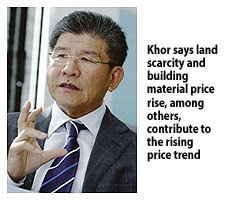
Hunza Properties Bhd (HPB) executive chairman Datuk Khor Teng Tong yesterday said land scarcity, teamed with a hike in building material prices and labour costs, have contributed to this trend.

"Going forward, the shortfall in supply of properties cannot be addressed and overcome in the short-term.

"This will lead to a situation where supply is unable to meet demand and further contribute to the increasing trend in property prices," he told an analyst briefing in Penang when announcing the company's 2010 fiscal results.

For its financial year ended June 30, HPB recorded revenues of RM258.7 million and profit after tax of RM50.9 million.

The figures reflect an increase of 172 per cent on revenues and 84 per cent on profit after tax respectively compared with the preceding financial year.

HPB benefited from stronger sales in fiscal 2010.

"Construction works on the two residential towers of our Gurney Paragon project in Pulau Tikus have also been progressing well, thus contributing to higher revenue and attributable profit on percentage of work done," he added.

On the construction progress of the sea-fronting RM450 million Gurney Paragon project, which comprises a residential development, an office block and shopping mall, Khor said:

"It has sped up with its superstructure completed up to its top, the 43rd-storey, and this makes Gurney Paragon the tallest condominium in Penang.

"As the demand for high-end property in Penang remains high, we expect a further increase in property price, thus making the outlook for the property market very positive.

"Due to these reasons, HPB expects a stronger performance for the 2011 financial year," he added.

Gurney Paragon has attracted both local and foreign interest, its developers say, with condominium buyers from 20 countries so far.

Of the total 220 units launched, Khor said 130 units with a sales value of RM242 million have been sold as of June 30. The shopping mall is due to start operations in early 2012.

By Business Times

Tuesday, August 17, 2010

Mapletree plans US$928mil Japan property fund

TOKYO: Mapletree Investments, a real estate firm wholly-owned by Singapore state investor Temasek Holdings, plans to launch a Japan property fund of around 80 billion yen (US$928mil) this year in a bid to expand in the country’s property sector ahead of its rivals.

The new fund, with 30 billion yen of equity, will invest in business-related properties such as data centres, research and development facilities, and office buildings just outside central Tokyo and other big cities, Terence Heng, general manager of Mapletree Investments Japan, told Reuters in an interview.

“We need to get ideal properties now. It’s likely to become difficult to see those attractive deals if we miss the chance now ... The opportunity window is open for a year or two, or even shorter period than that,” he said.

Mapletree, which opened its Japan office in 2007, has been ramping up its investment in Japanese logistics facilities mainly for its Mapletree Logistic Trust, which owns warehouses and other industrial properties across Asia.

In Japan, the Singaporean company manages 12 properties, mostly logistics assets, worth 60 billion yen. But it aims to more than triple this to 200 billion yen in the next two to three years before competition heats up in the market, Heng said.

”We should proactively buy properties if they are good,” he said.

By Reuters

PNB primed for KL Golden buys


Permodalan National is looking at acquiring B grade (commercial buildings) with potential and sell them to PNB's real estate investment trust, Amanah Harta Tanah PNB.

Permodalan National Bhd's (PNB) asset management unit is in talks to buy commercial buildings in the heart of Kuala Lumpur as it seeks to provide assets for its property trust.

PNB Commercial Sdn Bhd, which has RM1 billion of assets, plans to buy properties in the Golden Triangle area, improve their performance and sell them to PNB's real estate investment trust (REIT), Amanah Harta Tanah PNB.

"We have identified a few buildings within the Golden Triangle. We are looking at the feasibility and evaluating the target assets," PNB Commercial chief executive officer Datuk Mohamed Marzuk Basir said.

However, there is no set allocation or fund for these acquisitions.

When the study is completed, it will be presented to the board to decide on the acquisitions.

"We are looking at B grade (commercial building) with potential," Mohamed told Business Times in an interview.

"We will take an underperforming asset and then nurture it to a respectable yield level within three to five years," he said.

These buildings typically have about 100,000 sq ft to 150,000 sq ft nett lettable area.

PNB Commercial currently manages 19 assets. Out of this, 11 are owned and managed by PNB Commercial, while the remaining eight are managed for PNB.

Apart from office buildings, assets under its management include retail and hospitality properties.

For the time being, it is not looking at expanding its retail or hospitality portfolio but only enhancing its existing assets.

By Business Times

Monday, August 16, 2010

Dijaya to launch Danga Bay project by Dec

DIJAYA Corp Bhd will launch phase one of Tropicana City@ Danga Bay, its RM3.8 billion integrated waterfront flagship project in Johor by December this year, its chief said.

Phase one will feature some 700 units of upper middle serviced apartments in three blocks, worth RM600 million or more than RM600 per sq ft each, managing director Datuk Tong Kien Onn said.

"We hope to start construction by December and realise the units block by block. Piling works have been completed. We are confident of the project," Tong said in an interview with Business Times in Kuala Lumpur recently.

Dijaya is developing 14.8ha of prime waterfront land at Danga Bay in Johor Baru over the next 10-12 years with Iskandar Water Front Sdn Bhd (IWSB).
Goldhill Quest Sdn Bhd - a 60:40 joint-venture between Nagasari Cerdas Sdn Bhd (a Dijaya unit), and Global Corp Development Bhd (owned by IWSB) - bought the land from Danga Bay Sdn Bhd for RM308 million or RM190 per sq ft.

It is one of the biggest private land deals since the inception of Iskandar Malaysia in 2006, where it is located.

Goldhill plans to build a retail street mall, office towers and residences, SoHo (small office/home office) and a four- or five-star hotel.

"We are still working out the components. The project will be similar to the Mid Valley development. But our mall will be different as it will focus on food and entertainment," Tong said.

Tong said Dijaya is targeting homeowners, expatriates and investors from Asia Pacific and Europe.

He said there will be spillover from Singapore with the opening of Resorts World Sentosa and The Marina Sands resort, where each have said they will employ more than 35,000 people when the projects are fully completed.

"We expect many of the staff to be relocated to Johor. Singapore expects 10 million additional tourists a year and we hope to ride on that with the opening of a four- or five-star hotel within our development.

"We may look at international operators like Starwood or Ritz Carlton Group to run the hotel. Nothing is on the cards yet as the hotel will be developed at a later stage," Tong said.

Dijaya, known for its flagship Tropicana Golf and Country Resort development in Petaling Jaya, has RM290 million cash in hand which it will partly use to start the development, Tong said.

"We will look at bank loans but we are expecting the project to be self-financing later," he said.

By Business Times

Dijaya banks on Iskandar factor

JOHOR BARU: Dijaya Corp Bhd is banking on the long term development of Iskandar Malaysia as the main draw in attracting interest to its Danga Bay project here.

Group chief executive officer Tan Sri Danny Tan Chee Sing said apart from the project’s location on prime waterfront land, Johor’s proximity to Singapore would be another selling point.

“The timing is right for us to come to Iskandar in view of the good progress taking place in the economic growth corridor since its launch,’’ he said on Aug 10 at the signing of a sale and purchase agreement for two parcels of land totalling almost 15 ha in Danga Bay worth RM308mil.

The plots of land were acquired by Goldhill Quest Sdn Bhd - a 60:40 joint venture between Nagasari Cerdas Sdn Bhd (a wholly-owned subsidiary of Dijaya Corp) and Global Corporate Development Sdn Bhd, which is 100% owned by Iskandar Waterfront Sdn Bhd (IWSB).

Tan represented Dijaya at the event while IWSB was represented by its chairman Johar Salim Yahaya.

The signing ceremony was witnessed by Johor Mentri Besar Datuk Abdul Ghani Othman.

The joint venture company will develop the land which has a gross development value of RM3.8bil over the next 12 years.

Tan said the components of the integrated waterfront development project would include a stand-alone retail mall, four and five-star hotel towers and serviced apartments blocks.

“The project is likely to be known as Tropicana @ Danga Bay, after our flagship Tropicana Golf and Country Resort in Petaling Jaya,’’ he said.

By The Star

Saturday, August 14, 2010

There’s a price to pay for convenience

Rising house prices show that residential properties have become the “hottest” pick for investors who are flushed with cash and believe investing in a tangible asset is a good investment choice.

Although it may seem that the property market is on a “wholesale revaluation exercise” with prices climbing across-the-board, it is actually not so.

A check in the newspapers’ classified pages under the “houses for sale” column show that the price hikes are location centric. There is always a price to pay for convenience and living close to mature neighbourhoods with good basic amenities and infrastructure.

If one cares to check around, there are still many affordably priced (RM300,000 to RM400,000) new or second-hand houses out there, but one must be prepared to stay further away from the “conveniences”.

I believe there are various reasons why people invest in property over other investment instruments. The property market’s tenacity in withstanding the global financial crisis must have converted many sceptics to build up their investment portfolio with property assets.

Malaysians’ penchant to save has translated into lots of liquidity available for investment. Savvy investors will invest their money in instruments that will offer good returns over cost and risk.

The prevailing low savings interest rate and the under performing equity market are some of the “push” factors that are promoting property investment.

While these financial instruments are still affected by the external uncertainties in the US and Europe, property investments are very much locally-driven and has proven to be a reliable asset class.

The value of Malaysian properties, both houses and shop lots in good locations, have sustained very well so far and there have been more upsides than downsides.

The quick rebound of the property market in Singapore and Hong Kong may also have contributed to a resurgence in property buying here.

There is also pent-up demand for properties as some people who have procrastinated on signing on the dotted line previously have decided to do so now after seeing the market’s ability to withstand the tough times.

Supply has been slow to catch up after widespread project deferments by developers in 2008. New project launches have just resumed towards the later part of last year.

The high demand over supply has naturally resulted in housing prices escalating in various parts of Kuala Lumpur and the Klang Valley. Penang is also another hot property market where prices have come close to Kuala Lumpur levels and still climbing.

This is a good opportunity for less well known developers with reasonably sized land bank to build affordably priced homes to woo buyers.

One way developers can do this is to come up with products that allow buyers the flexibility to decide their own house built-up and layout plan, just like in the “Sims” computer game.

Instead of the “one-size-fits-all” model that is the norm now, it will be a value added service to buyers if there are various sizes and layout plans to choose from.

Some families have elderly folks and it would be more practical to have at least one or two bedrooms downstairs for a double-storey house.

I have heard mothers of teenage children staying in 2½-storey to three-storey houses complaining that they are “cut off” from what their children are up to these days. They yearn for “the closeness” of their single-storey or double-storey houses.

Large central parks would be another huge selling point as residents would like to unwind and relax in the open environment.

At the end of the day, all stakeholders must do their part to ensure the property market continues to be sustainable.

Developers should be more pro-active and ensure they take the necessary steps to “tune in” to their customers’ needs and ensure more timely launches to meet rising demand.

Buyers also have the responsibility to be prudent and not to over-commit themselves or default on their loans.

Deputy news editor Angie Ng thinks it is a good idea for relatives or friends, who want to stay close to each other, to pool their resources to buy a nice piece of land and turn it into a nice housing enclave.

By The Star (by Angie Ng)

CapitaLand’s Malaysian success

Last month, Prime Minister Datuk Seri Najib Tun Razak told Johor Umno branch leaders not to be emotional or parochial about Singapore investments.

For years, there has been this unhappiness about Singapore’s presence in the state, from the day tourists to corporate investors.

The fact remains that Johor – and the country – need the dollars, be it US or Singapore dollars, or any other foreign currency, for that matter.

Singapore’s business involvement in Malaysia can best be seen in the sprawling interest of CapitaLand Ltd, Southeast Asia’s largest property developer.

The company is also part of Temasek Holdings, the investment arm of the Singapore government. While CapitaLand is most bullish about its investments in China, it also upbeat about the region.

CapitaLand’s presence in Malaysia has been significant over the last 10 years.

In this relatively short time, CapitaLand has successfully branded itself in the Malaysia property scene.

Among its first condominium projects in Malaysia was Suasana Sentral, a 400-unit project built in partnership with Malaysian Resources Corp Bhd in 2001, when the Malaysian government was promoting Brickfields as a transport hub.

Since then, there have been various other projects. Says property consultancy Knight Frank MD Eric Ooi: “It was between 2002 and 2007 that the group became very aggressive in the Malaysian property scene. Its foray into the vicinity of the Petronas Twin Towers started with Marc Residences in 2002. It was already working on its branding then.”

Marc Residences was the third project to be launched after Stonor Park and Dua.

“They entered the high-end condominium segment because they saw pent-up demand for these condominiums. From their experience in Singapore, they saw the potential of that location and the demand for such high-end modern living, which Kuala Lumpur had never seen before,” says Ooi.

CapitaLand has since gone into quite a number of residential developments.

Among them Hamsphire Residences (with Zelan Bhd), Kiaraville and Tiffany by i-Zen (Ireka Corp Bhd) and Zehn Bukit Pantai (a joint venture with the landowners), to name a few. All of them are high-rise residentials. Its latest project is Seni Mont’Kiara (also with Ireka).

Successful branding

CapitaLand also has interest in UM Land Bhd, which is involved in township development in Johor.

Says Paul Khong, executive director of Richard Ellis Sdn Bhd: “CapitaLand has successfully branded itself in Malaysia, which is why other developers are keen to co-brand with them today.

“The name CapitaLand comes with a premium, and many Malaysians understand that,” says Khong.

CapitaLand’s presence in the commercial sector in Malaysia is through Quill Capita Trust (QCT), a real estate investment trust listed on the Main Market of Bursa Malaysia.

Currently, QCT has assets totalling about RM788.4mil, comprising 10 commercial properties in Cyberjaya, Kuala Lumpur, Shah Alam, Petaling Jaya and Penang.

CapitaLand is also involved in serviced residences through The Ascott Ltd, one of the world’s largest international serviced residence owner-operator, with more than 26,000 serviced residence units in key cities of Asia-Pacific, Europe and the Gulf region.

The company operates three brands – Ascott, Somerset and Citadines, and its portfolio spans 71 cities in over 20 countries.

In Malaysia, Ascott is the largest international serviced residence owner-operator, with nine properties offering close to 1,200 units.

Ascott manages seven properties in Kuala Lumpur – Ascott Kuala Lumpur, Ascott Sentral Kuala Lumpur (opening in 2013), Somerset Seri Bukit Ceylon, Somerset Ampang (opening in 2010) and three properties for corporate leasing.

In Kuching, Ascott operates Somerset Gateway and Citadines Kuching Uplands (opening 2012).

Says a CapitaLand spokesman: “CapitaLand has the experience and expertise along the entire real estate value chain. Exporting real estate expertise overseas has been CapitaLand’s forte. The group is an investor, developer, operator and manager, and provides financial solutions across sectors and geographies.

“Today, the group has nine listed entities, the latest being CapitaMalls Malaysia Trust, with a total market capitalisation of about S$40bil. It manages about S$50bil worth of real estate assets in more than 110 cities in over 20 countries.”

CapitaLand has no choice but to go overseas. With Singapore being just 700 sq km, it does not have much of an option other than to go offshore in search of opportunities.

After all, the whole of Singapore can only absorb 15,000 apartments a year, but in Shanghai alone, the same number of units can be sold within a week.

By The Star

Property buyers wary of govt move

SOME 40 per cent of property buyers planned on expected increase in property prices as the government phases out subsidies, a recent iproperty.com study revealed.

Another 38 per cent preferred to wait before making any purchases because they believe subsidies will not be phased out.

The remainder expressed indecisiveness and intended to sell their assets, iproperty.com noted.

By Business Times

HK moves to curb property bubble

HONG KONG: Hong Kong’s government said yesterday it will increase land supply to avoid a property bubble, warning that prices of some flats are approaching historic highs.

John Tsang, the city’s financial secretary, said prices in June were 8 per cent up from the end of 2009, despite a series of measures the government introduced in April to cool the overheating market.

By Business Times

Friday, August 13, 2010

Cyberjaya to be 30pc complete by year-end

CYBERJAYA'S overall development, encompassing the ambitious MSC Malaysia to leapfrog Malaysia into the information and knowledge age, is expected to be 30 per cent complete by year-end.

Cyberjaya landowner, Cyberview Sdn Bhd, said the township's current level of development has exceeded the target, with investors having injected RM5 billion worth of investments in building construction.

Rashid Mat, general manager for business, corporate communications and planning, said land worth RM390 million was sold last year and RM300 million in 2008, reflecting growing interest by global firms to relocate to Cyberjaya, dubbed the "Intelligent City".

The inflow of notable global multinational corporations (MNCs) into Cyberjaya continue unabated, with Hewlett-Packard (HP), the world's largest technology company headquartered in California, looking to expand its presence in Cyberjaya, Rashid said.

Cyberview has developed 600,000 sq ft of office building on 11.2ha for HP.

It is understood that HP is keen to buy another piece of land to develop a data centre in Cyberjaya. Spanning an area of about 2,800ha, Cyberjaya is home to more than 20 MNCs including Dell, Satyam, HSBC, Motorola, IBM, HP, data centres of Bank Negara Malaysia and Malaysian Communications and Multimedia Commission, universities, commercial zones and residential estates.

In terms of office space, Cyberview said the company is looking to develop 8.04 million sq ft by year-end from the previous five million sq ft target due to growing demand from MNCs and MSC-status companies.

Rashid said many companies are now willing to own a property in Cyberjaya than to rent premises. "We will continue to pursue the plan for foreign companies to set up their operations in Cyberjaya. The demand is not just from MNCs, but also MSC-status companies," he said.

For residential space, Rashid said more developers are starting to develop projects in Cyberjaya and purchase land from Setia Haruman Sdn Bhd, the master developer of Cyberjaya.

"Over 2,900 residential units have been completed, with another 2,300 in the pipeline, including the Garden Residence by Mah Sing Group Bhd and Symphony Hills (by UEM Land Bhd)," he said.

Rashid said Setia Haruman sold RM390 million worth of land in Cyberjaya last year and RM300 million in 2008 which will further alter its landscape into a bustling business enterprise.

By Bernama

Thursday, August 12, 2010

Five architects shortlisted for RM1bil job

KUALA LUMPUR: Sime Darby Sunrise Development Sdn Bhd (SDSD) has shortlisted architectural companies to send in their designs for its RM1bil mixed development project in Bukit Jelutong, Shah Alam.

The five are award-winning architectural firms, namely BIG, J&H Boifills, Benoy, DP Architects and Hijjas Kasturi, who are renowned for their forte in commercial developments and excellent achievements.


Datuk Tong Kooi Ong: We are confident of being successful.

“Our design participants were selected based on their vast and relevant experience in the comprehensive mixed development, international exposure and commitment to sustainability,” Sunrise Bhd’s executive chairman Datuk Tong Kooi Ong said in a statement yesterday.

The shortlisted architects are expected to present their design concept to the SDSD board of directors on Aug 13, 2010 and the winner would be announced at a later date, he said.

On the project in Bukit Jelutong, which would be a 50-50 joint venture between Sime Darby and Sunrise, he said the company was confident of it being as successful as its other projects.

“Having completed three commercial developments under the Sunrise brand, we are confident of replicating our success in Mont’Kiara to other geographical location, setting the benchmark for creative, contextual design and achieving a sustainable development of long-lasting architectural quality,” he said.

Bukit Jelutong is a self-contained and an excellently planned community spread over 2,200 acres of prime freehold land.

It is well served with a transportation network that link to the other towns in the Klang Valley via expressways.

Meanwhile, SDSD’s mixed development project will cover 21 acres and will be part of the strategically planned Bukit Jelutong Commercial Centre that span 120 acres.

The project will have a gross built-up area approximately 2.7 million sq ft, consisting of 80% for retail namely shop-offices and office-suites and 20% for serviced apartments.

Work will begin next year and the project will be developed in five phases and completed in seven years.

By Bernama

Homes becoming too costly for the average Malaysian

As I was getting ready for some exercise early yesterday morning, I saw a man walking up the street dropping a leaflet into the mailboxes of homes. I took one off him as he approached the front of my house and it was an advertisement for properties.

The houses on offer in the secondary market were not your typical medium cost house or apartment that many Malaysians live in these days, but were million dollar dream homes that many aspire to own.

This got me thinking. Why are many new property launches and existing homes exorbitantly priced? Why are there few to none of the bread-and-butter houses being built?

If developers keep developing and selling higher priced properties, this will lead to an imbalance in supply and demand in the housing market.

Some of the last major townships launched in the Klang Valley include Setia Alam, Kota Damansara, Mutiara Damansara, Ara Damansara and areas surrounding Kepong and Puchong.

Initially catering for affordable homes, the price and types of properties being sold in those areas have moved up in scale.

The surge in home prices these days has been faster than the rise in wages and it would not be long, if it is not already happening, before such properties in the Klang Valley become too expensive for the average Malaysian.

Cheap financing has enabled Malaysians to own more expensive houses. Home buyers often require a small downpayment before purchasing homes.

The low interest rate environment, banks flushed with cash and innovative schemes have also allowed loan repayments to be kept within check – for now.

Furthermore, banks wanting to grab a larger slice of the home loan market are said to have engaged with external sales teams and other agents whose sole motivation might be to secure more loans.

While the absence of large land banks would be the prime reason for developers opting for smaller and higher priced properties, the process of pricing, while still a function of supply and demand, is also subjective. This subjective approach is also the norm in the secondary market.

Those who own homes would have heard about how much properties in their neighbourhood were recently sold for. People would then take that as the market price and would likely want the same price or higher when selling their home.

A gauge of what a house is worth would be the rental it can fetch. As prices of homes rise and the rental market, which is more linked to the disposable income of people, remains static and rigid, the inflated prices of property becomes more apparent.

Yes, price inflation of properties – if it remains strong – would offset the loss in returns from rent if people buy properties as an investment.

But then people should also consider whether they are better off renting and investing their money in higher yielding assets.

Escalating property prices also pushes homes out of the reach of the current generation.

Younger people who are just starting out in life may have to live at the fringes of Klang Valley, which then increases their cost of commuting to their workplace.

Those wanting to stay in the Klang Valley have then no choice but to opt for cheaper apartments or low cost dwelling.

It’s almost like the pickings are getting slimmer. My parents’ generation could afford a bungalow, mine a terrace house and what about my children’s generation if prices keep going up as they have?

The escalation in home prices, which would add to the leverage of home buyers, is also a warning sign. All it takes is one bad recession – recessions are becoming more frequent than in the past – and that would be trouble.

We only have to look at the implosion of the sub-prime market in the US to see what a housing collapse can bring.

Deputy news editor Jagdev Singh Sidhu dreams of a juicy burger as he is on his second attempt of a weight loss programme.

By The Star (by Jagdev Singh Sidhu)

WCT aims to add 2 hotels to portfolio by 2014

WCT Bhd, a leading construction and property development company, plans to own and manage two hotels within the next four years.
It will open its maiden hotel in Klang, Selangor, under the Première brand name on October 10.

The hotel is part of the RM145 million BBT-One Tower and the Boulevard project developed by WCT.

BBT Hotel Sdn Bhd director Eddie Tan said Première, the newest addition to the WCT portfolio, will be one of the main contributors to its hospitality division.

BBT Hotel, known as Smart Seasons Sdn Bhd until September 2006, is a subsidiary of WCT.

“We have found an opportunity to leverage on our expertise and apply it to the hospitality industry,” Tan said, adding that the hotel will be an ideal destination for business visitors and tourists.

The business-class hotel offers 250 rooms, including suites, in a 22-storey tower.

“We expect to achieve an occupancy rate of 60 per cent with an average room rate of RM170,” Tan said.

Premiere Hotel was built at a cost of RM75 million and was financed with internal funds and borrowings.

WCT is also planning to open Platinum Plaza Hotel in Ho Chi Minh City, Vietnam.

It will be part of the Platinum Plaza mixed commercial development comprising a shopping mall, two office blocks of 22 storeys each and small office units. The total development area is 7.2 million sq ft.

Gross development value of the proposed development is RM1 billion. The project will be developed in three phases over a four-year period.

By Business Times

Gadang to launch RM110m property projects

KUALA LUMPUR: GADANG HOLDINGS BHD plans to launch RM110 million worth of property projects over the next year in Kuala Lumpur and Johor.

A company official said on Thursday, Aug 12 Gadang was also looking to expand its plantations in Sabah via joint ventures with the landowners. Currently, it has plantations in Ranau, Sabah.

On the proposed joint venture with Long An Province People's Committee, Vietnam to undertake a waterworks project with 300,000 cubic metres daily capacity there, he said it was still at a feasibility stage.

Its subsidiary Green Water Investment had signed an MoU with Long An People's Committee in November 2008 for the proposed project.
The delay was due to the change in the local government there, the official said.

By The EDGE Malaysia

AmFIRST posts 6.17% revenue growth in Q1

KUALA LUMPUR: AmFIRST Real Estate Investment Trust has registered a revenue of RM25.11mil for its first quarter ended June 30, 2010, up by 6.17% from RM23.65mil in the same quarter last year.

Its net property income rose 15.94% to RM17.66mil from RM15.23mil previously.

However, the company’s income after tax declined marginally to RM9.94mil from RM10.58mil previously due to higher interest expense that resulted from the overnight policy rate (OPR) hike and provision for doubtful debt, AmFIRST said in a filing to Bursa Malaysia yesterday.

“Despite a marginal slip in income after tax for the first quarter period, we are pleased to report a positive start to the year with a fair performance of all six AmFIRST’s assets,” said Lim Yoon Peng, chief executive officer of Am ARA REIT Managers Sdn Bhd, the manager of AmFIRST.

By Bernama

KHSB to buy land for RM62m

KUALA LUMPUR: Kumpulan Hartanah Selangor Bhd (KHSB) has proposed to acquire two parcels of leasehold commercial land in Section 14, Petaling Jaya, from Majlis Agama Islam Selangor for RM61.72mil.

In a statement to Bursa Malaysia, KHSB said the land, measuring approximately 38,850 sq m, would be used to develop a service apartment, shop offices and shopping complexes.

It said the acquisition would be settled via bank borrowings and internally-generated funds.

“The proposed acquisition is a continuing effort by KHSB to reposition KHSB Group of Companies as developer of choice as the prime land is in the heart of Petaling Jaya,” it said.

KHSB said the exercise was also to prepare the group for immediate development.

“The present strong economy, coupled with a conducive building environment, high financial liquidity and demand, will augur well for the development and sales plan by the company,” it said.

By Bernama

Hartanah Selangor buys PJ land

KUMPULAN Hartanah Selangor Bhd (KHSB) is buying two plots of leasehold land of 3.8ha in Petaling Jaya, Selangor, for about RM62 million. KHSB will pay RM45 million through borrowings, while the balance will be met from its own coffers.

The deal is subject to the approval of the state authority.

KHSB intends to develop serviced apartments, shop-offices and shopping complexes.

By Business Times

REIT managers propose new tax incentives

The Malaysian REIT Managers Association (MRMA) has proposed a new set of incentives to enhance the existing tax concessions for real estate investment trusts (REITs).

The current tax concessions will expire next year.

It is proposing zero tax for individual local and foreign investors and 10 per cent flat withholding tax for all investors.

"The current tax concessions granted by the MOF (Ministry of Finance) for REITs will run out next year.

"Hence, there is an urgent need to ensure that industry players will continue to benefit from a similar or enhanced tax regime in the coming years," MRMA chairman Stewart LaBrooy said in a statement.

The MRMA also wants to establish a framework to develop the industry and coordinate investment opportunities and networking in the region.

This will help industry players to have more effective discussions with the MOF and other authorities on issues that affect the industry.

The MRMA held its annual general meeting (AGM) recently, during which 10 REIT managers participated in the election of its office bearers. The elected representatives will represent the REIT industry in the country.

The AGM saw the appointments of Axis REIT chief executive officer (CEO) Stewart LaBrooy as the MRMA's chairman, AmFirst REIT CEO Lim Yoon Peng and Amanahraya REIT CEO Adenan Md Yusof as its vice-chairman 1 and 2 respectively.

Hektar REIT's CEO, Zalila Mohd Toon, was appointed the association's treasurer, while Tower REIT's CEO, Chan Wan Leong, was appointed its secretary.

By Business Times