Malaysia Property News is a free resource website sharing Daily Property News & information about Property in Malaysia, which related to, Property Market, Property Investment, Commercial Property , Hot Properties Malaysia, Real Estate, Retail Shop, Business Park, Condominium Malaysia, Terraces & Apartment Malaysia, Houses, Residence, Resort and many more.

Monday, August 10, 2009

Dijaya banking on lifestyle properties worth more than RM450mil


Datuk Tong Kien Onn with the model of Tropicana Grande condominiums.

PETALING JAYA: Dijaya Corp Bhd plans to build more lifestyle commercial and residential property projects in the Klang Valley and other growth areas to cater to a growing demand for such facilities.

According to managing director Datuk Tong Kien Onn, the company has at least three commercial projects in the pipeline, including Tropicana Avenue and Tropicana Office Towers in Tropicana Golf & Country Resort, and Tropicana Gardens in Tropicana Indah Resort. Tropicana Avenue, with two floors of retail podium and office space, will have net lettable space of 561,000 sq ft. The office space is for sale and the retail podium will be for lease. The RM205mil project will be launched by mid-2010.

Also coming up next year will be a RM250mil twin office towers project with 400,000 sq ft of net lettable space including space for holding events. One block will be for en bloc sale and the other will be for rental.

The third project, Tropicana Gardens on 6.8ha next to Kota Damansara, will have service apartments and lifestyle retail space. It is slated for launch in 2011.

Tong said Dijaya would also be looking to replicate the integrated lifestyle Tropicana City project in other growth markets.

“These self-contained projects with retail complex, offices and residences, promote the concept of work, live and shop for the new breed of young and trendy population,” he told StarBiz.

Tropicana City comprises Tropicana Mall with 450,000 sq ft of net lettable area, a 12-storey office block with 105,000 sq ft office space and a block of service suites.

Tropicana Mall, Dijaya’s first retail property, opened for business last December. The retail space is fetching rental rates of RM10 to RM20 per sq ft.

The office block will be completed in October while the 601 units of Tropics service suites will be ready by next June.

Tong said revenue contribution from its commercial projects was expected to rise to 55%-60% in the coming years from about 45% now.

“We intend to keep some of our commercial space for regular rental income going forward and to build up the company’s investment property portfolio.”

On the residential front, he said Dijaya would be targeting its new launches at foreign buyers, especially Singaporeans.

One of its upmarket high-rise projects is Tropicana Grande, to be built on the last parcel of land in Tropicana Golf & Country Resort. Located on 2.08ha, there will be four blocks with a total 300 units priced from RM600 per sq ft. Tropicana Grande will have a gross development value of RM540mil.

At Tropicana Indah Resort, 12 Grand Villa bungalows of 8,000 to 9,000 sq ft priced at RM4.5mil to RM5.8mil will be launched by year-end. There will also be 54 Pool Villa semi-detached homes of 5,812 to 7,945 sq ft priced from RM2.8mil each.

Also planned for launch next year will be Tropicana Bayou on 26.4ha in Balakong and a 8-ha residential development in Sungai Long.

According to Tong, innovation, superior quality and practicality would be the hallmark of all the company’s projects going forward.

“We will be leveraging on our success in building the 250-ha Tropicana Golf & Country Resort and 163.6-ha Tropicana Indah Resort and have more innovative and quality products for the market,” he added.

Describing the property market as going through a “cooling-down period” after “a confidence plunge” around the third quarter last year, Tong said the market was holding out well despite the severe meltdown in many parts of the world.

“We do see some positive signs in our sales and we are optimistic that the market will turn for the better towards the year-end and early next year. The market should start to recover by year-end when confidence starts to pick up again,” he added.

Over the past seven months, Dijaya achieved RM215mil in sales, or about 70% of its sales target of RM260mil for the financial year ending Dec 31 (FY09).

For FY08, it recorded a sales revenue of RM244mil.

By The Star (by Angie Ng)

GuocoLand plans high-end Damansara Heights project

GUOCOLAND (Malaysia) Bhd is targeting to launch an integrated high-end development in Damansara Heights, Kuala Lumpur, by the end of this year.

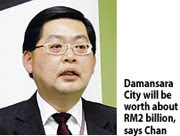
As the property arm of the Hong Leong Group, the project known as Damansara City will be worth about RM2 billion.

The 3.4ha project will comprise two landmark office towers, two blocks of luxury condominiums, a five-star boutique hotel that will be managed by the UK-based Thistle Group, and a 300,000 sq ft retail mall with four levels, the first in Damansara Heights.


Damansara City was due for launch in June 2008 but was held back as GuocoLand had wanted to fine-tune the design and layout for each of the components.

"We hope the building plans would be approved soon so we could launch the project by December and commence work on the basement and super structures. The foundation is ready," GuocoLand executive director Chan Chee Meng said.

Chan said that GuocoLand will launch the office towers first, and sell them en-bloc.

He added that GuocoLand has been approached by Malaysian as well as overseas buyers.

"The market for high-end condominiums at the KLCC area has been soft since last year but we reckon that office buildings in prime locations will be much sought after, especially in Damansara. Therefore, we will launch the office space first.

"We were approached by interested parties for the office blocks because of the prominence of the project. Talks are on-going but we are not committed yet," Chan said.

On whether the condominiums will go en-bloc, Chan said GuocoLand will look at selling the units individually, or in bulks.

"This is one of the last prime pieces of land left in Damansara Heights so there will be demand for luxury condominiums. We will look at the market situation before launching," Chan said.

On the hotel, Chan said it will be called Gouman.

Thistle Group owns two brands namely Gouman, which is the name for five-star hotels, and Thistle for four-star properties.

By Business Times (by Sharen Kaur)

New president of MIEA upbeat on spin-off conventions

PETALING JAYA: Malaysia Institute of Estate Agents (MIEA) president Julie Wong may be new in her post but she has kept busy from day one of her appointment on Apr 25, scheduling courses and conventions to help raise the standard of real estate agents in the country.

Julie Wong ... ‘we want to organise a Sunday Property Mart’

Wong said she wanted smaller versions of MIEA’s annual Malaysian Annual Real Estate Convention (MAREC) to attract a wider audience and help bring in additional revenue for the institute.

“We will be organising this spin-off convention from Oct 31 to Nov 1 in Johor. When we organise MAREC, the participants are mostly from the Klang Valley.

“By having an event like this further south, we can attract participants from the south of Malaysia and even Singapore,” she told StarBiz.

The Johor convention, themed Iskandar – Rise of the Metropolis, would focus on the prospects of Iskandar Malaysia and was targeted to attract up to 300 participants, she said.

Wong also plans to organise a one-day convention in Penang in March and mini courses for negotiators later this month and early September. She held her first negotiators’ course in May.

She also hopes to organise bi-monthly luncheons in cafes or restaurants that would be open to members of the institute and even the public.

Wong also wants to assist developers that are having problems “clearing their inventories”.

“A lot of developers have small pockets of property that are not sold and it is usually a waste of time to hire marketing experts to sell off these units. So we want to organise a ‘Sunday Property Mart’ where buyers can preview these unsold units on weekends. At the same time, we will try and push sales for the developers.”

Wong said the event could be held in a multi-purpose hall or an outdoor tent.

“It’s still in the planning stage but we hope to have our first property mart by December,” she said.

To enhance the image of real estate agents, Wong said the MIEA also intended to collaborate with Malaysia Property Inc (MPI) to help educate and train potential realtors.

“We hope to collaborate with the MPI and market courses such as CIPS (Certified International Property Specialist) and CRS (Certified Residential Specialist),” she said.

The MPI, a joint public-private sector initiative, was recently set up to attract foreign investments to the real estate sector over the next 10 years.

“This is a good profession to make money. If one is focused and determined, one can be successful in this line,” said Wong, who has over two decades of experience in selling residential, commercial and industrial properties and leasing of land.

She said estate agents should “think outside the box” to be resilient, especially with the current global economic downturn.

“They should do things differently, and if they have the finance, they should try to venture outside Malaysia and sell overseas.”

Under Wong, the MIEA also organised its inaugural National Real Estate Awards in June. She said it was a great achievement for the institute and that the awards would make a great benchmark for successful realtors.

“It’s our first award and we feel that we can improve on it and attract more participants in the future. For the winners, it’s a great recognition when they want to market themselves.”

Wong also said a rebound could already be seen in the local property sector.

“People are already starting to buy properties. This is especially for units worth RM600,000 and above.

“High-end developers, especially, should not be afraid of selling now,” she said.

By The Star (by Eugene Mahalingam)

Saturday, August 8, 2009

Pace of new property launches picking up


An artist impression of Five Stones, a condominium project in SS2, Petaling Jaya.

Last Saturday’s launch of double-storey linked houses in Glenmarie, Shah Alam had buyers queuing up several days before selling began.

The 133 freehold units, located from across a Perodua service centre, were sold in two hours.

At RM750,000 for an intermediate unit, the offerings from Island & Peninsular Bhd (I&P), known as Temasya Suria, were by no means cheap.

Even as you are reading this today, I&P is selling another series of double-storey housing in Bandar Kinrara, Puchong.

Known as Sentosa, the 80 units of double-storey terraced houses are priced between RM462,000 and RM694,000. As with previous week’s launch, buyers were known to have been queuing up several days.

General manager (group marketing and communications) Noor Lida Nazri says both situations reflect the confidence in the market. “Although many invest in different types of assets, there are those who find property to be the most reliable. They are essentially going back to what our forefathers have always believed in,” she says.

More than half of the buyers bought to stay, she says. It has been quite some time since freehold double-storey terraced housing, a staple in Malaysian housing market, has been put on the market and the interest generated is interesting.

Noor Lida says the other reason for the positive response is the financial package they are offering. Buyers pay 10% and their next payment is due when they get their keys. In the interim, the banks will pay the progressive payments and interest. Stamp duty, transfer and legal fees are absorbed by the developer. The fact that Temasya Suria is about 75% complete when they reached the market is also a selling point, Buyers will be able to move in the first half of next year. Its second project in Puchong will take two years to complete.

On Aug 14, Selangor Dredging Bhd (SDB) will be launching what will be Petaling Jaya’s most pricey condominium project in SS2/72. It will be SDB’s branding vehicle.

The last time they had an outing there, it was with Ameera in 2007, which had prices starting from RM380,000 onwards. Although it is building Ameera which will be ready next year, that project is a legacy from Luxor group, the previous land owner.

With this second project, known as Five Stones, SDB managing director Teh Lip Kim has a clean slate to put down her mark. It will be different from Ameera in terms of ambience and landscaping with lots of open space.

The 185-unit freehold project comprises three low, medium and high-rise blocks with prices starting from RM800,000 onwards, a jump of about RM500,000 from its Ameera launch.

Size ranges between 1,700 sq ft and 2,400 sq ft while Ameera comes in smaller packages.

Over the last three months and in the months ahead, developers had, and will continue, to dangle a carrot in terms of financing to get sales moving again from Penang to the Klang Valley. This has been a strong factor in pushing up sales. Most of these developers are among the country’s top players in the sector (see table).

But will sales continue to be buoyant when this carrot is taken away?

Two sources, an analyst who has been tracking the property market, and another from a locally incorporated foreign bank, say “for sure, it is still a buyer’s market”.

Says the bank source: “The attractive financing packages worked out by developers and their banking partners today reduce the price by between 5% and 7% for the buyer. This will eat into their margins. They may have the sales, but profit will slack.

“This trend of dangling the carrot has triggered a lot of forward buying. Many of the buyers may not need a house but because they have the savings, and all these costs are being absorbed by the developer, they enter the market.

“If an apartment costs RM600,000, I need only to pay RM30,000 under a 5/95 scheme where I pay only 5% downpayment and nothing more until I get the keys in three years. It is not far-fetched that the price will increase by 10% if the economy picks up. If it increases to RM660,000, I’d make 100% profit. If the economy does not pick up, with so much forward buying, a time may come when developers will have difficulty selling.”

Every developer is selling at a discount because they have to sell. Because the buyer are billed on a progressive basis, the sales are recognised only a few years later, until the house is built. There is a delayed revenue recognition. Hence, although the pickup rate is positive, profit will be slack because of the carrot they have been dangling since the beginning of this year.

Only when the carrot is taken away and the sale is as good as before, then one can safely say the market is rosy again, he says.

In the 1997/98 Asian financial crisis, the property market only picked up late 2000 and early 2001 and peaked at 2006. The pickup took time.

Between a V and a U-shaped recovery, he would prefer a U, says the bank source.

An analyst who has been tracking the sector says the optimism throws into focus how bad the situation was in the last quarter of 2008.

“Things are looking rosy today because we are starting from a very low base since Q408.”

As the year comes to an end, he says, developers will end their financing schemes because they eat into their margins.

“We will continue to see sales but this may be less compared to what we saw the last few months. Hopefully, the good run seen in June and July will continue into the coming months in what has been an erratic year,” he says.

By The Star (by Thean Lee Cheng)

Buyers find good value in economic downturn

When Diane See decided to move to Ara Damansara, after her daughter Jona, 5, got a place at the neighbourhood kindergarten last year, she found the home of her dreams nearby.

It was attached, with five bedrooms – but, sadly, at RM700,000, it was beyond her price range.

See, who was renting in the interim, finally bought the property this year for just RM525,000. She completed renovations three weeks ago and intends to move in once the new patio is ready and the decorators have left.

“I was so pleased, because I couldn’t afford to pay more than I did, and I had been looking at it for sometime,” See says.

“It’s a fascinating location and it’s all gone smoothly,” she says.

A wise person once said “don’t buy the house, buy the neighbourhood”. It certainly pays to know what’s the going rate per square foot in your neighbourhood.

It seems to be a cracking time to be buying residential properties especially in strategic locations.

The general consensus is that 2009 is shaping up to be a good year for the country’s housing market.

According to an analyst with a local research house, it is generally a good time to buy property now especially for owner-occupier residential property.

“Interest rates are at an all-time low while developers are willing to absorb much of the upfront property ownership costs such as stamp duty, legal fees, and interest,” he said.

He adds that buyers who are waiting for cheaper prices are going to be disappointed as prices have generally been stable (some even higher).

“Unlike during the Asian financial crisis a decade ago, there is no fire sale in the secondary market now. Even the developers are in stronger financial footing as the current gearing level is half of the level seen during the Asian financial crisis. This means developers can wait for sentiments to improve before launching new properties rather than dumping them at fire sale prices,” he says.

He says although much of the recent revival in residential property transactions was due to the attractive housing loan packages offered by developers and there is a possibility of buying activities easing once these packages are terminated, it does not mean that prices will start falling.

“As consumer sentiments improve and fear of job losses dissipates going forward, buying activities will continue even without the housing loan packages,” he says.

There are also bargains to be found in forced sale situations for whatever reasons they are placed on the market by mortgage lenders who have repossessed them from landlords who were unable to keep up with their mortgage payments.

A banker with a local bank who handles auction sale says that it has been improving from year to year.

“This year auction sales probably have the best improvement due to fewer options in the primary market and fair value as compared to new properties,” he says.

He says year to date there has been an increase of 20% in terms of value and 11% in terms of transactions under his portfolio.

He adds that the increase is due to public acceptance towards auction and an increase in participation of real estate agencies in auction marketing.

Meanwhile, Kim Realty business development manager Azlan Adnan who has sold four properties last month says that a notable trend in this low interest climate is that government servants are opting to take bank loans instead.

“We’re getting to the stage where civil servants are opting for bank loans and saving their government loans until they get a promotion and are entitled to a higher loan later,” he says.

“People are actively looking for properties,” Azlan says adding that current low interest rates make it a good time to buy now.

Apparently, it is a message that appears to be getting through to would-be buyers as well.

Dean Tan, 35, a lawyer, is hoping this will work for him: He is planning to add another property to his portfolio.

“Because I haven’t moved for 10 years, I’ve built up quite a lot of equity,” he says. “So I should be able to get a loan at this rate and earn extra income from my rental property.”

According to the Valuation and Property Services Department, the residential property sub-sector continued to spearhead market transactions last year by contributing 63.7% and 46.8% of the transaction volume and value, respectively. In total, 216,702 transactions worth RM41.30bil were recorded in 2008 against 199,482 transactions worth RM36.5bil in 2007.

For SK Brothers (M) Sdn Bhd managing director Chan Ai Ching, sentiments seem to be returning.

“There are quite a number of positives in favour of it being a good time to buy: attractive incentives for easy property ownership offered by developers including low payments, zero interest during construction, subsidised legal fees, freebies and lots more making it easy for buyers to purchase and some are designed to reduce the fear of uncertainties; attractive interest rates; and loan packages offered by the banks and the availability of choices/options.”

However nothing beats doing your homework to ensure that the price, package and property meet your requirement.

“It would not be wise to buy for the sake of buying,” she says.

So instead of leaving your money in the bank, earning little interest – put it in bricks and mortar. But unlike stocks and money, which can lose value on any day, you cannot dump real estate in a single day and try something new tomorrow.

By The Star (by Eileen Hee)

Still a buyer’s market

With the dust of the global financial crisis settling at least for now, barring further surprises, the new liberalised environment for the country’s business and property sectors is a good platform for local property players to leverage on.

If the relaxed measures are able to attract more foreign direct investments (FDIs) in the country’s business and property sectors, there should be greater demand for commercial and residential property from these foreign investors.

In fact, the removal of the Foreign Investment Committee ruling for foreigners purchasing commercial property has the potential to turn Malaysia into a vibrant commercial property market as more foreign investors are attracted to the market.

The commercial market has turned a lot more liquid and there could be more en-bloc transactions down the road.

The market has proven its resilience with capital values and rental rates for commercial space holding out quite well despite the onslaught of the global financial crisis.

However, to give a further boost to the local business environment and inflow of FDIs, it will certainly help if the Government can further liberalised the tax structure for businesses and individuals to raise the country’s competitiveness.

As for the residential market, the existing low interest rates for property financing and the housing packages that are still offered by most of the developers are attracting stronger buying interest.

Those who have yet to purchase their own property and are shopping around for one still can take advantage of the low entry cost until developers decide to put a stop to these facilities.

Going by the strong take-up for some of the recently unveiled condominium projects around the peripherals of Kuala Lumpur, it looks like more Malaysians are resorting to investing in property to hedge against inflation.

After all, bank interest rates for property financing are at one of their lowest and it will be wise to lock in at the current levels.

Meanwhile, industry players are also anxious to get on with their project launches once again after having to defer their plans over the past three quarters since the crisis broke out last September.

After having laid low for much of the past few quarters, it is not surprising that developers are eager to unleash their products and are lining up a string of projects for launch. A variety of property products will be making a beeline for the market soon.

They may feel that delaying the launch further will mean higher holding cost for them.

But, a word of caution for developers. The local economy is not yet out of the woods and the gross domestic product for the second quarter is likely to remain in the negative terrain, although the contraction is expected to ease and bottom out by year-end.

There is still an imbalance in demand and supply in the property market for now and it will take a few more months before a more balanced market sets in.

Developers should be prudent and conduct proper feasibility studies before launching their projects, especially new greenfield projects that take many years to complete.

Gauging the market response through project previews and pre-launch registrations will show whether a project is ready for launch.

To register sustainable earnings growth path going forward, developers have to come out with holistic plans for their residential and commercial properties.

There should not be a sudden clamour for project launches but they should be based on market fundamentals and actual takeup rates.

As the market is just about to make a turnaround and it is still very much a buyers’ market, developers have to be prepared with more quality projects and the right product offerings at the right pricing.

·Deputy news editor Angie Ng hopes to see more vibrancy back in the property market soon.

By The Star (by Angie Ng)

AWC secures RM177mil job in Abu Dhabi

PETALING JAYA: AWC Bhd, an integrated facility management and engineering solutions provider, has secured a contract worth RM177.4mil in Abu Dhabi from Aldar Properties PJSC.

AWC via its subsidiary Nexaldes Sdn Bhd is to design, supply and install its proprietary Stream automatic pneumatic waste collection system at the eastern precinct of the Al-Raha Beach Development.

Aldar Properties is a real estate development, management and investment company.

AWC group chief executive and managing director Azmir Merican said the contract would cover the period of 2009 to 2011 and included an infrastructure package for eight waste transport pipe networks of about 20km and four collection stations to serve more than 100 development plots, many of which would be built over the next five years.

“The contract also includes some in-plot works like Aldar’s iconic headquarters building, the upscale island development of Al Bandar and the Garden City of Al Zeina,” he said in statement yesterday.

The US$18bil Al-Raha Beach Development is a mixed development, consisting of 11 precincts sprawling across an 11km coastline that include residential, commercial, retail, entertainment, hospitality and canal components draped around an impressive marina.

It is scheduled for completion by 2019.

By The Star

L&G to focus on property, plantation and education

KUALA LUMPUR: Land & General Bhd (L&G) is embarking on a new chapter of business growth after settling all its debts and will now focus on property, plantation and education as its main business.

Managing director Low Gay Teck said with cash reserves of about RM100mil, L&G would unlock some of its assets for property developments that would contribute positively to the company’s performance in the financial year ending March 31.

“Our main focus will be the developments in Bandar Sri Damansara that include commercial, high-end condominiums and the recently launched commercial development of 8trium,” he said yesterday after the company EGM.

Shareholders had approved the proposed resolutions to reduce the par value of L&G shares from RM1 to 20 sen and reduce L&G’s share premium from RM133mil to RM14.6mil.

Low said the credit resulting from the exercise would be sufficient for L&G to fully eliminate its accumulated losses of RM597mil as at March 31.

Having settled its redeemable convertible secured loan stocks of RM71.7mil on June 30, L&G’s gearing is now zero.

Low said for FY10, property business would contribute more than 50% to L&G’s revenue while the rest would come from plantation and education business.

“We plan to launch a high-end condominium project with an estimated gross development value of RM1bil in Bandar Sri Damansara. Our sales launch target is next year. This project will take about five to eight years for completion,” he said.

He added that the company also had 36 acres and 12 acres respectively in Sungai Petani, Kedah and Johor Baru that could be used for future development or disposed of for income.

L&G was also in the process of disposing part of Sri Damansara Business Park for about RM30mil.

On plantation business, Low said L&G was targeting to complete the planting of oil palm on the remaining half of its Ladang Sg Jernih estate near Tanjung Malim within three years.

Ladang Sg Jernih is about 2,500 acres, of which 50% is currently planted with oil palm and rubber trees.

“In the education sector, we will continue to expand Sekolah Sri Bestari’s (in Bandar Sri Damansara) physical facilities and continue with teachers’ training programmes as the main strategies to increase student enrolment,” Low said, adding that this year, the school’s enrolment was 1,000, a modest increase from last year’s 943 students.

Low said L&G was also looking for more land locally (around the Klang Valley) and internationally for future property development opportunities either through joint ventures or strategic alliances with landowners.

Currently, the company is involved in a joint venture development called Hidden Valley in Melbourne, Australia, developing 2,500 acres for bungalow lots and a 18-hole golf course. Low said about 70% of the development was already sold.

By The Star

Building industry seen maintaining revenue

The local construction industry is expected to maintain its 2008 revenue of RM60 billion this year, despite the global economic downturn, says Master Builders Association Malaysia (MBAM).


MBAM president Ng Kee Leen said the sector expects to see some improvement in the second half of this year as the government starts awarding contracts under the RM60 billion stimulus package.

"The last four quarters have been slow for the sector. But going forward, we are optimistic as more tenders will be called. The big boys are hoping for contracts to build schools, hospitals, roads, highways and the low-cost carrier terminal," Ng said in Bandar Sunway, Selangor, yesterday.

"Although we see some light, we hope the government will speed up the process for awarding projects," he said.

The first stimulus of RM7 billion had benefited some 15,000 small contractors who were given contracts for building works, maintenance and repair, and the extension of schools.

Ng said the construction sector had a record breaking revenue of RM65 billion in 2007.

This figure could improve but there is concern now as the government has imposed the ad valorem stamp duty of 0.5 per cent for private and second-tier government construction contracts, which was proposed under Budget 2009.

This means ordinary service agreements are slapped with a 0.5 per cent stamp duty of the total contract value, whereas previously the stamp duty was fixed at RM10 for all types of contracts.

Ng said MBAM wants the government to review the stamp duty as it has resulted in serious cash flow constraints as contractors have to pay the fee up-front before they could get a hold of a contract.

"The money must be ready before they sign the contract. If the stamp duty is not paid, the contractors will not be able to get bridging loans and insurance. And, if they are government projects, the contractors would not be able to submit claims.

"There is inconvenience of doing business and also uncertainty. This is the voice from MBAM's 5,000 members, who command 70 per cent of the construction industry. We urge the government to revert to the previous practice of a RM10 flat fee for all types of contracts," Ng said.

He added that the stamp duty rate was exorbitant as contractors are also paying the Construction Industry Development Board (CIDB) a levy of 0.125 per cent on a construction contract.

The new ruling would cost the construction industry RM300 million more a year, or four times more than the CIDB levy of RM75 million per year.

Works Minister Datuk Shaziman Mansor had said in June that the government needs to relook the stamp duty of 0.5 per cent as it is having a negative impact on the construction sector.

The Building Industry Presidents' Council had a dialogue with the Ministry of Finance Inc in Putrajaya yesterday to present the impact of the new stamp duty rate, with the hope of reverting back to the old system.

The council members comprise MBAM, the Real Estate and Housing Developers' Association Malaysia, the Malaysian Institute of Architects, the Institution of Surveyors Malaysia, the Institution of Engineers Malaysia and the Association of Consulting Engineers Malaysia.

By Business Times (by Sharen Kaur)

Hap Seng buys half of Menara Citibank


Hap Seng Consolidated Bhd has bought half of Inverfin Sdn Bhd, owner of Menara Citibank in Jalan Ampang, Kuala Lumpur, for about RM310 million.

Its subsidiary, Hap Seng Realty Sdn Bhd (HSR) bought all interests in Inverfin owned by CapitalLand Ltd and Amsteel Corp Bhd.

The remaining half of Inverfin is owned by Menara Citi Holding Co Sdn Bhd.

A Citibank Malaysia spokesperson said it is not in talks to sell its 50 per cent stake in Inverfin. Late last year it wanted to sell its interest in Inverfin to IOI Corp Bhd but the deal fell through.

The Amsteel stake comprising 2,000,001 shares is presently charged to RHB Investment Bank Bhd.
This confirmed a Business Times report on June 30 2009 that Hap Seng was interested to buy half of Menara Citibank.

Inverfin is a special purpose entity and investment company formed for the sole purpose of owning and operating Menara Citibank.

At the end of August 2007, Inverfin issued medium term notes of RM160 million to selected investors where it charged Menara Citibank as security in respect of the notes.

Menara Citibank is built on a parcel of freehold land, measuring 12,694 sq m and has a net lettable area of 68,156 sq m.

Inverfin is the proprietor of Menara Citibank, and shares the use of five levels of basement car parks with the proprietor of an adjacent property known as "Hotel Nikko".

The purchase price of Inverfin is based on 50 per cent of the net asset value of the company as at June 30, after taking into account the agreed property value of Menara Citibank which is fixed at RM607,45 million. It is understood that Hap Seng is paying RM850 per sq ft of lettable area.

The transacted prices of prime office buildings within the Golden Triangle and the Central Business District were in the range of RM800 to RM1,200 per sq ft of lettable area.

The gross rental revenue based on the latest audited accounts of Inverfin for the financial year ended December 31 2008 was approximately RM48.76 million, giving a gross yield of 8.03 per cent.

Inverfin's operating profit was RM38.13 million, giving a net yield of 6.28 per cent. The rental revenue and operating profit are expected to improve with the rent rollover for year 2009 onwards, Hap Seng said in a statement to Bursa yesterday.

Hap Seng said the purchase is consistent with the group's corporate business direction of expanding its property division both for development and investment holding.

Menara Citibank is located in an established commercial precinct and is expected to rise further in popularity.

Hap Seng proposes to borrow from banks up to RM200 million to pay for the purchase, while the balance will be paid by internally generated funds.

With the acquisition, Hap Seng's gearing ratio is expected to increase from 1.06 to 1.14 based on its audited accounts as at December 31 2008.

By Business Times

Hap Seng unit buys into Menara Citibank owner

PETALING JAYA: Hap Seng Realty (KL City) Sdn Bhd, a wholly-owned subsidiary of Hap Seng Consolidated Bhd, has acquired a 50% stake in Inverfin Sdn Bhd, the owner of Menara Citibank in Jalan Ampang, Kuala Lumpur.

According to a company filing with Bursa Malaysia yesterday, the 50% adjusted net asset value of Inverfin as at Dec 31, 2008 was RM235.39mil.

The vendors are CapitaLand Ltd that holds 30% in Inverfin and Amsteel Corp Bhd, which has a 20% stake.

Menara Citibank, previously known as Menara Lion, is parked under Inverfin. The remaining 50% stake in the company is held by Menara Citi Holding Co Sdn Bhd.

CapitaLand’s 30% stake comprises three million ordinary shares while Amsteel holds 2,000,001 ordinary shares in Inverfin.

According to Hap Seng Consolidated group managing director Datuk Edward Lee Ming Foo, the purchase was in line with the company’s corporate strategy to expand the its property holding and development division.

“Demand for prestigious office space in the heart of the Golden Triangle has not waned despite the global economic downturn.

“Based on our experience in the market, we expect demand to remain robust, if not improve, while supply is naturally kept limited in super-prime areas such as these,” he said in a statement yesterday.

The 50-storey Menara Citibank has a net lettable area of about 68,000 sq m.

“The unique propositions of Menara Citibank offer potential for rental growth as well as capital appreciation.

“This will bode well for the group in terms of sustained recurring income and long-term value for its property division,” Lee added.

Menara Citibank will be the second major acquisition by Hap Seng.

In 2004, it bought the 22-storey MUI Plaza from the MUI Group. The company spent some RM60mil on the purchase, including refurbishing the building.

A CapitaLand statement said the consideration of RM145.1mil for its Inverfin stake would be wholly satisfied in cash and was subject to a post-completion adjustment of the net asset value of Inverfin at the completion date, which is expected to be in November.

It further said the completion of the sale was subject to the fulfilment of certain conditions set out in the agreement. Upon completion, Inverfin will cease to be an associated company of CapitaLand.

In response to queries from StarBizWeek, a CapitaLand spokesman said the divestment of the company’s stake in Menara Citibank was in line with its proactive portfolio management, which included asset enhancement and strategic investment and divestment decisions.

“Malaysia remains one of CapitaLand’s key markets in South-East Asia and the company continues to have a presence in the commercial, retail, residential, serviced residence and real estate financial services sectors in the country.

“The real estate market has immense underlying potential. The Government’s pro-business policies have presented many opportunities for international real estate companies like CapitaLand to leverage on its multi-sector and multi-local strategy.

“Riding on this positive backdrop, CapitaLand will continue to strengthen its footprint in Malaysia,” he added.

By The Star (by Angie Ng)

Friday, August 7, 2009

SunCity may revive REIT plan

Property group Sunway City Bhd (SunCity) may revive a US$860 million (RM3 billion) plan to float its property assets through a real estate investment trust (REIT) next year depending on the recovery in markets, a top executive said.


"We will certainly go forward with the REIT. The only question is the right timing," said Ngeow Voon Yean, managing director for property investment at SunCity.

The move was stalled earlier this year as markets tumbled amid the global financial crisis.

The listing plan will see SunCity, the country's sixth largest developer with a market value of US$455 million (RM1.6 billion), injecting its retail property assets such as shopping malls, hotels and theme parks into an investment trust.
"These few months will be a good signal to see where we are heading, but frankly, whatever we are looking at will be next year," Ngeow said in an interview.

Malaysia's recent move to ease listing rules and a recovery in Asia's initial public offering market augur well for the listing.

Ngeow, however, said the company was unlikely to bring back the plan until it could see a convincing recovery in foreign interest for local real estate.

"This would be one of the largest REIT exercises in Malaysia. So we would need foreign interest to take up some of the units. Once the foreign appetite for our real estate sector comes back, then we will come in," he said.

Starhill Global Real Estate Investment Trust, controlled by YTL Corp Bhd said in June that it planned to raise about S$337 million (RM822 million) to cut debt and get new funds for possible acquisitions.

The listing of SunCity's investment properties is part of its broader strategy to grow its overseas operations.

By Reuters

Tempo Prop sees more bookings

PETALING JAYA: Tempo Properties Sdn Bhd expects another 30% of the second phase of its The Atmosphere commercial development in Seri Kembangan to be taken up by this weekend.

The 20-acre phase comprises five components and encompasses shop offices, designer small office/home office (SOHO) suites, boulevard shops and retail outlets.

»We are optimistic that our pricing strategy, the project design and the incentives we are providing will appeal to buyers« KHOO BOO HIAN

Chief executive officer Khoo Boo Hian said type A, comprising 30 units of three- and four-storey shops, was already sold out following a series of previews. It will be launching 106 more units under types B, C and D tomorrow.

“We are optimistic that our pricing strategy, the project design and the incentives we are providing will appeal to buyers,” he told StarBiz in a telephone interview yesterday.

The second phase was targeted at investors and business people, he said, adding that the units were priced from RM860,000.

“We will be covering the (loan) interest during construction. We will also be providing a 6% rental guarantee for the third and fourth floors for a year for type-D units. This is so that the owners can take their time to look for tenants.”

Types B to D comprise four- and five-storey units.

Khoo also said The Atmosphere was being developed in a “fast growing area”.

“The area is fairly developed. There is already a Jusco (supermarket cum department store) there, with Giant and Tesco (hypermarkets) also coming up. The Atmosphere is being developed in what we like to call the heart of the golden triangle of southern Klang Valley.

“We see great potential for growth,” he said.

The commercial development is accessible via major highways such as Lebuhraya Damansara-Puchong Expressway, South Klang Valley Expressway, Maju Expressway and the North-South Highway.

The Atmosphere, with a gross development value (GDV) of about RM900mil and comprising three phases, is located on over 40 acres that are being jointly developed by Tempo Properties and main market-listed Eksons Corp Bhd.

Khoo said the first phase was sold for RM23mil for the development of the Giant hypermarket.

Phase 2 has a GDV of RM300mil. The third phase, with a GDV of up to RM600mil, is expected to be launched within two years, said Khoo.

“Development of The Atmosphere is expected to be completed by early 2014,” he said.

By The Star (by Eugene Mahalingam)

Eksons expects RM1b GDV for maiden property project

The second phase of the mixed development project dubbed 'The Atmosphere' will be launched on Saturday


Export-Oriented plywood producer Eksons Corp Bhd expects its maiden property project in Seri Kembangan, Selangor, to be close to RM1 billion in gross development value (GDV) over five years.

Eksons, listed on Bursa Malaysia's main market and records about RM300 million revenue per year, owns 60 per cent of the mixed development project dubbed "The Atmosphere".

Tempo Properties Sdn Bhd, a Seremban-based boutique property developer, holds the remaining 40 per cent of the project sprawling some 20.23ha, its location considered as "the heart of the Golden Triangle of southern Klang Valley".

"We are scouting for more (property) projects with Tempo," Eksons director Tang Seng Fatt told a news briefing yesterday on The Atmosphere's second phase that will be launched on Saturday.
Eksons specialises in the manufacturing of tropical thin plywood and operates two factories in Sibu and Tawau, with a combined capacity of 285,000 tonnes per year.

Over 90 per cent of the company's output is exported mainly to the US, the Middle East, North America, North Africa, Taiwan and South Korea.

Tempo, meanwhile, has been involved in property development for more than 10 years. Its projects include Taman Cengal Utama, Taman Prima Tropika and Medan Suria in the Klang Valley.

Tempo chief executive officer Khoo Boo Hian said the second phase of The Atmosphere is expected to generate a GDV of RM300 million and will be ready in two years.

Its third phase, due to kick off in 2011 or 2012, is expected to churn out RM600 million in GDV.

Eksons and Tempo Properties have secured RM23.5 million from the sale of its first phase covering 3.64ha that will entirely be occupied by the Giant hypermarket.

The Atmosphere is marketed as the premier lifestyle commercial development.

"It will be a hub for culture, nature, lifestyle and community for people from different walks of life," Khoo said.

Phase Two is divided into five themed segments with a total of 136 units of shopoffice, designer SOHO (small office home office) suites, boulevard shops and retail outlets.

The units are priced from RM860,000 onwards.

By Business Times (by Zuraimi Abdullah)

Hap Seng buys stake in Menara Citibank

Hap Seng Consolidated Bhd today signed an agreement with CapitaLand Ltd and Amsteel Corp Bhd to acquire their entire shareholding in Inverfin Sdn Bhd.

The acquired shares represent a 50 per cent stake in Inverfin, which in turn owns Menara Citibank, a 50-storey office building in the Kuala Lumpur City Centre.

Hap Seng's group managing director Datuk Edward Lee Ming Foo said the acquisition will be funded by new bank borrowings and internally generated funds.

The group has proposed to obtain bank borrowings for up to RM200 million to finance the proposed acquisition, he said in a statement today.

The acquisition consideration of the Inverfin shares from CapitaLand and Amsteel is based on 50 percent of the net asset value of Inverfin as at June 30, 2009, taking into consideration the agreed property value of Menara which is fixed at RM607,448,952.

With the acquisition, the gearing ratio of Hap Seng is expected to increase marginally from 1.06 to 1.14 based on its audited accounts as at Dec 31, 2008.

According to Lee, the demand for prestigious office space in the heart of the Golden Triangle has not waned despite the global economic downturn.

"Based on our experience in the market, we expect demand to remain robust, if not improve, while supply is naturally kept limited in super-prime areas such as these," he said.

Menara Citibank sits on a parcel of freehold land measuring 12,700 square metres and has a net rentable area of 68,000 square metres.

"The unique propositions of Menara Citibank offer both the potential for rental growth as well as capital appreciation," Lee said.

"This will bode well for our group in terms of sustained recurring income and long-term value for our property holding and development division," he said.

By Bernama

YTL Land package to help spur sales of Centrio

KUALA LUMPUR: YTL Land & Development Bhd hopes to sell the remaining units of its latest property development, Centrio, when a new financial package is offered from this weekend.

The package is launched in conjunction with the opening of small office/home office (SOHO) show units to the public.

Sales and marketing senior manager Jessica Loo said the financial package, which would be available for two weeks, would give up to RM150,000 rebates to purchasers of the available units at Centrio.

“About 75% of the units at Centrio have been taken up. We hope this special package will help boost sales for the remaining units,” she said at a media briefing yesterday.

The Centrio project that started in December 2006 comprises 306 units of SOHOs, office suites, boutique garden offices and retail stores on 3.8 acres in Bukit Kerinchi.

It is YTL Land’s latest development on the 90 acres it owns in Bukit Kerinchi after launching Pantai Hillpark and Andalucia residential units.

With a gross development value of RM100mil, Centrio is being developed by YTL Land unit Syarikat Kemajuan Perumahan Negara Sdn Bhd.

“We do have plans to launch another new development in this area, maybe next year, to build semi-detached and bungalow units,” Loo said, adding that Centrio was expected to be completed in the first quarter next year.

She said there were eight designs for the SOHO units that ranged from 623 to 1,536 sq ft and priced between RM550 and RM600 per sq ft.

The office units are priced from RM450 to RM550 per sq ft.

As for retail stores, Loo said all the units were only for rental because YTL Land wanted better control over the tenants.

Located on the immediate south of Bangsar, Centrio is accessible through the Federal Highway, Sprint Duta-Kerinchi Link and New Pantai Expressway.

By The Star

Bina Puri secures RM51m building job

Bina Puri Holdings Bhd, through its wholly-owned subsidiary Bina Puri Construction Sdn Bhd, has won a RM50.9 million contract from Rakyat Elite Sdn Bhd to build the foundation and substructure of a 13-story building.

With the award to build the Plaza Merdeka Commercial Complex/Hotel in Kuching, Sarawak, the company’s order book stands at RM2.35 billion, it said in a statement.

The group has managed to secure new projects of up to RM 1.1 billion so far in 2009 and is continuously bidding for new project, both locally and internationally, Bina Puri added.

At 9.16am in Kuala Lumpur trading, the company's stock gained 8.5 per cent to 89.5 sen, headed for the largest advance since May 25.

By Business Times

Thursday, August 6, 2009

TSR gets nod for RM1.8b tourism project in Port Dickson

TSR Capital Bhd, a construction company, has won the Negri Sembilan state government's approval to develop a RM1.8 billion tourism project over 10 years.

It plans to build a tax-free mall, Customs and Immigration complex, international ferry terminals, aquarium and water theme parks, hotels, convention centre, theme shops, medical centre and apartments in Port Dickson.

The project, TSR Ocean Park, will be located on a 40ha beachfront site, which will be made available by the state government and private owners, it said in a statement to Bursa Malaysia.

"The first phase involves the development of two- to three- storey retail shops and seafront promenade, shop-offices, apartments, with an estimated gross development value of RM100 million," it added.

The project will be within walking distance of the Port Dickson bus terminal and 10-15 minutes drive from the Army Museum, Lukut Museum and major highways.

TSR will start construction immediately once approval is received from the relevant authorities.

It will use internal funds and borrowings to finance the project.

By Business Times

Sunway City to adopt sustainable landscaping

PETALING JAYA: Sunway City Bhd (SunCity) will implement sustainable landscaping practices in its future property developments.

Managing director for property development Ngian Siew Siong said the company was “very serious” and committed to its corporate responsibility of promoting the concept of sustainable development.

“For this purpose, we are designing buildings that are not only visually pleasing but also economically viable by making sure that these buildings are environmentally sustainable and durable,” he said yesterday.

Ngian said this at the third SunCity’s Liveable City Series Seminar titled Sustainable Landscaping.

Ngian said sustainable landscaping meant the design of an attractive liveable environment was in balance with the local climate.

“A sustainable landscape should require very minimal resource inputs. There shouldn’t be too much use of fertilisers, pesticides or water.

“The keywords used in defining a sustainable landscape include functional, cost-effective, environment friendly, maintainable and of course visually pleasing,” he said.

He also reminded seminar participants that landscaping was not only about planting trees and flowers.

“Good landscape design begins with a proper understanding of the future use of the property.”

By The Star

Funds for Johor Baru rehabilitation, Fed Govt to give RM200m

JOHOR BARU: Iskandar Regional Development Authority (Irda) has agreed to set up a special purpose vehicle (SPV) to rehabilitate Johor Baru city centre.

Mentri Besar Datuk Abdul Ghani Othman, who is also Irda co-chairman with Prime Minister Datuk Seri Najib Tun Razak, said the SPV would come under the state government.

“The Federal Government is allocating RM200mil for the project including cleaning up Sungai Segget which flows along Jalan Wong Ah Fook in the city centre,’’ he told a press conference yesterday.

He was speaking after handing over RM750,000 to the Southern Area Johor Fishermen’s Association and RM15,000 each to four Village Development and Security Communities by Central Malaysian Properties Sdn Bhd, the developer of the RM2.7bil Lido Boulevard waterfront development project near here.

Ghani said the SPV would come out with the project details within the next three months including the designs of façade of the buildings along the street.

He said the 1.6km Jalan Wong Ah Fook would be converted into a pedestrian mall starting from Kompleks Tun Abdul Razak to a pocket garden at Jalan Tun Sri Lanang.

He said vehicles would no longer be allowed to enter Jalan Wong Ah Fook while the existing bus stops and taxi stands along the road would be moved to Jalan Tun Abdul Razak near the railway station.

“The rehabilitation project is part of the Comprehensive Development Plan under Iskandar Malaysia which started in 2006 and ends in 2025,’’ said Ghani.

He said the main objective of the rehabilitation project was to ensure that Johor Baru city centre remained a vibrant place in line with the transformation of Lido Beach into an international waterfront development.

On an unrelated matter, Ghani said the state government was currently negotiating with several local investors including public-listed companies to invest in Johor.

The potential investors are in the property, manufacturing, and oil and gas sectors.

“We are looking at the medium rather than the huge-scale investments as they can take off faster,’’ said Ghani.

By The Star (by Zazali Musa)