Malaysia Property News is a free resource website sharing Daily Property News & information about Property in Malaysia, which related to, Property Market, Property Investment, Commercial Property , Hot Properties Malaysia, Real Estate, Retail Shop, Business Park, Condominium Malaysia, Terraces & Apartment Malaysia, Houses, Residence, Resort and many more.

Monday, March 14, 2011

Focal Aims looks for more land in the Klang Valley

JOHOR BARU: Focal Aims Holdings Bhd is looking for land in the Klang Valley for future development when its maiden project is completed by 2013.

Group executive director Yee Yok Sen said the company has started negotiations with several land owners to expand its landbank.

He said there would always be demand for houses in the Klang Valley.

“We will either buy land to develop it ourselves or set up a joint venture company between us and the land owner for the project,'' Yee told StarBiz after the company AGM recently.

He said the company was confident of getting potential buyers for its future launches as it has a track record with its project - Saujana O-Lot in the Klang Valley.

The project, which comprised of high-end residential properties on 10.48ha in Mukim Damansara in the Petaling district, is entering the final stage of development.

The 48 units of three-storey semi-detached houses are selling from RM1.5mil under phase one. Thirty units of semi-detached houses and 10 bungalows under phase two are sold out, he said.

Yee said the last phase of the project consisting of 37 units of semi-detached houses and four bungalow, priced from RM2.5mil per unit would be launched in the middle of this year. It has a gross development value (GDV) of RM105mil.

“We have many repeat buyers from our phase one who also purchased the units in phase two,'' he said.

In Johor, the company will focus on offering more high-value residential properties for its Kota Masai township project, as it had received enquiries from buyers for the properties.

He said 566.55ha of the 1,011.71ha township have already been developed.

When it started the township about 15 years ago, the main focus was on offering affordable homes to the low and low-medium income earners. “This segment is growing in the Masai and Pasir Gudang areas and we want to offer them better quality homes in term of living space and designs,'' said Yee.

For the financial year ended Sept 2010, Focal Aims Holdings recorded RM3.96mil net loss on RM63.91mil revenue against RM8.33mil net loss on RM30.95mil revenue registered in FY2009..

By The Star

Saturday, March 12, 2011

Putting housing on firmer foundation


Prevailing weaknesses in the sell-then-build system requires changes in the property delivery system to protect buyers

LINGERING problems caused by abandoned housing projects have given rise to calls for developers to adopt a more equitable property delivery system that has built-in features to protect the interest of buyers, particularly from falling victims to abandoned projects.

Abandoned projects result in much grief for the affected buyers and their families as they have to continue servicing their bank loans despite not getting delivery of the property they have bought.

The dissatisfaction over the current sell-then-build system (STB) has led consumer groups such as the National House Buyers Association (HBA) to propose a hybrid version of the build-then-sell system (BTS), or the 10:90 BTS.

There are also calls for a trust fund, similar to the practice in Australia, to safeguard buyers' interest.


Chang Kim Loong says the root of the problem lies with the current STB system

Under the Australian trust fund system, 10% is paid into a trust fund or a lawyer who holds it in trust for the purchaser.

Upon completion of the property, the buyer will apply for a bank loan for the balance amount (the banks generally provide up to 70% financing).

Industry observers say this system ties up a lot of cashflow and could be a reason that property development projects in Australia are generally carried out on a smaller scale.

The push for more sweeping changes in the local property delivery system to better protect buyers is due to prevailing weaknesses in the STB which include higher risks to buyers when they fall victim to abandoned projects.

The scourge of abandoned projects

It is debatable as to what would entail a more equitable system, but at the end of the day it has to promote a stronger foundation for the local property industry and one that benefits all stakeholders.

Real Estate and Housing Developers' Association (Rehda) president Datuk Seri Michael Yam says the STB has proven to be the best system for a developing market like Malaysia and it is unfair to blame the system as the root cause of project failures and poor housing quality.

Yam believes stringent monitoring of ongoing projects and enforcement of the existing Housing Development (Control and Licensing) Act against errant developers would be a more effective method to curtail the incidences of abandoned projects as well as addressing the issue of low quality products.

He says Rehda has always strongly supported heavy penalties to be imposed on irresponsible developers.

“In fact some of the causes of abandonment were by unlicensed developers and fraudulent businessmen who should not be in this industry in the first place. Those who are venturing into the housing development business should be equipped with proper knowledge and trainings undertaken either by the Housing Ministry or Rehda so that they are better informed of their role as a responsible developer,” he points out.

The HBA had for years advocated phasing out STB on the basis that it is unfair to use housebuyers' money to fund project construction costs. It had proposed the 10:90 BTS where house buyers make a 10% downpayment when the sales and purchase (S&P) agreement is signed, and the remaining 90% will only be paid upon delivery of the property.

The BTS, which is supposed to replace the STB system, is said to be a fool-proof system to protect the rights of property buyers from project abandonment.

HBA secretary-general Chang Kim Loong says that as of last December, data from the Housing Ministry shows that 9% of housing projects are classified as either delayed, problematic or abandoned.

He concedes that the root of the problem lies with the current STB system.

Under STB, buyers pay a 10% deposit of the property price upon signing of the S&P agreement and take up a bank loan to pay for the balance sum.

Developers will be allowed to draw down the loan progressively based on the progress of construction work of the property in question.


“With the STB, the cost of financing the property's construction is largely borne by the buyers. On top of that, they have to face the risks of project delays or abandonment,” Chang says.

Developing discipline

He says that by making developers assume the role of a borrower to finance their projects (under the 10:90 BTS), they will be more vigilant and responsible to build good quality products and ensure timely (if not earlier) delivery of projects to save on interest costs.

“Instead of making the buyer take up the responsibility as the loan borrower to finance the project construction, the developer should be responsible for it,” he points out.

Only upon completion and delivery of the property with certificate of fitness to the buyer will the developer be able to collect the balance 90%.

Chang says this will weed out unethical individuals so only the responsible and good ones will remain as developers.

“Without having house buyers' money to fall back on, the 10:90 BTS will encourage industry players to manage their cashflow more effectively, and banks will be more cautious and undertake the due diligence on ascertaining project completion before disbursement of buyer's loan to developers,” he says.

It will ensure only credible developers with their own financing capability will remain in business.

It has been five years since the Government put on trial the BTS and offered a host of incentives to developers to adopt the scheme.

Financing risk

Despite that, the BTS has not taken off the ground and property projects are still mostly sold off the plan today.

Although there have been a few successful BTS projects, developers are generally lukewarm to the scheme because they say banks are not lending their support to developers who adopt the scheme. (See story on developers' views)

They are also worried that buyers who only have to put down 10% for the purchase may decide to walk out of the contract and leave the developer with unsold units.

The much higher financial exposure by developers will inevitably lead to higher cost of the completed project and this will have to be transferred to the buyers.

Yam says financing from banks is the major hindrance for developers to undertake BTS as banks would lay down the conditions of achieving a pre-sale of at least 65%, lock in the construction contract and a director's guarantee before lending.

“It normally takes between six months to three years to achieve a 65% pre-sale. In addition, developers undertaking BTS who get a bank loan will have to borrow at a commercial rate of about 7% to 7.5% per annum.”

Lending curbs need to be raised

Moreover, Bank Negara has set a cap of only a certain percentage of a bank's lending to property development.

“Therefore, Bank Negara's lending guidelines would need to be amended not only to increase the lending percentage, but Bank Negara must also ensure that all banks and financial institutions must commit to finance projects to completion (availability of project financing) along with all the supporting frameworks in place,” Yam adds.

He says BTS is a raw deal for developers as they are obliged to honour the sale from the locked-in price of the initial 10% deposit. Buyers, on the other hand, might just forfeit the 10%, leaving developers in the lurch.

“It would be difficult for developers to undertake a development without certainty that the sold and completed homes will be taken up,” he says.

As for the proposed trust fund, Yam says money in trust fund or held back in any way will starve developers of much-needed cash flow.

“There is no point putting in a trust fund which presumably the developer will use it as security against loan for construction wherein the interest rate payable is around 7%-8% while the amount in trust fund, even if its interest can be allowed to offset, is only earning 2.6%,” he says.

By The Star

Build-then-sell concept gives buyers more protection


Gevanantham Marimuthu (Geva) has been waiting for over a decade to move into his Lembah Beringin home he bought in the late 1990s, 50km from Kuala Lumpur. Today, Geva, alongside some 2,000 others in that area, have not moved into their dream homes because the project has been abandoned. Geva started paying his mortgage in 1998. He stopped in 2006.

“Why should we pay for something we did not own. In fact, I want them to take me to court!”


S.M. Mohamed Idris ... ‘CAP has been advocating for the BTS system

Geva is also the chairman of the Lembah Beringin House Buyer's Association, a group comprising the victims of that project. He is currently living at rented premises.

The project's developer was a subsidiary of Land & General Bhd (L&G), Lembah Beringin Sdn Bhd. L&G was badly hit during the Asian financial crisis in 1997/98 while Lembah Beringin has been under receivership since 2005.

For decades, the sell-then-build (STB) delivery system has managed to deliver homes to meet the housing needs of Malaysia's young and growing population. But along the way, due to unforeseen circumstances, this model of buying houses has met with undesirable outcomes.

Projects have been delayed, stalled or worse still, abandoned. National House Buyers Association (HBA) secretary-general Chang Kim Loong feels that the STB system is the crux of the “abandoned project” problem.


Muhammad ShaÍani Abdullah ... ‘Buying a house is a lifetime commitment to most buyers

“Buyers are exposed to the business risks (and are at the) mercy of developers. Why should the buyers share in the developer's business risk through this progressive payment mode?” he asked.

Chang admits that any housing project can fail, regardless of the type of delivery system, adding

that no amount of legislation can guarantee the success of any housing project.

“Only the Government can institute a system that to a large extend, insulates house buyers from risks and uncertainties,” he says.

Consumers Association of Penang (CAP) president S.M. Mohamed Idris believes that non-enforcement of the Housing Developers Act is the problem .“If projects are detected when they are delayed', or sick', they may not be eventually abandoned'. We have the laws but not the enforcement.

“In a 10:90 BTS model, buyers get to see the actual product. A house is the biggest purchase that a buyer will make. It is not right that he cannot see what he will be committing himself to for the next 30 years.” Mohamed Idris says.

Federation of Malaysian Consumer Associations secretary-general Muhammad Shaani Abdullah says given the failure of respective authorities to improve the current delivery system, it is justifiable to implement the 10:90 build-then-sell (10:90 BTS) system.


Susan Tan believes both the STB and BTS systems should exist to provide buyers a choice.

An absolute BTS system would be too big a paradigm shift for the local players. Six years ago, the House Buyers Association, under the stewardship of Chang, proposed a variant to the STB system, namely the “BTS 10:90” model. Buyers pay a 10% deposit, sign the sales and purchase agreement and pay the rest when the house is completed and occupiable. Chang says the BTS 10:90 concept has become a reality with the amendments to the Housing Development (Control & Licensing) Regulations, 2007 which was implemented on Dec 1, 2007.

“The Government proposed to let the two systems (STB and BTS 10:90) run concurrently and was supposed to review the situation after two years from August 2006, which has long lapsed. Nevertheless, it remains an option,” says Chang.

Perdana ParkCity Sdn Bhd marketing and sales director Susan Tan believes that both systems should co-exist to provide buyers with a choice.

“Generally, property investors will prefer the STB to reduce their commitment and they can quickly flip the property for a gain when it is completed.. Only the seasoned ones with sufficient capital will invest in completed properties and will look at yields instead of capital gains,” she says.

Chang believes that the quality of houses will improve with the proposed “BTS 10:90” system as developers will not risk dispute with buyers over quality, come full payment time.


“With the 10:90, developers have to seriously focus more on building better quality houses and execute greater care and responsibilities to ensure that the houses are constructed in accordance with specification and proper workmanship manner if they harbour hope of their finished product' being saleable upon completion of the house.”

Chang says the risk faced by developers that buyers may refuse to complete the sales when property prices have dropped at the time of hand-over is negated by the forfeiture of the initial 10% paid upon the signing of the SPA, as well as other possible specific performance liabilities.

“Today due to the prevailing system in the housing industry, house buyers are facing serious risks when they make purchases. Indeed, even car buyers have more protection than house buyers.”


M. Gevanantham says the agony was beyond just ‘financial’.

Learning from past mistakes

For Christopher John who bought into abandoned Bandar Golden Valley Golf Resort in Jasin, Malacca, the road towards finding a solution seems endless.

The RM380mil resort township started out as a joint-venture between Yeng Chong Realty Sdn Bhd and MBSB Development Sdn Bhd, a unit of listed Malaysia Building Society Bhd, which is a subsidiary of the Employees Provident Fund.

Construction was to begin in 1999 and the properties handed over to buyers in 2002. That did not happen. Today, the site remains an oil palm estate. In 2009, Christopher and others in the same dilemma met up with the Public Complaints Bureau, Yeng Chong and MBSB for the first time. There are about 200 buyers. There was no solution.

“We are thinking about litigation but that is a long, tedious procedure. We want to settle this amicably. We want our money back at market value and with interest, which we believe is fair,” he says.

“Over the past few months, we've had two purchasers passing on,” he laments, adding that the BTS delivery system is definitely a better alternative when it comes to buying a house.

By The Star

Resorts World Sentosa bullish


Singapore's Resorts World Sentosa expects to attract as many if not more visitors as in 2010 as it adds more attractions.

Last year, the integrated resort operator - which opened Singapore's first casino and Southeast Asia's first Universal Studios a year ago, received 15 million visitors.

"We hit 15 million in the first year of operation ... we expect to hit the same number or more as new developments are coming up," Robin Goh, assistant director of communications, said.

This dispels some views that the resort may attract fewer people once the novelty of the product diminishes.

According to Goh, of the 15 million, 60 per cent were foreigners and 40 per cent locals. Each of them spent an average of S$85 (S$1 = RM203) per person.

Singapore itself received 11.6 million tourists in 2010 and has a target of achieving 17 million tourists by 2015.

Goh said that Resorts World Sentosa's next opening before June 2011 will be the Maritime Xperimental Museum, which takes one through the maritime Silk Route based on Admiral Zheng He journey in 4D.

Following that, in early 2012, Resorts World Sentosa will add Marine Life Park, which is touted as the largest oceanarium in terms of species and gallons of water.

The resort will go on to open its fifth and sixth hotel, Equarius and the Spa Villas, that will bring the total number of rooms on the 49ha resort to 1,800.

The existing four hotels enjoy close to 80 per cent occupancy and an average room rate of S$294 (RM703) per night.

Meanwhile, Goh said the group was pleasantly surprised by the response to its Resorts World Convention Centre (RWCC).

RWCC, the region's largest column free ballroom, which can accommodate 6,500 people, managed to hold over 1,500 events hosting over 415,000 guests last year.

This year, it has received forward bookings for over 500 events until year-end.

Resorts World Sentosa is wholly-owned by Genting Singapore plc. Genting Bhd holds some 51 per cent in Genting Singapore.

In the financial year ended December 31 2010, Genting Singapore made S$2.7 billion (RM8.45 billion) in revenue and an earnings before interest tax and amortisation of S$1.3 billion (RM3.1 billion) .

Genting Singapore's integrated resort is a S$6.6 billion (RM15.8 billion) development with the Universal Studios portion of the bill at US$1 billion (RM3.04 billion).

By Business Times

Stakeholder duty vital for sustainability

It is not easy to fathom what affected buyers of stalled or abandoned housing projects are going through but for many who have put down their life savings for their dream homes, they must have been badly traumatised. If the project failed to be revived or rescued, they would lose their deposit along with their dream of ever owning a home.

Most victims are average Malaysians trying to make ends meet and have saved every sen for the first 10% in downpayment for their own roof over their head.

Buying a house is a big-ticket item and the loan to finance the property will take many years to be repaid. It is time the whole process of owning a house becomes a pleasant experience for house buyers and their families. To ensure that happens, all stakeholders need to work towards a fool-proof housing delivery system that protects house buyers from stalled and abandoned projects.

There are weaknesses in the current housing delivery system that need to be addressed.

As far as legislations are concerned, the Housing and Local Government Ministry is working towards further tightening some “loose ends” in the Housing Development (Control and Licensing) Act. One of the important changes underway is that the deposit required to obtain a developer's licence will be raised from the current RM200,000. The quantum will depend on the project cost.

This will hopefully, weed out wayward individuals from jumping into the bandwagon of property development and ensure only genuine developers with sufficient capital outlay and reputation will remain in the business.

Another important step to safeguard buyers' interest is the need to tweak the schedule of payment in the sales and purchase agreement so that the percentage of progressive payment due to developers will be lower in the initial stages and higher as the project nears completion.

At present, prior to handover time, buyers would have paid up to 95% of the property's price and this gave them little or no bargaining power when there are unfulfilled terms as stipulated in the S&P.

The strict enforcement of the law to bring to book developers who flout the law will ensure those who are serious in discharging their duties will thrive and further lift the property landscape.

Keeping order

Developers need to walk the journey with their buyers right to the last mile and deliver their projects in good order and on time. First and foremost, they should have done all the basic groundwork of having sufficient capital outlay, a good team with the necessary technical capability, proper project planning and concept, and of course, the right location for the project.

Even in the face of difficulties, developers should not shirk their responsibilities and work towards fulfilling all the terms in the S&P contract.

Instead of absconding and not facing up to reality when their projects are faced with problems, they should seek help and be around to ensure things are in order when rescue work gets underway.

Meanwhile developers who have the expertise and know-how should step forward to lend their support as white knights to rescue stalled and abandoned projects.

Such rescue work calls for unique expertise and it will be good if a special consortium comprising the various stakeholders in the industry can be set up to rescue troubled projects.

In fact, most projects would have gone through the due diligence and feasibility studies and certified as financially viable before they can get bridging loans.

But sometimes, the unforeseen happens and most of the time, they are led by bad economic times like a recession or financial crisis.

While legislation can only do so much, the onus also lies with prospective buyers to equip themselves with the necessary information on property matters to make informed decisions.

As pointed out by a veteran developer P.K. Poh: “A buyer who is sufficiently educated in property matters will not only be a good buyer, but also a safe one.”

Deputy news editor Angie Ng hopes to see greater responsibility from all stakeholders in the property market to ensure sustainability.

By The Star

Buying in England and Wales

The last couple of years, British house builders and developers have been making regular visits to Malaysia to promote and sell their properties. Some of them sold off plan, others offered completed projects.

Sales and marketing director Paul Bennett of St James Urban Living says England and Wales has three models when selling residentials. The Scottish system is totally different and not covered here.


St James Urban Living sales and marketing director Paul Bennett

St James Urban Living is part of The Berkeley Group Holdings plc, one of Britain’s largest house builders and in the FTSE 250 top UK companies by market value. It has various brands Berkeley Homes, St George and St Edward and has been marketing properties in Asia for over a decade.

● To buy off plan

When buying “off plan” you pay a Reservation Fee (normally £500-£2,000) to secure your property. At this point, you will be given a date when the developer expects the property to be completed. You have the opportunity to choose your kitchen design, bathroom tiling, accessories and finishes.

You appoint a solicitor to work on your sales contract.

Once the contract is agreed between your solicitor and the developer you can exchange contracts with a 10% deposit payable by the purchaser on exchange of contracts (normally three-four weeks after you reserve) with the remaining 90% being paid in one payment when the property is completed and ready for occupation.

Buying off plan allows you to take advantage of market growth during the construction process.

● Buying a completed unit

The process is the same as above: you pay a reservation fee; 10% when you exchange contracts; the remainder to complete the sale and you will then be handed the keys to your new property.

The main difference being you do not get the early choice of the prime plots and you have to accept the builders pre-selected kitchen and bathroom selections.

● Trust funds

In England and Wales, solicitors have special, secure client accounts specifically for holding funds from mortgage lenders or individuals between exchange and completion. The solicitor transfers the funds to the developer’s bank account.

By The Star

Friday, March 11, 2011

Naza TTDI targets 18 new launches this year


NAZA TTDI Sdn Bhd, the property development arm of Naza Group, plans to launch 18 new projects this year with a combined gross development value (GDV) of RM1.6 billion.

Naza TTDI chairman SM Nasarudin SM Nasimuddin said the launches are part of its long-term plan to become one of Malaysia's top 10 property companies in the next three years.

"We also plan to launch our projects outside of the Klang Valley and make our maiden venture overseas such as in Singapore, Vietnam, Indonesia and China," Nasarudin said at a briefing on its financial performance in 2010 and outlook this year in Shah Alam, Selangor, yesterday.

Group managing director SM Faliq SM Nasimuddin said the new projects are expected to increase Naza TTDI's net profit in 2011 by 22 per cent to RM100 million from RM82 million in 2010.

Group turnover this year is targeted to hit RM1 billion, up 57.5 per cent from RM635 million in 2010.

Faliq added that the company hopes to rake in a net profit of RM267 million and a turnover of RM2.2 billion by 2015.

"In future, we hope to form joint ventures or embark on merger and acquisition plans with companies that have strategic assets and landbanks as part of our expansion plan at home and abroad," said Nasarudin.

He said the company aims to boost its landbank to over 200ha in the next two years from 161ha currently.

The project launches this year will comprise both residential and commercial developments such as TTDI Grove in Kajang, TTDI Alam Impian in Shah Alam, TTDI Dualis in Puchong, as well as a 35-storey tower in Jalan Tun Razak, Kuala Lumpur.

The company has also formed an associate construction company, Naza TTDI Construction, as it feels it is the right time to start diversifying and entering the construction business.

Naza TTDI Construction will complement Naza TTDI's business, offering complete construction services in the fields of building, civil engineering and infrastructure works.

On its RM650 million Matrade International Exhibition Centre, Nasarudin said piling works are ongoing and it will call the media for an update in June.

He added the company has no plans to go for a listing yet but may do so in the future, should the need to raise funds arise, coupled with right stock market conditions.

Established 37 years ago, the Naza Group, which also has operations in automotive, hotels and food, has completed more than 14,000 residential and commercial units, including in Taman Tun Dr Ismail, Petaling Jaya, Section 13 Shah Alam and the Platinum Park in Kuala Lumpur City Centre.

By Business Times

Naza TTDI plans 18 new launches

SHAH ALAM: Property developer Naza TTDI Sdn Bhd plans to launch 18 new property projects with total gross development value (GDV) of RM1.6bil this year.


SM Nasarudin SM Nasimuddin

Chairman SM Nasarudin SM Nasimuddin said the new projects were expected to increase the group's net profit this year by 22% to RM100mil from RM82mil last year.

“Having said this, the group's turnover this year is targeted to hit RM1bil, up 57.5% from RM635mil in 2010,” he said yesterday at Naza TTDI 2010 Performance Review & 2011 Plans event.

SM Nasarudin added that these new launches would comprise both residential and commercial developments such as TTDI Grove in Kajang, TTDI Alam Impian in Shah Alam, TTDI Dualis in Puchong and a 35-storey tower at Jalan Tun Razak.

“This year's launches are in line with our aspirations to be among the top 10 property developers in the country over the next three years,” he said, adding that by 2015, the group was targeting to achieve a net profit of RM267mil and turnover of RM2.22bil.

Meanwhile, group managing director SM Faliq SM Nasimuddin said in addition to the new launches, Naza TTDI had also established an associate construction company, Naza TTDI Construction (NTC).

“This company will complement Naza TTDI's business and offer complete construction services, specialising in the fields of building, civil engineering and infrastructure works,” he said.

SM Faliq also said the group was looking at expanding its land bank locally and regionally over the next few years.

The group currently has an existing land bank of over 161.87ha in Malaysia.

“Apart from that, we are also looking at the potential of penetrating other markets in the region such as Singapore, Vietnam, Indonesia and China with high-impact and high-visibility projects that will provide the necessary profile to propel us into the global property market,” he said.

By The Star

LBS Bina to make high-end jump


The small property developer with a market value of about RM228 million wants to reposition itself as a builder of high-end property

LBS Bina Group Bhd, well known for building affordable homes, wants to reposition itself as a builder of high-end property, an indication that demand for expensive properties is still strong.

The small property developer with a market value of about RM228 million plans to focus on the medium-high to high-end market segment to earn better profit margins.

"We are transforming ourselves. We need to make profits as we are answerable to shareholders," LBS Bina managing director Datuk Lim Hock San told Business Times in an interview recently.

Property prices in certain parts of the country and especially the Klang Valley have been rising strong, helped by cheaper loans and easy purchase schemes offered by developers.
Last year, Bank Negara Malaysia had to set a limit on loans for those wanting to buy more than two houses as it sought to curb speculation.

Spearheading LBS Bina's brand in the high-end market will be its jewel project called D'Island Residence in Puchong - an eight-year project with a gross development value (GDV) of RM2.9 billion.

Overall, the D'Island Residence will be developed on 175 acres and once completed, it will have a total of 237 units of super-link house, 298 semi-detached units, 148 bungalow units and 352 high-end condominiums as well as commercial units.

The signs are good as during the soft launch recently, 51 units of super-link houses were sold. The official launch is in April 2011.

It also plans to launch 122 units of super-link houses that cost just below RM1 million each and 74 units of semi-detached houses at above RM2 million.

A property analyst said most developers are now pricing in higher land and development costs into selling prices to sustain profit margins.

The key items that have risen significantly are land and construction materials, especially steel.

"Of course LBS Bina has a big task to convince investors that we are able to provide return on investment for high-end projects. Location will be a key element as well," Lim added.

Still, LBS Bina will continue to build affordable homes pegged below RM350,000, albeit at a redu-ced scale.

The group has been building affordable homes at Bandar Saujana Putra - its flagship development spanning over 835 acres.

This self-integrated township was first launched in February 2003 and LBS Bina has handed over more than 5,000 units of various types of properties since then.

This year, the group plans to build 60 per cent of houses priced above RM350,000. As of March 3 2011, LBS Bina had sold properties worth RM121.7 million and 83 per cent of them were in the medium-high segment.

LBS Bina shares fell 3.3 per cent to close at 59 sen yesterday.

By Business Times

New residential property prices to go up 13%

KUALA LUMPUR: The average prices of newly developed residential property this year is expected to grow by 13% against last year in line with the increase in raw materials cost, according to a survey by Real Estate & Housing Developers' Association Malaysia (Rehda).

The survey showed that the average terrace house in Malaysia last year had gone up to RM176,590 in the third quarter from RM168,667 in the first quarter.

High-rise property price in the same timeline had gone up to RM165,530 each from RM163,300.

Rehda president Datuk Seri Michael Yam said since a year ago, raw materials prices such as steel and cement had increased significantly.

“Generally, the majority of the survey respondents are optimistic of the property market for the next six months as the overall sentiments governing the market are positive,” he said at a media briefing yesterday.

Meanwhile, for new properties in the Klang Valley, Rehda national treasurer Teh Boon Ghee said they might rise around 15% this year.

“But, it is also interesting to look at this price increase from a different angle as 88% of the transactions in 2009 were from the secondary market and only the remaining 12% came from new development. The 13% and 15% expected increase only applies to new homes while the momentum for secondary market is slower than that,” he said.

On the new home loan guideline by the Government under My First Home Scheme, Yam said although Rehda supported the move, it would be challenging to develop houses priced between RM100,000 and RM220,000 in the Klang Valley and Penang.

“In these developed urban areas, it would be impossible to develop anything below RM200,000.

“This is because the land costs in these areas are very high. The land component out of the total development cost in these areas may be around 40% to 50%,'' he said.

For comparison, the land cost per sq ft in Sungai Petani is RM1.30, Cyberjaya RM36 while in Kuala Lumpur, it could be as high as RM2,000.

But due to the new guidelines, Yam said developers might have to relook at their unit size if the development was in the Klang Valley.

“At the average price of about RM400 per sq ft, they can develop a 500 sq ft studio unit or a one-bedroom apartment. This is actually the trend in most developed cities around the world. But to enable developers to embark on this, the Government must encourage local authorities to review their Planning Act as it is now based on number of units per acre.

“Let's say, the authority allows a developer to build only 50 units per acre. Would it build 50 units of 500 sq ft houses or 50 units of 2,000 sq ft houses?” he said.

The survey were answered by 135 or 14% out of 972 Rehda members that comprises of housing and property development companies from all 12 states in Peninsular Malaysia.

By The Star

ETP will boost property mart, say developers

Property developers are upbeat that they will do better with hints of better market conditions ahead due to the Economic Transformation Programme (ETP).

More developers will be launching new projects nationwide in the second half of the year, findings by the Real Estate and Housing Developer's Association Malaysia (Rehda) showed.

These include terrace houses, condominiums and apartments priced from RM100,000 to RM500,000, and service apartments, semi-detached houses and bungalows worth RM500,000 to more than RM1 million.

The survey showed developers will raise the prices for new houses by an average 13 per cent this year.

Some have indicated their prices may rise by 20 per cent to 50 per cent, depending on the locality of the projects.

Rehda president Datuk Seri Michael Yam said while the housing market may have strong underlying demand due to the country's demography, young population, and now the ETP, the pressure of increased building materials, labour costs and land prices pose huge challenge to industry players.

The survey had 135 developers responding to market conditions in 2010 and their outlook for 2011.

Fifty-nine per cent of them said the ETP is expected to add value to their developments.

Rehda national council member NK Tong said despite the price rise, he believes demand for new houses will be higher.

"People will buy in anticipation of a brighter economy. People who are trying to predict the property market will have to view the local and global economy, which for this year looks positive," Tong said.

The ETP aims to generate RM76 billion for the country by 2015. Since the launch in October 2010, the government had announced 60 projects, including the Mass Rapid Transit and the greater Kuala Lumpur Light Rapid Transit extension.

The government is aiming for a population boom in Greater Kuala Lumpur/Klang Valley (Greater KL/KV) to 10 million by 2020 from the current six million, with foreigners making up some 20 per cent of the population. Tong said the additional 1.6 million foreigners expected in Greater KL/KV by 2020 from the current 540,000 will help boost property sales.

By Business Times

I-Berhad plans mixed REIT


I-BERHAD, an integrated ICT developer, aims to launch a mixed real estate investment trust (REIT) worth more than RM1 billion in four to five years.

The idea is to unlock the value of investments at i-City, the company's 29ha knowledge and tourism hub in Shah Alam, Selangor.

I-Berhad chief executive officer Datuk Eu Hong Chew said the REIT will comprise data centres, an office tower, hotel, mall and carpark block.

"We are growing our property portfolio. When we have developed 30 to 40 per cent of i-City, we will launch the REIT," Lee told Business Times recently.
I-City, the first private initiative to be awarded the Malaysian Super Corridor Cybercentre status, is currently 20 per cent developed. The project started in 2005.

The company has so far built cybercentre office suites, data-centres and innovation centre with a combined 500,000 sq ft of space.

Al Rajhi Banking Group owns 200,000 sq ft of the space and the rest have been leased to multi national firms and small- and medium-sized enterprises.

Lee said I-Berhad will double the existing 1,000-bay carpark block within the next two years to enhance its value.

It has RM50 million in cash to fund the construction of new properties for the next three years.

Lee added that the company will not borrow from banks at this point. It plans to plough back future profits for its investments in i-City.

The company, helmed by its executive chairman Tan Sri Lim Kim Hong, aims to be profitable in fiscal 2011 with expected growth in all its three divisions - property development, property investment and tourism.

For the nine months ended September 30 2010, I-Berhad posted a net loss of RM1.73 million on revenues of RM6.4 million.

State-owned investment fund Permodalan Nasional Bhd holds 20 per cent of I-Berhad.

By Business Times

Axis said to launch RM3b Islamic REIT

Malaysian REIT manager Axis REIT Management Sdn Bhd is set to list the world’s largest Islamic real estate investment trust valued at over RM3 billion ($988 million), three sources with direct knowledge of the deal said on Friday.

Axis REIT Management, which also manages Axis REIT, is now conducting book building for the Axis Global Industrial REIT, said the sources who asked not to be identified as they are not authorised to speak to the media.

The REIT will manage 33 properties located in three Asian countries including Australia and Hong Kong. Some of the assets were bought and leased back from Australia’s Goodman Group.

Axis REIT’s chief executive officer Stewart LaBrooy declined to comment on the deal when contacted by Reuters. The deal’s principal adviser is Malaysia’s CIMB .

By REUTERS

Thursday, March 10, 2011

PM: Housing prices still manageable


Datuk Seri Najib Tun Razak and Tan Sri Dr Zeti Akhtar Aziz at the press briefing.

KUALA LUMPUR: The rise in residential property prices is still manageable and measures such as the My First Home Scheme will allow those in the lower-income brackets to own homes.

Prime Minister Datuk Seri Najib Tun Razak said at a press briefing yesterday, following the annual meeting with Bank Negara governor Tan Sri Dr Zeti Akhtar Aziz, that the rise in house prices was being monitored.

“We're watching the increase in property prices closely which we think is still manageable,” he said, adding that the My First Home Scheme, which was launched on Tuesday for those earning less than RM3,000 a month, was a people-friendly measure to enable the lower income groups to own houses.

Those who qualify for the scheme can obtain 100% financing to buy their first home with a repayment period of 30 years for houses costing between RM100,000 and RM220,000.

Najib added that the Government was also looking into the supply side of housing to see if measures had to be taken to build more residential properties around the RM200,000 level.

According to data released by the Valuation and Property Services Department, the national house price index rose 6.2% year-on-year in the third quarter of 2010 after rising 6.2% in the second quarter and 5.7% in the first quarter.

Najib said any new issues of Islamic bank licences and foreign banks looking to increase their shareholding in local banks would be looked at on “merit” and on a “case-by-case” basis.

He said last week during a visit to Australia that the Government was open to allowing Australia & New Zealand Banking Group Ltd (ANZ) raise its stake in AMMB Holdings Bhd, which owns AmBank (M) Bhd.

Currently the limit for foreign shareholding in local commercial banks is 30%. ANZ has a 26.59% stake in AMMB, making the Australian bank the single largest shareholder.

Najib said the foreign shareholding limit for banks here would be reviewed individually and there would not be any changes to the Banking and Financial Institutions Act 1989 because this was an “administrative issue”.

So far, there has been no proposal by ANZ to raise the bank's stake in AMMB and other foreign banks have also not applied.

Meanwhile, Najib said the economy was expected to grow by 5% to 6% this year but would face challenges due to slower global growth, which would affect external demand.

He said the challenges were from higher crude oil prices, inflation and the sovereign debt crisis in the euro-zone.

“We'll monitor these developments closely and take the necessary steps,” Najib said.

He added that several interim measures would have to be taken to support private consumption and investment should energy prices continue to rise to a “critical point”.

However, Najib said the Government was committed to long-term subsidy rationalisation, although on a gradual basis, with savings from the lower subsidy to go to those in the lower-income brackets.

By The Star

Residential properties to appreciate 13pc

Residential properties are expected to appreciate an average 13 per cent between January and June due to spiralling building materials and petrol prices.

President, Real Estate and Housing Developers Association Malaysia (REHDA), Datuk Seri Michael Yam said:"Property prices in specific locations within the Klang Valley will remain extremely high due to expensive land cost".

In the third quarter of last year, terrace houses in Kuala Lumpur were averaging about RM430,000.

Yam said while government efforts to encourage first time home ownership, through the "My First Home Scheme", would promote the sale of properties priced between RM100,000 and RM220,000, there was a need to review the price limit to RM350,000 for properties in the Klang Valley.

"Developers also face cost pressures in terms of absorbing road building cost," Yam told a press conference on property market trends this year.

REDHA council member, Anthony Cho Tian Han, said developers faced several constraints in that they were not able to sell off every unit in a housing project as developers had to reserve a minimum 30 per cent for Bumiputera ownership over a long period of time.

As for foreign buyers in the property market, Yam said, they were not as aggressive as many believed. "A majority of the buyers are still locals," he said, adding that Singaporeans, Europeans, Indonesians and South Koreans accounted for a cross-section of the foreign purchasers.

By Bernama

The challenge of owning a house in urban areas

AFFORDABLE housing is a subject matter which a great many homebuyers are talking about. Often, friends will comment how crazy the housing market has become.

Those who own one house, which is their primary residence, might feel the pinch when it's time to upgrade. Those who own more are probably enjoying the growth in equity.

For those who do not own a home and just starting their careers or a family, it's a nightmare for them. When salaries have not kept pace with the appreciation in home prices, the dream of owning a home becomes more distant by the day.

Knowing that is a growing problem, the Government on Tuesday launched My First Home Scheme, a programme that will enable people earning less than RM3,000 a month to get 100% financing from banks to buy houses costing between RM100,000 and RM220,000 to be repaid over a period of 30 years.

The monthly repayment sum should not exceed a third of their gross salaries but can go up to 50% if a bank allows for such a percentage.

The premise of the scheme is great but the way home prices are going, one will find it hard to find a home between that price range in the major urban centres of Malaysia.

It should be possible to find homes priced in that range in the rural and smaller towns in the country, but not in the major urban centres of the country.

The plight of the young or those with a salary of up to RM3,000 a month over housing needs will exacerbate as urban migration rises.

In 2009, according to Unicef, 71% of the population in Malaysia was urbanised but those flocking to the large and expensive cities will rise even further as the economy develops, more so as services widen its gap with manufacturing as the engine of growth.

The other issue is the rising cost of living.

Let's say a person working in Kuala Lumpur earning just under RM3,000 a month wants to buy a house costing RM220,000. If he or she is lucky to find such a house and is charged 4% interest over a period of 30 years, the person will have to pay around RM1,050 a month in house repayments.

Knowing that houses costing that much would be a long way out, a person would most probably need to own his or her own vehicle and factor the cost of vehicle ownership, utilities and the ever-rising cost of food.

He or she will do well to balance his ledger at the end of every month.

The best solution, as I have said before, is for the federal and state governments to actually build homes costing that much in the major urban centres for the public to buy because I don't think there is a private sector developer in town who will be willing to sell homes at that price.

Deputy news editor Jagdev Singh Sidhu wonders if it's even possible for a higher middle income family to afford a second house in Kuala Lumpur.

By The Star (by Jagdev Singh Sidhu)

Penang heritage zone 'refresh'

More than RM400,000 in grants have been approved for four physical rejuvenation projects in the heritage city.

Khazanah Nasional Bhd - via its wholly-owned unit Think City Sdn Bhd - will re-introduce the affordable housing concept into George Town's World Heritage Site in Penang via its public grants scheme - George Town Grants Programme (GTGP) - this year.

Think City's programme director Dr Neik Khor yesterday said more than RM400,000 in grants from the GTGP have been approved for four physical rejuvenation projects in the heritage city. They include a restoration project along Lebuh Pantai for communal student housing, and another rejuvenation of 10 shophouses belonging to Wawasan Open University for a student hostel.

"In line with Think City's objective to encourage private sector and civil society initiatives to promote economically sustainable housing models, these projects were chosen for their potential to kick-start regenerative efforts in their respective locations," Khor told a media briefing in Penang to announce Think City's third tranche of GTGP.

A total of 18 grants worth RM1.18 million under the scheme's third round have been approved and 17 of these are for physical restoration projects. They include the refurbishment of the Penang Road Catholic Cemetary (RM21,600), restoration of the Nagakavidhu Chettiar Lodge (RM62,000) and the repair and restoration of the Datuk Koya tomb (RM25,120).

Think City was set up in 2009 to manage urban rejuvenation in the Unesco world heritage site of George Town. The GTGP , a Think City initiative, was launched in December 2009 and three rounds of grants applications have been conducted.

George Town's historic city, which was nominated by the government for world heritage listing together with Malacca, covers 109.38ha on the island's north-east and is known as the core zone. Surrounding the core zone is a 150.04ha band referred to as the buffer zone.

"At the close of round three," Khor noted, "Think City has 34 physical conservation projects, 16 cultural mapping porjects, 3 shared spaces projects and 6 technical assistance grants."

Think City now manages 60 projects with approximately RM6.9 million committed.

"Based on the same principles we applied with the earlier three rounds of grants which are aimed at protecting George Town's outstanding universal values while helping in the process of urban regeneration, projects for round 4 of the GTGP must be catalytic, build capacity via partnerships and include a developmental element, among others," Khor said.

By Business Times

Rehda says property prices to increase up to 20pct in next 6 months

Kuala Lumpur: Real Estate and Housing Developers' Association (Rehda) Malaysia expects property prices to increase up to 20% in the next six months in general as material and land costs continue to rise.

Its president Datuk Seri Michael Yam said on Thursday, March 10 that building material costs increased 5% to 10% annually. For instance, steel bar was transacted at RM2,350 to RM2,580 per tonne at end-2010 from RM1,800 at end-2009.

Yam said at a media briefing for the 2011 property outlook that for the full year of 2011, property prices were expected to increase by an average of 13%.

“The range of the increase will range between 2% and 50%, depending on the location and the development type. With higher property prices, condominiums are a good buy in KL, compared to terraced homes,” he added.

The estimation is based on a half-yearly survey done by Rehda with its members, comprising housing and property development companies, as at December last year. Some 135 out of 972 members from all states, or 14%, responded.

Yam noted that 58% of the respondents indicated they had increased their launch prices by an average of 11% (minimum: 5%; maximum: 40%) in the second half last year, compared to the previous launches in the first half of 2010.

By The EDGE Malaysia (by Racheal Lee of theedgeproperty.com)

Gefung makes foray into Indonesia property sector

KUALA LUMPUR: GEFUNG HOLDINGS BHD is making its foray into Indonesia and is planning to undertake a mixed development property project in east of Jakarta.

Gefung said on Thursday, March 10 it had signed an MoU with PT Greenworld Development to undertake the project totaling 50.74 acres east of Jakarta.

It said the proposed involvement in property development was in line with the group’s strategy to diversify its revenue stream.

It said the site was along Jalan Pengangsaan Dua, Rawa Terate Village and surrounded by established neighbourhoods in the Kelapa Gading sub-district which is mainly a middle to upper middle class area.

It added Kelapa Gading had six shopping malls within a 20-km radius and it was 14km from central Jakarta.

By The EDGE Malaysia

Mixed views on KL-Singapore rail link

PETALING JAYA: The proposed Kuala Lumpur-Singapore high-speed rail link has gained support owing to its potential to boost growth and there are also concern the project could burden the Government with financially.

A transport consultant has come out in support of the proposed high-speed rail link between Kuala Lumpur and Singapore saying such a service would be a boost to growth ambitions of Malaysia.

But others cautioned about the cost of such a project on government finances, pointing out that the mass rapid transit (MRT) project for Greater Kuala Lumpur and the extension of the light-rail transit (LRT) project is estimated to cost a staggering RM57bil.

Land Public Transport Commission (SPAD) recently said that the Government was conducting a feasibility study on the rail project. The proposal was cited as a high-impact project under the Economic Transformation Programme.

It was reported that the cost of the KL-Singapore high-speed rail was between RM8bil and RM14bil.

Frost & Sullivan vice-president, Asia Pacific transportation & logistics practice and country head, Malaysia Gopal R said the KL-Singapore link was a critical and landmark link that needed to be established through high-speed rail.

“This is a cross-border link that has already been leveraged by different other modes of transport like air and road.

“With the next decade attributable to the growth of the services sector, a high-speed rail connectivity can greatly help organisations to leverage on Greater KL to establish larger offices with competent workforce that can commute most effectively in markets like Singapore.

“In effect, Greater KL will transform into a service sector hub with this model, if high-speed rail connectivity is available towards the north and southern directions, creating a sustainable economic profile for the city,” Gopal told StarBiz.

A transport analyst with a local research house said although there was a need to establish KL-Singapore high-speed rail, the high cost of such a project remained a concern.

“This is because we already got two huge rail projects in hand the MRT system that is estimated to cost RM50bil and extension of the two LRT systems that would cost RM7bil.

“Alternatively, the Government could rely on the private sector to fund the project.

“But, the proposal is still under study. If it is proven viable, I think it would only kick-off in 2012 because the project involves cross-border link,” he said.

On the timing of the high-speed project, taking into consideration that countries globally are still recovering from the economic crisis, Gopal said the economic activity in Malaysia as well as the region was on the rise and the momentum would surely continue into the immediate future. “Therefore, the timing is just right to embark on high-speed rail projects,” he said.

Gopal added that almost all high-speed rail networks had been promoted as a tourist experience and consequently been a must see attraction cities such as in Shanghai, Taipei and Tokyo.

“The connectivity options in any mega city has certainly influenced property values due to the ability of residents to save time in commuting,” he said.

SPAD said it was currently conducting a feasibility study on a high-speed rail link between Kuala Lumpur and Singapore, which is expected it to be completed in May.

“The study will look into the viability, business case, benefits and the possible implementation plan of the project,” it said.

On the types of systems for high-speed rail, it was reported that there were basically two main systems namely, magnetic levitation technology and conventional rail network.

By The Star

Wednesday, March 9, 2011

Mara ventures into properties

Majlis Amanah Rakyat (Mara), a government agency set up to develop Bumiputera entrepreneurs, is venturing into the property business as it seeks to rely less on the government for funding.

Mara Inc Sdn Bhd chief executive officer Abd Halim A. Rahim said the move is in line with the government's wish to see agencies become independent and generate their own revenue.

Mara, an agency under the preview of the Regional and Rural Development Ministry, was set up to promote Bumiputera participation in commercial and industrial activities.

Since 1952, Mara has disbursed loans worth over RM2.1 billion to more than 160,000 Bumiputera entrepreneurs. The money comes from the government.

It now aims to develop its landbank, starting with the Klang Valley. However, it is not known how much land Mara has.

To start with, Mara Inc will develop 0.9ha at Persiaran Gurney, Kuala Lumpur, in a 51:49 joint venture with Zikay Group .

Mara Inc and Zikay, via their joint venture company Symbolic Avenue Sdn Bhd, will develop a project called Gurney Avenue, featuring three blocks of medium to high-end condominiums, retail and shop lots, worth some RM300 million.

"This is an on-going exercise within Mara to develop land. We will have more projects of similar nature coming up after identifying the land that we want to develop," Abd Halim said.

Abd Halim was speaking to Business Times yesterday in Kuala Lumpur, at the signing of the joint venture agreement between Mara Inc and Zikay.

Zikay group chief executive officer Anuar Mohamed said the project, now in design stage, is slated to launch by the end of this year or early next year.

"We have not priced the properties. We are bullish on sales as it is a prime asset in a strategic area," Anuar said.

The price of condominiums within the vicinity of Persiaran Gurney is above RM1,000 per sq ft, he said.

By Business Times

EPF appoints chief executive for Kwasa Land

PETALING JAYA: The Employees Provident Fund (EPF) has appointed Mohamad Lotfy Mohamad Noh the chief executive officer of Kwasa Land Sdn Bhd, a 100% subsidiary of EPF and the master developer of the Rubber Research Institute Malaysia (RRIM) land in Sungai Buloh, sources said.

They also said that according to initial plans by Kwasa, the RRIM project would consist of an integrated township development with a good mix of residential, commercial and industrial properties with facilities and amenities.

“The development is expected to feature breathtaking landscape parks, green lungs, open spaces, walkways and water bodies,” one party familiar with the plans said. “The township will also incorporate full information technology and data infrastructure (MSC City Status) and complete urban transportation integration.”

The RRIM land will also house the depot of the planned mass rapid transit (MRT) project.

StarBiz reported recently that Syarikat Prasarana Negara Bhd, the project owner of the MRT, will be allocated a parcel of land in the RRIM development project for commercial development as part of the “rail-plus-property” model being used to offset the cost of building the MRT.

Negotiations are believed to be ongoing between Prasarana and EPF for this purpose.

The RRIM land, measuring more than 3,000 acres, has been dubbed the “new hub” of the Klang Valley and will be developed over the next 15 years.

Mohamad Lotfy currently heads the property investment department at the EPF, a position he has held since 2005. He was formerly a director of Malaysian Resources Corp Bhd (MRCB). Mohamad Lotfy resigned from the board of MRCB in October last year, likely due to his impending role in Kwasa Land.

Mohamad Lotfy, 52, began his career with Public Bank Bhd in 1982 before moving to then Kwong Yik Finance Bhd in 1986. Subsequently, he joined MK Associates Sdn Bhd (part of the MK Land Holdings group) in 1989 as a sales manager and was promoted to deputy general manager in 1991.

In 1993, he joined Land & General Bhd as a general manager, moving on to Golden Hope Development in 2003 and later Golden Hope Properties.

It has been reported that Kwasa will appoint or partner with various parties to co-develop the massive project, with parcels of land to be tendered out to different developers using an open and transparent basis.

“Developers are lobbying and pitching development plans to EPF even as we speak,” a source said.

As it stands, there is still little visibility on the selection criteria.

In fact, some industry players are wondering how open and transparent EPF is going to be on this development and whether the terms of the joint ventures are going to be fair or lopsided towards the pension fund.

Last March, the Government announced that EPF would form a joint venture to develop 3,000 acres of land in Sungai Buloh owned by RRIM into a new hub for the Klang Valley. The new hub, which is also part of 10th Malaysia Plan will lead to over RM5bil of new investments, it was then reported.

Earlier, market talk put MRCB as one of the lead developers for the project by virtue of its link to EPF, which controls MRCB.

At press time, EPF had yet to respond to queries from StarBiz.

By The Star (by Yvonne Tan)

Call to include PJ South in MRT project

The Selangor Petaling Business and Industry Association is requesting that the government consider Petaling Jaya South in the RM43 billion Mass Rapid Transit (MRT) project.

Based on the original proposal, residents in Petaling Jaya may not benefit from the MRT project immediately as there were no MRT lines or stations slated for the Petaling Jaya South area.

"For example, Taman Medan, Taman Maju Jaya and Taman Seri Manja have been left out of the limelight although the area is densely populated," its Deputy President Tee Kee Tian said in a statement today.

Tee said Petaling Jaya South provided a very important linkage between Subang Jaya and Sunway via Sungei Way.

"We hope the government can take into account the people's feedback and suggestions, and review the alignment of the MRT to include some stations in Petaling Jaya south so that more people can enjoy the convenience of the mega project," he added.

The government recently disclosed details of the Sungai Buloh Kajang line and the 51 kilometer line should bring massive economic benefit and employment opportunities.

By Bernama

Tuesday, March 8, 2011

Sunway unit bags RM74.1mil contract

PETALING JAYA: Sunway Holdings Bhd's unit Sunway Construction Sdn Bhd (SunCon) has secured a contract worth RM74.1mil from Bio-XCell Sdn Bhd to undertake the engineering, procurement, construction and commissioning of a central utilities facility at Biotechnological Park Bio-XCell in Nusajaya, Johor.

“The proposed project is targeted to be completed by May 25, 2012.

“It is expected to contribute positively to the earnings of Sunway group for the financial year ending Dec 31, 2011 onwards,” Sunway Holdings said in a note to Bursa Malaysia yesterday.

The proposed project is subject to normal construction risk of materials price fluctuation, according to the company.

“However, with the past experience and expertise of SunCon in construction projects in Malaysia, this risk could be mitigated at this juncture.”

By The Star

Mydin to invest RM1.4b on 14 hypermarts

Mydin Mohamed Holdings Bhd plans to open 14 new hypermarkets nationwide over the next few years by investing RM1.4 billion, its managing director, Datuk Ameer Ali Mydin said today.

He said the group is also mulling the idea of raising some RM350 million via a bond issuance to fund its expansion plan but declined to reveal details.

The amount can fund three hypermarkets, namely one in Seremban and two in Johor Baru, as on average, each hypermarket will cost RM150 million, he told reporters after Prime Minister, Datuk Seri Najib Tun Razak unveiled the nine new projects under the Economic Transformation Programme (ETP) here, today.

He also said it took between 12 to 15 months to complete a hypermarket.

By Bernama

Monday, March 7, 2011

RM700m projects to enhance i-City's value


I-BERHAD, an integrated ICT developer, will start to build three properties worth about RM700 million at its i-City development in Shah Alam, Selangor, by the end of this year.

The properties are a serviced apartment block with over 100 units, a 210-room boutique hotel and a 300,000 sq ft data centre.

Chief executive officer Eu Hong Chew said the projects are meant to improve its income and enhance the land value, which is now about RM400 million.

"Because of the development model, we have vested interest to ensure that the property and land value will continue to be enhanced," Eu told Business Times during a recent study tour to Seoul, South Korea.
i-City, a RM2 billion knowledge and tourism project which started in 2005, will be developed on 29ha, over the next 10 to 15 years.

I-Berhad bought the land in the early 1990s for some RM60 million.

Eu said the company had invested RM150 million in the development, which now boasts a broadband speed of 20Mbps with fibre optics network and a back-up power supply.

Some 20 per cent of the land area has also been developed with cybercentre office suites, data-centres and an innovation centre with a combined 500,000 sq ft of space.

Eu said the company is expected to sign soon a joint venture agreement with a major local property developer to build the serviced apartments.

It also plans to do the same for the hotel development.

For the data centre, I-Berhad has a strategic alliance with a company called HDC, controlled by Datuk Richard Fong Loong Tuck, who is Glomac Bhd group executive vice-chairman.

"We believe that the tourism development will spur investment interest in i-City and demand for new office space," Eu said.

Future developments at i-City will include a one million sq ft mall, almost equivalent to Mid Valley Megamall in Kuala Lumpur, a four-star and five-star hotel, amusement park and an animation studio.

Eu said I-Berhad is in talks with foreign operators to help develop the mall. He declined to name them.

It is learnt that I-Berhad is talking to a major operator in Australia.

Earlier reports speculated that Singapore's CapitaLand Ltd would be its foreign partner.

By Business Times

Saturday, March 5, 2011

MRT – mired in controversy


Click thumbnail for larger image.

The planned mass rapid transit (MRT) project may be just what the city of Kuala Lumpur needs as a long-term solution to public transportation. But the MRT plan is today mired with controversy.

Some resident associations have been up in arms about the potential disruption to their homes and likely increased traffic congestions during the construction phase of the mega project. Some are also questioning the proposed alignment of the MRT on the grounds that the Sungai Buloh to Kajang route does not reach the right catchment areas while unjustifiably passes through mature and wealthier neighbourhoods that have less of a need for public transport.

Another oft-cited critique is that the Government should first fix other forms of public transport such as the bus system, which should cost much less to solve, before embarking on the multi-billion MRT.

That then leads to the issue of cost can the Government really afford to fork out the estimated whopping RM50bil needed for building the MRT?

There are also concerns about the Government's choice of making Syarikat Prasarana Bhd the MRT project owner. Critics argue that since Prasarana and its subsidiary RapidKL have failed at something as basic as creating an efficient public bus service in the city, that it isn't the best body to be owning the MRT.

Not only that, Prasarana's track record is questionable. According to the 2008 Auditor-General's report, a number of troubling allegations were made over the past management of Prasarana, including the acquisition of land at inflated prices, the purchase of loss-making entities for no good reason and buying buses that didn't work properly. Its financial strength is another issue.

Yet another grouse with the MRT is the choice of making Gamuda Bhd and MMC Corp Bhd the project delivery partners (PDP) of the MRT project, considering that these two companies are planning to bid for a significant portion of the whole project mainly the tunnelling works.

To be fair, many of these concerns are being addressed. Consider first the worries of residents in pockets such as Taman Tun Dr Ismail (TTDI). What had heightened their concerns was the pasting of notices in their neighbourhood that some of their houses could be acquired under the Land Acquisition Act 1960 for the purposes of building the MRT track.

SPAD sheds light

But the body at the centre of the MRT, the newly-formed Land Public Transport Commission (SPAD), is helping to ease concerns. For starters, soon after the TTDI fiasco concerning the land acquisition notices, Spad issued a statement saying that houses there need not be acquired as they are located beyond the 20m minimum buffer zone for the proposed MRT line. Spad said that the final decision on the land acquisition would only be made after the public display ends in May. “At this moment, the proposed alignment does not require acquisition of residential homes in TTDI.”


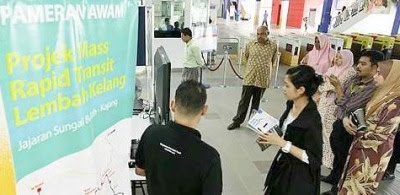
Members of the public looking at an exhibition on the MRT project in Bangsar LRT station.

In an interview with StarBizWeek, SPAD's chief executive Mohd Nur Ismal Kamal stressed that it was open to feedback from the rakyat. “This (the MRT project) is not about bulldozing ideas or pushing solutions down people's throats,” he said.

SPAD has opened various lines of communication for public feedback on the project, especially on the alignment of the MRT stations, through public displays, its website and telephone lines. Nevertheless, a consultant says for a project that may cost up to RM50bil or more, there is little information about the stations, traffic flow, parking facilities, or fare mechanism.

The environmental impact assessment (EIA) report, which has been made public, is another source of information on the MRT.

Notably, the EIA report itself has raised a few issues about the MRT, such as traffic congestion, noise, dust and pollution and ground vibrations that could affect households from the building of the MRT. The report said the MRT project will affect 108,000 residential units in 403 lots where the 51km mass rapid transit line will traverse.

However, the EIA report also recommended steps to overcome or mitigate those impacts. SPAD has said it would ensure the MRT project owner would follow the steps.

Is Prasarana right for the job?

As for the choice of Prasarana as the project owner, questions are raised as to its suitability. Not only are there questions about its track record and alleged past transgressions, there is also the concern about its financial viability. It has been reported that Prasarana had total debts to the tune of RM9.64bil as at end-2009 and has to repay bonds to the tune of RM7.1bil (in principal amounts) that will mature between 2011 and 2023. There are also reports that the Government has allocated RM2.5bil to pay for Prasarana-issued bonds which are due in November 2011.

Prasarana has recently said it would be raising between RM5bil and RM10bil over the next five years via a bond sale to fund the light rail transit (LRT) extensions. It had also raised RM2bil in 2009.

According to SPAD, there is sound rationale for the choice of Prasarana as the MRT project owner. “It is 100%-owned by the Ministry of Finance Inc and was set up to facilitate, coordinate, undertake and expedite infrastructure projects approved by the Government. As the MRT is a government-funded infrastructure project, Prasarana is the most relevant entity to be the owner of the asset of the (MRT) network. It also has a lot of expertise in owning public transport assets built up over the years,” explains SPAD's Mohd Nur. He adds that there is going to be a governance structure in place to ensure that Prasarana meets the high standards expected of it.

Prasarana's property play

Interestingly, Prasarana will play a key role to try to make money from real estate opportunities given to it by the government.

The financial model being used for Malaysia's MRT is called “rail plus property” and is similar to what Hong Kong's Mass Transit Railway, which is often cited as one of the world's most-successful examples of a well-run and financial-viable inner city train project.

Explains Prasarana's newly-appointed group managing director Shahril Mokhtar in a recent interview with StarBizWeek: “We are doing a study that out of the 51 km (line of proposed MRT), we have to identify a few parcels (of land) that can be developed into commercial or residential areas. We can partner with property developers and profit from the development can be shared. These properties will be around the station or on top of the stations. It can be rented or sold. The profit can be returned to the Government to offset the cost of the MRT. Hong Kong has done this for the last 20 over years.”

According to a consultant familiar with the Hong Kong experience, it had the advantage of planning the system in the 70s when it was still developing. Another success factor was the strict check and balances imposed by the Government on the operator of the MTR.

Shahril says that under his stewardship, Prasarana will become self-sustaining, with a target of breaking even by 2015. Prasarana has yet to reply to specific questions on its financial status.

Shahril took over the helm of Prasarana in October last year and his mandate is to transform the asset owner and operator of several public transport providers. Two months after he came on board, he dished out a 2-year transformation plan while a five-year master plan is crafted. He also restructured the management team, tweaked the organisational structure and set a direction for the company.

“We have to win the trust of the customer. If there is no trust, it would be tough. We also need to change the perception of Prasarana,'' he says.

The PDP issue

Back to the MRT. On the appointment of the MMC-Gamuda joint venture as the project's PDP, SPAD has explained that MMC-Gamuda will be the MRT project manager but with the added responsibility of having to deliver the project within an agreed time and cost.

“Any cost overrun and delays in project completion which are basic common risks in projects will be borne by the PDP. The PDP is not a turnkey contractor and the project will be divided into work packages which will be awarded individually through open tender. The Government will make the final decision on the awarding of contracts.”

The fact remains though that the Government will be footing the bill of the MRT, which means MMC-Gamuda should stand to make a decent profit as project managers of the multi-billion project. It is understood that MMC-Gamuda were picked as the MRT projects PDP as they are the ones to have first pitched the MRT project to the government, having hired consultants to do a detailed study on it.

MMC-Gamuda will also not be allowed to tender for any of the work packages except for tunnelling works. SPAD said the Government felt that an exception should be made as the PDP is the only local construction company that has experience in major tunnelling works. Still, the tunnelling work should again provide decent profit margin to MMC-Gamuda if they win the bid.

SPAD's Mohd Nur also says that costs will be kept down through the implementation of a value management study where an independent party will scrutinise the project plans to ensure that optimum value is derived.

Together with the “rail plus property” model, the plans sound good but that's only on paper. It is left to be seen if the MRT project will be carried out without any excesses and in the most transparent way possible. To be fair, one positive step has already been the setting up of SPAD.

“Before, public infrastructure projects were just dished out to different parties, who subsequently needed to be bailed out by the Government. Now at least, there is a one-stop regulator that is trying to ensure that things get done correctly,” says one observer.

One of SPAD's first tests will be to decide on the alignment of the MRT, which is turning out to be a challenging job.

“We're having to look at it from a myriad of perspectives and balance it all,” says Mohd Nur. Among the factors being taken into account are the social impact, engineering aspect or “constructability”, journey times, land acquisition costs, accessibility to users and ridership.

It will certainly be interesting to see SPAD's final decision on the MRT allignment and the basis at which it came to that conclusion.

By The Star

AP Land sees good potential in Niseko

The influx of tourists and investors from around the world, especially Asia and Europe, is set to change the real estate and infrastructure landscape of one of the most popular ski resort destinations in the world, Niseko in Hokkaido, the northern island of Japan.

Currently there is still a lack of awareness on the potentials and opportunities there, which explains why it is still a relatively untapped market as far as real estate development and investment is concerned.

According to Asia Pacific Land Bhd (AP Land) joint managing director, Low Su Ming, the pioneer developers from Australia, who are generally small fit outs, have taken more than 10 years to develop Niseko to what it is today.

“The rest of the world are only now beginning to take note of Niseko. As such, properties here are still affordable but it is not so much about the cost of investment but the propensity for the properties to improve in value that is of great interest,” Low tells StarBizWeek.

Low believes Niseko will continue to enjoy growth, adding that investment returns have been growing in recent years, with further capital growth expected.

“Niseko is clearly a world-class ski location, with its real estate still a fraction of the price of other comparable international destinations.

“This place, ranked by Forbes as the second snowiest place on earth and famed for its long ski season (from November to April yearly) and fine powder snow, has seen tourist arrivals doubling every year.

“We see great potential and opportunities in this area. At this moment, demand for accommodation far outpaces supply,” Low says.

AP Land is undertaking its maiden development in Japan – Shiki Niseko comprising 69 units of 1, 2 and 3 bedroom high-end residences with commercial component in the heart of the ski village, known as central Hirafu. The project is scheduled for completion by the end of 2012.

Low says most investors have taken a long-term position and are comfortable to enjoy their asset and ride out any short-term volatility.

LJ Hooker Niseko Resort branch manager Derek Kennewell concurs, saying that if Niseko’s attractions can be elevated to the level of some of the more mature resorts in Europe and North America over the next decade or two, “then we may see big tourism growth numbers, which will drive property investment.”

“Niseko offers something unrivalled in Asia, with access that cannot be beaten by Europe and America. The tourism market here is one of the biggest in the world, and if the bullet train makes it to Niseko in the coming decades it will bring a massive influx of domestic tourists,” he says.

He adds that Niseko is growing organically at its own pace.

“Many still think of Niseko as an anomaly, and are waiting for it to dry up as it did in the Japanese Bubble era in the late 80s and early 90s leading to the ‘lost decade’.”

“In actual fact, we are under-supplied when it comes to commercial premises, and more shopping facilities will bring a new level of tourists to the area.

“No doubt this will take time to manifest,” he says.

In recent years, big property players from Hong Kong and Malaysia are making their presence felt in Niseko with land and whole villages exchanging hands.

Their plan is to cater to the growing affluence in various Asian markets and higher demand for more lifestyle properties in Niseko.

Hong Kong’s PCCW Ltd has planned to add 14,000 beds in Hanazono over the coming decade, including a couple of hotels and village shops and services.

Besides APL, another Malaysian corporation, YTL Corp’s hospitality arm YTL Hotels & Properties Sdn Bhd has last April purchased Niseko Village located at the southeastern foothills of Mt Niseko An’nupuri.

Kennewell says that with the Chinese yuan rising steadily against the greenback in the past several years, China represents a huge market opportunity as it is now much cheaper to buy a property in Japan.

On what are the missing links in the Niseko tourism and real estate landscape now, he says: “Boutique shops, and personal services.

“There is also a need for more cultural and international events to attract guests all through the year, though these are improving year on year,” he adds.

By The Star

Guocoland unit sells land for RM45m

GUOCOLAND (Malaysia) Bhd’s associate company is selling a piece of land in Malacca to Perbadanan Kemajuan Negeri Melaka for RM45 million.

The associate, Continental Estates Sdn Bhd (CESB) — a property developer that also operates an palm oil estate — will use the proceeds for working capital and repayment of borrowings.

Guocoland said in a stock exchange filing yesterday that the sale will result in a gain of about RM15 million to CESB and RM7.5 million to the group.

The land, measuring about 202.5ha, is located in Jasin.

By Business Times

Sunway bags deal to build part of Legoland

SUNWAY Holdings Bhd’s construction unit has bagged a RM258 million contract to build part of the Legoland Theme Park in Johor.

The project, which will take 15 months, is targeted to be completed on June 2 next year, Sunway said in a statement to Bursa Malaysia yesterday.

Sunway Construction Sdn Bhd accepted the letter of award from IDR Assets Sdn Bhd.

The project is expected to contribute positively to the Sunway group’s earnings from this year onwards, the group said.

By Business Times

Sarawak offers land to AirAsia for LCCT

KUCHING: The Sarawak government has offered a piece of land next to the Kuching International Airport to AirAsia Bhd to build a dedicated low-cost carrier terminal (LCCT), said Deputy Chief Minister Tan Sri Dr George Chan.

He said the LCCT would not only draw more air travellers but also boost the state's tourism industry and double its revenue.

“The state government has offered land to AirAsia to set up an LCCT here. Now, AirAsia just need to build the terminal. They (AirAsia and the state government) are talking seriously,” Dr Chan, also the state's Tourism and Heritage Minister, told Bernama yesterday.

AirAsia has plans to turn Sarawak into a low-cost air travel hub with extensive domestic and international connections.

The plan to set up an LCCT in Sarawak was because the airport tax of RM51 imposed at the KL International Airport was considered too high by travellers.

Dr Chan urged Malaysia Airports Holdings Bhd (MAHB) to seriously consider reducing the airport tax and charges so as to develop new traffic and to further promote the state's tourism industry.

He said the high airport tax had hindered AirAsia from increasing flight frequency and introducing new routes in the state.

“It is a chicken and egg situation. MAHB should seriously consider lowering the airport tax or charging a minimum rate. It is better than having none, especially when the Miri, Sibu and Bintulu airports are not very busy.”

By Bernama