Malaysia Property News is a free resource website sharing Daily Property News & information about Property in Malaysia, which related to, Property Market, Property Investment, Commercial Property , Hot Properties Malaysia, Real Estate, Retail Shop, Business Park, Condominium Malaysia, Terraces & Apartment Malaysia, Houses, Residence, Resort and many more.

Saturday, March 3, 2012

Moderately-priced houses in trend

The trend of developing residential properties priced between RM200,000 and RM400,000 is picking up in Penang, a state where property prices are second highest in the country after Kuala Lumpur.

Tambun Indah Land Bhd, PLB Engineering Bhd, Ideal Property Development Sdn Bhd, and Belleview Group are some of the Penang-based developers with plans to launch moderately priced projects on the island.

With the exception of Belleview, Tambun Indah, PLB, and Ideal Property are taking advantage of the plot ratio guidelines introduced in 2010 which allowed developers to build 87 units per acre, with a total built-up area of 122,000 sq ft per acre and priced at between RM200,000 and RM300,000.

Under the revised guidelines, developers have to allocate 5% of the total units in a development scheme to be priced at RM200,000, 10% to be priced at RM300,000, and 5% not exceeding RM500,000.

Tambun Indah's Straits Garden in Jelutong, PLB's Sungai Nibong Residences and Ideal Property's Valencia Park are the new projects using the revised guidelines.

The layout plans of the projects have been approved and the company is now waiting for the go-ahead for the building-plans.

Previously, the plot ratio guideline for high-rise was 60 units per acre or 42,000 sq ft per acre or 30 units of 1,400 sq ft apartments.

The revised plot ratio guidelines are applicable in areas where it is allowed to develop 30 units per acre and above and in areas designated as commercial/tourism areas under MPPP's structural planning and development control plan.

They are not applicable for prime residential areas such as Jalan Tunku Abdul Rahman (popularly known as Ayer Rajah Road), Jesselton area, existing established housing zones and general housing areas, George Town Heritage Site (which includes the buffer zone), certain areas in Tanjung Bungah and Tanjung Tokong.

Real Estate and Housing Developers' Association (REHDA, Penang) chairman Datuk Jerry Chan said the new plot ratio guidelines for the island was a win-win situation for both the developers and the state government.

“The guidelines make the developers supply affordably priced properties and in return the developers get to better utilise the land for development,” Chan said.

Tambun Indah is proposing to develop a RM180mil high-rise residential project called Straits Garden in Jelutong on a 1.69ha site, the north-east district of the island, with 15% of the total units priced between RM200,000 and RM300,000.

Tambun Indah managing director Teh Kiak Seng said the project's layout plan had been approved and was now waiting for the building-plan approval from the relevant authorities.

“The project located in the heart of the island and would feature modern apartments, office suites and shop lots to meet the demand for commercial and lifestyle properties in the central business district.

“We anticipate to commence development in the fourth quarter of the year. Targeted completion is by the fourth quarter of 2014,” he added.

In Sungai Nibong, which is close to the Penang International Airport, PLB plans to launch the Sungai Nibong Residences, comprising 98 units of medium-cost apartments on an over 0.4ha site.

Ong says the Sungai Nibong Residences is expected to be launched in Q3.

PLB executive chairman Datuk Ong Choo Hoon said the project has a gross development value (GDV) of RM70mil and was expected to be launched in the third quarter this year.

Some 15% of the total units would be priced between RM200,000 and RM300,000 in accordance with the conditions of the revised plot ratio guidelines.

The lay-out plan of the project had been approved and is now waiting approval for it's building plan.

Ooi says Valencia Park, comprising apartments, has GDV of RM330mil.

Ideal Property also plans to launch 788 apartment units called Valencia Park on a 9.1-acre site in Relau, south-west district of the island in September.

Ideal Property managing director Datuk Alex Ooi said the project, which had a GDV of RM330mil, comprised apartments with built-up areas of 1,000 sq ft and 1,200 sq ft.

In the past two years, Ideal Property had developed and sold over 500 units of apartments priced between RM300,000 and RM400,000 in the south-west district.

Ho says the RM100mil Autumn Tower project does not come under the new guidelines.

Belleview's RM100mil Autumn Tower project, comprising 220 condominiums at All Seasons Park in Bandar Baru Air Itam, does not come under the new plot ratio guidelines.

“The project is scheduled for launch in May 2012.The pricing for the units ranges between RM350,000 and RM400,000”, said Belleview managing director Datuk Sonny Ho.

Meanwhile Raine & Horne Malaysia director Michael Geh said the sub-sale transactions of high-rise properties priced between RM300,000 and RM400,000 were very active in the south-west district of the island in Relau, Bukit Jambul, Bayan Baru, Bayan Lepas, and Sungai Ara.

Geh says the demand for houses comes from newly-weds, families and retired couples.

“Properties in these locations have been steadily rising at about 10% per annum,” Geh said, adding that there was strong take up for newly-launched properties in the first two months of 2012.

“We observed that the demand came from newly-weds, families that want to upgrade their lifestyle, and retired couples looking for smaller high-rise properties in prime locations,” he said.

In Seberang Prai, Asas Dunia Bhd is undertaking some 1,357 units of landed properties this year with a GDV of RM226.7mil in Central and South Seberang Prai.

Group managing director Chan said the price ranged between RM120,000 and RM580,000, depending on the type of property and the location.

The properties comprised largely single-storey terraced, single-storey semi-detached, and single-storey bungalow houses.

Over the past two years, the prices of residential properties have increased from 10% to 15% per annum on the island, making properties in the RM200,000 to RM400,000 price range increasingly rare.

Prime Minister Datuk Seri Najib Tun Razak had last July launched the first phase of 1Malaysia Peoples' Housing (PR1MA) programme, under which residential properties priced between RM150,000 and RM300,000 would be developed.

PR1MA is specifically for first time house buyers and moderate-income Malaysians earning not more than RM6,000 monthly regardless whether they work with the government, the private sector, or self-employed.

Some 42,000 houses under PR1MA have been identified for 20 sites in the Klang Valley, Rawang and Seremban, and companies like Sime Darby Bhd, SP Setia Bhd and Putrajaya Corp have been invited to participate.

In the last budget announcement, the federal government also raised the ceiling price for first home scheme buyers to RM400,000 from RM220,000 with 100% loan financing and stamp duty exemption to promote home ownership among the middle-income groups.

As Sime Darby owns a large bulk of land bank in Penang via Eastern & Oriental Bhd, the state could be a site for moderately priced housing projects under PR1MA.

Eastern & Oriental Bhd is reclaiming 740 acres for the second phase of the Seri Tanjung Pinang project in Tanjung Tokong to develop two islands for mixed development projects, which will have a GDV of RM12bil.

By The Star

Divided views on home price hike in Kuching

KUCHING: Speculators are said to be behind the high demand for residential properties, which have driven up prices significantly, in the Sarawak state capital.

According to leading property consultant CH Williams Talhar Wong & Yeo Sdn Bhd, there were fears the property market was highly speculative.

Chew says new houses fetched higher prices in areas like Tabuan Jaya because of high demand as land had become scarce.

It said that although the response to property launches had been encouraging, buyers and investors had grown more cautious due to the uncertainty in the global economy.

But the Sarawak Housing and Real Estate Developers' Association (Sheda) and top property developer Ibraco Bhd are of the opposite view, saying there was little element of specualation in the city's property market.

The consultancy said residential property prices had increased 10% to 20% across the board last year.

It said homes in the city's prime locations such as Tabuan, BDC, 3rd Mile and Jalan Song were consistently sought-after and that the high demand had kept prices on the uptrend.

“Standard double-storey intermediate terraced houses now easily command prices between RM350,000 and RM400,000,” the consultancy said in its newly released Sarawak Property Market Review 2011 and Outlook 2012.

It said even new residential projects on the outshirts of Kuching like along Kuching-Serian Road, Batu Kawa and Matang had received encouraging response, with properties being snapped up within several months of their launch.

It said more residential properties were launched in the second half of last year and housing schemes in the city area offered mostly double-storey terraced houses and double-storey semi-detached houses, while projects in secondary locations comprised mostly single-storey houses.

The consultancy said there was a tendency for developers to build to take advantage of the current high residential prices, while buyers were rushing to buy for fear of missing out.

Sheda secretary-general Sim Kiang Chiok said there were few speculators in the landed residential sector as the houses were for buyers' own occupation.

He said the 2% population growth in Kuching last year over 2010 meant the state capital required some 4,000 new houses a year to meet the demand. “There is no overbuilt of houses. There is no mismatch of supply and demand,” he told StarBizWeek yesterday.

Sim said more people could afford to buy houses due to low bank interest rates and longer loan repayment period as the financial system was flush with liquidity.

He said the low saving rates had encouraged people to invest in properties instead of keeping their money in banks.

The buoyant prices of commodities like oil palm, pepper and rubber are another contributor to the vibrant property market, according to Sim.

Noting the drastic increase in house prices in the city's prime locations in the past few years, Sim expects the price uptrend to continue. “We expect prices will still increase slightly, in single digit, this year,” he said.

Sim considers the current residential property prices in secondary locations in Samarahan Division (its population grew about 6% last year) as “quite reasonable”.

Buyers could still get a single-storey terraced house, for example along Kuching-Serian Road, for RM200,000, he said.

Ibraco managing director Chew Chiaw Han dismissed market speculation for the significant increase in residential properties in the city's strategic locations.

He said buyers of Ibraco houses were individuals comprising young professionals who were first-time buyers. There were also parents who bought houses for their children.

Chew said new houses fetched higher prices in areas like Tabuan Jaya because of high demand as land had become scarce.

He said development costs for houses had gone up because of increasing costs of building materials and labour.

Ibraco, which has built more than 10,000 residential units in the prime Tabuan Jaya area, is in the second year of implementing its flagship mixed development project, Tabuan Tranquility.

The project has a gross development value of RM517mil.

Chew said Tabuan Tranquility had registered high take-up rates for both commercial and residential properties.

By The Star

UEM Land looks to expand land-bank in other locations

PETALING JAYA: After posting a stellar set of results, UEM Land Holdings Bhd is on the prowl again to expand its land-bank in other locations and diversify geographically in Malaysia and also regionally.

“Our business development division has been very busy with regional expansion, and we like what we see in Sabah and Sarawak,” said managing director and chief executive officer Datuk Wan Abdullah Wan Ibrahim.

“Some developers may have created their footprint in these locations, but it is never too late to venture into these states, as we can learn from past experiences,” he said.

He said the company was in advanced negotiations with some land owners and expected to get something on board this year.

Currently, the company owns about 3,640ha with a gross development value (GDV) of RM77bil, which mainly are located in the Nusajaya area in Johor.

He also said if UEM were to venture into a new location, it would do the projects on a joint-venture basis.

“We still have some land-bank in the Klang Valley out of the acquisition of Sunrise Bhd, and we have some 45 acres of land in Mont Kiara,” Abdullah said.

He said there were still a lot of projects in the pipeline, totalling more than RM30bil.

“We are in discussions with other government agencies to acquire strategic parcels around Penang and Kuala Lumpur, and we hope to be able to land some of these deals this year,” he said.

On the prospects for the Johor property industry, he said although there was a softening of prices in the industry as a whole, Johor was a different story altogether.

“Johor can leverage on its proximity to Singapore and also new product offerings that cater to not only a section of the market but also to the region and the world at large,” Abdullah said.

Meanwhile, the company just released its first full-year consolidated results after the merger between UEM and Sunrise, which showed a growth of 55% in net profit to RM301.7mil from RM194.5mil in 2010. The company has also set a net profit growth target of 40% for 2012, on the back of a 50% rise in revenue.

UEM still has unbilled sales totalling RM1.85bil as at Dec 31, 2011, and is aiming to achieve RM3bil in sales for 2012. Launches worth RM4.5bil in GDV are planned for this year.

By The Star

UEM Land eyes 40pc profit growth

KUALA LUMPUR: UEM Land Holdings Bhd has ambitiously targeted a 40 per cent net profit increase under its Key Performance Indicators (KPI) this year.

The property developer is also aiming for 50 per cent growth in revenue this year, its managing director and chief executive officer Datuk Wan Abdullah Wan Ibrahim said.

UEM Land, the country's largest propery company by market capitalisation, saw its net profit increase 55.1 per cent in the year ended December 2011 to RM301.7 million.

Group revenue climbed 261.5 per cent to RM1.7 billion from RM469.7 million in the year before, exceeding its 2011 KPI target.

Wan Abdullah said the optimism is driven by various project launches this year, which has a combined gross development value of RM4.5 billion.

"For 2012, UEM Land aims to achieve RMM3 billion property sales with planned new residentail and commercial property launches in Nusajaya (Johor), Mont Kiara, the Kuala Lumpur central business district and Kajang, Selangor with a total gross development value of RM4.5 billion," he said.

Wan Abdullah was speaking at a press conference on its 2011 financial results here yesterday.

UEM Land reported total sales of RM2.2 billion in 2011, exceeding the target of RM2 billion set at the beginning of 2011 with total unbilled sales value of RM1.8 billion as at December 2011.

UEM Land, the property arm of government-owned UEM Group Bhd, is the master developer of Nusajaya, Johor and is fresh from its acquisition of Sunrise Bhd.

He said property demand is expected to be strong this year, with the completion of several projects especially in Nusajaya such as University Of Southampton, Marlborough College, Legoland, Trust School, Bio-Xcell, Institut Maritim and Traders hotel.

Some of the company's projects that will be launched this year include Nusa Idaman, East Ledang, Nusa Bayu, CS2, Lifestyle Retail Mall and Residence, Summer VOS, Lot 149 (at the former Bangunan Angkasaraya Jalan Am-pang), Mont'Kiara 22, SL 1,2 & 3, Kajang, Arcoris and Symphony Hills.

On another note, Wan Abdullah said UEM is in talks with foreign parties on joint property projects in Southeast Asian countries such as Myanmar and Vietnam as well as in India.

"We are also looking at increasing our 3,643.7ha landbank in Sabah, Sarawak and the region and expect to seal a deal this year," he said, without elaborating.

By Business Times

Bank Negara’s lending guideline is a blessing in disguise

ENVIRONMENTALISTS and green champions must be applauding the lower number of cars that have been sold since Bank Negara's latest directive to banks to disburse the quantum of household loan based on a borrower's net income instead of gross income.

Since Jan 1, banks have to use net income instead of gross income to calculate the debt service ratio for loans. The guideline covers housing, personal and car loans, credit cards, receivables and loans for the purchase of securities.

The effectiveness of the ruling can be seen in the lower number of vehicles sold in January. At 40,948 units, it was 14% lower than in December 2011 and a 25% drop against January last year.

This goes to show that many of those who previously managed to sign up for new car loans and other types of consumer loans could be grossly over-geared and may have inadequate disposable household income. What's left of one's income after deducting payment for loan servicing, income tax and contribution to the Employees Provident Fund, differs from individual to individual, depending on one's financial commitment.

Don't forget that for many sole breadwinners, they also have to shoulder a host of other payments - spouse and children's household expenses and education fees, pocket money to ageing parents and dependents, and other miscellaneous expenses. The list goes on.

The central bank has good reasons to rein in the rising ratio of household loan to income as the benefits are manifold.

The measure should be applauded as I believe the right policy is the first step to steer people in the right direction of living within their means rather than allowing them to become dependent on debts to maintain their lifestyle.

With the prevailing uncertainties in the world today, it is a good time for families to consolidate their household income and expenses account. And along the way they can point out to their young ones about the virtues of being contented with what they have.

Instead of rushing to place booking for a new car whenever a new model comes out, it is nothing wrong to drive around in an older model as long as the vehicle is road worthy.

Don't forget that our young ones are always watching us, the adults, as their role model. In many ways, they are a mirror of what we are, so it is important for us to watch our thoughts, words and deeds. Remember the saying, “What goes around, comes around.”

As a mother to two teenage girls, I know - even our facial and body language would be scrutinised for “signs” of approval or disapproval. A friend had once vouched that her teenage girl (girls are said to be more mentally discerning) even use telepathy to read her mind - so beware of what goes on in our head when in their presence.

Come to think of it, since less people qualify for loans to buy cars now, it may be an opportune time to revert to cycling or better still, walking.

Cycling and walking are certainly more sustainable modes of moving around, more environmentally friendly and healthier options.

When there are less vehicles on the roads and facilities are provided for pedestrians and cyclists, such as covered walkways and bicycle lanes on roads and highways, the walking and cycling vogue is bound to take off.

Less petrol would be consumed and there would be less pollution from vehicular emissions.

As for the property sector, the net income formula and maximum loan-to-value ratio of 70% for a third and subsequent housing loan taken by a borrower would avert unhealthy speculative activities and rein in sharp jump in property prices.

The lower loan quantum would inadvertently increase demand for affordable housing products and developers would have to redesign their products to cater to this market.

The same maxim applies: If the house is still functional, stay put first. Moving into a newer and trendier place, although is a status symbol, incurs cost and may involve higher loan commitment.

Nevertheless, those with the means and surplus cash to spare can opt to invest in multiple properties as they still offer one of the best hedge against inflation.

Deputy news editor Angie Ng says amid the uncertainties eclipsing the world today, major overhauls need to be made to the way people live, and key to this is to be sustainable.

By The Star (by Angie Ng)

Major shareholder injects land-bank, property into Dijaya

PETALING JAYA: Dijaya Corp Bhd’s majority shareholder, Danny Tan Chee Sing is injecting his personal assets into flagship property company, Dijaya, to enlarge the size of the company and unlock further value for shareholders, said sources close to the company.

These personal assets are currently privately held by Tan and consists of land-banks nationwide as well as investment properties.

While the size of the assets are not known, sources said the injection of the assets would result in Dijaya’s market capitalisation increasing from RM766.4mil to about RM1bil.

Dijaya shares were suspended at about 4.30pm yesterday with its last traded price of RM1.67. The suspension will be from 9am on March 5 to 5pm on March 6.

In an announcement to Bursa, Dijaya said that the company intended to propose a corporate exercise involving a very substantial transaction.

Sources said: “The intention is to create a bigger company and grow more aggressively, moving forward. The investment properties will also provide some form of recurring income for the company.”

The acquisition was likely to be satisfied by a combination of cash and a corporate exercise, the sources added.

Tan is the single largest shareholder of Dijaya, with a 30.51% stake in the company. The other substantial shareholders are Golden Diversity Sdn Bhd (18.27%) and Impeccable Ace Sdn Bhd (17.87%).

For the fourth quarter to Dec 31, 2011, Dijaya’s net profit rose 12.8% to RM39.02mil on a 53.24% increase in revenue to RM156.2mil. For the full year, net profit increased 50.43% to RM65.07mil on a 27.87% increase in revenue to RM373.72mil. As of the period, the company had cash of RM116.36mil, compared with RM232.74mil previously.

Last month, Dijaya’s managing director Datuk Tong Kien Onn told StarBiz that the company planned to build up its market presence in Johor and Penang, and expected to see a bigger contribution from these two growth markets.

Selangor is still its biggest contributor, accounting for more than 70% of sales and bottomline. This year, Dijaya plans to launch RM1.1bil worth of projects, compared with about RM700mil last year.

In Johor, Dijaya has two joint ventures with Iskandar Waterfront Sdn Bhd for projects in Danga Bay.

Tropicana Danga Bay is a 60:40 joint venture between Dijaya and its partner, with an expected gross development value (GDV) of RM3.8bil and an estimated period of eight to 10 years to complete.

Dijaya also has 50:50 joint venture with Iskandar Waterfront to undertake the 91ha Tropicana Danga Cove. This development has a GDV of RM2.8bil and is expected to be completed in 10 to 12 years.

In Penang, Dijaya has a 55:45 joint venture with Ivory Properties Group Bhd to buy and develop a 41.02ha in Bayan Mutiara. The joint-venture company, Tropicana Ivory Sdn Bhd will undertake a mixed residential and commercial property project with a GDV of RM9.8bil over the next eight to 12 years.

By The Star (by Tee Lin Say)

MRT Corp inks deal with Jalan Sultan landowners

KUALA LUMPUR: MRT Corp has signed Points of Agreement (POA) with the owners of six lots of land in Jalan Sultan, including that of a budget hotel, for the development of the MY Rapid Transit (MRT) project.

The POA will form the basis of an agreement that will offer mutually beneficial solutions to both parties.

The terms of the POA that will be incorporated into the mutual agreement include the withdrawal of land acquisition upon the signing of the mutual agreement and a "no demolition of existing buildings" guarantee.

Also in the POA is the relocation of occupants of those buildings during the tunnelling works for a maximum of six months and having land titles endorsed with a statement to recognise the tunnel beneath these properties.

Fair compensation will also be paid for any inconvenience caused and the loss of profits during the stipulated tunnelling period.

"We are grateful for the owners' trust in MRT Corp and their response to our offer," said MRT Corp chief executive officer Datuk Azhar Abdul Hamid.

"This agreement indicates significant progress in getting the MRT project up and running and according to schedule," he added.

MRT Corp recently signed a POA with Bungsar Hill Holdings Sdn Bhd, owner of several lots of land, including the car park in front of Help University in the Pusat Bandar Damansara, for the construction of the Pusat Banda-raya Damansara MRT station's ticketing area and park-and-ride facilities.

In November last year, MRT Corp signed a similar pact with the owners of 21 lots of land in Jalan Inai.

By Business Times

Friday, March 2, 2012

RM124m financing for LBS upmarket D'Island Residence

KUALA LUMPUR: Property developer LBS Bina Group Bhd is borrowing RM124.6 million from Malaysia Building Society Bhd (MBSB) to finance its upmarket development in Selangor.

The 70.8-hectare D'Island Residence housing project in Puchong, with gross development value of RM3.6 billion, is expected to be completed by 2020.

LBS managing director Datuk Lim Hock San said the first phase was fully sold out.

"We expect to hand over the houses to owners in six months," he told reporters here yesterday after sealing the loan agreement with MBSB.

The RM125 million loan is to finance the second phase of D'Island Residence, consisting of semi-detached and superlink homes.

The semi-detached homes are priced from RM2.38 million while the three-storey superlink homes will be sold from RM1.7 million.

In its filing to the stock exchange yesterday, LBS said its fourth quarter profits to December 2011 fell 19 per cent to RM9.02 million.

Revenue dipped five per cent to RM143.41 million.

For the full-year, the group's profits more than doubled to RM36.72 million, thanks to progressive sales at D' Island Residence and The Lake Residence in Puchong, Topaz III & IV, Ivory Residences I & II, Indigo Homes, Magenta Homes and Lavender II in Bandar Saujana Putra.

The high profits were mainly driven by the group achieving RM662 million sales last year, 57 per cent more than 2010's RM422 million.

As at December 2011, the group has 20 ongoing projects and unbilled sales of RM649 million.

Lim said LBS is confident of topping RM800 million sales this year as domestic consumption is still growing at a sustained pace.

"There's liquidity in the market. Property sales at select locations are doing well," he said.

By Business Times

Sunway eyes Iskandar expansion

Company aims to more than double its landbank in Medini Iskandar

PETALING JAYA: Sunway Bhd plans to more than double the size of its landbank in Medini Iskandar, raising it to around 2,000 acres from the already-announced acquisition of around 700 acres, industry sources said.

“The project will be a significant one and Sunway hopes to differentiate itself from other developments in Iskandar with a unique offering, targeting very much the Singapore market,” said one source.

“It will be more innovative than what Sunway has in Malaysia,” the source added.

Another source said there was also a plan for a new road linking the Sunway project in Iskandar to the Second Link in order to give Singaporeans better access to the development.

Sunway hopes to capitalise on its established brand name and its “Singapore connection” through the presence of the Government of Singapore Investment Corp (GIC) as one of its major shareholders since 1999.

An analyst said he was expecting the Iskandar project to be significant for Sunway's earnings going forward and was awaiting more details on their plans.

Last December, Sunway said it had entered into a joint venture with Khazanah Nasional Bhd to buy 276.4ha of land in Medini that would have an estimated gross development value (GDV) of RM12bil.

With the acqusition of the additional land, sources said the GDV of the project would be higher, at more than RM15bil.

The land is in Medini's Zone F, which is strategically located in the heart of Iskandar Malaysia.

It is about 10 minutes from Singapore via the Second Link Expressway and 25 minutes from the Senai International Airport.

The joint venture company, Semerah Cahaya Sdn Bhd, is in the midst of drawing up the masterplan for the project.

Sunway currently holds 38% in the joint venture but will increase it to 60% within 54 months from the date of the lease purchase agreement.

This integrated development project will be named Sunway Iskandar, and the first launch is expected in early 2013.

Sunway is required to pump in an initial equity investment of RM136.8mil, and will subscribe for shares in Semerah Cahaya for RM198mil in four tranches.

The first payment of RM49.5mil a year will start from the 18th month from the date of the lease purchase agreement.

Sunway already has a presence in Iskandar through its construction division which is undertaking three major construction jobs in Iskandar Malaysia, including Legoland, Pinewood Iskandar Malaysia Studios and the Central Utilities Facility at the Bio-XCell biotechnology park.

A research house has highlighted that Sunway is paying less than Eastern & Oriental Bhd (E&O) for the land in Iskandar, but said that did not mean the planned RM12bil development would carry a lower risk given the rising competition among developers in the area.

Also, the report said Sunway might have to tap shareholders for funding at some point in the future to pay for project.

“We believe Sunway has managed to pull a coup, as the location of this land is better than its other competitors at much lower cost,'' Hwang-DBS Vickers research said in a report.

This is Sunway's largest acquisition after the merger of the businesses of two public-listed companies, Sunway Holdings and Sunway City in August which resulted in the merged entity becoming one of the top five property-construction companies listed on Bursa Malaysia.

By The Star

UEMLand may buy more land

KUALA LUMPUR: UEM Land Holdings Bhd is exploring more opportunities to increase its landbank in Sabah, Sarawak and the region.

Managing director and chief executive officer Datuk Wan Abdullah Wan Ibrahim said the company is currently in advance negotiations with the land owners, and expects to seal a deal this year.

Currently, the company owns about 9,000 acres of land, located mainly in the Nusajaya, Johor.

By The Star

Thursday, March 1, 2012

Sime Darby net profit jumps to RM1b in Q2

Revenue surged to RM11.3 billion from RM9.9 billion in the comparable period before riding on good yield of its palm oil trees, higher automotive sales and booming property sales.

KUALA LUMPUR:SIME Darby Bhd made a net profit of RM1.1 billion in the second quarter ended December, a 25.5 per cent increase compared with RM877.0 million in the comparable quarter a year ago.

But the country's oldest conglomerate warned of challenging times in the remaining six months of the year.

The diversified group saw good performance in all of its six business divisions spearheaded by strong crude palm oil (CPO) prices, encouraging property and automotive sales as well as good sales at its industrial and healthcare divisions.

Sime Darby's six business divisions are plantations, property, energy, automotive, healthcare and industrial and others.

Sime Darby president and group chief executive officer Datuk Mohd Bakke Salleh said the group had a commendable first half with all six divisions achieving double-digit earnings growth due to its continuous emphasis on enhancing earnings quality.

"But the third quarter is usually challenging due to the shorter month of February, lower yield of fresh fruit bunches and the unpredictable external environment such as the debt problem in Europe.

"We are bracing ourselves for lower contributions and not overly optimistic but hope things will fan out nicely over the next few months," Mohd Bakke told reporters here yesterday after unveiling the group's second quarter results.

However, he is confident that the group will be able to hit a pre-tax profit of RM3.3 billion, one of its 2012 key performance indicators.

In the first six months of the year, higher realised CPO prices and operational efficiency improvements boosted the plantation division's operating profit by 38 per cent to RM1.8 billion.

The industrial unit continued to thrive on the back of robust activity in mining, logging and construction sectors in Australia and Malaysia to post an operating profit of RM628 million, a rise of 38 per cent.

The property division showed a significant increase of 46 per cent in its operating profit to RM193 million in the first half of this year compared to the same half last year.

Meanwhile, the energy and utilities division operating profit grew by 127 per cent in the first half of the year under review due to the recognition of deferred revenue of RM99 million from the local power plant.

The healthcare division posted a higher operating profit of RM14 million, a 7 per cent rise compared with the same period a year ago underpinned by the higher inpatient and outpatient visits offsetting the higher costs incurred by Sime Darby Medical Centre Ara Damansara, which had a soft launch in January this year.

By Business Times

Mah Sing units buy Gombak land for RM41m

PETALING JAYA: Two Mah Sing Group Bhd subsidiaries are buying two parcels of adjacent land in Bandar Kundang in Gombak, Selangor for a total RM40.94mil, or RM6 per sq ft.

In a statement to Bursa Malaysia, Mah Sing said its unit, Major Land Development Sdn Bhd, was buying 79 acres from Vibrant Domain Sdn Bhd for RM20.60mil, while another subsidiary, Elite Park Development Sdn Bhd, was acquiring 78 acres from Topaz Best Sdn Bhd for RM20.34mil. Both are cash transactions.

Mah Sing plans to develop the land into a self-contained, secured lifestyle township, named M Residence 2@Rawang, with a gross development value of around RM650mil. The development, comprising mainly linked semi-detached homes, is positioned to complement and leverage on the success of the group's 226-acre township development, called M Residence@Rawang, located just 1km from the new planned project.

“As the proposed development plan is subject to the authorities' approval, it is too preliminary at this stage to ascertain the total development cost and expected profit to be derived from the development,” the statement said. Mah Sing said it planned to fund the acquisition and the development cost of the land through internal funds and/or bank borrowings. The company said the acquisition was not expected to have a material impact on the net assets per share and earnings of the group for the financial year ending Dec 31, 2012, as the development was expected to commence in the second half of 2012.

The project would be developed over three to four years. The development of the land is expected to enhance the future earnings of the group.

By The Star

Hua Yang to expand landbank

JOHOR BARU: Property developer Hua Yang Bhd is actively looking for land in Iskandar Malaysia as part of its long-term plan to further strengthen its presence in south Johor.

Johor branch manager Soo Kim Hiang said the country's first economic growth corridor offered good prospect for property development.

Speaking at a briefing on the company's projects in Iskandar, he said the Johor Baru property market showed similar growth patterns to that of Kuala Lumpur 10 to 15 years ago and the market here was more owner-occupiers than speculators.

Soo said Iskandar, which received strong Federal Government backing and has concrete plans, would be a driving factor to push up demand for properties in south Johor.

He said Hua Yang's immediate plan was to acquire a piece of land in Johor Baru city centre as the area would undergo a multi-billion-ringgit transformation this year.

“We understand that some strategically located land in the city centre will be sub-divided and up for sale for high-density development,'' Soo said.

He said the company was also interested in buying land in Nusajaya as there were no restrictions on property ownership by foreigners there.

Hua Yang currently has one ongoing project, Taman Pulai Indah, which is a mixed development of 4,942 residential and commercial units on a 193.03ha site.

About 134.35ha have been developed so far and it would take three to four years to fully develop the remaining area with a gross development value (GDV) of RM818mil.

“We have two new projects coming up this year in south Johor and one next year,'' Soo said.

He said the company would launch Taman Pulai Hijauan next month, comprising 1,400 double-storey, terrace, cluster and semi-detached houses. The project has a GDV of RM380mil.

Soo said it would also launch Polo Park Residential, consisting of 28 units of 2-storey semi-detached houses and three bungalows with a GDV of RM40mil, in September.

Hua Yang's residential apartments at Jalan Abdul Samad near Thistle Hotel and Hospital Sultanah Aminah with a GDV of RM130mil in Johor Baru would be launched in the last quarter of 2013, he added.

By The Star

Knusford unit to buy Kajang land

KUALA LUMPUR: Knusford Bhd’s wholly-owned subsidiary, Lakaran Cahaya Sdn Bhd, will acquire 5.39ha of freehold land in Semenyih for RM14.21mil from Idealpalm Ventures Sdn Bhd.

In a filing with Bursa Malaysia yesterday, it said the land was located adjacent to the group’s current property development, Kajang Perdana, in Kajang.

The acquisition will be funded by internally-generated funds and/or bank borrowings.

By Bernama

Wednesday, February 29, 2012

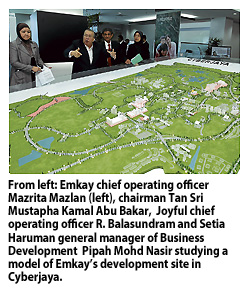
Emkay's development of Cyberjaya enters phase 3

EMKAY Group of companies will develop the third phase of Cyberjaya for the next five years with a gross development value (GDV) of RM3.8 billion.

Emkay group chairman Tan Sri Mustapha Kamal Abu Bakar said it plans to embark on an additional 3.1 million sq ft of office space, 3,250 units of various types of residen-tial units, 856 commercial units and a light industrial area for automo-tive support services starting this year.


"A lot of people say there isn't much things to do here at night. Well, we plan to come up with something soon and no, it won't be in the form of nightclubs," Mustapha said at a briefing on its projects at Wisma Mustapha Kamal here yesterday.

He believes that Emkay's investment in Cyberjaya will increase by three-fold with the third phase of the development.

The group's involvement in Cyberjaya began eight years ago and from 2006 onwards, the company has started focusing on three types of development - residential, commercial units and office space.

Under the third phase of the Cyberjaya development, the group will venture into developing green buildings and light industry development.

The master developer of Cyberjaya, Setia Haruman Sdn Bhd is 75 per cent-owned by the Emkay Group.

On another matter, Mustapha said the group plans to own seven buildings nationwide in the near future.

Two of the seven buildings, Menara Mustapha Kamal in Damansara Perdana and Wisma Mustapha Kamal in Cyberjaya, have been completed.

The third building, Mercu Mustapha Kamal located in Damansara Perdana, will be completed late 2014.

Mustapha said the other buildings would be built over the next six to seven years. "The average GDV of each building is RM200 million."

He did not reveal the location of the other buildings.

By Business Times

Emkay banking on RM3.8bil Cyberjaya project

More to come: Emkay group chairman Tan Sri Mustapha Kamal Abu Bakar gesturing during the media briefing on a five-year plan by the group to further develop mixed property projects in Cyberjaya.

CYBERJAYA: Property developer Emkay Group is embarking on a five-year plan to further develop mixed property projects in Cyberjaya.

Chairman Tan Sri Mustapha Kamal Abu Bakar said the plan, to run from 2012-2016, would see an additional 3.1 million sq ft of office space development.

There will also be 3,250 units of various types of residential units, 856 of commercial units and a light industrial area for automotive support service.

“The total gross development value for this period of development will be about RM3.8bil,” he said yesterday at a media briefing.

Mustapha said the group's commitment to pump in more investments in Cyberjaya showed its commitment and confidence in Cyberjaya's progress of development.

“Together with other notable stakeholders, we have managed to position Cyberjaya appropriately in tandem with our Government's aspiration towards the realisation of Malaysia's first intelligent city,” he said.

Emkay Group had invested some RM1.3bil from 2006 to 2011 in developing office, commercial and residential units.

The projects provide a total net floor area of 1.9 million sq ft of office space, 214 commercial units and 452 residential units.

Mustapha said the group made a profit of RM213mil from the RM1.3bil invested from 2006 until 2011.

Emkay's development of residential units will see an increase of seven times with its plan to build another 3,250 units in the next five years compared with only 452 units built between 2006 and 2011.

“It is anticipated that an additional 7,488 residential units will be offered in the near future, which is capable of housing some 32,000 residents,” he said.

He added that the increase in supply of residential property in Cyberjaya would further boost the development of Cyberjaya as a liveable city.

Mustapha also said the group planned to build affordable homes in Cyberjaya under Projek Perumahan Rakyat 1Malaysia (PRIMA) after being given the nod by the Perak state government to build affordable homes under PRIMA in the state.

By The Star

Mah Sing notches RM2.26b property sales for last year

KUALA LUMPUR: Lifestyle developer Mah Sing Group Bhd has reported a RM168.6 million net profit on the back of RM1.6 billion revenue for its financial year 2011.

This represents 43 per cent and 41 per cent increases respectively against the net profit and revenue achieved in 2010.

Property development projects that contributed to Mah Sing's revenue and profit during the year under review included Garden Residence in Cyberjaya, Kinrara Residence in Puchong, Perdana Residence 2 in Selayang, M-Suites in Jalan Ampang, One Legenda, Hijauan Residence and Bayu Sekamat in Cheras, and Icon Residence in Mont' Kiara.

The group closed 2011 with some RM2.26 billion locked in property sales, surpassing the previous year's full sales target of RM2 billion.

Group managing director and chief executive officer Tan Sri Leong Hoy Kum said the 2011 financial performance marks a new record high and represents more than 46 per cent improvement from the RM1.55 billion achieved in 2010.

As for this year, Leong said the group is on track to meet its sales target of RM2.5 billion. "We achieved about RM338 million as at February 15," he said in a statement.

Meanwhile, Mah Sing also intends to roll out at least RM3 billion worth of property launches this year to achieve its sales target.

Leong said the greater Kuala Lumpur projects are expected to make up the bulk (68 per cent) of the launch targets, while Penang and Johor Baru are expected to contribute 20 per cent and 12 per cent respectively.

"We have a clear focus on residential projects this year, and our high-rise and landed residential projects make up 75 per cent of our launch targets.

"Commercial projects are expected to be a strong contributor, at 22 per cent of launch targets, and industrial projects to make up the balance 3 per cent," he said.

Leong said close to 70 per cent of Mah Sing's launches will come from products with an average unit price of RM1 million and below, in view of the current market sentiment and pent-up demand in this segment.

Launches planned for this year include new and existing residential projects such as Kinrara Residence, Garden Residence 2 in Cyberjaya, Garden Plaza in Cyberjaya, M-City in Jalan Ampang, Icon Residence in Georgetown.

By Business Times

City centre to get facelift

Can be improved: Jalan Wong Ah Fook in downtown Johor Baru will undergo major redevelopment work under the Johor Baru city centre transformation plan.

JOHOR BARU: The Iskandar Regional Development Authority (Irda) will ensure minimal disruptions and inconvenience to the people when the Johor Baru city centre transformation plan kicks off this year.

Chief executive officer Ismail Ibrahim said the RM1.8bil project was expected to start by the middle of the year or by the end of the year and would take between five to seven years to be completed.

“The main objective of the project is to transform Johor Baru city centre into a vibrant place for working, living and doing business,” he said in an interview with StarMetro.

Ismail said ‘vibrant’ indicated activities that would generate an influx of people into the city centre, throughout the day.

He said this could be done by turning heritage buildings or those with attractive architectural elements into offices, food and beverage outlets and boutique hotels.

The same would apply to residential properties, condominium towers, office blocks and retail centre.

Ismail said it was vital to redevelop and rejuvenate Johor Baru city centre in line with its status as one of the five flagship development zones in Iskandar Malaysia.

He said there was a need to put a proper management plan, which would be a guideline not only for Irda, but also for other stakeholders involved in the project.

These included the Federal and Johor governments, land owners, businessmen operating within the city centre, non-governmental organisations and community leaders.

“Every one has to embrace to the management plan, otherwise we will not be able to see seamless transformation as we go along,” added Ismail.

He said the roadmap of the project has to be monitored during the progression and development period to ensure that every thing that has been planned work accordingly.

Ismail said there would definitely be hiccups here and there, and the roadmap must be flexible enough to adopt and absorb to changes as the project went along.

He said the city centre transformation project was more challenging as all parties involved would be working on brown field instead of green field.

He said Irda would look into the traffic management issue from day one of the project or else the situation would be chaotic for people and businesses within the affected areas.

“We hope everybody will fully cooperate with us to ensure the project’s success and welcome constructive views or opinions for our benefit,” said Ismail.

The redevelopment project covers 485.62ha area with the city central area including Jalan Wong Ah Fook, Bukit Timbalan, the former sites of the Lumba Kuda low-cost flats, the former Tanjung Puteri Lorry Customes complex and areas within the Johor Zoo, Ayer Molek prison and Hospital Sultanah Aminah.

By The Star

Sea-facing sanctuary

The luxurious Andaman sea-facing condominiums at Tanjung Seri Pinang in Tanjung Tokong, Penang, have now been launched.

Built by Eastern & Oriental Berhad (E&O), a premier lifestyle property developer listed on Bursa Malaysia Main Board, the Quayside project is touted to be the finest on Penang island.

It is sited on 8.5ha of the final prime plot of E&O’s acclaimed world-class masterplan development, likened to those of Sentosa Cove in Singapore and Sanctuary Cove in Australia.

E&O deputy managing director Eric Chan said Andaman is conceptualised to celebrate the best facets of the Pearl of the Orient with 75% of all suites meticulously aligned to provide unobstructed views of the sea and Gurney Drive.

“The Andaman at Quayside sits within the island’s largest seafront development at the northenmost cape, which is the most sought-after residential address.

“Imagine being greeted by spectacular views of the sea each morning as you awake, hearing the sound of the waves rippling across the shore from the comfort of your Andaman home,” said Chan.

This signature E&O development boasts nearly 60% of green lung and recreation area that includes a 1.8ha waterpark, the first of its kind in the region, and another 2.8ha of verdant parks.

Units range from 914sq ft for a one-bedroom suite, priced from RM973,800, to the 4,755sq ft penthouse. There are also 1+1 (one bedroom and one study), two-bedroom and three-bedroom suites at 1,188sq ft, 2,047sq ft and 4,755sq ft respectively.

Chan said Andaman’s excellent location and outstanding value proposition were expected to attract healthy local and foreign demand.

On the timing of the launch, he said the developer was encouraged by the thriving response to its earlier launches and with Andaman, it was confident that a project of this calibre was a blue-chip investment.

According to E&O (Penang) marketing and sales head Christina Lau, the condominiums are based on a hotel suite concept and all units are fully fitted with furnishing, including the kitchens and bathrooms.

Designed by GDP Architects, the Andaman series boasts eight layouts offering a range of living choices.

State-of-the-art integrated security systems, developed by GDSS Security Consultants, include perimeter fencing with fibre optic cable, CCTV and video motion detector, a home intercom and call-assist button linked to a 24-hour manned security control room, and a scanning system which electronically records the faces of drivers, vehicle registration numbers and vehicle types.

For details on early bird promotions and special packages, contact 04-8909999 (Penang) or 03-20958888 (Kuala Lumpur).

By The Star

Public can get developments on Iskandar projects

Grand ceremony: The Sultan (second from left) officiating Iskandar Malaysia Information Centre at the celebration. Looking on are Najib (third from right), Sultan of Johor Royal Consort Raja Zarith Sofea Ibni Almarhum Sultan Idris Shah (second from right), Najib’s wife Datin Seri Rosmah Mansor (right) and Abdul Ghani (left).

JOHOR BARU: Members of the public can learn of the latest development projects in the Iskandar Malaysia areas with its new information centre (IMIC), which was launched by Johor Ruler Sultan Ibrahim Ibni Almarhum Sultan Iskandar last week.

Also present during the ceremony was Prime Minister Datuk Seri Najib Tun Abdul Razak and Johor Mentri Besar Datuk Abdul Ghani Othman.

Businessman Abdul Malek Abdullah,54, said IMIC provides useful information on the plans for Iskandar Malaysia.

“The IMIC is very useful for businessmen such as myself as we want to know the latest projects or ongoing developments in Iskandar Malaysia,” he said.

Student Jenny Hau, 19, said she had fun learning about the development in Iskandar Malaysia at the centre.

“The IMIC is equipped with interactive touch-screen panels where it gives an image of projects in Iskandar Malaysia and what it would look like once completed.

“I am looking forward to see how Iskandar Malaysia will look like in the next few years,” she said.

Trader G. Vasu, 35, said IMIC provided views on upcoming projects in Iskandar Malaysia.

By visiting the centre, he was now aware of the development of Iskandar Malaysia.

“The IMIC helped me understand of the kind of development and changes in Iskandar Malaysia which will benefit all of us once it is completed,” he said.

The IMIC, which cost about RM5mil, is divided into Invest, Work, Live and Play sections and is also equipped with UniFi.

The centre, built on an area of 19,057 sq feet, is projected to receive 200,000 visitors per annum and is located in Danga Bay.

IMIC is open on Tuesdays to Sundays between 10am and 7pm and is closed every Monday and during public holidays.

By The Star

New residential site for S’pore

Spring Grove being considered for collective sale but the process may be difficult

SINGAPORE: One of the largest residential sites in Grange Road could hit the market if talks between home owners and the US embassy are successful.

Spring Grove on the site of the former residence of the US ambassador is being considered for collective sale, although the process is likely to prove difficult due to the complex nature of the estate's ownership.

The 24,481-sq-m plot was acquired from the US government by City Developments more than 20 years ago and developed into a 325-unit condominium.

It has a 99-year lease that started on Dec 1, 1991. Ownership will revert to the US government which has freehold rights to the estate at the end of that period.

This is unusual as it is the government that usually sells 99-year leasehold sites in its land sales programme while holding its freehold interest.

In November, the embassy told a committee hoping to have the estate converted to freehold status that the “most appropriate way forward” for both parties would be through open bidding for their respective rights.

This would typically mean that the MCST subsidiary proprietors or home owners consider the potential of a collective sale, said the notice obtained by The Straits Times.

“The combined offer of vacant possession of land along with either long-term leasehold or freehold rights would be quite compelling, given the location and size of the estate in Prime District 9 and is likely, in our view, to offer the best possible returns to both parties in an open and transparent manner.” The notice also requested that home owners consider forming a sales committee for the estate.

Spring Grove's management committee chairman Parag Goradia said the sales committee would be formed after the estate's EGM in April. The block was expected to fetch “over a billion dollars” and was likely to come onto the market in the next six to 12 months, he added.

Goradia noted that most residents wanted to sell en bloc while the US government was still keen to divest its interest.

However, there are concerns from those who recently bought units there, as they would have to pay the sellers' stamp duty on a sale. Other owners want to continue to stay at Spring Grove.

Experts said a possible collective sale would involve a more complicated process.

Credo Real Estate managing director Karamjit Singh said home owners and the US government must first enter into a joint sale agreement to sell the freehold land and building and agree on the total sale price and how they would share the proceeds.

“While there are no precedents on sharing formulas between the home owners and the freehold interest owner in an en bloc sale there could be parallels drawn from how leasehold en blocs are priced against the top-up premium payable to the state,” he added.

Law firm Rodyk & Davidson partner Norman Ho said two separate tenders could also be conducted simultaneously: one for home owners collectively for the remainder of their 99-year lease and another on behalf of the US embassy, either for an additional leasehold interest or the sale of the estate's freehold right.

By The Straits Times

US housing woes slowing recovery

WASHINGTON: The struggling US housing market is a “significant drag” on the overall economic recovery, Federal Reserve governor Elizabeth Duke told Congress in testimony obtained by Reuters.

“The failure of the housing market to respond to lower interest rates as vigorously as it has in the past indicates that factors other than financial conditions may be restraining improvements in mortgage credit and housing market conditions,” she said.

High rates of foreclosures were likely to persist for a while and push home prices down, Duke said in testimony prepared for delivery to the Senate Banking Committee.

The Fed has in recent months emphasised that turmoil in housing markets, where US homeowners have lost US$7 trillion in equity since 2006 from falling home prices, is a serious impediment to more robust growth.

The central bank released a study of housing woes in January that was criticised by Republican lawmakers for political meddling, but Fed officials have continued to voice qualms about the damage done by housing market setbacks.

Duke said the elevated pace of foreclosures was likely to continue “for quite a while” and would push prices down further. While some retrenchment from the over-eager lending that preceded the 2007/2009 recession had been necessary, current lending caution appeared to be standing in the way of lending even to credit-worthy households, she said.

By Reuters

Tuesday, February 28, 2012

IGB planning hotel REIT

Cititel Mid Valley is among the 16 hotel assets under IGB’s hospitality division.

PETALING JAYA: IGB Corp Bhd is said to be mulling over a hotel real estate investment trust (REIT) to unlock the value of its hospitality assets in the country and overseas.

Industry observers said the hotel REIT was likely to come about after the property group's 75%-owned unit, KrisAssets Holdings Bhd, had successfully injected its two retail assets in Mid Valley City - the Mid Valley Megamall and The Gardens shopping mall into a retail real estate investment trust later this year.

The two retail assets have an estimated total asset value of close to RM4bil and the retail REIT is expected to be materialised within this year.

An analyst with a bank-backed brokerage said IGB's new hotel REIT might be the next in line and the plan was an indicator of a positive outlook for the local hospitality sector.

IGB owns a stable of business-class as well as upmarket hotel assets and has been streamlining the assets parked under its hospitality division. Plans for more hotels are also under way.

Last December, IGB acquired a 50% stake in Great Union Properties Sdn Bhd (GUP), the owner of The Renaissance Kuala Lumpur Hotel, for RM277.5mil. Upon completion of the acquisition that is expected in the first quarter of this year, GUP will become a wholly-owned subsidiary of IGB.

According to the company's website, IGB has 16 hotel assets under its hospitality division including nine in Malaysia Renaissance Kuala Lumpur Hotel, The Gardens Hotel & Residences, Boulevard Hotel, MiCasa All Suite Hotel, Cititel Mid Valley Kuala Lumpur, Cititel Penang, Cititel Express Kuala Lumpur, Cititel Express Kota Kinabalu and Pangkor Island Beach Resort.

It also owns seven hotels overseas MiCasa Hotel Apartments Yangon, Myanmar; New World Saigon, Vietnam; St Giles Hotel Makati Manila; St Giles Hotel The Court, New York; St Giles Hotel The Tuscany New York; St Giles Hotel Heathrow, London and St Giles Hotel Central London.

Meanwhile, IGB's unit, Cititel Hotel Management Sdn Bhd (CHM), is said to be building two new hotels in Penang.

The four-star St Giles Hotel and three-star Cititel Express Hotel will cost about RM180mil and they will be ready for business in 2014. The 32-storey St Giles Penang with about 500 rooms will be the first St Giles hotel in Malaysia.

By The Star

IOI gets tenants for mall

An artist’s impression of IOI City Mall.

PUTRAJAYA: IOI Properties Bhd's new shopping mall, IOI City Mall, will be sealing an agreement with one anchor tenant and one key tenant next month. Construction of the mall is on track to be completed by 2014, and will feature a one-of its-kind entertainment park that has yet to be seen in any mall in the Klang Valley.

“By 2014, the mall, along with two office towers will be completed. By 2015, a hotel will be added next to the mall. The mall and the office blocks will be fully leased out. We will only sell the office blocks if we get an en-bloc buyer,” said IOI Properties Bhd senior general manager, Lee Yoke Har.

She added that the total gross development value for the commercial project was some RM2bil, with the mall taking up RM1bil. The mall, the office blocks and the hotel would occupy 36 acres and funding of it will come from internal funds.

Lee Yoke Har

The mall would have a crucial differentiation point that would set it apart from other malls. While refusing to divulge details, she added that the differentiation was in its entertainment park that was targeted at teenagers and young adults.

“If you like adrenaline rush coupled with information technology, then our entertainment park is for you,” said Lee.

Featuring the Garden Mall concept with lots of alfresco dining, the IOI City Mall will have a net lettable area of 1.35 million sq ft, some 350 shops and 7,200 car parks. The mall will be located in IOI Resort City.

“At present, construction of the three basement levels of the malls had been completed, and we are now starting to construct the above level storeys. The mall will have four storeys,” said Lee.

She added that the immediate target market of the mall was the 1.1 million residents living within a 10 minute drive from the Putrajaya area. Once completed, she felt that the mall would play a big role in further stimulating the vibrancy of Putrajaya.

“Actually, it was one of our tenants who suggested that we build the mall here. The southern portion of the Klang Valley is an untapped mall area. Most of them are concentrated in the northern part,” said Lee.

To support the commercial activity of the mall and the office towers, IOI Properties will also be launching condominiums and semi-detached houses in IOI Resort City and 16 Sierra, in 2013.

Lee said that accessibility to IOI City Mall was excellent, and they were targeting people from the KL-Seremban highway. Right now, IOI City Mall's location is five minutes off the Kajang Toll. It is connected to Kuala Lumpur via the Maju Expressway to Putrajaya.

“There will be two new interchanges from the Maju Expressway in the future. One is from the Equine Park in Serdang, where construction has already started.

“The other interchange, which has just received approval, is near the Malaysian Agricultural Research and Development Institute, which is diagonally opposite to us,” said Lee.

Meanwhile, she added that the other exciting project in the pipeline was its IOI Vivo City commercial project in Puchong.

This project, which takes up some 80 acres, will have a high emphasis on the green concept. Infrastructure construction of Phase 1 which consists of some 7 acres, will start by year-end.

“We see demand for a neighbourhood mall in Puchong. A mall which is unlike the family mall of IOI Mall.

The new neighbourhood mall will have a heavy focus on food and beverage with lots of niche offerings for the young adults,” she said.

By The Star

Challenging property market in China

PETALING JAYA: Malaysian developers are vying for a share of the vast China market especially after cooling measures introduced by the Chinese government to curb overheating and flyaway property prices.

An analyst with a local bank-backed brokerage said although China’s 1.3 billion population posed a big market for a broad range of property products, including residential properties, it would not be a bed of roses for developers with projects in China as more challenges had cropped up in the country’s economic front.

China’s economy is facing risk of a hard landing should its manufacturing and export sectors falter further as a result of the eurozone debt contagion. The country’s vast manufacturing sector is facing a drastic downturn in external demand from Europe and the United States .

Leong: ‘In terms of accessibility, climate, culture, livability, and political stability, Malaysia is an attractive avenue for Chinese property investors.’

The analyst said measures to cool the property market introduced since late 2009 had resulted in slowing property demand and falling prices.

“Developers with projects in China will be facing a more challenging market as demand and prices ease. That’s why some prefer to wait and see how the market pans out, “ he added.

Meanwhile, amid the tightening measures, mainland Chinese buyers are looking to invest outside China, and have shifted their attention to markets like Singapore and Malaysia.

But the move last December by the Singapore government to curb foreign purchases by imposing an additional stamp duty of 10% on the value of residential properties sold to foreign buyers meant that Malaysia – which has no such curbs – stood a better chance to win over the Chinese buyers.

According to Mah Sing group managing director and group chief executive Tan Sri Leong Hoy Kum, China’s ongoing efforts to cool its property market by tightening bank loans, restricting purchase of multiple properties and imposition of higher down payments will cause more mainland Chinese to invest in other growth markets like Malaysia.

“There is growing interest for quality properties in Malaysia by Chinese purchasers who are keen to diversify their investments out of China to other parts of the world.

“In terms of accessibility, climate, culture, livability, and political stability, Malaysia is an attractive avenue for Chinese property investors,” Leong added.

Mah Sing has recently set up its representative office in Shanghai to tap and explore opportunities in China’s property market.

Located in Imago Tower in Putuo District, the representative office serves as a property gallery featuring a number of projects including Icon Residence Mont’Kiara, M City Jalan Ampang and Icon City Petaling Jaya.

Leong said the office would serve as a business liaison between Mah Sing and the Chinese regulators and companies.

The office will also conduct market and product research, marketing, brand promotion and coordination of Mah Sing’s activities in China.

By The Star

Monday, February 27, 2012

Danga gets 14 enquiries from local and foreign investors

Modern city: An artist impression of the hotels, serviced apartments and mall at Danga Bay

DANGA Bay had seen a flurry of investors coming to its place last week, some serious, some just wanted information as to what is available and at what prices.

That has become a daily thing at Danga Bay since the end of last year and the visitors came from far and near. Some from within the country, some from Singapore and some as far as China.

They are companies and high net worth individuals who are looking for land and properties in Johor, especially at the southern tip of Johore Baru city which fronts Singapore.

This is the place that will be transformed into the most modern waterfront city in the region. To develop that, Iskandar Waterfront Holdings Bhd (IWH) has entered into a public private partnership with a state government agency, Kumpulan Prasarana Rakyat Johor (KPRJ).

The whole area covers 1,214ha, stretching from west to east of the southern tip and is located next to Iskandar Malaysia, the country's economic corridor in the south. The whole waterfront city project will have a gross development value of RM80bil.

The story of Danga Bay dates back to 15 years ago. That was the time Datuk Lim Kang Hoo came to Johor. He liked what he saw and by the stroke of luck he got introduced to KPRJ and that relationship has led him to be party to the development of a waterfront city.

Lim was born in Kuala Lumpur. He ventured into the business world 40 years ago by doing small renovations to big ones and has worked in various places until he landed in Johor in 1997/98.

“Today he is a much sought-after man in the state, having the right connections and a vast land bank,'' says an observer.

But after 15 years, there is really nothing much to shout about in Danga Bay other than some buildings, infrastructure, and a park. However, Lim is quick to point out that he has spent a lot of time rehabilitating the river which was filled with rubbish and sludge.

Some sections of Danga Bay has been developed and thus far, IWH has invested RM250mil to reclaim 161.9ha and build the infrastructure in the area. Recently, Prime Minister Datuk Seri Najib Tun Razak announced a RM200mil facilitation fund to kick-start the Iskandar Integrated Waterfront City project in Danga Bay.

At the end of January, he created quite a stir when he, via Iskandar Waterfront Holdings Sdn Bhd, announced a proposed purchase of a 33% stake in Tebrau Teguh Bhd from KPRJ.

Last week both parties entered into a definitive agreement. The purchase triggers a mandatory general offer that has to be undertaken at 76 sen per Tebrau share. Tebrau stock price has been soaring ever since the sale was announced. The counter closed at 2.5 sen higher to 87.5 sen yesterday.

Though Lim seems happy to have partnered KPRJ in the Tebraru deal, some do not think he is paying a fair piece for the 33% stake. They felt the deal should have been worth more though the Tebrau land and the river would also need to be rehabilitated and that would cost about RM250mil, if not more.

The funding is likely to come from IWH “given the fact that Tebrau may have insufficient funds to undertake the project as its last audited accounts show that it has a cash balance of RM36mil. Tebrau may need to raise cash.

“So this was factored into the deal since IWH had undertaken the rehabilitation of the river at Danga Bay. He also cannot develop a city overnight and it will take time but to be fair, there is some progress,'' said a source.

Whatever the critics said, Lim has restructured his companies and turned IWH into a holding company of all the land assets. Because of the Tebrau stake, KPRJ now has increased its take in IWH from 30% to 40% and Lim reduced his stake from 70% to 60%, which he holds via Credence Resources Sdn Bhd.

With the partnership, IWH and KPRJ are the master developers that will take charge of the development of Danga Bay, Iskandar Waterfront, Tebrau Coast and CBD development in Johor.

IWH will hold 100% equity stake in Danga Bay Sdn Bhd, 20% of Iskandar Coast Sdn Bhd (the remaining stake is held by Iskandar Investment Bhd), 72% of Iskandar Waterfront Sdn Bhd and 33% of Tebrau.

In terms of land bank, Danga Bay has 216.5ha, Iskandar Coast 985.4ha, Iskandar Waterfront (240.8ha), and Tebrau (404.7ha).

Khazanah Nasional Bhd has 80% stake in Iskandar Investment, KPRJ 20% and the Employees Provident Fund 20%.

For the waterfront city to become a reality, IWH needs investors. That is why Lim spends five out of seven days in Johor. He personally meets a lot of visitors so that he can get investor and develop parcels of land or just buy plots for the development.

IWK has made some progress as it has partnerships with some developers including Dijaya Corp Bhd, Singapore's Azea Residences, Plazzo Hotels & Service, Waz Lian Group, Tune Hotel and Australia's Walker Group.

Over the next two weeks a major deal with Brunsfield Group will be inked.

Those in the know claim that exploratory talks are on with some Singapore companies including Temasek, CapitalLand and Fraser and Neave Ltd.

“On Thursday, the company had 14 new enquiries and all those who came were taken for a site tour.

On an average they get about three to four serious visitors each day and some of whom are high net worth individuals, and the deals will flow through because many want to get the early bird pricing before the valuations go up,'' said a source familiar with IWH.

There was one investor who even wanted to buy Danga City Mall but could not agree on the pricing.

Lim, is also executive chairman of Ekovest Bhd, in which he has a 20.83% stake, and holds a 30% equity stake jointly with the royal family of Johor in Knusford Construction.

He also has a 10% stake in PLS Plantation Bhd and last week, KPRJ sold its 23.4% stake in PLS to Iskandar Waterfront Holdings Sdn Bhd and this brings IWH's purchases from KPRJ to a total of RM261mil.

By The Star

SP Setia’s Aeropod will feature hotels, residential units and railway headquarters

KOTA KINABALU: Chief Minister Datuk Musa Aman boarded a train for a ride from the Tanjung Aru railway station to a marquee to launch a redevelopment of the facility existing since for more than a century.

Accompanying him on the five minute ride on Saturday was SP Setia group president and chief executive Tan Sri Liew Kee Sin whose company is making its first foray into Sabah with the RM2bil project called Aeropod.

That ride, Liew later said, symbolised the journey that Sabah was undertaking from the past to the future with the train station being transformed into a transportation hub and more.

Liew says Aeropod modelled after SP Setia’s successful SetiaWalk in Puchong

The project for SP Setia, that has been described as Malaysia's top property developer, is by any measure a massive undertaking.

To be implemented over five phases in a span of about eight to 10 years, Aeropod would ultimately become a place that people would want to go to, said Liew.

When fully completed, Aeropod being built on a 24ha site, would feature three hotels, nearly 28,000 sq m of retail space, some 5,000 residential units as well as the new Sabah Railway Department headquarters.

He said SP Setia's inaugural Sabah venture began in 2008 when the firm worked closely with the Sabah government for the redevelopment and modernisation of the Tanjung Aru railway station to become a state-of-the art transportation hub.

Thus the Aeropod would not only serve as a railway station but would also be geared for the future by being built to accommodate mass rapid transit (MRT) or monorail services.

“Our agreement with the Sabah government sees us redeveloping this transport terminal in return for the rights to build a mixed commercial project on the surrounding land,” said Liew.

He said Aeropod was modelled after SP Setia's successful SetiaWalk in Puchong and conceptualised along with the group's development philosophy of Live, Learn, Work and Play.

“Our award-winning approach of building well-planned developments with great accessibility and extensive amenities within a single location will see to it that Aeropod becomes a hot spot in the state,” Liew added.

He said Aeropod would feature boutique retail lots, office blocks, a shopping mall, hotels and serviced apartments.

“For investors looking to capitalise on Sabah's rising economic potential to families planning an enjoyable outing, Aeropod will have something to offer everyone,” Liew added.

The first phase of the project, according to Liew, would see SP Setia investing some RM235mil covering an area of some 11ha for the construction of among others 28 units of shop lots which have been sold out.

That phase would also see the realignment of rail tracks and the construction of the Sabah Railway headquarters and train station apart from building replacement quarters for department staff at Kinarut.

“Our pledge that despite the ongoing work at the railway station, there will be no disruption of train services,” Liew added.

He said other components of the first phase include the Galleria - a public area featuring among others a huge aquarium showcasing Sabah's diverse marine life as well as a railway museum.

He said the first phase would also see the construction of two ramps or flyover for easier vehicle traffic access between Aeropod and the nearby Jalan Kepayan.

Liew said SP Setia had also committed to preserving the Kepayan Ridge hills just behind the project site and instead landscape it to become a park.

By The Star

Selia seeks partnership to fast-track SouthKey project

JOHOR BARU: Selia Pantai Sdn Bhd is exploring strategic partnerships with domestic and foreign investors to fast track the development of its on-going SouthKey project.

Zaini (second from left) briefing Ghani on the project. With them are Southkey chairman Datuk Abdul Karim Ahmad Tarmizi (left) and executive director Quek Cham Hong.

Managing director Datuk Mohamed Zaini Amran said the company was currently negotiating with several reputable developers from Malaysia and Singapore for partnerships.

“We are looking at partners who can add value to our long-term development project,'' he said at the launch of SouthKey by Johor Mentri Besar Datuk Abdul Ghani Othman on Saturday.

Mohamed Zaini said the joint-venture development would involve certain precincts of the project which would be divided into nine different development zones.

He said the company liked to work with Singapore-based developers as this would pave the way for the company to attract property buyers from the republic.

Mohamed Zaini said the new ruling introduced by Singapore for foreigners buying private properties in the republic would benefit property developers in Iskandar Malaysia.

Singapore had in December last year imposed a 10% duty stamp for foreigners buying private residential properties in the island state raising the selling price by 10%.

“We are banking on our project's strategic location to attract buyers not only from Singapore but also those from outside Johor and other countries in the region,'' he said.

Mohamed Zaini said apart from its strategic location, the company also saw Iskandar Malaysia as another strong pulling factor to help sell the project.

He said phase one made of 128 units of Lakefront strate-titles shop offices comprising of three, four, five and eight-storey blocks with prices ranging from RM918,000 to RM15.50mil. Ninety-seven per cent of the units have been sold.

SouthKey is located on a 133ha in the Majidee Army Camp area which dubbed as the “last remaining large prime development land” about 4km north of the Johor Baru city centre.

It enjoys good accessibility and connectivity via three major highways the Tebrau Highway and Southern Link Expressway and soon-to-be-opened Eastern Dispersal Link Expressway.

The project, with a GDV of RM13bil, will take about 15 years to develop and is a 70:30 joint venture between Selia Group and state-owned Kumpulan Prasarana Rakyat Johor.

By The Star

Saturday, February 25, 2012

Magna Prima upbeat on Aussie property project

MAGNA Prima Bhd (MPB) expects to record a gross profit of A$50.3 million (RM162.81 million) from its project in Australia.

With a gross development value (GDV) of A$210 million (RM679.24 million), the project, named The Istana, is set to be completed in 2014.


The Istana is a 25-storey single- tower residential apartment situated on A'Beckett Street in Melbourne, with more than 27,000 sq ft space and 320 units comprising studio units; two-, three-, and four- bedroom apartments; and double- storey penthouses.

The project has garnered 62 per cent take-up from Australians and international buyers.

Magna Prima executive director Datuk Rahadian Mahmud said Australia is among the popular countries for property investment, due to its stable real estate market which offers good investment returns.

Indeed, he said, Australia's expected 3.25 per cent gross domestic product growth per year, positive employment growth rate, contained inflation and property price increases of about 3.0 per cent this year, support the company's investment decision.

"We immediately recognised that it would be financially lucrative for the company and our investors," he said at the launch of The Istana by popular local singer Datuk Siti Nurhaliza Tarudin here yesterday.

While MPB has set in motion its vision for regional development, the company will not deviate from its primary focus on local property development projects.

"Our regional plans will run in tandem with our local projects. The local property scene remains our mainstay, especially with the impending escalation in housing and commercial projects.

"We will continue to identify suitable landbank that we can acquire which will offer us niche pocket-size developments with high GDV (gross development value)," said Rahadian.

Currently, MPB's landbank totals 28.35ha, mostly located in the Klang Valley.

Among the company's latest projects are the Boulevard Business Park, which will be launched by first half of this year, and the Habitat d'16 in Shah Alam, to be launched in second half of this year.

MPB is also in the midst of exploring options for a signature development of a two-tower residential and commercial project in Jalan Ampang with a GDV of around RM1.3 billion, planned to be launched within two years.

By Business Times

Tan & Tan is not limiting itself to high-end projects

RENOWNED property developer Tan & Tan Developments Bhd, which is known for developing high-end projects, is not limiting itself to this segment if it considers other prospects viable.

“We develop projects for all segments and across the board, and not just high end,” IGB Corp Bhd property development head Teh Boon Ghee tells StarBizWeek.

Tan & Tan is a wholly-owned subsidiary of IGB Corp.

“If it is viable and feasible, we will do it. We have found a niche in the market and prefer to do more value-added projects,” Teh says.

Established in 1971, Tan & Tan is known for developing the first condominium lifestyle concept in Malaysia with Desa Kudalri in 1979 and Sierramas in 1993 - the first gated community development in the country.

One of the company’s latest developments, the G Residence service apartments project at Jalan Desa Pandan, he says, is “not too expensive” compared with other projects within the area.

“We don’t think it’s expensive, seeing as response is quite good. It is around the range of terrace house prices within the Klang Valley,” Teh says, noting that other apartments within the area ranged between RM850 and RM1,100 per sq ft.

According to Teh, the G Residence units are priced at an average of RM650 per sq ft with an expected maintenance fee of 30 sen per sq ft, including the sinking fund. Units range from 1,080 to 1,545 sq ft, and are located on two 23-storey-high blocks. Selling price are between RM610,000 and RM1mil.

He says that the units are targeted at young couples and families.

Despite the recently tightened lending rules, Teh says he expects the G Residence service apartments to be fully sold within the next few months.

“Since sales opened in December, about 80% of the 474 units have already been sold. Over the next one to two months, we should see more units sold,” he says.

Teh says he is confident of full take-up given the response the development has received so far and despite the recently tightened lending rules.

“One or two of our buyers had problems with the new banking requirements, but most of them had no issues.”

However, Teh does believe that the new rules will have some impact on property buying trends in Malaysia.

Effective this year, banks have started using net income instead of gross income to calculate the debt service ratio for loans. This pre-emptive move by Bank Negara is meant to contain the rise in household debt.

“It will affect the buyers’ ability to buy property. However, it’s still early days since it (the new rules) was implemented and we will monitor closely to see if there will be any impact going forward.”

Separately, a recent online property survey conducted by the iProperty Group covering Singapore, Indonesia, Hong Kong and Malaysia, revealed that demand for houses priced at around RM1mil had dropped and was expected to be flattish throughout the rest of this year.

iProperty Group chief executive officer Shaun Di Gregoria was quoted in a local news report as saying that Malaysians were expected to continue to be upbeat about the property market, with interest seen mostly in properties priced between RM400,000 and RM500,000.

Teh meanwhile noted that location played an important factor in the development of property, adding that the company’s G Residence was strategically located.

“G Residence is just a few minutes’ drive away from the Kuala Lumpur city centre and within embassy row.

Construction of G Residence, which has a gross development value of RM430mil, has commenced and is expected to be completed by February 2015. The project is located on 1.46ha of leasehold land. Two car parking bays are allocated for each apartment.

G Residence is being developed by Opt Ventures Sdn Bhd, a joint-venture (JV) company between Tan & Tan and Sin Heap Lee Sdn Bhd.

G Residence also comprises 26 units of retail outlets on the ground and first floors. On whether the developer had secured any anchor tenants for the retail outlets, Tan says: “They (the potential tenants) like to see some progress in the project first before they take it up.”

“We expect mainly food & beverage (F&B) stores, as the surrounding area has a shortage of high-end (F&B) outlets.”

The current rental price is RM4,000 per unit, with an approximate size of 1,500 per sq ft. Teh says the retail space will not be for sale.

“This is so that we can have better control (of managing the tenant mix),” he says.

On its other projects, Teh said IGB is developing an apartment project in Jalan Tun Razak, which the company hopes to launch by mid-2013. It also has a JV bungalow project with KL Kepong Bhd.

IGB has some 688ha of landbank in Malaysia.

By The Star

Skills and expertise needed when marketing foreign property

EARLY last week, one of London’s largest lettings agency gave a presentation to a small but eager group of investors who have either bought, or about to complete negotiations to invest in a property in London.

Most of them are buying foreign real estate for the first time while a few of them have been landlords for several years. Despite that, they still had questions about various issues like taxation and rights of landlords/tenants.

Many of them have formed an attachment with Britain because of their student days. Some have children studying there. Yet, there are others who bought into that market to take advantage of the favourable currency exchange rate as it has dropped quite a bit since 2008 and because of the drop in real estate prices.

Most, if not all of them, have bought off-plan. While some of them have visited the location of their future property, many of those who were present at the presentation have not. So it was a rather enlightening evening for most of them.

Anita Mehra and her team from Benham and Reeves Residental Lettings gave a bird’s eye view of the London rental market as many of them are keen to see some sort of yield from their investments while being an absentee landlord. She answered questions about yield for the different areas, the popularity of some areas over others, the advantages of one and two-bedroom units versus three-bedroom units, the benefits of buying in central London versus one located on the fringe of the city.

Mehra says yield will not be all that attractive and instead suggested that capital appreciation will be a better option for investors to consider.

As the evening wore on, it became obvious that while rental yield was important to the investors, it was the issues related to property ownership in a country they are unfamiliar with which brought them out for the evening.

Being a student tenant in their younger days and now being the landlord means they are now sitting on opposite sides of the fence. They are driven by different forces.

Many of them have questions about taxation. This includes taxation from UK’s Inland Revenue Department, local council taxes and the issue of the 40% inheritance tax.

There were questions about insurance, length of leases and what recourse they have when a tenant defaults on rental or reduces the duration of a lease. Because everything is governed by laws and rights, they are also concerned that in the event of a default, the services of a lettings agent may no longer be adequate and there may be the need to engage legal help. There were also many questions whether it was better to take a loan, or to pay cash and why.

It is obvious that being a landlord in Malaysia and a landlord in Britain present two sets of challenges. Mehra answered all these questions with patience but the fact that such questions were posed indicates the fact that they were generally unaware of or have little information when they bought the properties and the implications of that investment.

Foreign property ownership is something that is relatively new to many of these middle-income investors.

Says an investor who bought a property two days before attending the presentation: “I was not able to sleep the day I signed on the dotted line. Many of these presentations were very property oriented. The girls who attended to us told us the property was X minutes from the subway, has X number of rooms and what the price includes and what discount they can give us. I have no idea what the tax issues and property ownership is going to be like.

“At many of these presentation, I was serviced by young personnel who passed me from one colleague to another simply because they cannot answer my questions. Sometimes the property developer and a lawyer are present. But they were unable to give me their single-minded attention. So it was good to have Anita (Mehra) here to answer all our queries,” he says.

Having to glen information from one person to another is troublesome and frustrating. So why did he buy? “There were no competition (from other agencies) and if we wanted to invest in UK and take advantage of the weak Sterling and hope for capital appreciation for a £200,000 investment, we had limited choice.”

At the minimum, a property in London would cost about £200,000 or thereabouts. With an exchange rate of RM4.80 to £1, that works out to about RM1mil.

That is a lot of money in exchange for a property located in another country whose cultural and legal environment we are unfamiliar with despite the fact that our legal system is pretty much British-based.

At the same time, the people who sold them the property need to upgrade the skills and expertise of their personnel because selling a property located in Malaysia to Malaysians and promoting foreign real estate to Malaysians pose two different sets of challenges. Selling foreign properties requires a deeper knowledge of the culture and laws of that country. Those who promote foreign properties need to put themselves in the shoes of their investors to understand their concerns.

Assistant news editor Thean Lee Cheng thinks marketing personnel need to be very familiar with a foreign market and that includes legal issues before marketing a project there.

By The Star