Malaysia Property News is a free resource website sharing Daily Property News & information about Property in Malaysia, which related to, Property Market, Property Investment, Commercial Property , Hot Properties Malaysia, Real Estate, Retail Shop, Business Park, Condominium Malaysia, Terraces & Apartment Malaysia, Houses, Residence, Resort and many more.

Monday, June 21, 2010

AmFIRST to build up assets


AmFIRST Real Estate Investment Trust aims to acquire a few assets in the Klang Valley to increase its asset size of more than RM1 billion

AmFIRST Real Estate Investment Trust (AmFIRST REIT), Malaysia's second biggest property trust by assets, is out to increase its asset size of more than RM1 billion and expects a deal to be done in the current financial year.

Its performance will also be driven by the expansion of major tenant AmBank Group and progressive upgrading of existing buildings to attract new tenants.

Am ARA REIT Managers Sdn Bhd chief executive officer Lim Yoon Peng said the trust manager also aimed to acquire a few assets in the Klang Valley.

"For every asset we acquire, we look at its returns or yield and potential capital appreciation," he said in an interview with Business Times in Kuala Lumpur.
The new acquisitions will be funded with cash after which AmFIRST REIT will issue new units to raise funds and cut its borrowings.

In Malaysia, REITs are allowed to borrow up to half of total assets.

Am ARA is fully owned by Am ARA REIT Holdings Sdn Bhd, which in turn is 70 per cent owned by AmInvestment Group Bhd and 30 per cent by ARA Asset Management (M) Ltd. ARA Asset Management is fully owned by the Singapore-based ARA AmFIRST (Singapore) Pte Ltd.

Lim said ARA Asset Management was actively looking at property acquisitions in Malaysia via its private real estate funds.

"Should the fund dispose of these assets in future and the yields are attractive, AmFIRST REIT has the option to acquire them.

"This will serve as a pipeline of properties to boost AmFIRST REIT's investment portfolio."

As of March 31 this year, AmFIRST REIT is the second largest REIT in the country, after Starhill REIT, in terms of assets under management of RM1.008 billion. Its portfolio comprises office (63 per cent), hotel (13 per cent) and retail (24 per cent) assets.

Bursa Malaysia-listed AmFIRST REIT has six properties: Bangunan AmBank Group, Menara AmBank Group and AmBank Group Leadership Centre in Kuala Lumpur; Menara Merais in Petaling Jaya, Kelana Brem Tower in Kelana Jaya and The Summit Subang USJ in Subang Jaya, Selangor.

AmFIRST REIT fully owns the properties, except for The Summit, a mixed development. AmFIRST REIT owns the Summit Hotel, nearly 70 per cent of retail space in the mall, and 12 out of 13 floors of the office tower.

AmFIRST REIT is repositioning the Summit mall and intends to buy retail lots that fit into its plans.

The upgrading works will cost about RM25 million, of which AmFIRST REIT's share will be 70 per cent based on its ownership of the stratified retail mall.

"This will be carried out in stages until the end of 2011," Lim said.

It will also spend RM3 million to refurbish the Summit Hotel, which will generate additional annual rental of RM200,000.

In the financial year to March 31 2010, AmFIRST REIT reported after-tax realised income of RM41.9 million, up 12 per cent from the previous year's. The increase was attributed to new lettings and higher rentals upon renewals.

During that period, rental revenue increased 5.5 per cent to RM98.2 million.

The property trust has declared an income distribution of 9.75 sen per unit, up 11.4 per cent from the previous year's.

Its unit price increased to RM1.10 from 85 sen, a dividend yield of 8.86 per cent.

AmFIRST REIT expects to maintain its performance for the financial year ending March 31 2011.

"We hope that we can fill up the buildings that have low occupancy. Secondly, as we reposition the buildings, we hope to get more tenants."

Lim said the outlook for commercial buildings had become more challenging with the greater supply of new offices in the central business district (CBD).

Commercial office rentals may soften when supply outstrips demand given that about 4.2 million sq ft of new office space will be available in future. The annual take-up is around 2.5 million sq ft.

However, it is unlikely to hurt AmFIRST REIT as three of its buildings in the CBD are tenanted mainly by AmBank Group, which occupies 78 per cent of the total net lettable area.

The buildings - Bangunan Ambank Group, AmBank Group Leadership Centre and Menara Ambank - also represent 34.6 per cent of AmFIRST REIT's portfolio.

"The average occupancy of these three buildings is 98.2 per cent and, with AmBank Group looking to expand, we should be looking at 100 per cent occupancy soon," Lim said.

As at March 31 this year, AmFIRST REIT's borrowing was RM413 million, which is 39.6 per cent of its total assets.

AmFIRST REIT, listed on Bursa Malaysia on December 21 2006, has an approved fund size of 429 million units. Its market capitalisation is RM471.9 million based on RM1.10 per unit as at March 31 this year.

By Business Times

Perdana ParkCity eyes regional marts

Perdana ParkCity Sdn Bhd, a subsidiary of the timber-based Samling group, hopes to replicate its successful Desa ParkCity township model abroad, targeting Southeast Asia.

The company is looking for landbank of more than 120ha in Jakarta, its group chief executive officer Lee Liam Chye said.


"We will form joint ventures with landowners and developers. We think Asia is on an upstream and we are at the beginning of a recovery after a recession.

"For me, the sooner we get into actualising our vision to be a regional player the better it would be for the company," Lee said in an interview with Business Times in Kuala Lumpur recently.
Perdana ParkCity is now busy with its multi-billion ringgit Desa ParkCity project, which is expected to be completed by 2015.

It has a similar project in Hanoi worth more than RM6 billion, which will take eight years to develop.

Lee said township development will be the driving force for the company to grow into a regional player.

"There are reasonable margins to be made in township development. This year, we are expecting sales of RM650 million from our Desa ParkCity project and the money will be rolled over," he said.

Lee ruled out listing to raise funds for expansion.

"As a listed company, you are compelled to fix things short term and that does not go well with township developments. In township, we always fix things on long-term consideration," he said.

Lee said the company's recent win at the Fiabci World Congress in Bali, where it bagged the Fiabci Prix d'Excellence Awards 2010 for the Residential (Low Rise) Category, will put the company on good footing.

Fiabci is the acronym for the Paris-based International Real Estate Federation.

"We have a brand and taking that overseas will be easy for us. The Fiabci award comes at a time when we are looking to expand overseas," Lee said.

The award was for Perdana ParkCity's Adiva Parkhomes, one of 13 neighbourhoods at Desa ParkCity.

The 4.5-acre gated-and-guarded freehold strata-titled Adiva comprises 78 units of Parkhomes, 66 courtyard terraces and 16 courtyard apartments.

They were launched in July 2003 and completed and handed over in April 2006.

By Business Times

Perdana Parckcity project in Hanoi delayed

Perdana ParkCity Sdn Bhd has rescheduled its launching of a billion ringgit township project in Hanoi to the fourth quarter of this year.

"We are excited about the project but we pulled the breaks as there is uncertainty in the market place, affecting buying sentiments.

"If you want to go to a place like Vietnam, you have to be prepared and the market has to be ready," group chief executive officer Lee Liam Chye said.

The 78ha housing project, dubbed ParkCity Hanoi, is valued at more than RM6 billion and was scheduled for July launch.
"We are ready to launch but we will wait and see how the market reacts over the next few months," Lee said in an interview in Kuala Lumpur recently.

ParkCity Hanoi comprises townvillas, townhouses, semi-detached homes, bungalows, condominiums as well as apartments. It is a replica of the company's ongoing Desa ParkCity township project in Bukit Menjalara, Kuala Lumpur.

The township will be developed in 15 phases and include a commercial belt, a community clubhouse, a central park and international schools.

It will be developed by The Vietnam International Township Development JSC, in which Perdana ParkCity has a 59 per cent stake.

Vietnam's Vinaconex-Hoang Thanh Urban Development and Investment JSC holds another 40 per cent in the joint venture, while the remaining 1 per cent is owned by a local Vietnamese businessman.

Lee said Perdana ParkCity expects to launch phase one and two of the project by December, comprising 1,200 units of three-storey terraced houses and apartments.

The 2,200 sq ft terraced houses are priced from RM1.4 million each and the apartments at around RM750 per sq ft, with sizes ranging from 950 sq ft to RM1,600 sq ft.

"We expect brisk sales when we launch as the Vietnam market is underserved in areas including offices, houses, retail, hotel and industrial. We will be targeting affluent Vietnamese," he said.

Lee said the company has taken possession of the land and completed earthworks.

By Business Times

Development of Pudu Jail site to begin 1Q2011

KUALA LUMPUR: UDA Holdings Bhd would commence construction to redevelop the Pudu Jail site by the first quarter of 2011 (1Q2011) with the project to be built in stages over 10 years, Deputy Finance Minister Datuk Awang Adek Hussin told the Dewan Rakyat.

In a reply to Fong Kui Loon (Bukit Bintang - DAP), Awang Adek said on Monday, June 21 the mixed development on Jalan Pudu in the city centre had been divided into six phases and will be developed over 10 years.

Awang Adek added that the decision to stagger construction of the development, earlier named Bukit Bintang Commercial Centre, was made after considering current and projected property market positions as well as economic projections for the next ten years.

According to Awang Adek, about 40% of the development would be residential properties while the remainder would be commercial spaces, which would be owned by UDA Holdings to be rented out.

The RM5 billion mixed development on the former prison's site will include a transit centre, serviced apartments, a hotel, office spaces, recreation areas and commercial spaces, Awang Adek added.

By The EDGE Malaysia

Saturday, June 19, 2010

Asian Pac increases on its property investments


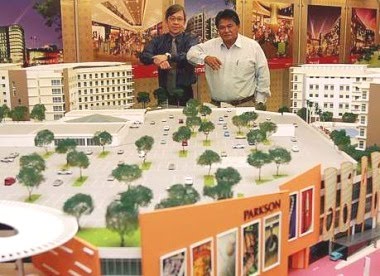
Calvin Low (left) and Datuk Mustapha Buang viewing the model of KK Times Square 2. The project is set to be launched next month.

Asian Pac Holdings Bhd is building up its property investment portfolio in new growth areas to widen its income streams.

According to managing director Datuk Mustapha Buang, the company will consider land that is ready for development in the Klang Valley, Penang and Johor.

“By raising our property investment portfolio, we expect to raise our annual income from investment property of about RM1.5mil now to more than RM40mil in the next three to four years. The existing income is mainly derived from car parking fees,” Mustapha says.

Currently, Asian Pac operates 1,300 car park bays in Kota Kinabalu and another 2,300 bays will be ready in the next three to four years. It also has a 6.3 acre site in Kepong Entrepreneurs’ Park that is being leased to Carrefour.

Mustapha points out that most of Asian Pac’s projects are in Kuala Lumpur now and the company has experienced some delay in the approval application process pending the Kuala Lumpur City Draft Plan 2020.

“It is also getting more challenging as land cost in the city has appreciated by 20% to 30%. Building up another source of regular income flow will ensure we are able to diversify our income streams,” he adds.

Currently 40% of Asian Pac’s sales come from commercial projects and the balance from residential projects.

For the financial year ended March 31, 2010 (FY10), the company recorded sales of RM101.6mil against RM83mil in FY09.

The company has in the pipeline four mixed developments with a total gross development value (GDV) of more than RM1.8bil for launch in one to two years.

The first will be KK Times Square phase two in Kota Kinabalu; Dataran Wangsa in Wangsa Melawati, Kuala Lumpur; Kepong Entrepreneurs’ Park parcel B4 in Kepong and Dataran Larkin in Johor Baru.

A residential project for launch early next year will be Bijan at Country Heights comprising 12 terraced bungalows and semi-detached houses with GDV of RM20mil.

KK Times Square 2 will be launched next month, Dataran Larkin by November, Dataran Wangsa by December and the Kepong Entrepreneurs’ Park project will be early next year.

Mustapha sees opportunity to further expand the company’s presence in Kota Kinabalu,

Its wholly owned unit, Syarikat Kapasi Sdn Bhd has built up a good track record in Kota Kinabalu through its KK Times Square 1 comprising 5-, 6- and 8-storey shop offices and Karamunsing Capital’s 55 units of two- and three-storey shops.

“We want to leverage on this presence and are on the look out for strategic land for development in Kota Kinabalu. We are also exploring possible joint ventures with Government-linked companies.

“With climbing palm oil prices, the Sabah Development Corridor and increasing tourist arrivals, we see good potential for Kota Kinabalu’s property market,” he adds.

Syarikat Kapasi, which owns the 23.45 acres that KK Times Square is located on, was acquired in 1997.

The land is strategically located at the coastal area of Kota Kinabalu, close to Sutera Harbour.

Located about 10 minutes from the airport, KK Times Square comprises shop offices, a shopping mall of about 670,000 sq ft in net lettable area, 41 exterior shops and 498 serviced apartments.

Asian Pac chief operating officer Calvin Low says the project with a total GDV of close to RM1.4bil, is slated for completion in 2013.

“The 670,000 sq ft of net lettable area to be completed in the later part of 2013 will be able to churn out rental income of RM40mil a year. The five blocks of serviced apartments and shoplots with a GDV of RM460mil are for sale,” Low adds. To raise funds for the KK Times Square 2 project, Sykt Kapasi would issue RM200mil nominal value of up to 5-year guaranteed commercial papers or medium-term notes to be guaranteed by Danajamin Nasional Bhd.

Danajamin is guaranteeing the bonds based on the viability of the project as the fund will be raised specifically to finance the project.

Mustapha says Danajamin’s guarantee has provided the company the opportunity to raise longer term borrowings at a reasonable cost within a shorter time.

He says this form of fund raising would be popular, especially in projects where there are no sales during the construction period.

“Despite being a mid-sized developer, we are now able to raise bonds for project financing.

“Bonds wrapped by Danajamin will automatically be upgraded to AAA rating, which gives investors an assurance of the quality of the paper,” Mustapha adds.

By The Star

Bristeel to buy land at POIC

BRISTEEL Properties Sdn Bhd plans to buy up to 16 hectares of land at the Palm Oil Industrial Cluster (POIC) in Lahad Datu to develop industrial shoplots intended for small and medium enterprises (SME).


"We believe that over the next 10 years, POIC in Lahad Datu would have grown into a major integrated industrial complex anchored by oil palm-related downstream industries," said company spokesman William Chee.

The company yesterday signed a deal to buy an initial four hectares.

The Bristeel Group, which owns the patented BriSteel Roof Truss System, has been in business for more than 10 years.
Bristeel Properties has an option to purchase another 12 hectares of adjoining land for future development in anticipation of rapid economic growth in Lahad Datu.

Starting in 2005 with an initial 460 ha area, POIC Lahad Datu is being developed by state-owned POIC Sabah Sdn Bhd.

Some 25 companies have already bought land for a variety of palm oil-based and supporting industries in the area. A further 1,200 ha have been set aside for a new phase.

"We are confident in the future of not only POIC Lahad Datu, but the greater Lahad Datu and its surrounding areas," Chee said.

Its project, dubbed Port City@POIC, will provide premises of modern and functional designs for SMEs.

The initial phase will offer 33 units of detached and semi-detached warehouse-type buildings.

By Business Times

New launches and better connectivity

The local property market is abuzz with new launches once again with reports of good take-up for quite a number of recently launched residential projects especially those in well sought after locations.

Things are looking up for the market, especially in the landed residential sector although the condominium market is still quite soft.

The overall sentiment has certainly improved and developers are reporting much stronger sales compared with the last two years.

In fact, residential property prices have appreciated quite substantially with prices even doubling in some areas.

Property buyers are taking advantage of the prevailing low entry cost and cost of financing to “catch the rising tide”.

Although interest rates have increased slightly, the hike is quite gradual and minimal, and have not impacted sales much.

Mortgage loans easily make up close to 30% to 40% of the total loans disbursed and this shows the importance of the property market to the overall economy.

Although the market has been quite resilient, it is important to ensure it will not be over-geared as too much borrowings could be a prelude to over-speculation and price bubbles.

While more launches mean more choices for buyers, the question is whether the flurry of new project launches is good or bad for the market.

This depends on various factors including the percentage of buyers who are buying for their own occupancy, the holding power of those who buy for investment, the strength of the local economy and market sentiment going forward.

More buyers buying for their own occupancy is a good sign as it shows the market is fundamentally stable and well supported. This seems to be the case for the landed residential market so far.

Those who purchase for investment but do not have the holding power may need to liquidate their positions to cut their losses in the event of a market correction. They are actually speculators and many of them usually resort to bank loans to finance their purchase.

If the market gets too speculative, it is unhealthy as the risk of artificially driven prices and overheating will be higher.

While things still seem to be going well, industry players should plan and build according to what the market actually needs and should not over-price their projects. Affordable housing projects that have good accessibility and infrastructure facilities are still in short supply.

Meanwhile, the commercial property sector is still facing a glut and there should be better planning to space out the developments.

While new project launches take care of the supply side of the equation, the demand side is also important and should be given due attention.

One of the factors driving demand for a project is its accessibility.

News that the Government is looking at a mass rapid transit (MRT) system to improve Kuala Lumpur’s public transportation network will give a boost to buying sentiment, especially for areas that will be serviced by the MRT.

It should be accorded top priority as it is a project that will improve the people’s quality of life.

Having a highly efficient and well integrated public transport system that is dependable upon will take the load off our heavily congested roads.

There are many ways to raise the quality of life for Malaysians and one of the fast tracked ways is to put in place a world-class public transport system right where it is needed most.

Much has been said about how disenchanted Malaysians are with the state of the existing public transport system as the various modes of transport and facilities are not integrated with nor complementary to each other.

Hopefully the latest initiative will look into all the important areas and will be implemented holistically with other ancillary facilities and services to ensure the whole public transportation network is totally integrated and complements each other.

Hopefully it will ply most of the heavily populated neighbourhoods and commercial centres not just in the city but also in other parts of the Klang Valley like Petaling Jaya and the suburbs. Besides the cost savings, it will also be a greener option and ensure a more oxygenated environment for city folks.

·Deputy news editor Angie Ng looks forward to leaving her car at home and enjoying the simple luxury of a cheap and safe mode of travelling around the Klang Valley in public transportation.

By The Star (by Angie Ng)

LBI Capital to launch 3 projects in Johor, Klang Valley

LBI Capital Bhd, a small property developer, plans to launch three projects in Johor and the Klang Valley with a total gross development value (GDV) of RM210 million.

LBI Capital, which diversified into property development in 2004, embarked on its first project in Ara Damansara.

The company used to supply air-conditioners to Proton Holdings Bhd but exited the business due to stiff competition.

"Property development now contributes more than 95 per cent to our earnings while the manufacturing of rubber mats and outer shoe soles make up the rest," said managing director Datuk Ng Chin Heng.

"We expect to launch projects at the end of the year as consumer confidence picks up," he told reporters after the company's annual general meeting in Shah Alam, Selangor, yesterday. Also present were chairman Tan Sri Arshad Ayub and executive director Kong Sau Kian.

LBI Capital is banking on three property projects with a total GDV of RM210 million - two in the Klang Valley and one in Tampoi, Johor - to drive profits for the group until 2012.

The group plans to build 11 units of three-storey bungalows in Section 14, Petaling Jaya. The 0.85ha site is located opposite the Aman recreational park and near the Sri Aman secondary school.

In Puchong, LBI Capital will step up sales of industrial lots on a 14.4ha site in Puchong, Selangor, a project with a potential GDV of up to RM90 million. The industrial area will cater for the needs of various industries especially those from the small- and medium-sized sector.

"We see high demand for corporate office and warehousing in industrial lots due to the growing number of SMEs. Each lot measures 10,000 sq ft," he said.

Over in Tampoi, Johor, LBI Capital is building 21 units of shop lots worth RM14 million. The shop lots are located along the Skudai Highway in Taman Mewah.

On the outlook, Kong said the group will continue to look for opportunities to partner landowners in the Klang Valley to develop mid-to-high-end properties.

By Business Times

Putrajaya Perdana gets RM143m job

CONSTRUCTION and property development group Putrajaya Perdana Bhd has won a RM142.8 million contract to build a 300-bed private hospital in Desa ParkCity, Kuala Lumpur.

The project was awarded by Trekker Avenue Sdn Bhd, a subsidiary of Perdana ParkCity Sdn Bhd, to Putra Perdana Construction Sdn Bhd.

The project, which will include a six-storey elevated car park, will be completed in April 2012.

Perdana ParkCity is the developer of the 473-acre Desa ParkCity township.

By Business Times

Mulpha eyes HK listing for unit

Property developer Mulpha International Bhd aims to list unit Manta Holdings Co Ltd on the main board of the Stock Exchange of Hong Kong (SEHK) by next month.

Mulpha chief executive officer Chung Tze Hien said it expects to hear from the listing committee in Hong Kong in the next few days.

"We still have to secure shareholders' approval. I'm waiting to hear from the listing committee in Hong Kong whether our proposed listing is successful within the coming two days.

"I met up with them yesterday (Thursday), but they may need to ask more questions or requirements. If they had approved (the proposal), the listing would have been done by the middle of July. I'm waiting for some outcome," Chung told reporters after Mulpha's annual and extraordinary general meetings in Kuala Lumpur yesterday.

In April, Mulpha applied to Stock Exchange of Hong Kong Ltd to list its subsidiaries involved in the sale, rental and servicing of construction equipment on the SEHK.
Chung said the listing will enable Manta to raise money from the capital market to fund the group's business activities and expansion plans.

"Being accorded listing status will allow the Manta group, which comprises four companies, to have greater financial flexibility in pursuing its growth plans."

The listing of Manta will involve Manta Engineering and Equipment Co Ltd, Manta Equipment Rental Co Ltd, Manta Equipment Services Ltd and Manta Equipment (S) Pte Ltd.

According to Chung, Mulpha owns 88 per cent of Manta. Pan Ocean International Ltd, which holds the remaining 12 per cent via Ku Sze King, will sell its stake to Mulpha prior to the listing.

As part of the listing exercise, Mulpha will undertake internal restructuring and reorganisation, after which it will issue 50 million new Manta shares representing 25 per cent of the enlarged issued and paid-up capital of the company. The new shares will comprise five million issue shares available to the public in Hong Kong and 45 million shares by way of placement to professional, institutional and other investors.

None of the directors in Mulpha and Manta will be offered shares in Manta pursuant to the proposed listing.

"We hope to raise about HK$50 million, or about RM25 million, from the proposed public issue," Chung said.

He added that the proceeds will be used to buy tower cranes and construction equipment for rental purpose, general working capital, expansion and improvement of storge facilities, service and maintenance workshops.

"Singapore is booming. Market price in Singapore is shooting up. So is the situation in Hong Kong and China. Construction of high-rise buildings needs a lot of cranes. This augurs well for our business."

Chung expressed confidence that Mulpha's financial performance will improve further this year in tandem with economic recovery here and in countries where it operates.

"Last year was a bad year. We are now going out of the 2008 and 2009 crisis. Last year also, we had impairment, but not this year. As we move on, things will be better. In fact, our first quarter results look pretty good. We are on the road to recovery," he said, adding that Mulpha registered a net profit of RM48 million in the first quarter ended March 31 2010.

By Business Times

Friday, June 18, 2010

Asian Pac to build 'the most fashionable address' in KK

ASIAN Pac Holdings Bhd wants to make KK Times Square II, the second phase of its mall and office project in the heart of Kota Kinabalu, Sabah, 'the most fashionable address in the city'.

The second phase, a 3.7 million sq ft mall and service apartments, is being developed by Syarikat Kapasi Sdn Bhd, a subsidiary of Asian Pac.


"Much thought has been put into its design with the aim of making it into the most fashionable address and shopping destination in the city," said Asian Pac chairman Tan Sri Megat Najmuddin Megat Khas.

Strategically located along the coastal highway within the city's business district, the 15-acre development comprises a four-storey shopping mall and serviced apartments.
The shopping centre, to be called The Mall, will have 670,000 sq ft of retail units available for lease only and not for sale. Parkson is the confirmed anchor tenant.

There will also be five blocks of serviced apartments. KK Times Square II's third component is 41 units of exterior shops which will be sold.

Construction of KK Times Square II is expected to start this year.

Megat Najmuddin was speaking to reporters at the signing ceremony between Kapasi and Danajamin Nasional Bhd for a financial guarantee facility agreement where Danajamin will guarantee Kapasi's RM200 million five-year Private Debt Securities programme.

By Business Times

SP Setia’s Q2 net profit rises 26%

KUALA LUMPUR: Property developer SP Setia Bhd posted a 26% increase in net profit to RM51.2mil for its second quarter ended April 30, compared with RM40.52mil in the corresponding period last year.

Revenue for the second quarter increased to RM409.1mil from RM352.2mil previously.

In a filing to Bursa Malaysia yesterday, the company said the improved performance was mainly due to better sales in residential and commercial properties in the Klang Valley and Johor Baru. SP Setia said it continued to set new sales benchmarks with second-quarter sales of RM598mil and cumulative six-month sales of RM1.206bil.

As at May 31, the company’s sales (based on sale and purchase agreements signed) for the first seven months totalled RM1.44bil

The management expects to achieve its sales target of RM2bil for the financial year ending Oct 31, 2010 (FY10) on the back of strong sales momentum and upbeat consumer sentiment.

Underpinned by the strength of sales in established markets, SP Setia said it would continue to strengthen its position and standing in new market segments, locally and abroad.

“This will broaden our earnings base and ensure continued dynamism and growth over the long run,” it said.

In a separate filing, the company said it had proposed an interim dividend of 6 sen per share less income tax of 25% for FY10.

By The Star

SP Setia at month high after profit surges

SP Setia Bhd, Malaysia’s biggest property developer, rose to a one-month high after profit in the second quarter ended April 30 climbed 26 per cent from a year earlier.

SP Setia posted a higher pre-tax profit of RM71 million for its second quarter ended April 30, 2010, compared with RM55.7 million in the same period last year.

This was mainly attributed to profit from residential and commercial properties in the Klang Valley and Johor Baru, it said in a filing to Bursa Malaysia on Thursday.

SP Setia's revenue for the second quarter increased to RM409.1 million from RM352.2 million while the net profit rose by 26 per cent to RM51.2 million from RM40.5 million previously.
The stock gained 1 per cent to RM4.07 at 9:03 am local time in Kuala Lumpur trading, set for its highest close since May 13.

Meanwhile, the group has said that it continues to set new sales benchmarks with second-quarter sales of RM598 million and cumulative six-month sales of RM1.206 billion.

As at May 31, the group's sales for the first seven months totalled RM1.438 billion, with the sale and purchase agreements signed.

SP Setia said the management was confident that the group's financial year 2010 sales target of RM2 billion was achievable based on the strong sales momentum and upbeat consumer sentiment.

Underpinned by the strength of sales in established markets, the group said it continued to strive to strengthen its positioning and standing in new market segments, both locally and abroad.

"This will broaden the group's earnings base and ensure continued dynamism and growth over the long run," it added.

By Bloomberg

Sunway plans S. Lanka tie-up

KUALA LUMPUR: Sunway Holdings Bhd and Sri Lanka-based Dasa Tourist are looking at the possibility of forming a joint venture to develop a 34-storey tower in Colombo, Sri Lanka.

In a statement yesterday, Sunway said it had entered into a memorandum of understanding (MoU) with Dasa Tourist for the proposed project which has an estimated gross development value of RM250mil.

Dasa Tourist is a wholly-owned subsidiary of the Dasa Group.

Under the MoU, Sunway shall undertake feasibility studies and market research to ascertain the viability of the proposed property project.

The move is in line with Sunway’s strategy to invest in industries of growing economies in which it has a core expertise.

It would also provide Sunway the opportunity to explore the feasibility of expanding its property development business in Sri Lanka by developing a parcel of land in an attractive location.

The proposed project is located on a plot of prime freehold land in the premium mixed-use zone of Bambalapitiya in District Colombo 4.

It has the potential to generate a total sellable area of 400,000 square feet.

By Bernama

Magna Prima upbeat on earnings rebound

PROPERTY developer Magna Prima Bhd is optimistic of net profit in the financial year ending December 31 2011 recovering to 2007 and 2008 levels of around RM27 million.

Last year, its net profit declined to RM6.67 million as most of its projects neared completion.

The projected numbers, however, are based on current accounting standards, Magna Prima chief executive officer Yoong Nim Chee said.

He added that the company has projected some RM150 million to RM200 million revenue this financial year from RM1 billion of projects that it will be launching.

"This year, revenue will be maintained at around last year's level of RM191 million, but profit will be up primarily because we are starting new projects with better profit profiles," Yoong told reporters after Magna Prima's annual general meeting in Kuala Lumpur yesterday.

The projects include residential developments in Selayang, Selangor, and Bukit Jalil in Kuala Lumpur. Magna Prima will also be launching commercial projects in Shah Alam and Petaling Jaya, both in Selangor, and in Jalan Kuching, Kuala Lumpur.

Magna Prima, which saw some 16.8 per cent of revenue last year from construction and engineering activities, said it will not be aggressively seeking external construction jobs but will focus on in-house projects.

With the exception of the land in Jalan Ampang on which the Lai Meng Chinese School sits, the group expects to complete all of its ongoing projects by 2014. Currently, it has some 30.38ha landbank.

It also expects to begin the proposed RM1.3 billion commercial and residential development on the site of the Lai Meng Chinese School in 2012 as planned and to complete it by 2015.

The company is hopeful that the Ministry of Education will give its approval within the next three months for the school to be relocated to Bukit Jalil.

Magna Prima, which will provide advice on design in the construction of the school, said that tenders will be called out and that it will also bid for the project.

While Yoong was not able to state the estimated project value, he said the school was looking at including a swimming pool and an auditorium.

To a question on new shareholders Lee Ban Chuan and Lee Hing Lee, who have emerged in the company via Fantastic Realty Sdn Bhd which now owns 15.41 per cent of Magna Prima, Yoong said he understood that they were passive investors and that there had been no indication that they would raise their stake in the company.

On the police report made against its former chief executive officer, Lim Ching Choy, for alleged criminal breach of trust, Yoong said that there had been no developments.

By Business Times

Thursday, June 17, 2010

China property bubble to burst 'very quickly'

SINGAPORE: The "bubble" in China's property market is going to burst very quickly, with prices set to fall as much as 20 per cent in the next 12 to 18 months, according to Nomura Holdings Inc.

National real-estate prices may drop between 10 per cent and 20 per cent on average, compared with an increase of about 22 percent last year, Sun Mingchun, a Hong Kong-based economist at Nomura, said in a Bloomberg Television interview.

"If you look at housing prices to disposable income in Beijing and Shanghai, they are 13, 14 times," said Sun. "There's no way you can say there's no bubble."

Real-estate prices jumped 12.4 per cent across 70 cities in May, adding to the 12.8 per cent surge in April that was the most since the data series began in 2005. The gains suggest that measures ranging from a ban on loans for third-home purchases to higher mortgage rates and downpayment requirements for second- home purchases have yet to cool the real-estate market.
Stephen Roach, chairman of Morgan Stanley Asia Ltd, said the government's measures are working "by all accounts".

China's property boom isn't a bubble because it's supported by "solid" demand for residential housing, he said. While portions of the real-estate market such as high-end apartments are overheating, demand for homes will remain robust as rural Chinese migrate to bigger cities, he said in a radio interview.

"This is just a sliver of the property boom," Roach said, citing that each year since 2000, between 15 and 20 million people migrate to Beijing, Shanghai, and second- and third-tier cities in the mainland.

The China Banking Regulatory Commission warned of growing credit risks in the nation's real-estate industry and increasing pressures of non-performing loans. Risks associated with home mortgages are growing and a "chain effect" may reappear in real-estate development loans, according to its annual report published on its website on Monday.

By Bloomberg

Wednesday, June 16, 2010

Sunway REIT IPO launched


Minister in the Prime Minister’s Department Tan Sri Nor Mohamed Yakcop (left) and Sunway Group founder and chairman Tan Sri Dr Jeffrey Cheah at the launch of Sunway REIT’s prospectus yesterday.

PETALING JAYA: Sunway City Bhd (SunCity) and Sunway REIT Management Sdn Bhd have launched the initial public offering (IPO) of 1.65 billion units in Sunway Real Estate Investment Trust (Sunway REIT).

Sunway REIT, which has an approved fund size of 2.78 billion units, will become Malaysia’s largest listed REIT when it lists on the Main Market of Bursa Malaysia in July. Sunway REIT Management is the manager for Sunway REIT.

Eight properties, with an appraised value of RM3.7bil, would be injected into the REIT. They are Sunway Pyramid Shopping Mall, Sunway Carnival Shopping Mall, SunCity Ipoh Hypermarket, Sunway Resort Hotel and Spa, Pyramid Tower Hotel, Sunway Hotel Seberang Jaya and office properties.

Sunway REIT Management chief executive officer Datuk Jeffrey Ng said the company was committed to actively providing value-added services to the properties.

“Four of the assets are in Bandar Sunway, which has over the years proven its growth potential as a landmark tourist destination,” he said.

He said there was a planned enhancement of several existing assets, and leasing of recently completed space, adding that the assets being injected into the REIT were assets in locations that had proven track records for growth.

Sunway REIT’s IPO comprises an institutional and selected investors portion of 1.52 billion units and a retail portion of 134 million units.

The final retail price per offer unit would be the lower of 97 sen, or 97% of the institutional offer price, to be determined by way of bookbuilding.

Four cornerstone investors – the Employees Provident Fund, Permodalan Nasional Bhd, Government of Singapore Investment Corp and Great Eastern Life Assurance (M) Bhd – have secured 376 million units, or about 22.7% of the offer units.

An analyst with a local brokerage said the listing of Sunway REIT next month would be a milestone for Malaysian REITs (M-REITs) not only because of its large fund size, but also because it had attracted several cornerstone investors.

“Sunway REIT will be on the radar of the ‘big boys’ and this can only be good for the smaller REITs as well,” he said.

The analyst also said Sunway REIT could bolster the equity market and make it more attractive to foreign institutional players.

According to the analyst, Sunway REIT’s dividend yield was about 6.7% (based on forecast dividend per unit or DPU of 6.7 sen), which was below the average 8.5% for other REITs. He said the REIT’s IPO was at a premium to other M-REITs.

“But taking account of the size of the trust and its potential, we believe Sunway REIT has its merits,” he said.

A REIT adviser said that while Sunway REIT had its “attractiveness”, there could be some investors who preferred to invest in pure-play REITs that were focused on specific asset classes such as retail, office space and warehouse.

“Sunway REIT is a fairly unique trust because it’s a mixed REIT that has retail and hospitality elements,” he said.

The REIT adviser said if the different asset classes were integrated in a synergistic manner and managed well, Sunway REIT might actually offer a favourable return to investors over the longer term. “This is left to be seen,” he said.

By The Star

Sunway REIT sets RM7.4b target


With about 1.6 billion units up for subscription by retail and institutional investors, the REIT is also set to be the most liquid of REITs available in the market.

Malaysia's biggest property trust, the Sunway real estate investment trust (REIT), has set a target to double its size to RM7.4 billion in the next five to seven years.

It will focus its investments on shopping malls, hotels and offices.

"Sunway REIT is very much a township REIT, with the best assets of Bandar Sunway. So, if you believe that in 10 to 15 years we will continue to grow, then you would invest in us," Sunway REIT Management Sdn Bhd chief executive officer Datuk Jeffery Ng said.

The Sunway REIT is made up of eight of Sunway City Bhd's (SunCity) properties in the retail and hospitality space, located in Penang, Perak, Selangor and Kuala Lumpur, valued at RM3.7 billion.
This includes the popular Sunway Pyramid Shopping Mall and its newest purchase, Sunway Tower, an office building in central Kuala Lumpur.

It has an approved fund size of 2.78 billion units.

With about 1.6 billion units up for subscription by retail and institutional investors, the REIT is also set to be the most liquid of REITs currently available in the market.

About 8 per cent of the initial public offer units will be offered to retail investors, while the rest will be offered to Malaysian and foreign institutional investors.

About 35-38 per cent of total approved fund size will be held by SunCity.

"Investors are not looking for the lowest tax scheme, rather they are looking for growth and liquidity. Generally, Malaysian REITS have been illiquid, so the Sunway REIT will interest a lot of investors," RHB Investment Bank Bhd managing director Chay Wei Liong told reporters after the launch of the REIT's prospectus in Petaling Jaya, Selangor, yesterday.

Malaysia imposes a withholding tax of 10 per cent on individual investors for income made from REITs. Singapore, a popular destination for REIT listings, does not have such a tax.

On whether the recent announcement by CapitaMalls Asia to list its REIT on Bursa Malaysia would dampen interest in Sunway REIT, Chay said there was enough money to go around.

Ng did not discount the possibility of secondary listing in Singapore, saying the board will have to decide on that.

On possible plans to inject SunCity's overseas properties into the REIT, Ng said it will focus on Malaysia for the short and medium term.

"In the long term, should and when the opportunity arise we will consider it, and work hand in hand with our sponsor. It would be something that our board of directors would decide on," Ng said.

By Business Times

IJM Prop, Angkasa scrap building plan

IJM Land Bhd said its unit IJM Properties Sdn Bhd and Angkasa Gagah Sdn Bhd, a unit of IGB Corp Bhd, have scrapped a plan to build residential property in Setapak, Selangor.

Both parties signed a deal for the project in October 2006.

IJM did not say why they aborted it but said that it needed regulatory approval for the project.

By Business Times

Monday, June 14, 2010

RM3b boost for Naza TTDI's Platinum Park

The Platinum Park is a high-end integrated residential and commercial lifestyle properties in the Kuala Lumpur City Centre area, worth RM4 billion.

Naza TTDI Sdn Bhd's Platinum Park project in Kuala Lumpur will see a new wave of development as the property developer launches lifestyle properties worth about RM3 billion next year and in 2013.


The 3.68-hectare Platinum Park is a high-end integrated residential and commercial development in the Kuala Lumpur City Centre (KLCC) area, worth RM4 billion.

Group managing director SM Faliq SM Nasimuddin said Naza TTDI will introduce its first residential property - a luxury serviced apartment, by early next year.

It will next launch a high-end condominium towards the end of 2011 or by early 2012.
Faliq said the towers may be named Platinum Park Suites and Platinum Park Residences, respectively.

He said there will be more than 200 units of serviced apartments, with sizes ranging from 500 sq ft to 1,100 sq ft offered to retail investors.

The condominium tower will have more than 100 units, ranging from 2,000 sq ft to 3,500 sq ft.

"We will sell individual units but if we get a good offer for an en bloc, we will consider," he told Business Times in an interview in Shah Alam, Selangor, recently.

Faliq said Naza TTDI will build niche lifestyle retail outlets with some 200,000 sq ft of space.

The final component of Platinum Park will include a luxury five-star 50-storey hotel, where construction will start after 2012.

Faliq said Naza TTDI is in negotiations with several international operators in Asia Pacific and Europe to run and manage the hotel.

Naza TTDI is also in talks with local and foreign investors who are keen to form joint ventures with the company to build the hotel or buy it over.

"We have several options. The end deal will depend on what we have on the table," Faliq said.

Naza TTDI will look at a few financing options to fund the lifestyle components.

"I am very excited with the Platinum Park development. My aim is to make it the most iconic project here. We are targeting to complete this project by 2016 or 2017," Faliq said.

Work in progress include three office towers, which will be built between March and December in 2013.

They include the 50-storey Naza Towers, which will be the Naza Group of Companies' new headquarters, and a 50- and 38-storey tower for plantation group Felda and a government-linked company, respectively.

The towers are designed to be "green buildings" through the efficient use of energy, water and materials.

Naza TTDI will apply for certification under the Green Building Index of Malaysia.

By Business Times