Malaysia Property News is a free resource website sharing Daily Property News & information about Property in Malaysia, which related to, Property Market, Property Investment, Commercial Property , Hot Properties Malaysia, Real Estate, Retail Shop, Business Park, Condominium Malaysia, Terraces & Apartment Malaysia, Houses, Residence, Resort and many more.

Tuesday, November 2, 2010

Property demand boost in Greater KL


Greater Kuala Lumpur/Klang Valley will need to house one million new residents by 2020, says the Economic Transformation Programme report

DEMAND for medium- to high-end properties in Greater Kuala Lumpur/Klang Valley (Greater KL/KV) is expected to increase to match regional peers, the Economic Transformation Programme (ETP) report said.

Greater KL/KV will need to house one million new residents by 2020, the report added.

Currently, the population of Greater KL/KV is about six million, contributing RM263 billion or 30 per cent to the nation's Gross National Income (GNI).

Over the next decade, Greater KL/KV is targeted to grow in population by 5 per cent annually and achieve a GNI growth of 10 per cent a year.

The economic aspiration for Greater KL/KV is to grow its GNI contribution to RM650 billion by 2020, the report noted.

The economic clusters that will contribute to growth is the Sungai Buloh land development, Sime Darby Vision Valley and Matrade centre as well as the Kampung Baru, Blackwater and Batu Kantomen mixed developments.

Others include the Kuala Lumpur International Financial District, commercial projects in Pudu and Cochrane, the Sungai Besi Bandar 1Malaysia mixed development, Media City Angkasapuri and Global Healthcare Metropolis.

The Greater KL/KV has been identified as one of the 12 National Key Economic Areas (NKEA) laboratories to drive rapid growth parallel with upgrading the city's liveability.

The report said strategic redevelopments such as the old Pudu Jail site, the old KTM railway station and Chinatown has the potential to create more iconic places within Greater KL/KV, adding to its liveability.

Across the 12 NKEAs, Greater KL/KV has the largest public sector funding requirement of RM58 billion or 34 per cent of the total investment requirement.

Greater KL/KV covers 10 municipalities, each governed by local authorities - Kuala Lumpur City Council, Perbadanan Putrajaya, Shah Alam City Council, Petaling Jaya City Council, Klang Municipal Council, Selayang Municipal Council, Ampang Jaya Municipal Council and Sepang District Council.

The ETP has outlined nine entry point projects that will be pivotal towards achieving the nation's aspiration for Greater KL/KV to achieve a top 20 ranking in city economic growth by 2020.

The aim is also to attract 200 new MNCs by 2020. Attracting 100 such firms will contribute about RM40 billion in annual GNI to Greater KL/KV.

There are now 1,600 MNCs based here, compared with 17,000 in Shanghai and 6,000 in Singapore.

By Business Times

ARK in RM100m Paroi job

PETALING JAYA: ARK Resources Bhd has entered into an agreement with Prop Development Sdn Bhd to complete the construction works worth RM100mil for the development of business/commercial units and buildings in Paroi, Negri Sembilan.

In a statement to Bursa Malaysia yesterday, the group said it would undertake the main construction works under the project on a design-and-build basis, carried out in two phases and expected to be fully completed in two years.

It added that the award of the contracts for the project was conditional inter alia upon the successful completion of ARK’s corporate restructuring exercise, re-quotation of ARK’s shares on the Main Market of Bursa Malaysia and upliftment of ARK’s PN17 status within 120 days from the date of the agreement, and relevant approvals from the authorities/parties to commence the development of the project.

By The Star

Framework for disused mines

PETALING JAYA: A solid commercial framework that embraces environmental concerns is necessary to transform disused mines into useful land, said Malaysian Chamber of Mines (MCOM) president Datuk Seri Mohd Ajib Anuar.


»We are targeting to produce a blueprint on the use of ex-mining land in 12 months to be forwarded to the Government« DATUK SERI MOHD AJIB ANUAR

Mohd Ajib said there was a common perception by the public that former mines were barren and useless.

“This is not true. There is definitely life after a land is mined off its tin and other minerals.

“Ex-mining land can be used for many commercial and community-driven activities,” he told StarBiz yesterday after the launch of a coffee table book titled Tin Story: Heritage of Malaysia by MCOM.

The book was launched in conjunction with the inagural International Conference and Exhibition On the Rehabilitation, Restoration and Transformation Of Mining Land, which started yesterday and ends tomorrow.

The conference was to gather experts in various fields from 15 countries to meet, brainstorm and look at commercial as well as sustainable ways to maximise the use of former mines nationwide.

“We can learn from each other’s proven ways to commercialise idle ex-mining land to benefit people in a profitable and sustainable manner,” he said.

Mohd Ajib said MCOM, together with various parties including the Kuala Lumpur Tin Market, Ministry of Natural Resources and Environment, Department of Minerals and Geoscience as well as external parties were collaborating on two fronts.

“We are targeting to produce a blueprint on the use of ex-mining land in 12 months to be forwarded to the Government for approval and the development of a solid commercial framework for those interested in converting ex-mining land into useful land,” he said.

There are about 200,000 hectares of disused mines across the country, of which two-thirds have been used while the balance one-third remain idle.

Mohd Ajib, who is also Kuala Lumpur Tin Market chairman, said it had been proven that former mines could be used for various agricultural activities, property development and as a place to harvest renewable energy.

“We are in talks with several experts to kickstart various projects on ex-mining land and some of the projects are expected to commence once we get the nod from the authorities,” he said.

Mohd Ajib said there was also opportunity to market the talent (in the use of former mines) to other countries.

“We also believe these projects will create a lot of employment for Malaysians locally and abroad once they have developed the required skills.”

By The Star

Monday, November 1, 2010

Winners see benefits in clinching FIABCI Malaysia Property Award

PETALING JAYA: To the casual observer, the annual International Real Estate Federation (FIABCI) Malaysia Property Award (MPA) might just be glitz and glamour, but previous victors have attested that winning has certainly helped boost their business in some way.


Yeow Thit Sang ... Winning the awards had a number of intangible benefits.

FIABCI-Malaysia president Yeow Thit Sang said winning the awards had a number of intangible benefits.

“It helps boost the winner’s branding and marketing. It also helps generate publicity to get their products to another level,” he said.

Perdana ParkCity Sdn Bhd marketing and sales director Susan Tan said when the company won the MPA for best residential (low-rise category) for its Adiva Parkhomes at Desa ParkCity in Kuala Lumpur, prices of the houses shot up.

“We noticed some price appreciation for Desa ParkCity properties in the secondary market with Adiva enjoying as much as 30% additional increase in prices after the awards were announced,” she said.

The following year, Perdana ParkCity’s Adiva bagged the FIABCI Prix d’Excellence Awards 2010 for the residential (low-rise) category in Bali.

“Obviously, winning did put Desa ParkCity in the spotlight and we have benefited from the exposure as more purchasers and investors are keen on other offerings (that we have) available,” said Tan.

Sunrise Bhd assistant general manager for branding and community development, Anne Tong, said winning at FIABCI was like “icing on the cake” for the company.

“Accolades from prestigious professional bodies such as FIABCI builds credibility for the Sunrise brand, which will in turn instill customer confidence in our products and services,” she said.

Tong said winning at FIABCI helped to elevate awareness to purchasers on its product quality and service excellence.

“Winning a competitive award confers peer acknowledgement that we are on track in our mission to deliver sustainable value to customers.”

Sunrise has won accolades at FIABCI for projects such as Mont’Kiara Palma (1997), Mont’Kiara Sophia (2001) and Mont’Kiara Damai (2005).

Selangor Dredging Bhd communications and corporate affairs manager Lina Othman said among the benefits of winning a FIABCI award was that it gave credibility to the development as it was recognised to be one of the finest in the country.

“It also gives credibility to the company for being able to come up with an award-winning building. This of course helps with marketing of other developments as it is a testimony of the company’s commitment and capability in developing quality homes,” she said.

Selangor Dredging won the MPA in 2009 for its Park Seven development (residential high-rise). The project was subsequently runner-up at the Prix d’Excellence 2010.

FIABCI Malaysia will be organising the 2010 MPA on Nov 11 in Kuala Lumpur with Malayan Banking Bhd as the official sponsor. A total of 10 categories will be contested.

Winners of the MPA in their relevant categories will represent Malaysia the following year at the International Prix d’Excellence, an annual competition that honours the world’s best property projects.

By The Star

PKNS to spend RM140.7m for Bukit Botak

The Selangor government, through the Selangor State Development Corporation (PKNS), will spend RM140.7 million to develop Bukit Botak.

Menteri Besar Tan Sri Abdul Khalid Ibrahim said the development would involve 1,422 single-storey terrace houses which would be offered to the landowners for RM99,000 each.

"If the landowners don't want the houses, PKNS will buy them from the landowners at RM170,000 per unit," he said after the project's ground breaking ceremony in Selayang today.

The houses bought by PKNS would then be offered to the public at a price based on the size of land per unit, he added.

"The project is part of the economic stimulus package introduced by the state government which among others focuses on redevelopment of stalled housing projects like Bukit Botak," Khalid said.

He said the project was being carried not for profit but a charity.

The Bukit Botak development project involves 201 acres and a resettlement of 2,300 families who have been waiting for over 20 years since the project began in 1986.

The houses are expected to be ready for occupation by June 2012.

By Bernama

DRB-HICOM seeks revenue balance


DRB-HICOM Bhd plans to improve the balance of revenue contribution from its services, automotive and property businesses over the next five years as it seeks to expand.

Currently, its motor vehicle business makes up some 57 per cent of revenue, followed by its banking, insurance and power plant maintenance services at about 40 per cent.

Property makes up less than 2 per cent of revenue now, but DRB-HICOM wants to boost this to 20 per cent in five years.

"I never like to put all my eggs in one basket," group managing director Datuk Seri Mohd Khamil Jamil told reporters at a briefing in Kuala Tahan, Pahang, yesterday.

DRB-HICOM, controlled by Tan Sri Syed Mokhtar Al-Bukhary, reported net profit of RM472 million in the financial year to March 31 2010, 29 per cent down from the year before mainly because it gained almost RM600 million from an asset sale last year.
Revenue hit a record of RM6.3 billion.

The group plans to launch properties with a total gross development value of RM9 billion over 10 to 15 years. This will be a mix of residential and commercial properties.

It has some 607ha near Mount Austin, Johor, which will be developed into a new township.

"There are still pockets of land in DRB which are very prime," Mohd Khamil said. They include a piece of land in Taman Wahyu in Jalan Tun Razak, Kuala Lumpur, and tracts of land in Shah Alam, Selangor.

This month, it plans to launch Glenmarie Gardens, a high-end bungalow project.

As for its motor vehicle business, it aims to sign a definitive agreement with Europe's Volkswagen AG (VW) next month.

VW had signed in August a memorandum of understanding with DRB-HICOM to produce VW cars from 2012 at the group's plant in Pekan, Pahang.

"The final negotiations are going on well and the parties are finalising the terms," he said.

Eventually, the deal may include the export of VW cars to Asean countries, among other things.

DRB-HICOM is also still looking for a foreign partner to buy 30 per cent of its Islamic lender, Bank Muamalat Malaysia Bhd. It holds 70 per cent of the bank currently.

It was in talks with five foreign parties and one local firm, but the talks fell through amid the global financial crisis last year.

Asked about the weak performance of its stock, Mohd Khamil said it could be due to the fact that the group was too diversified.

It is also classified under the industrial sector on Bursa Malaysia although services have become a big part of its business.

"If shareholders understood the nature of our business, the share would definitely escalate and show their true value," Mohd Khamil said.

Apart from Syed Mokhtar with 55.92 per cent, its other main shareholders are the Employees Provident Fund with 9.11 per cent and Khazanah Nasional Bhd with 5.13 per cent, according to its 2010 annual report.

By Business Times

Saturday, October 30, 2010

Most Malaysians cannot afford the high price of property

With prices of terraced houses in the Klang Valley and Penang having appreciated beyond the regular RM300,000 to RM600,000 range to close to and some even surpassing RM1mil, it is not surprising to find many average Malaysians who are rather hapless or even lost as to what and where to buy their house.

There are really not many choices available to them unless they don’t mind moving further away to other suburban addresses where they would have to travel longer distances. But if they still choose to stay near the conveniences close to the city centre, most of them will have to settle for much smaller units or apartments with the price that they can afford.

To maximise their land use, developers have resorted to building high-rise dwellings instead of landed houses which account for the short supply of such housing these days.

A shortage of land available for development can be singled out as one of the factors for the sharp increase in land cost and property prices.

Whatever large tracts of land available have already been snapped up and what’s left are mostly smaller plots.

In Kuala Lumpur, land prices have appreciated even more sharply and the recent sale of a piece of land for over RM7,000 per sq ft has raised alarm among some consumer groups and industry players.

They worry that the high price transacted for the land will be used as the bargaining power for other land owners to push their land prices upwards in the surrounding areas.

This will inevitably be an unhealthy prelude to an overheating in the property market as land is the basic commodity in a property development process. When the price paid for a piece of land escalates way beyond the market norm or the last transacted price, it has actually moved ahead of market fundamentals.

The question is who then will have to bear the high cost at the end of the day. Certainly it will not be the developers as they will factor into their total project costing and recoup the cost by pricing the property they build higher.

And if the property is not for sale but for leasing, the rental rates can also be expected to be higher. Although property buyers are not directly or immediately affected by the high land cost, they will also have to share part of the burden when the prices of goods and services are fixed higher (as the business operators who rent the space will factor the high rent into their pricing.)

If we are worried of a potential property bubble, it is important to keep a close watch on the availability of land supply to keep prices of land in check.

Opening up new corridors of land for development is an effective and speedy measure to ensure adequate land supply.

The other option is to encourage redevelopment of dilapidated parts of the city or old buildings and add value to them.

The Government’s plan to redevelop the 160ha Sungei Besi airport and the 1,320ha Rubber Research Institute land in Sungei Buloh should help to ease the land-scarcity problem.

The initiative should be accorded a top priority and, if possible, a dedicated agency is set up to oversee the whole planning and development process for these large parcels of land, taking into account the real needs of the people.

This will ensure better integration of public transport services and other infrastructure, housing and other commercial property needs that are more long-term and sustainable.

Given the huge need for more affordable housing in the Klang Valley, especially homes priced between RM200,000 and RM350,000, this will be the golden opportunity to plan for such housing projects. Hopefully at least 30% of the land for housing development will be allocated to affordable housing for all eligible Malaysians.

It is indisputable that real estate is an important economic sector, accounting for 50% of the country’s wealth. But the cap on the sector’s growth could be the relatively lower earning and purchasing power of Malaysians compared with those in other high income countries. For the industry to leapfrog to another level of growth, the people’s purchasing power has to grow faster or at least in tandem with the rising property prices as we will need investors who can afford to pay for the high-end properties that are to be built.

The Government’s iniatitives to turn Malaysia into a high income economy will create the platform for the people to earn higher per capital income to support their higher purchasing power.

Expanding the pool of buyers who have the means to absorb the high-end property that are being churned out by developers now will hopefully create a more sustainable property market – one where demand matches supply.

Otherwise the market will have to depend on foreign buyers who can afford to pay for the high-end property.

Deputy news editor Angie Ng believes developers, especially those who own large tracts of land and are involved in major township development, have a moral responsibility to offer a more balanced portfolio of different range of housing projects, to help cool the market from overheating.

By The Star

Mayland sees demand for city condominiums

Hong Kong-based property developer Malaysia Land Properties Sdn Bhd (Mayland) is very bullish about demand for high-rise condominiums in the city.

Based on the positive take-up rates of their properties so far, director Andrew Chiu says the interest in certain categories of city condominiums is expected to remain sustainable this year and next.

He says interest will be on properties of about 1,000 sq ft and below. More than half of its Royal Regent development in Jalan Kuching is sold. The only ones left are the bigger units with a built-up of 1,500 sq ft and above. The smaller units ranging from 900 sq ft to 1,200 sq ft have been sold.

“Even before we launched, our previous buyers have taken up the smaller units,” he says. A typical Mayland investor will have two to three projects already and these buyers bought nearly 70% of Royal Regent, with some of them buying two or three units at a time, he says.

Royal Regent is the third project in the Jalan Kuching location. The other projects in that 20-acre site includes Sri Putramas 1, Sri Putramas II and Royal Domain.

Sri Putramas I was the first project to be launched in that location in 2002. The units, with a standard size of about 1,000 sq ft, had prices starting at RM140,000.

Mayland subsequently launched Royal Domain at about RM200 per sq ft with units priced at about RM240,000. Today, Royal Domain, is selling at about RM320 per sq ft.

Its latest launch, Royal Regent, is priced at about RM400 per sq ft, says Chiu, adding that the location will have a total of about 3,500 units, with the completion of phase four. Royal Regent. which is phase three, is expected to be completed in 2013.

Mayland is also building Regalia@Jalan Sultan Ismail with Bina Puri Holdings Bhd, one of the largest construction groups in the country. The 38-storey has a gross development value of about RM600mil. It is scheduled for completion by early 2011.

“We are positive about demand for units located in the Golden Triangle. Land is a scarce commodity and if the Malaysian government can get the public transport system off the ground, this will add further value to the projects in the city,” Chiu says.

He says property development has become so sophisticated in his home country in Hong Kong that even with a 2,300 sq ft piece of land, it is possible to put up a 40-storey building with no car parks.

Buoyed by demand, Mayland is also embarking on another high-rise project in Ampang, just behind Ampang Point shopping centre. Known as The Elements@Ampang, the freehold service apartment project will have a gross development value of RM650mil. It sits on 2.6 acres adjacent to another high-rise project known as GBC.

The Elements will be developed by Land & General Bhd (L&G). Mayland is the largest shareholder in L&G. Besides Ampang Point shopping centre, the other closest mall is Great Eastern Mall.

The Elements will be competing with Mah Sing group’s M Suites and Brunsfield’s EmbassyView. While The Elements is located a little way off Jalan Ampang, M Suites and EmbassyView are located on Jalan Ampang itself.

L&G MD Low Gay Teck says there are several international schools in the vicinity of The Elements. These are Fairview International School, Sayfol International School, International School of Kuala Lumpur and Mutiara International School.

It will be served by Gleneagles Intan Medical Centre, Ampang Puteri Specialist Centre, Pantai Indah Hospital, Hospital Ampang, Ampang Medical Centre and Prince Court Medical Centre.

Prices at The Elements begin at RM350,000 for units with a build-up of 625 sq ft. The largest built-up is 1,550sq ft.

Low says the company is looking to buy land for residential developments with plans to sell the units at RM400 per sq ft and above.

“Cost of construction and inflation will only go up. As the Government moves along in their plans to remove subsidies, cost of construction, building materials and labour will only go up. Land prices will not be coming down. so prices will just have to keep adjusting upwards,” says Low, adding that there is a demand for land in light of expected future increase in prices.

He says the demand for certain types of properties have also led some developers to price their units at RM5mil in a RM2mil-a-unit area.

As for Mayland and companies within the group, Mayland advertising and promotions manager Ian Tay says the group together with L&G have a good following of buyers.

“Both The Elements and Royal Regent will appeal to different categories of investors. Most of those who buy into Royal Regent are upgraders. They have probably units in Sri Putramas I and II, and maybe even Royal Domain and they see the opportunity to buy into Royal Regent at RM400 per sq ft because they know the city will continue to expand. The development in the Matrade area by the Naza group is after all just a few minutes drive away,” says Tay.

Over at Elements, with prices beginning at around RM700 to RM750 per sq ft, most buyers would be investors. Tay says many may not be able to afford to stay in the city but they will want somewhere close to the city. “Ampang is not too far away from the KLCC City Centre, so the appeal is there,” he says.

By The Star

Growing Sunrise’s earnings


An artist impression of the oasis in the Quintet project.

KUALA LUMPUR: Sunrise Bhd is expected to launch at least four major property projects with gross development value (GDV) totalling RM2.7 billion next year and anticipates to register better results for FY2011 ending June 30, given its large unbilled sales of RM1.2 billion.

Its executive chairman Datuk Tong Kooi Ong said among those slated to be launched would be the ‘MK20’ mixed development project in mid-2011 with GDV of about RM1 billion, stressing that the project nestled in Mont’Kiara would be multi-phased, offering different kinds of products.

“MK20 will meet the demands of the market,” he told a press conference after the group’s AGM yesterday when asked to elaborate on the project.

Tong also said Sunrise would likely launch the Menara Solaris office buildings in the city centre early next year and that it was deliberating on whether the project with a GDV of RM480 million would be sold en-bloc or in the market.

“We are also very sensitive to market perception at the moment, especially for commercial properties after the recent 2011 budget,” said the executive chairman, while not ruling out that Menara Solaris could take off sooner.

Menara Solaris is a commercial development with 587,000 sq ft of net saleable area of strata office space and 20,000 sq ft of retail space. It is located off Jalan Sultan Ismail, behind the Renaissance hotel.


Tong says the success of Sunrise Bhd’s Canada project marks the start of the developer’s Stage 3 growth.

According to Tong, Sunrise was also hoping to launch its landed and gated residential development in Kajang before end-2011. The project, located near The Mines Resort, is situated on 58 acres of land and is expected to generate GDV of RM500 million.

On developments in Canada, Tong pointed out it was expected to launch the second phase of its ‘Quintet’ development in Richmond, which would contribute about 60% of the project’s total GDV of C$400 million (about RM1.2 billion).

He said the take-up rate for Quintet’s phase 1 was much faster than expected with nearly 300 units “literally all sold out” following its launch last month.

“We are basically rushing to launch the the second phase sometime in February or March 2011. The second phase is slightly bigger, closer to 450 units,” he said, adding that Sunrise currently had total unbilled sales of RM1.2 billion.

Based on the concept of an “urban oasis”, the majority of the units in Quintet are one and two-bedrooms with sizes ranging from 500 sq ft for a one-bedroom unit to over 1,500 sq ft for penthouses and townhouses.

Commenting on the outlook for the property market, Tong said he explained to shareholders there was no overbuilding per se in terms of the total number of units in Mont’Kiara, but acknowledged there could be some overbuilding in the type of units that cater more to the general segments of the population.

“There is an oversupply in certain types of condos, but there is no oversupply overall,” he said.

“Clearly, Malaysia is a growing population with a lot of young people who need homes. They move out from their parents’ homes when they get married. It is a question of affordability. It is the type of properties that the market demands,” he elaborated.

A property observer said that smaller-sized condominium units in general have fared well in the recent property upturn, due to affordability issues and rising demand from young families. The observer noted that prices of small-sized condominium units at Sunrise’s Solaris Dutamas have risen to around RM620 psf, compared to RM380-RM400 psf when they were first launched in 2006.

On its financial performance, Tong said the group was confident of registering sustainable revenue and profit for FY2011 and would “probably do better” than the results in FY2010. Sunrise posted a net profit of RM133.95 million on the back of revenue of RM590.74 million for FY2010.

“We have a basket of products and plans coming that will sustain us,” noted Tong.

He also said Sunrise could have strong returns riding on “Stage 3” of its growth development plans starting 2010, where it offered multiple-products and multiple-locations with a focus expanding beyond Mont’Kiara.

Sunrise’s share price yesterday added five sen to close at RM2.24 with 1.35 million shares traded. The counter has risen 8.74% year-to-date.

By The EDGE Malaysia (Posted on 29Oct2010)

Budget hotels urged to shape up to thrive

Malaysia's budget hotels will not have much of a future if they do not improve their facilities and services as foreign rivals are about to make their presence felt.

Come 2012, foreigners are expected to be allowed to operate budget hotels in the country, said Malaysian Budget Hotel Association (MBHA) vice-president for training and research Mohamed Hassan Hamzah.

"Our local budget hotel owners need to be more innovative in terms of marketing and promotion to ensure their survival," he said.

Mohamed Hassan cited the proposed liberalisation of services trade tabled in the middle of last year during the Asean Framework Agreement on Services.

Under the proposal, foreigners will be able to own up to 30 per cent of a budget hotel in the country by 2012 and 49 per cent in 2015. It involves one-and two-star hotels. However, this has yet to be decided.

There are about 6,000 budget hotels in Malaysia.

"Currently, only 1,500 budget hotels are registered with MBHA, and the number ought to rise," Mohamed Hassan told reporters at a press conference in Shah Alam recently.

The budget hotel business here has huge growth potential as Malaysia is a major tourism destination in the world.

Under the Economic Transformation Programme, the government has big plans to develop the industry further.

"If we want tourists to come to Malaysia and stay at our budget hotels, owners can help by providing good facilities and services."

Mohamed Hassan observed that budget hotels here are normally 50 per cent to 60 per cent full during weekdays and could be fully occupied on weekends. Although occupancy rates have risen, many will not survive if they do not upgrade their services.

Tourism is the country's second highest earner, after manufacturing, accounting for 12.3 per cent of the economy last year.

By Business Times

Budget for KLIA 2 increased

Malaysia Airports' board of directors has mandated RM2.5 billion for the overall construction cost of Kuala Lumpur International Airport 2.

Malaysia Airports Holdings Bhd (MAHB) is ready to spend some RM500 million more than the earlier budgeted RM2 billion for total construction cost of Kuala Lumpur International Airport 2 (KLIA 2).

Prime Minister Datuk Seri Najib Razak had said in his second stimulus package announcement in March last year that the new permanent low-cost carrier terminal (LCCT) would cost RM2 billion.

The airport operator said yesterday that its board of directors had mandated a sum of RM2.5 billion for the overall construction cost of KLIA 2.

MAHB chief financial officer Faizal Mansor, however, stressed that the RM2.5 billion budget was not final.
"While we will try to keep it below the budget, it is important to us to get the terminal completed well," he said at a briefing to announce the group's third quarter results in Sepang, Selangor.

While some big contracts have been dished out, Faizal declined to reveal how many more would be awarded.

KLIA 2 is now being planned to have double the initial size of 120,000 sq m.

While the new terminal is only half the size of KLIA's main terminal building, it is designed to have more than double the commercial space of the main terminal building.

After the recent completion of a retail optimisation plan at the KLIA main terminal building, about 7 per cent of the building is now commercial space compared to KLIA 2, which is expected to have about 20 per cent commercial space.

"What this means is that while the cost of running KLIA 2 will be half that of the main terminal building, it will be more viable, more sexy," Faizal said.

On its results for the third quarter ended September 30 2010, MAHB said net profit was down by almost 26 per cent. This was largely due to accounting losses it had to recognise in that period because of the adoption of the Financial Reporting Standard (FRS) 139.

MAHB made RM61.8 million net profit compared with RM83.4 million a year ago. The loss arising from adopting FRS 139 was about RM30 million.

Part of this loss came from recognising concessions payable at fair value for the Sabiha Gokcen International Airport in Istanbul, Turkey.

Year to date, the group recognised RM54 million accounting losses from the associate. MAHB has projected that the full-year figure will touch RM80 million.

Group operating profit in the period reviewed was up 12 per cent to RM128.3 million compared with RM114.4 million in the previous corresponding period.

By Business Times

Friday, October 29, 2010

Mortgage cap decision soon


Bank Negara Malaysia may make it harder for Malaysians to buy more than two houses as it seeks to stem speculative buying that is pushing up property prices.

Sources said the central bank would be meeting with banks next week to discuss plans for a mortgage cap whereby loans would be limited to a portion of the property value.

"The expectation is a cap of about 70-80 per cent. We think a directive will be issued to cap," said two sources with knowledge of the meeting.

Earlier, Bank Negara Malaysia governor Tan Sri Dr Zeti Akhtar Aziz said it was prepared to take pre-emptive action and that it has wide-ranging instruments to prevent a property bubble.

"We want to promote house ownership, but we want it to be done in an orderly manner and we don't want speculative activities," she told reporters on the sidelines of the Global Islamic Finance Forum in Kuala Lumpur yesterday.

She acknowledged that there may be pockets of bubbles forming in parts of Malaysia, but believes Malaysian banks are dealing with this through their own risk management process.

Areas like the Klang Valley and Penang have reported strong property demand.

In June this year, some 147 double-storey terrace houses just outside of Kuala Lumpur priced from RM1.75 million each were sold out in just five hours.

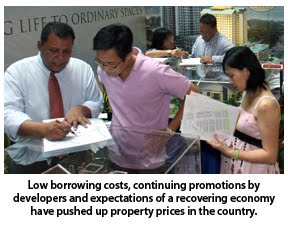
Rising property prices have been fuelled by low borrowing costs, the continuing promotions by developers and expectations of a recovering economy.

More money is also flowing into Asia from developed economies where interest rates are low as investors seek higher returns elsewhere.

But this is not unique to Malaysia. Regulators in China, Hong Kong and Singapore have imposed measures to cool their property markets.

Zeti also said that "massive" financial literacy programmes would be rolled out as a pre-emptive measure.

These would be aimed at those aged below 30 to help them better manage their finances at the start of their careers.

By Business Times

Sunrise to launch RM3b worth of projects next year

PROPERTY developer Sunrise Bhd will launch about RM3 billion worth of property projects next year to boost profit and revenue for the year ending June 2011.

The projects are mainly located in the Klang Valley as well as a mixed residential development known as Quintet on 1.94ha in Richmond, a suburb of Vancouver in Canada.

Sunrise will launch Phase Two of Quintet within the first quarter of next year. It will comprise 450 residential units with a gross development value (GDV) of C$400 million (RM1.1 billion).

Quintet's first phase of 300 residential units were sold out when it was launched this year.
"We have been seeking property development work overseas and outside Mont' Kiara to ensure sustainable projects to push for further growth," Sunrise executive chairman Datuk Tong Kooi Ong said after its annual general meeting in Kuala Lumpur yesterday.

Locally, the company will launch Solaris Tower located behind the Renaissance Kuala Lumpur Hotel off Jalan Sultan Ismail. It is a two-block strata office development on 1.8 acres of land with a GDV of about RM480 million.

Meanwhile, Sunrise's residential projects that will be launched next year are mixed developments comprising condominiums, serviced apartments, a retail area known as MK 20 with a GDV of RM1 billion, and a gated residential development at The Mines with a GDV of RM500 million.

"We have a good basket of products for the next launches, we will make sure market demand is met," said Tong.

For the year ended June 30 2010, Sunrise reported a 14.2 per cent decline in net profit to RM133.95 million from RM156.18 million previously.

Revenue dropped 26.5 per cent to RM590.74 million against RM803.92 million before. Earnings per share was 27.04 sen.

Sunrise said the lower full-year revenue was due to the completion of Mont' Kiara Meridien and substantial completion of 10 Mont' Kiara and Solaris Dutamas in the previous financial year.

The residential area construction of 11 Mont' Kiara and 28 Mont' Kiara were on schedule and slated for completion in 2011 and 2013 respectively, it added.

By Business Times

Plenitude plans RM400m small-scale projects

PLENITUDE Bhd plans to launch several small-scale property projects worth as much as RM400 million over the next eight months.

The builder is taking advantage of a run-up in property prices to launch the seven residential projects that will cover areas in Klang Valley, Johor and Penang.

"These properties will be launched during this financial year (ending June 30 2011), and we expect positive contribution to the bottom line over the next few years," said executive chairman Elsie Chua after the company's extraordinary general meeting in Kuala Lumpur yesterday.

The company is also planning to launch a big-scale project in Penang in two years' time, which has an estimated gross development value of RM230 million.
"The development will mainly comprise landed residential units, of course. There will be some condominiums as well," said Chua.

The company, which has more than RM75 million in cash as at June 30 2010, said it will use it as a warchest to fuel expansion, and as such, it has no immediate plans to return more cash to shareholders.

Plenitude currently has a policy of returning between 20 and25 per cent of net profits as dividend to shareholders.

"That's what the shareholders were asking for, but we need this cash because we know we want to expand. If we cash it out, instead of having our own cash, we start borrowing, then it's bad," said Chua.

Zukarnine Shah, a director, added that the deciding factor for not returning the cash as dividend is the company's sustainability.

"If we issue out as dividend, shareholders will be happy for sure, but can we sustain? Will we have enough working capital or reserves to acquire valuable land to expand? So, we are trying to keep a balance, but of course, balance is subjective," Zukarnine said.

Chua said its landbank, currently at about 720ha, can keep the company busy for the next 10 years.

By Business Times

i-REIT from GCC may list next year

BURSA Malaysia Bhd expects an Islamic real estate investment trust (i-REIT) from the Gulf Cooperation Council (GCC) to be listed on the exchange next year, adding to its three existing i-REITS.

It did not identify the issuer, but market speculation is that that it may be Qatar-listed property group Ezdan.

News reports as early as May last year indicated that Ezdan was interested in listing an i-REIT made up of Qatar-based assets on Bursa.

"I don't think they (the issuer) have decided what they want to put in yet because it is a very big company. In their market, they're one of the top 10 listed companies. The reason they're coming over is because they don't have a REIT framework," Bursa's global head of Islamic markets, Raja Teh Maimunah Raja Abdul Aziz, told reporters after speaking at the Global Islamic Finance Forum in Kuala Lumpur yesterday.

Meanwhile, a US-dollar exchange traded fund (ETF) by BNP Paribas Investment Partners may be listed here by year-end or in the first quarter next year. The ETF is pending the Securities Commission's approval, she said.

By Business Times

Thursday, October 28, 2010

Mutiara Goodyear plans RM1.6bil projects

Property developer sees timing right for high-end development

KUALA LUMPUR: Property developer Mutiara Goodyear Development Bhd targets to launch several high-end property projects with a total gross development value (GDV) of about RM1.6bil in the next 12 months.


Hamidon Abdullah says the Malaysian property market is on an upward trend.

Executive chairman Hamidon Abdullah said the Malaysian property market was on an upward trend and the timing was just right for the launch of its matured projects.

Hamidon Abdullah said the property projects that would be launched (in phases) were the Nadayu Melawati high-end property development comprising luxury bungalows, semi-detached homes, super links and commercial units (GDV: RM850mil).

The project is slated for completion by 2012.

Other property projects to be launched next year are the Nadayu 92 Kajang (GDV: RM250mil) and Nadayu 28 Sunway (GDV: RM300mil).

Hamidon said the company would launch another property project known as Nadayu Penang (GDV: RM450mil) by next year.

Interestingly, Nadayu Penang is a property project under a 50:50 equity partnership with Affin Bank Bhd.

Hamidon said that with Affin Bank as a partner it would place the company in a stronger financial position.

“All these property projects will keep us busy for several years,” he said after Mutiara’s AGM yesterday.

Hamidon said the company’s high-end property project this year – Prima Avenue, with a GDV of RM120mil – had been completely sold out and slated for completion in the first quarter 2011.

On the company’s performance, Mutiara executive director Lim Beng Guan said the company had taken the option of early adoption on issues of Committee Interpretation 15 (IC 15), which essentially recognises revenue based on completion of project as against the previous practice of percentage of completion.

“If we had not early adopted IC 15 and revenue recognition based on percentage of completion of project, Mutiara’s revenue and net profit for the financial year ended April 30, 2010 (FY10) would have been RM124.2mil and RM17.7mil respectively,” Lim said.

Mutiara recorded a net profit of RM3.2mil and revenue of RM52.6mil for FY10.

Earnings per share for the year under review stood at 1.4 sen and net assets per share was RM1.35.

On the offer of 97 sen per share to buy back Mutiara’s shares not held by Atis IDR Ventures Sdn Bhd, a company that currently holds a 52% stake in Mutiara, Lim said Mutiara shareholders were told by their independent adviser PM Securities Sdn Bhd to reject the offer.

“Some shareholders had accepted the 97 sen per share offer, while others had chosen not to do so. So long as Mutiara is transparent, shareholders can decide on their own accord,” Lim said.

The first closing date for the offer is Nov 8.

By The Star

SunCity mulls over new projects for REIT

PETALING JAYA: Sunway City Bhd (SunCity) is mulling over office and retail projects to be nurtured into yield-accretive assets which can later be injected into the Sunway real estate investment trust (REIT).

The listing of Sunway REIT on July 8 involved the injection of eight assets – Sunway Pyramid Shopping Mall, Sunway Carnival, SunCity Ipoh Hypermarket, Sunway Resort Hotel & Spa, Pyramid Tower Hotel, Sunway Hotel Seberang Jaya, Menara Sunway and Sunway Tower.

The listing exercise raised some RM520mil for SunCity’s project development activities, including land purchase.


Ngeow ... ‘We want to build up Bandar Sunway into a location of choice for quality offices.’

SunCity property investment managing director Ngeow Voon Yean said the divestment and unlocking of the value of the assets marked a new chapter for SunCity.

“We are now looking for opportunities in property development or investment to venture into. In the last two years, the ratio of earnings between investment and development property was about 60:40, but post-REIT, it should be around 50:50,” Ngeow told StarBiz.

Besides distribution income from its 37% stake in Sunway REIT, SunCity can also channel the funds raised from its assets divestment to other income-generating activities.

It recently paid RM129mil to acquire an additional 45% stake in its 51%-owned unit, Sunway Lagoon Sdn Bhd.

Ngeow also said the funds would be used to develop more office blocks and retail-related projects. There are 100 acres still undeveloped in the 800-acre Bandar Sunway Integrated Resort, and SunCity also has other smaller parcels of land in Kuala Lumpur.

He said the first project kicked off The Pinnacle in Bandar Sunway, a 25-storey corporate office block with net lettable area of 560,000 sq ft that was scheduled for completion by 2013.

Next up would be the development of a parcel of land beside Sunway Pyramid Shopping Mall. Currently referred to as SP3, this would be a retail and serviced apartments development with vehicular and pedestrian links to the mall.

“The supply of Grade A and international standard office and commercial space in this part of the Klang Valley is still in short supply. We want to build up Bandar Sunway into a location of choice for quality offices to attract blue chip office tenants here,” Ngeow added.

He said the new state-of-the-art office and commercial buildings would qualify as green and sustainable buildings. “The aim is to integrate and link all the office and retail complexes in Bandar Sunway with covered walkways to make them pedestrian-friendly and promote more walking instead of driving within the township. This will lower the carbon footprint of the township and is also in line with the LOHAS philosophy that Sunway has embraced from the start, ” he added.

LOHAS (Lifestyles of Health and Sustainability) is a term that describes the market and lifestyle of consumers interested in issues of health and fitness, personal development, the environment, sustainable living and social justice.

Ngeow said a new commercial project now underway was Sunway Velocity in Cheras, comprising office towers, serviced apartments, shoplots and a shopping mall. The RM1.5bil project on 22 acres will be completed in 2015. It will have a total net lettable area of 850,000 sq ft and gross development value of RM1.5bil.

SunCity also plans to build a 27-storey office building with a net lettable area of 350,000 sq ft, Sunway Tower, in Jalan Ampang, Kuala Lumpur. Plans for the project on a one-acre site are still being firmed up. “We have a couple of other projects on the drawing board and will keep our project pipeline going for synergistic growth between the various divisions of SunCity,” Ngeow said.

By The Star

SunCity unit in JV for RM4.3bil project in China

PETALING JAYA: Sunway City (S’pore) Pte Ltd (SCS), a wholly owned subsidiary of Sunway City Bhd (SunCity), has entered into a joint venture to develop a project with an estimated gross development value of RM4.3bil in Sino-Singapore Tianjin Eco-City, China.

SunCity told Bursa Malaysia yesterday that SCS had signed an equity joint-venture (EJV) contract with Sino-Singapore Tianjin Eco-City Investment and Development Co Ltd (SSTEC) to set up a joint-venture firm for developing 27.96ha in the township.

“The preliminary feasibility study of the proposed development features mixed residential and commercial development complemented by integrated and high quality amenities,” it added.

SunCity said the proposed development would span five years with the earliest start in March 2011 and an expected completion in mid-2015.

SCS will be the majority shareholder of the EJV company.

SSTEC, the master developer for the Tianjin Eco-City, is a 50:50 joint venture between a Chinese consortium led by Tianjin TEDA Investment Holding Co Ltd and a Singapore consortium led by the Keppel group.

By The Star

Sime reports brisk sales in 3 townships

Sime Darby Property Bhd is achieving a high rate of sales for three townships -- Denai Alam in Shah Alam, Bandar Bukit Raja in Klang and USJ Heights in Subang Jaya.

The three phases of terraced houses at Denai Alam boasted an average 85.6 per cent take-up rate, while the two phases of Bandar Bukit Raja averaged 93 per cent take-up, it said in a statement today.

The four recent phases at the USJ Heights averaged 90 per cent take-up, with one phase sold out within three months from launch, it said.

Managing director Datuk Tunku Putra Badlishah said the trio of recent success stories "speaks volumes for the resilience of Kuala Lumpur's property market".

"The sales achieved at the three townships demonstrates the continued strong demand for landed property in well-planned communities within the Klang Valley," he said.

Going forward, he said that there will be new two launches in USJ Heights and a launch of Lavender Park in Denai Alam, both scheduled for next month.

By Bernama

MK Land seeks cheap loans for Bangalore project

PROPERTY developer MK Land Holdings Bhd is seeking cheap loans from Exim Bank to develop affordable housing in northern Bangalore with India's Embassy Group.

The project, with gross development value of around RM4 billion, is set to be undertaken by MK Embassy Land Sdn Bhd, in which MK Land and Embassy Group hold 47.5 per cent each while MKN Embassy Development Sdn Bhd has 5 per cent.


"I hold a 5 per cent stake in the project. We have been invited by our partner Embassy Group to replicate the low-medium-cost model of Damansara Damai in Bangalore," executive chairman Tan Sri Mustapha Kamal Abu Bakar said.

"The joint-venture company will buy land from Embassy Group. With that as collateral, we will borrow money from Exim Bank, at a low payback rate ... as low as 4 per cent," he said.
Mustapha Kamal was speaking to reporters after MK Embassy Land sealed a development agreement with NAM Estates Pvt Ltd, a unit of Embassy Group, in Putrajaya yesterday.

He said the joint-venture company was buying the 185-acre site from Embassy Group at RM2.3 million an acre.

The low-cost apartments will be in the range of 660-880 sq ft and priced between RM115,000 and RM175,000 each.

Since the new township is 8km away from the new Bangalore International Airport, the apartment blocks will be limited to eight storeys.

"We'll launch this project as soon as we receive the approvals from the authorities in India," Mustapha Kamal added.

By Business Times