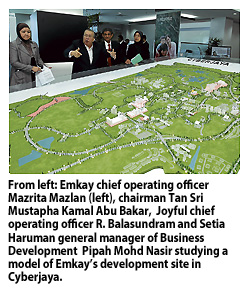
Top draw: SP Setia’s show houses in Bukit Indah, seen here, were a big hit among buyers.
JOHOR BARU: SP Setia Bhd sees southern Johor as the company's fixed deposit in view of the development and progress taking place in Iskandar Malaysia.
President and chief executive officer Tan Sri Liew Kee Sin said the economic growth corridor was moving in the right direction and would drive growth of the property market in Johor.
“We made the right decision to come to Johor Baru in 1997 although at that time it was not on the radar of many Klang Valley-based developers,'' he told StarBiz in an interview recently.
Liew: Iskandar Malaysia is moving in the right direction and will drive growth in Johor’s property market.
Liew, who was born and bred in Johor, said he had a vision that the state would be the next growth centre in the country after Klang Valley and he was right.
He said Johor was now the company's main revenue earner, contributing about RM1bil in sales for three consecutive years 2009, 2010 and 2011.
“We are confident of repeating the same figure this year as the take-up rate for our properties here has been good since day one,'' said Liew.
The company was fortunate as all of its projects in southern Johor were strategically located within the flagship development zones of Iskandar Malaysia.
Liew said Johor's close proximity with Singapore was another added advantage as Johor Baru was always the first choice among Singaporeans and expatriates working in the republic looking for residential properties as their second or weekend homes.
Its on-going projects in southern Johor are Bukit Indah with only 5% land left for development, Setia Eco Gardens and Setia Business Park (383.64ha and 50% still available for future development).
Others are new developments - Setia Business Park II (107.24ha), Setia Tropika (299.46ha and 40%), Setia Indah (359.36ha and 10%) and Setia Eco Cascadia (110.07ha and 70%).
“The remaining landbank will keep us busy in Iskandar Malaysia in the next 10 to 15 years with a gross development value of RM8bil,'' he said.
Liew said the company would continue looking for more land in Iskandar Malaysia and outside Johor Baru, adding that there were still large tracts of land available in Johor for township development.
Almost a decade after the company set foot in Johor Baru, the Government under the then Prime Minister Tun Abdullah Ahmad Badawi launched Iskandar Malaysia on Nov 4, 2006.
SP Setia was the first developer to start a housing scheme in Nusajaya at that time Bukit Indah - long before Nusajaya was declared as one of the five flagship development zones in Iskandar Malaysia.
Other flagship development zones in the 2,217 sq km Iskandar Malaysia are the JB City Centre, Eastern Gate Development Zone, Western Gate Development Zone and Senai-Kulai.
“The company's early years in Johor Baru were the toughest time because Malaysia in 1997 and 1998 was not spared from the Asian financial crisis,'' said Liew.
At one time, Liew even pondered about whether the company had made the right decision expanding to Johor but he was determined to stay put.
Liew said unlike house buyers in the Klang Valley, those in Johor were quite sceptical at that time and a majority of them would only buy houses from Johor-based developers.
Initially it was hard to convince potential buyers in Johor Baru as for many years until the 1990s, most of them only knew three reputable Johor-based developers.
“These three developers have been around long before those from outside Johor started coming in and have a long list of loyal customers,'' said Liew.
However, through perseverance, never-give-up attitude and an innovative selling campaign, SP Setia had been able to win them over with its maiden project called Bukit Indah.
“Despite the 1997-98 recession, Bukit Indah was selling well and it was a launching pad for more of our projects in Johor Baru,'' he added.
Liew said apart from offering competitive prices for its Bukit Indah houses at that time, the company set itself apart from the other Johor Baru-based developers.
He said instead of building a few units of show houses at a certain precinct of development as was usually done by other developers here, the company decided to build a show village in Bukit Indah showcasing several types of houses.
The idea was a big hit among buyers as they had a better idea of what were being offered at the different precincts in the housing estate.
“We were also the first developer to build a central town park in Johor Baru at our Bukit Indah project and it has set a precedent not only in Johor but in the country too,'' said Liew.
Since then, the state government has decided that developers in Johor were required to provide a central green lung area or park for house buyers in their projects.
SP Setia has allocated 8.09ha from the 610.67ha of Bukit Indah for use as a park. The park which was opened 16 years ago is undergoing a RM15mil upgrading work.
By The Star
Monday, March 5, 2012
Saturday, March 3, 2012
CapitaLand looking for more land in the key cities for property projects
An artist’s impression of CapitaLand’s Sastra U-Thant, a luxury residential project in Taman U-Thant in Kuala Lumpur.
CAPITALAND Commercial (M) Sdn Bhd, an indirect wholly-owned subsidiary of Singapore's CapitaLand Ltd, is actively looking for potential land in prime locations in the Klang Valley and other key cities in Malaysia for more property developments.
Its vice-president of project and asset management Lim Chee Ming says the company's long term plan is to focus on residential and commercial projects.
“We also intend to set up new funds to take part in more developments. We are monitoring market conditions very closely as the timing must be right,” he shares with StarBizWeek.
Lim says the Malaysia Commercial Development Fund (MCDF) is a successful fund which has distributed double-digit returns to its investors to-date. It is on track to return the balance of the investments by 2013.
MCDF was established in 2007 by CapitaLand and Maybank to invest in real estate development projects in the Klang Valley. The private real estate fund closed at US$270mil.
Some of the completed projects by the fund include One Mont Kiara and KL Sentral Lot J, in which MCDF has already divested.
Lim says moving forward, the company intends to set up similar funds for its new developments.
“The Malaysian government's plan to attract 100 multinational companies to establish their global or regional headquarters in the Klang Valley has the potential to upkeep a buoyant outlook for the office sector.
“We are also positive with the outlook of the residential sector. There is still high demand for new residential properties as the take up rates of recently launched residential developments are encouraging,” he says.
The company's most recent project in Kuala Lumpur is Sastra U-Thant, a luxury residential project in Taman U-Thant, a prestigious diplomatic enclave off the Kuala Lumpur City Centre. The project is a joint venture between CapitaLand and Juta Asia Corporation Sdn Bhd.
As of last month, the foundation and basement works for the project have been completed, and Sastra U-Thant is slated for completion next year.
CapitaLand Commercial Malaysia head of marketing Jaselyn Wan says the project has received strong support from high net-worth Singaporean buyers who are keen to invest in prime properties in Malaysia.
Wan says the sentiment for the local residential market is still positive with encouraging take up for new residential projects.
“There is increasing interest from high net-worth Singaporeans to invest in prime Malaysian properties due to the attractive rental returns and affordability,” she notes.
Lim says CapitaLand Commercial's portfolio of investment property is through Quill Capita Trust (QCT), a real estate investment trust listed on Bursa Malaysia.
CapitaLand Commercial's investment in QCT is held through CapitaCommercial Trust which has a 30% stake in QCT.
According to Lim, QCT's investment objective is to acquire and invest in office and commercial properties. “We are always actively exploring acquisitions for QCT,” he says.
Beng Chee says the focus is on growing urban centres in Malaysia.
In the retail sector, CapitaMalls Asia chief executive officer Lim Beng Chee says the company continues to look for opportunities to grow its presence in the local market.
“We are open to acquiring or investing in good mall assets which will benefit our stakeholders and which are in line with our investment criteria. The focus is on growing urban centres in Malaysia.”
CapitaMalls Asia is well-positioned for growth in the country's retail sector, given that its five malls are located in the major urban centres of Penang, Kuala Lumpur, Selangor and Kuantan.
The malls are Gurney Plaza and Queensbay Mall in Penang; Sungei Wang Plaza in Kuala Lumpur; The Mines in Selangor; and East Coast Mall in Kuantan.
CapitaLand's serviced residence unit, The Ascott Ltd, also sees strong growth potential for its serviced residence operation in Malaysia.
The Ascott Ltd regional general manager for Singapore and Malaysia, Tan Boon Khai says the company is positive about the serviced apartment outlook in Malaysia and would continue to look for opportunities to expand its footprint and presence.
“The country's resilient economy and attractiveness as a destination for foreign direct investments (FDIs) augurs well for the sector.
“As FDIs increase, we expect strong demand for serviced residences and we are constantly seeking opportunities to strengthen our leadership position in Malaysia,” Tan adds.
As at December 31, 2011, Ascott's Malaysia portfolio is valued at S$101mil, The assets include Somerset Ampang Kuala Lumpur and Somerset Seri Bukit Ceylon Kuala Lumpur which are 100% owned by the company, and Ascott Kuala Lumpur (which it has a 50% stake).
Last year, Ascott expanded to Cyberjaya, Petaling Jaya and Iskandar Nusajaya in Johor, which consolidated its leadership position as the largest international serviced residence owner and operator in Malaysia.
Tan says the company has more than 1,000 units in the country which are scheduled to open over the next five years.
“This year, we will be opening our first Citadines serviced residences in the country, Citadines Uplands in Kuching. This will be followed by Ascott Sentral Kuala Lumpur and Somerset Puteri Harbour Iskandar in 2013.
“2014 will see us opening Citadines D'Pulze Cyberjaya and in 2016, we will have our new Somerset property in Damansara in Petaling Jaya. In total, this will bring our Malaysian portfolio to about 1,600 units,” Tan says.
By The Star
CAPITALAND Commercial (M) Sdn Bhd, an indirect wholly-owned subsidiary of Singapore's CapitaLand Ltd, is actively looking for potential land in prime locations in the Klang Valley and other key cities in Malaysia for more property developments.
Its vice-president of project and asset management Lim Chee Ming says the company's long term plan is to focus on residential and commercial projects.
“We also intend to set up new funds to take part in more developments. We are monitoring market conditions very closely as the timing must be right,” he shares with StarBizWeek.
Lim says the Malaysia Commercial Development Fund (MCDF) is a successful fund which has distributed double-digit returns to its investors to-date. It is on track to return the balance of the investments by 2013.
MCDF was established in 2007 by CapitaLand and Maybank to invest in real estate development projects in the Klang Valley. The private real estate fund closed at US$270mil.
Some of the completed projects by the fund include One Mont Kiara and KL Sentral Lot J, in which MCDF has already divested.
Lim says moving forward, the company intends to set up similar funds for its new developments.
“The Malaysian government's plan to attract 100 multinational companies to establish their global or regional headquarters in the Klang Valley has the potential to upkeep a buoyant outlook for the office sector.
“We are also positive with the outlook of the residential sector. There is still high demand for new residential properties as the take up rates of recently launched residential developments are encouraging,” he says.
The company's most recent project in Kuala Lumpur is Sastra U-Thant, a luxury residential project in Taman U-Thant, a prestigious diplomatic enclave off the Kuala Lumpur City Centre. The project is a joint venture between CapitaLand and Juta Asia Corporation Sdn Bhd.
As of last month, the foundation and basement works for the project have been completed, and Sastra U-Thant is slated for completion next year.
CapitaLand Commercial Malaysia head of marketing Jaselyn Wan says the project has received strong support from high net-worth Singaporean buyers who are keen to invest in prime properties in Malaysia.
Wan says the sentiment for the local residential market is still positive with encouraging take up for new residential projects.
“There is increasing interest from high net-worth Singaporeans to invest in prime Malaysian properties due to the attractive rental returns and affordability,” she notes.
Lim says CapitaLand Commercial's portfolio of investment property is through Quill Capita Trust (QCT), a real estate investment trust listed on Bursa Malaysia.
CapitaLand Commercial's investment in QCT is held through CapitaCommercial Trust which has a 30% stake in QCT.
According to Lim, QCT's investment objective is to acquire and invest in office and commercial properties. “We are always actively exploring acquisitions for QCT,” he says.
Beng Chee says the focus is on growing urban centres in Malaysia.
In the retail sector, CapitaMalls Asia chief executive officer Lim Beng Chee says the company continues to look for opportunities to grow its presence in the local market.
“We are open to acquiring or investing in good mall assets which will benefit our stakeholders and which are in line with our investment criteria. The focus is on growing urban centres in Malaysia.”
CapitaMalls Asia is well-positioned for growth in the country's retail sector, given that its five malls are located in the major urban centres of Penang, Kuala Lumpur, Selangor and Kuantan.
The malls are Gurney Plaza and Queensbay Mall in Penang; Sungei Wang Plaza in Kuala Lumpur; The Mines in Selangor; and East Coast Mall in Kuantan.
CapitaLand's serviced residence unit, The Ascott Ltd, also sees strong growth potential for its serviced residence operation in Malaysia.
The Ascott Ltd regional general manager for Singapore and Malaysia, Tan Boon Khai says the company is positive about the serviced apartment outlook in Malaysia and would continue to look for opportunities to expand its footprint and presence.
“The country's resilient economy and attractiveness as a destination for foreign direct investments (FDIs) augurs well for the sector.
“As FDIs increase, we expect strong demand for serviced residences and we are constantly seeking opportunities to strengthen our leadership position in Malaysia,” Tan adds.
As at December 31, 2011, Ascott's Malaysia portfolio is valued at S$101mil, The assets include Somerset Ampang Kuala Lumpur and Somerset Seri Bukit Ceylon Kuala Lumpur which are 100% owned by the company, and Ascott Kuala Lumpur (which it has a 50% stake).
Last year, Ascott expanded to Cyberjaya, Petaling Jaya and Iskandar Nusajaya in Johor, which consolidated its leadership position as the largest international serviced residence owner and operator in Malaysia.
Tan says the company has more than 1,000 units in the country which are scheduled to open over the next five years.
“This year, we will be opening our first Citadines serviced residences in the country, Citadines Uplands in Kuching. This will be followed by Ascott Sentral Kuala Lumpur and Somerset Puteri Harbour Iskandar in 2013.
“2014 will see us opening Citadines D'Pulze Cyberjaya and in 2016, we will have our new Somerset property in Damansara in Petaling Jaya. In total, this will bring our Malaysian portfolio to about 1,600 units,” Tan says.
By The Star
Malaysia a real-estate shopping destination
Welcoming foreign buyers will not necessarily affect property prices
LATE last year and once again about two weeks ago, at least two courses were organised to equip property agents and developers to sell Malaysian properties abroad.
In one of them, real estate professionals paid a few thousands of ringgit to attend a Certified International Property Specialist (CIPS) course to prepare them to sell Malaysian properties overseas. In another, a tax consultant and a lawyer were invited to share their experience and expertise when selling Malaysian properties.
For about a decade now, developers who have projects around the KLCC area, Penang and Johor have been taking their offerings to Singapore, Hong Kong, Japan, London and China. So far, these overtures have been limited to residential and commercial developments. On a broader scale, the Malaysian government has also been encouraging foreigners to buy into Malaysian realty and has started networking with governments and local authorities to make itself known via government agency Malaysia Property Inc.
The question is: will foreigners buying into Malaysian real estate encourage developers to focus on building high-end developments, which are way above the affordability levels of locals?
Invariably, references are made to Singapore and how foreign buying has brought in that element of volatility because at the first sign of trouble, the foreigner leaves the island state.
Kumar: ‘Sales to foreigners only make up 2% of total property sales in Malaysia. Of the 120,000 units entering the market annually, 2% is 2,400 units
Malaysia Property Inc (MPI) chief executive officer Kumar Tharmalingam likes to debunk this: “The number of foreign buyers buying into Malaysian properties is very small. Sales to foreigners only make up 2% of total property sales in Malaysia compared with Singapore's 30% . Singapore's volume of properties entering into the market annually is about 20,000 units and foreigners are only allowed to buy private condominiums; which averages about 6,000 units.
“Malaysia has about 120,000 units entering the market annually and 2% of this is 2,400 units.”
Kumar also says it is not possible to compare Malaysia with Singapore and Hong Kong and the market dynamics are very different.
MPI was set up in 2008. The government-property agency has two core objectives: to create international awareness and to establish connections between foreign interests and Malaysian real estate industry players. Its scope of work is not limited to just residential and commercial properties but includes the whole gamut of property investment, from land acquisition to building of factories if this is needed by the foreign investor. MPI has been branding itself for the last 18 months. This year will see the agency implementing some of their strategies when it matches foreign companies with Malaysian projects.
“MPI and much of what we would like to do is still pretty much work-in-progress,” says Kumar who took over the reigns of the agency in Feb 2010.
“MPI is an extension of three government agencies. These are national trade promotion agency Matrade, International Trade and Industry Ministry and Malaysian Investment Development Authority,” he says.
MPI's work is very much tied up with the foreign direct investment. The foreign direct investment will first seek out one of the above three agencies. After that connection is made, and when a foreign investment is approved by the government, there will be a need for land or office space, or even accommodation for staff.
“There is a time lag between the foreign investor applying for government approval for his investment and his need for real estate. But which ever way one looks at it, land, office building, factories or staff accommodation, real estate comes into the picture. Because these three agencies are not involved in property matters, the requirements of these investors will be eventually be be referred to MPI.
“Or it could be a foreign direct investor who is keen to enter into a joint venture with our local boys. The South Koreans, for example, are keen to contribute a certain amount of equity, but would like to negotiate' a tender as opposed to having an open tender. This was the model they used in Vietnam and China for their real estate investments.” Its role is to facilitate.
With the United States' fragile recovery and Europe going through a recession, Kumar expects interest in Malaysian properties to come mainly from Japan, South Korea, Hong Kong, South China, Singapore, Indonesia, India, Saudi Arabia and Qatar.
Whether it is a coincidence or otherwise, the same year MPI was set up, news of the Government's plans to develop several pieces of land in key strategic areas in the city began to filter out. These mega projects include what is currently known as the Kuala Lumpur International Financial District in Jalan Tun Razak, KL Metropolis in Matrade-Jalan Duta area, the 100-storey building in the Stadium Negara site, now known as Menara Warisan and the Rubber Research Institute land in Sg Buloh. The global financial crisis, which started in 2007 and whose full blown effect was felt around the world, came a year later.
While MPI plays an intermediary role to facilitate the business needs of the real estate, concerns about foreign interest pushing up prices are also pooh-poohed by Reapfield chief executive officer Gerard Kho. On the contrary, he says there are a few locations that need the support of foreign buyers.
“The high-end condominium market need the support of foreign buyers. This year, we expect to see rent and prices adjust a bit in that sector. It will also be a challenging year for the high-end condominium market.”
By contrast, domestic demand is expected to remain resilient.
“I am bullish up to the middle of this year despite the 30% downpayment requirement for the third and subsequent house and other measures by Bank Negara to curb the growth in household debts. The third and fourth quarter are difficult to predict,” he says.
“Last year, 84% of our transactions were from the secondary market, a reflection of strong domestic demand despite the many predictions of 2011 being a difficult year,”
Following up on Kho's concerns about the high-end condominium sector, the National Property Information Centre's Residential Property Stock Table shows the Federal Territory having an existing stock of serviced apartments and condominiums totalling 156,251 units including about 4,000 units completed last year.
While these numbers do not separate the high-end units from the rest, it does indicate the large number of serviced apartments and condominiums in the Federal Territory and the yearly additions that enter the market.
About 5,000 units were added into the market this year and another 4,500 units are expected to stream in next year, says Kho.
On the often quoted Singapore-Malaysia example, Kho says the “Singapore and Hong Kong property markets have a high global exposure. Both these markets are very different from Malaysia in terms of land, and government-control measures.
Tan: ‘Our properties are very affordable to Singaporeans. In the region, our real estate is attractively priced.’
“In Singapore, foreigners are allowed only to buy into private condominium projects. Malaysia is different. Foreigners can buy into any segment of the property market if it is beyond a certain price threshold, which dilutes the focus on any particular sub-segment of the property market,” says Kho.
Lawyer Chris Tan who acts on behalf of foreigners buying into the Malaysian market says his biggest clientele are from Singapore.
“Our properties are very affordable to them because of the exchange rate and because of the high prices in the city state. In the region, our real estate is attractively priced,” he says.
The locations his clients buy into include the KLCC area, Mont'Kiara, Damansara, Bangsar and Ampang. Johor and Penang are other popular destinations.
“Iskandar Malaysia is like Shenzhen and Hong Kong. Shenzhen is thriving today because of the Hong Kong factor,” says Tan.
By The Star
LATE last year and once again about two weeks ago, at least two courses were organised to equip property agents and developers to sell Malaysian properties abroad.
In one of them, real estate professionals paid a few thousands of ringgit to attend a Certified International Property Specialist (CIPS) course to prepare them to sell Malaysian properties overseas. In another, a tax consultant and a lawyer were invited to share their experience and expertise when selling Malaysian properties.
For about a decade now, developers who have projects around the KLCC area, Penang and Johor have been taking their offerings to Singapore, Hong Kong, Japan, London and China. So far, these overtures have been limited to residential and commercial developments. On a broader scale, the Malaysian government has also been encouraging foreigners to buy into Malaysian realty and has started networking with governments and local authorities to make itself known via government agency Malaysia Property Inc.
The question is: will foreigners buying into Malaysian real estate encourage developers to focus on building high-end developments, which are way above the affordability levels of locals?
Invariably, references are made to Singapore and how foreign buying has brought in that element of volatility because at the first sign of trouble, the foreigner leaves the island state.
Kumar: ‘Sales to foreigners only make up 2% of total property sales in Malaysia. Of the 120,000 units entering the market annually, 2% is 2,400 units
Malaysia Property Inc (MPI) chief executive officer Kumar Tharmalingam likes to debunk this: “The number of foreign buyers buying into Malaysian properties is very small. Sales to foreigners only make up 2% of total property sales in Malaysia compared with Singapore's 30% . Singapore's volume of properties entering into the market annually is about 20,000 units and foreigners are only allowed to buy private condominiums; which averages about 6,000 units.
“Malaysia has about 120,000 units entering the market annually and 2% of this is 2,400 units.”
Kumar also says it is not possible to compare Malaysia with Singapore and Hong Kong and the market dynamics are very different.
MPI was set up in 2008. The government-property agency has two core objectives: to create international awareness and to establish connections between foreign interests and Malaysian real estate industry players. Its scope of work is not limited to just residential and commercial properties but includes the whole gamut of property investment, from land acquisition to building of factories if this is needed by the foreign investor. MPI has been branding itself for the last 18 months. This year will see the agency implementing some of their strategies when it matches foreign companies with Malaysian projects.
“MPI and much of what we would like to do is still pretty much work-in-progress,” says Kumar who took over the reigns of the agency in Feb 2010.
“MPI is an extension of three government agencies. These are national trade promotion agency Matrade, International Trade and Industry Ministry and Malaysian Investment Development Authority,” he says.
MPI's work is very much tied up with the foreign direct investment. The foreign direct investment will first seek out one of the above three agencies. After that connection is made, and when a foreign investment is approved by the government, there will be a need for land or office space, or even accommodation for staff.
“There is a time lag between the foreign investor applying for government approval for his investment and his need for real estate. But which ever way one looks at it, land, office building, factories or staff accommodation, real estate comes into the picture. Because these three agencies are not involved in property matters, the requirements of these investors will be eventually be be referred to MPI.
“Or it could be a foreign direct investor who is keen to enter into a joint venture with our local boys. The South Koreans, for example, are keen to contribute a certain amount of equity, but would like to negotiate' a tender as opposed to having an open tender. This was the model they used in Vietnam and China for their real estate investments.” Its role is to facilitate.
With the United States' fragile recovery and Europe going through a recession, Kumar expects interest in Malaysian properties to come mainly from Japan, South Korea, Hong Kong, South China, Singapore, Indonesia, India, Saudi Arabia and Qatar.
Whether it is a coincidence or otherwise, the same year MPI was set up, news of the Government's plans to develop several pieces of land in key strategic areas in the city began to filter out. These mega projects include what is currently known as the Kuala Lumpur International Financial District in Jalan Tun Razak, KL Metropolis in Matrade-Jalan Duta area, the 100-storey building in the Stadium Negara site, now known as Menara Warisan and the Rubber Research Institute land in Sg Buloh. The global financial crisis, which started in 2007 and whose full blown effect was felt around the world, came a year later.
While MPI plays an intermediary role to facilitate the business needs of the real estate, concerns about foreign interest pushing up prices are also pooh-poohed by Reapfield chief executive officer Gerard Kho. On the contrary, he says there are a few locations that need the support of foreign buyers.
“The high-end condominium market need the support of foreign buyers. This year, we expect to see rent and prices adjust a bit in that sector. It will also be a challenging year for the high-end condominium market.”
By contrast, domestic demand is expected to remain resilient.
“I am bullish up to the middle of this year despite the 30% downpayment requirement for the third and subsequent house and other measures by Bank Negara to curb the growth in household debts. The third and fourth quarter are difficult to predict,” he says.
“Last year, 84% of our transactions were from the secondary market, a reflection of strong domestic demand despite the many predictions of 2011 being a difficult year,”
Following up on Kho's concerns about the high-end condominium sector, the National Property Information Centre's Residential Property Stock Table shows the Federal Territory having an existing stock of serviced apartments and condominiums totalling 156,251 units including about 4,000 units completed last year.
While these numbers do not separate the high-end units from the rest, it does indicate the large number of serviced apartments and condominiums in the Federal Territory and the yearly additions that enter the market.
About 5,000 units were added into the market this year and another 4,500 units are expected to stream in next year, says Kho.
On the often quoted Singapore-Malaysia example, Kho says the “Singapore and Hong Kong property markets have a high global exposure. Both these markets are very different from Malaysia in terms of land, and government-control measures.
Tan: ‘Our properties are very affordable to Singaporeans. In the region, our real estate is attractively priced.’
“In Singapore, foreigners are allowed only to buy into private condominium projects. Malaysia is different. Foreigners can buy into any segment of the property market if it is beyond a certain price threshold, which dilutes the focus on any particular sub-segment of the property market,” says Kho.
Lawyer Chris Tan who acts on behalf of foreigners buying into the Malaysian market says his biggest clientele are from Singapore.
“Our properties are very affordable to them because of the exchange rate and because of the high prices in the city state. In the region, our real estate is attractively priced,” he says.
The locations his clients buy into include the KLCC area, Mont'Kiara, Damansara, Bangsar and Ampang. Johor and Penang are other popular destinations.
“Iskandar Malaysia is like Shenzhen and Hong Kong. Shenzhen is thriving today because of the Hong Kong factor,” says Tan.
By The Star
Labels:
Property Market
IOI Properties targets revenue of RM1bil
It owns land in prime locations in Klang valley where land is scarce and expensive
MANY may have forgotten that IOI Properties Bhd was and still is a heavyweight property developer in terms of size and profitability.
Privatised in 2009, its last two financial years of 2011 and 2010 have seen the company steadily increasing its revenue base which now averages close to RM1bil. This is a 30% jump from the revenue recorded in 2009.
For its year ended June 30, 2011 the company recorded sales value of RM942mil, a slight decrease from the RM1.04bil it recorded in the previous year.
Lee: ‘We are transforming IOI Resort City in Putrajaya into a commercial and entertainment centre.’
During its time as a listed entity, although revenue wasn't as high, it was one of the most profitable developers around. For the three financial years prior to its privatisation in 2009, the company was recording operating margins in property development segment of 48.8%, 56.4% and 53.3% respectively.
Speculation is now rife that a re-listing of IOI Properties is something top management is mulling over. Investors may recall that IOI Properties was privatised in 2009 by IOI Corp Bhd at a price of RM2.60n per share. The company was privatised after its price began to languish, touching a seven-year low.
Analysts at that time favoured the privatisation move, saying that IOI Corp got a good price at a valuation of 0.7 times its book value.
The offer price of RM2.60 was at a substantial 34% discount to IOI Properties' net tangible value of RM3.95.
Judging by the number of launches it will be making (approximately six next year), revenue looks set to top the RM1bil mark again for its financial year (FY) 2013. While executives of IOI Corp are mum on the privatisation issue, they are decidedly more than happy to talk about the property projects in the pipeline.
IOI Properties will be kept extremely busy over the next two years. This is chiefly apparent with its latest forays into Singapore and its move to build more commercial buildings for recurring income purposes. Currently, recurring income contributes some 11% to IOI Properties revenue.
With land prices having moved up significantly, and its townships in Puchong and IOI Resort City maturing, is IOI Properties' still confident on the Malaysian property outlook?
“We are actually very optimistic. Based on our planned launches, both for residential and commercial, you will see that we are pretty confident of the demand we are likely to garner. The trend we see now is that there are a lot of parents buying houses for their children,” says IOI Properties Bhd senior general manager Lee Yoke Har.
“Landbank is not just getting expensive, it is getting scarce. This is especially true in Klang Valley where there is not much landbank available. Location is important, and most of our landbank is on prime and central locations. These places will always see demand. As the scarcity becomes more pronounced, house prices will start to rise again,” says Lee.
Busy Year Ahead
In Malaysia, it is planning launches in three key townships IOI Resort City Putrajaya, 16 Sierra, and IOI Vivo City. The company is working around the clock to complete the construction of its mall, the IOI City Mall in Putrajaya by 2014. This is something the management of IOI Properties is extremely excited about.
“We will be signing with one anchor tenant and one key tenant next month for the mall. All in all, we will eventually be signing with four anchor tenants,” said Lee. “We are transforming IOI Resort City in Putrajaya to become a commercial and entertainment centre. Other than the new 18-hole golf course, a big part of the entertainment will come from the mall. We are planning for various activities for all age groups, but there is something special for the teenagers and young adults,” says Lee.
Situated on 36 acres, besides the mall, there will also be two office blocks, and a hotel. The mall is scheduled to be completed in 2014 and the office towers a year later.IOI Properties plans to lease the mall and the office blocks to increase its recurring income. It will only sell the office block en-bloc.
The key differentiation of the mall is its one-of its-kind entertainment park that has yet to be seen in any mall in the Klang Valley.
The total gross development value for the commercial project is about RM2bil, with the mall taking up RM1bil.
Featuring the Garden Mall concept with lots of alfresco dining, the IOI City Mall will have a net lettable area of 1.35 million sq ft, some 350 shops and 7,200 car parks. “The immediate target market is the 1.66 million residents living within a 20-minute drive who can reach the resort city easily from the KL-Seremban Highway and LDP,” says Lee.
She adds that there are five universities near the IOI Resort City. It is also close to the various corporate training centres in Bangi.
Right now, IOI City Mall's location is three minutes off the Kajang Toll along the KL Seremban highway and it is also connected to Kuala Lumpur City Centre via the Maju Expressway.
“There will be two new interchanges from the Maju Expressway in the future. One is from the Equine Park in Serdang, where construction has already started.
“The other interchange, which has just received approval, is near the Malaysian Agricultural Research and Development Institute, which is diagonally opposite to us,” says Lee.
Now, with all the major activity around the mall, it is only natural that it will need to be supported with more residential developments.
The IOI Resort City township has been around since the 1990s. Its appeal has been the greenery and golf course in the area. Half of its condominium buyers are foreigners, many of whom are in Malaysia under the Malaysia My Second Home programme.
“We are launching 120 condominium units with a view of the golf course.The development will come with clubhouse facilities. One can have both the resort ambience and city conveniences all at his doorstep,” she says.
While the price has yet to be decided, Lee says the price of condominiums in IOI Resort City has been steadily increasing from RM300 per sq ft to about RM550 per sq ft.
16 Sierra
Meanwhile, closer to the southern part of Puchong, but still near Cyberjaya and Putrajaya, is IOI Properties' other township, 16 Sierra.
This 530-acre township will also see upcoming launches which boasts of 16 different themed gardens for each phase and a private clubhouse.
The themed gardens called The Ark, Tic-Tac-Toe, Algebra Garden and Peek-A-Boo among others, are designed with nature in mind.
Residents of 16 Sierra will have access to all 16 themed gardens which will be interconnected via jogging paths and walkways.
“So far, three gardens are complete. One of them being the 7.2-acre Central Park, while the other two are neighbourhood gardens within the residential precincts. We have just handed over one precinct together with the garden,” says Lee.
She says some of the launches being lined up include semi detached houses and superlink houses.
“Each new phase gets better than the previous one. You think you've seen the best, but the best is yet to come,” says Lee.
Currently, 16 Sierra is linked to several highway networks via Damansara-Puchong Highway (LDP) and the newly extended South Klang Valley Expressway (SKVE).
It can be reached directly via the extended SKVE from Puchong, Seri Kembangan, Kajang, Putrajaya and Cyberjaya.
Bdr Puteri, Bdr Puchong Jaya
IOI Properties has been largely been responsible for Puchong's commercial success. With a ready population catchment of some 600,000, IOI Properties is looking to offer more through its undeveloped parcels of land.
One of them is the 80-acre IOI Vivo City development.
Infrastructure construction of Phase 1 which consists of about seven acres, will start by year-end. The seven acres will consist of a retail component, shop offices, office suites and suite apartments. It will also have a green concept.
“Previously in Puchong, the commercial and residential component have always been spread out and separated. But today, the people want convenience. We see demand where commercial activities are within the immediate vicinity of the residential components yet with separate accesses and buffered with dense landscaping.
“The commercial components will be connected via retail streets which make up the neighbourhood retail centre in Puchong. It will be a retail centre unlike the IOI Mall. The new neighbourhood centre will have a heavy focus on themed food and beverage outlets with landscaping and lots of offerings for the young adults. IOI Vivo City will be the next pulse of Puchong,” she says. Apart from IOI Vivo City, there will be two other big launches next year. The first is townhouses and condominiums in Puteri Hills while the second are condominiums in Bandar Puchong Jaya.
A total of 640 units of service apartments called Skypod and 1,000 units of condominiums called The Skyz will be separately launched in Bandar Puchong Jaya. These launches is an indication of the company's confidence in that area.
“Location is an extremely important factor in determining demand. We feel that our properties are located in existing areas that are already thriving with ready built infrastructure. Furthermore, these units will have unique features targeted at different segments of the market. The Skyz will be located on the highest point in Puchong. There will be beautiful skylines of Petaling Jaya, Shah Alam and Kuala Lumpur.
Serviced apartments Skypods are targeted at yuppies and young families with an emphasis on high tech living. It will sit on two storeys of retail podium.
The Puchong Financial Commercial Centre, which encompasses some 8 acres is anticipated to be Puchong's corporate and financial hub. Location wise, it is a 3-minute walk to the nearest proposed LRT station and fronts the LDP.
The PFCC has five towers, two blocks which are already 60% and 40% occupied. One of the 2 completed towers is expected to receive its MSC Cybercentre status soon.
The 12-storey Tower 1 has a net lettable area of 124,831 sq ft and has secured a university tenancy which takes up 60% of the floor space.
Meanwhile, the 20-storey Tower 2, with a net lettable area of 253,212 sq ft has secured tenancy from a telco company and an oil and gas company. The buildings have state-of-the-art commercial features such as high speed voice and data facilities.
Lee says IOI Properties is now making an application to seek MSC Malaysia Cybercentre status from the Multimedia Development Corporation for PFCC.
“We want to appeal more to the IT-based and multinational companies since Cyberjaya is just a 15-minute drive away. Currently, there are less than 10 buildings in the Klang valley with the MSC status,” says Lee.
Lee says while many people feel that land prices in Singapore are already high, the issue of scarcity on the island state has been more pressing. Hence, the group is confident about the long term prospects of their projects.
Singapore connection
“The government of Singapore has been very proactive in managing their economy. It is rare for a developed economy to continue growing at the pace of a developing economy. We feel that with the unique macroeconomic factors there, coupled with the scarcity and value of the land, property will continue to do well,” says Lee.
She says construction for South Beach, a mixed use development on Singapore's Beach Road, has started, and is on track to be completed by 2015.
South Beach is IOI Properties' third foray into the city state, which now includes its joint venture with Singapore's Ho Bee Group for two condominium developments in Sentosa Cove and the development of a condominium project in Mergui Road with another local joint venture partner.
IOI Corp has a 49.9% interest in the South Beach project through a restructuring exercise. The 51.1% shareholder of South Beach is City Developments. In total, IOI paid S$317mil (RM761mil) for its stake and expects to contribute further equity in proportion to its respective shareholding for the said project.
The land is located between Raffles Hotel and Suntec City and is next to the Esplanade MRT station. The total land area is 376,295 sq ft and has a leasehold tenure of 99 years.
It will have some 188 apartments, 705 hotel rooms, 529,013 sq ft of office space and 77,726 sq ft of retail space.
Lee saysthe hotel and office portion are to be leased..
More recently, IOI Corp successfully tendered for a parcel of land in Jalan Lempeng, off Clementi Avenue 6 in Singapore, for S$408 million (RM995 million).
The Housing and Development Board of Singapore accepted the bid from Multi Wealth (Singapore) Pte Ltd, in which IOI Corp holds a 99.8%-owned subsidiary. That piece of land will be used to build condominiums.
It is within walking distance of the Clementi Mass Rapid Transit station and the Clementi bus interchange.
The 99-year leasehold parcel of land measures about 2.4ha with a permissible gross floor area of 736,000 sq ft, which translates into a plot ratio of 2.8.
“The gross development value and gross development costs of the proposed development have yet to be determined. We have started planning now and should come up with a plan by year end.” says Lee.
This project comes at a time when the Singaporean government has effected an additional 10% stamp duty on foreigners buying private property in Singapore. Lee says that the Clementi project is wholly residential and targeted at the local market.
By The Star
MANY may have forgotten that IOI Properties Bhd was and still is a heavyweight property developer in terms of size and profitability.
Privatised in 2009, its last two financial years of 2011 and 2010 have seen the company steadily increasing its revenue base which now averages close to RM1bil. This is a 30% jump from the revenue recorded in 2009.
For its year ended June 30, 2011 the company recorded sales value of RM942mil, a slight decrease from the RM1.04bil it recorded in the previous year.
Lee: ‘We are transforming IOI Resort City in Putrajaya into a commercial and entertainment centre.’
During its time as a listed entity, although revenue wasn't as high, it was one of the most profitable developers around. For the three financial years prior to its privatisation in 2009, the company was recording operating margins in property development segment of 48.8%, 56.4% and 53.3% respectively.
Speculation is now rife that a re-listing of IOI Properties is something top management is mulling over. Investors may recall that IOI Properties was privatised in 2009 by IOI Corp Bhd at a price of RM2.60n per share. The company was privatised after its price began to languish, touching a seven-year low.
Analysts at that time favoured the privatisation move, saying that IOI Corp got a good price at a valuation of 0.7 times its book value.
The offer price of RM2.60 was at a substantial 34% discount to IOI Properties' net tangible value of RM3.95.
Judging by the number of launches it will be making (approximately six next year), revenue looks set to top the RM1bil mark again for its financial year (FY) 2013. While executives of IOI Corp are mum on the privatisation issue, they are decidedly more than happy to talk about the property projects in the pipeline.
IOI Properties will be kept extremely busy over the next two years. This is chiefly apparent with its latest forays into Singapore and its move to build more commercial buildings for recurring income purposes. Currently, recurring income contributes some 11% to IOI Properties revenue.
With land prices having moved up significantly, and its townships in Puchong and IOI Resort City maturing, is IOI Properties' still confident on the Malaysian property outlook?
“We are actually very optimistic. Based on our planned launches, both for residential and commercial, you will see that we are pretty confident of the demand we are likely to garner. The trend we see now is that there are a lot of parents buying houses for their children,” says IOI Properties Bhd senior general manager Lee Yoke Har.
“Landbank is not just getting expensive, it is getting scarce. This is especially true in Klang Valley where there is not much landbank available. Location is important, and most of our landbank is on prime and central locations. These places will always see demand. As the scarcity becomes more pronounced, house prices will start to rise again,” says Lee.
Busy Year Ahead
In Malaysia, it is planning launches in three key townships IOI Resort City Putrajaya, 16 Sierra, and IOI Vivo City. The company is working around the clock to complete the construction of its mall, the IOI City Mall in Putrajaya by 2014. This is something the management of IOI Properties is extremely excited about.
“We will be signing with one anchor tenant and one key tenant next month for the mall. All in all, we will eventually be signing with four anchor tenants,” said Lee. “We are transforming IOI Resort City in Putrajaya to become a commercial and entertainment centre. Other than the new 18-hole golf course, a big part of the entertainment will come from the mall. We are planning for various activities for all age groups, but there is something special for the teenagers and young adults,” says Lee.
Situated on 36 acres, besides the mall, there will also be two office blocks, and a hotel. The mall is scheduled to be completed in 2014 and the office towers a year later.IOI Properties plans to lease the mall and the office blocks to increase its recurring income. It will only sell the office block en-bloc.
The key differentiation of the mall is its one-of its-kind entertainment park that has yet to be seen in any mall in the Klang Valley.
The total gross development value for the commercial project is about RM2bil, with the mall taking up RM1bil.
Featuring the Garden Mall concept with lots of alfresco dining, the IOI City Mall will have a net lettable area of 1.35 million sq ft, some 350 shops and 7,200 car parks. “The immediate target market is the 1.66 million residents living within a 20-minute drive who can reach the resort city easily from the KL-Seremban Highway and LDP,” says Lee.
She adds that there are five universities near the IOI Resort City. It is also close to the various corporate training centres in Bangi.
Right now, IOI City Mall's location is three minutes off the Kajang Toll along the KL Seremban highway and it is also connected to Kuala Lumpur City Centre via the Maju Expressway.
“There will be two new interchanges from the Maju Expressway in the future. One is from the Equine Park in Serdang, where construction has already started.
“The other interchange, which has just received approval, is near the Malaysian Agricultural Research and Development Institute, which is diagonally opposite to us,” says Lee.
Now, with all the major activity around the mall, it is only natural that it will need to be supported with more residential developments.
The IOI Resort City township has been around since the 1990s. Its appeal has been the greenery and golf course in the area. Half of its condominium buyers are foreigners, many of whom are in Malaysia under the Malaysia My Second Home programme.
“We are launching 120 condominium units with a view of the golf course.The development will come with clubhouse facilities. One can have both the resort ambience and city conveniences all at his doorstep,” she says.
While the price has yet to be decided, Lee says the price of condominiums in IOI Resort City has been steadily increasing from RM300 per sq ft to about RM550 per sq ft.
16 Sierra
Meanwhile, closer to the southern part of Puchong, but still near Cyberjaya and Putrajaya, is IOI Properties' other township, 16 Sierra.
This 530-acre township will also see upcoming launches which boasts of 16 different themed gardens for each phase and a private clubhouse.
The themed gardens called The Ark, Tic-Tac-Toe, Algebra Garden and Peek-A-Boo among others, are designed with nature in mind.
Residents of 16 Sierra will have access to all 16 themed gardens which will be interconnected via jogging paths and walkways.
“So far, three gardens are complete. One of them being the 7.2-acre Central Park, while the other two are neighbourhood gardens within the residential precincts. We have just handed over one precinct together with the garden,” says Lee.
She says some of the launches being lined up include semi detached houses and superlink houses.
“Each new phase gets better than the previous one. You think you've seen the best, but the best is yet to come,” says Lee.
Currently, 16 Sierra is linked to several highway networks via Damansara-Puchong Highway (LDP) and the newly extended South Klang Valley Expressway (SKVE).
It can be reached directly via the extended SKVE from Puchong, Seri Kembangan, Kajang, Putrajaya and Cyberjaya.
Bdr Puteri, Bdr Puchong Jaya
IOI Properties has been largely been responsible for Puchong's commercial success. With a ready population catchment of some 600,000, IOI Properties is looking to offer more through its undeveloped parcels of land.
One of them is the 80-acre IOI Vivo City development.
Infrastructure construction of Phase 1 which consists of about seven acres, will start by year-end. The seven acres will consist of a retail component, shop offices, office suites and suite apartments. It will also have a green concept.
“Previously in Puchong, the commercial and residential component have always been spread out and separated. But today, the people want convenience. We see demand where commercial activities are within the immediate vicinity of the residential components yet with separate accesses and buffered with dense landscaping.
“The commercial components will be connected via retail streets which make up the neighbourhood retail centre in Puchong. It will be a retail centre unlike the IOI Mall. The new neighbourhood centre will have a heavy focus on themed food and beverage outlets with landscaping and lots of offerings for the young adults. IOI Vivo City will be the next pulse of Puchong,” she says. Apart from IOI Vivo City, there will be two other big launches next year. The first is townhouses and condominiums in Puteri Hills while the second are condominiums in Bandar Puchong Jaya.
A total of 640 units of service apartments called Skypod and 1,000 units of condominiums called The Skyz will be separately launched in Bandar Puchong Jaya. These launches is an indication of the company's confidence in that area.
“Location is an extremely important factor in determining demand. We feel that our properties are located in existing areas that are already thriving with ready built infrastructure. Furthermore, these units will have unique features targeted at different segments of the market. The Skyz will be located on the highest point in Puchong. There will be beautiful skylines of Petaling Jaya, Shah Alam and Kuala Lumpur.
Serviced apartments Skypods are targeted at yuppies and young families with an emphasis on high tech living. It will sit on two storeys of retail podium.
The Puchong Financial Commercial Centre, which encompasses some 8 acres is anticipated to be Puchong's corporate and financial hub. Location wise, it is a 3-minute walk to the nearest proposed LRT station and fronts the LDP.
The PFCC has five towers, two blocks which are already 60% and 40% occupied. One of the 2 completed towers is expected to receive its MSC Cybercentre status soon.
The 12-storey Tower 1 has a net lettable area of 124,831 sq ft and has secured a university tenancy which takes up 60% of the floor space.
Meanwhile, the 20-storey Tower 2, with a net lettable area of 253,212 sq ft has secured tenancy from a telco company and an oil and gas company. The buildings have state-of-the-art commercial features such as high speed voice and data facilities.
Lee says IOI Properties is now making an application to seek MSC Malaysia Cybercentre status from the Multimedia Development Corporation for PFCC.
“We want to appeal more to the IT-based and multinational companies since Cyberjaya is just a 15-minute drive away. Currently, there are less than 10 buildings in the Klang valley with the MSC status,” says Lee.
Lee says while many people feel that land prices in Singapore are already high, the issue of scarcity on the island state has been more pressing. Hence, the group is confident about the long term prospects of their projects.
Singapore connection
“The government of Singapore has been very proactive in managing their economy. It is rare for a developed economy to continue growing at the pace of a developing economy. We feel that with the unique macroeconomic factors there, coupled with the scarcity and value of the land, property will continue to do well,” says Lee.
She says construction for South Beach, a mixed use development on Singapore's Beach Road, has started, and is on track to be completed by 2015.
South Beach is IOI Properties' third foray into the city state, which now includes its joint venture with Singapore's Ho Bee Group for two condominium developments in Sentosa Cove and the development of a condominium project in Mergui Road with another local joint venture partner.
IOI Corp has a 49.9% interest in the South Beach project through a restructuring exercise. The 51.1% shareholder of South Beach is City Developments. In total, IOI paid S$317mil (RM761mil) for its stake and expects to contribute further equity in proportion to its respective shareholding for the said project.
The land is located between Raffles Hotel and Suntec City and is next to the Esplanade MRT station. The total land area is 376,295 sq ft and has a leasehold tenure of 99 years.
It will have some 188 apartments, 705 hotel rooms, 529,013 sq ft of office space and 77,726 sq ft of retail space.
Lee saysthe hotel and office portion are to be leased..
More recently, IOI Corp successfully tendered for a parcel of land in Jalan Lempeng, off Clementi Avenue 6 in Singapore, for S$408 million (RM995 million).
The Housing and Development Board of Singapore accepted the bid from Multi Wealth (Singapore) Pte Ltd, in which IOI Corp holds a 99.8%-owned subsidiary. That piece of land will be used to build condominiums.
It is within walking distance of the Clementi Mass Rapid Transit station and the Clementi bus interchange.
The 99-year leasehold parcel of land measures about 2.4ha with a permissible gross floor area of 736,000 sq ft, which translates into a plot ratio of 2.8.
“The gross development value and gross development costs of the proposed development have yet to be determined. We have started planning now and should come up with a plan by year end.” says Lee.
This project comes at a time when the Singaporean government has effected an additional 10% stamp duty on foreigners buying private property in Singapore. Lee says that the Clementi project is wholly residential and targeted at the local market.
By The Star
Labels:
Property Market
Moderately-priced houses in trend
The trend of developing residential properties priced between RM200,000 and RM400,000 is picking up in Penang, a state where property prices are second highest in the country after Kuala Lumpur.
Tambun Indah Land Bhd, PLB Engineering Bhd, Ideal Property Development Sdn Bhd, and Belleview Group are some of the Penang-based developers with plans to launch moderately priced projects on the island.
With the exception of Belleview, Tambun Indah, PLB, and Ideal Property are taking advantage of the plot ratio guidelines introduced in 2010 which allowed developers to build 87 units per acre, with a total built-up area of 122,000 sq ft per acre and priced at between RM200,000 and RM300,000.
Under the revised guidelines, developers have to allocate 5% of the total units in a development scheme to be priced at RM200,000, 10% to be priced at RM300,000, and 5% not exceeding RM500,000.
Tambun Indah's Straits Garden in Jelutong, PLB's Sungai Nibong Residences and Ideal Property's Valencia Park are the new projects using the revised guidelines.
The layout plans of the projects have been approved and the company is now waiting for the go-ahead for the building-plans.
Previously, the plot ratio guideline for high-rise was 60 units per acre or 42,000 sq ft per acre or 30 units of 1,400 sq ft apartments.
The revised plot ratio guidelines are applicable in areas where it is allowed to develop 30 units per acre and above and in areas designated as commercial/tourism areas under MPPP's structural planning and development control plan.
They are not applicable for prime residential areas such as Jalan Tunku Abdul Rahman (popularly known as Ayer Rajah Road), Jesselton area, existing established housing zones and general housing areas, George Town Heritage Site (which includes the buffer zone), certain areas in Tanjung Bungah and Tanjung Tokong.
Real Estate and Housing Developers' Association (REHDA, Penang) chairman Datuk Jerry Chan said the new plot ratio guidelines for the island was a win-win situation for both the developers and the state government.
“The guidelines make the developers supply affordably priced properties and in return the developers get to better utilise the land for development,” Chan said.
Tambun Indah is proposing to develop a RM180mil high-rise residential project called Straits Garden in Jelutong on a 1.69ha site, the north-east district of the island, with 15% of the total units priced between RM200,000 and RM300,000.
Tambun Indah managing director Teh Kiak Seng said the project's layout plan had been approved and was now waiting for the building-plan approval from the relevant authorities.
“The project located in the heart of the island and would feature modern apartments, office suites and shop lots to meet the demand for commercial and lifestyle properties in the central business district.
“We anticipate to commence development in the fourth quarter of the year. Targeted completion is by the fourth quarter of 2014,” he added.
In Sungai Nibong, which is close to the Penang International Airport, PLB plans to launch the Sungai Nibong Residences, comprising 98 units of medium-cost apartments on an over 0.4ha site.
Ong says the Sungai Nibong Residences is expected to be launched in Q3.
PLB executive chairman Datuk Ong Choo Hoon said the project has a gross development value (GDV) of RM70mil and was expected to be launched in the third quarter this year.
Some 15% of the total units would be priced between RM200,000 and RM300,000 in accordance with the conditions of the revised plot ratio guidelines.
The lay-out plan of the project had been approved and is now waiting approval for it's building plan.
Ooi says Valencia Park, comprising apartments, has GDV of RM330mil.
Ideal Property also plans to launch 788 apartment units called Valencia Park on a 9.1-acre site in Relau, south-west district of the island in September.
Ideal Property managing director Datuk Alex Ooi said the project, which had a GDV of RM330mil, comprised apartments with built-up areas of 1,000 sq ft and 1,200 sq ft.
In the past two years, Ideal Property had developed and sold over 500 units of apartments priced between RM300,000 and RM400,000 in the south-west district.
Ho says the RM100mil Autumn Tower project does not come under the new guidelines.
Belleview's RM100mil Autumn Tower project, comprising 220 condominiums at All Seasons Park in Bandar Baru Air Itam, does not come under the new plot ratio guidelines.
“The project is scheduled for launch in May 2012.The pricing for the units ranges between RM350,000 and RM400,000”, said Belleview managing director Datuk Sonny Ho.
Meanwhile Raine & Horne Malaysia director Michael Geh said the sub-sale transactions of high-rise properties priced between RM300,000 and RM400,000 were very active in the south-west district of the island in Relau, Bukit Jambul, Bayan Baru, Bayan Lepas, and Sungai Ara.
Geh says the demand for houses comes from newly-weds, families and retired couples.
“Properties in these locations have been steadily rising at about 10% per annum,” Geh said, adding that there was strong take up for newly-launched properties in the first two months of 2012.
“We observed that the demand came from newly-weds, families that want to upgrade their lifestyle, and retired couples looking for smaller high-rise properties in prime locations,” he said.
In Seberang Prai, Asas Dunia Bhd is undertaking some 1,357 units of landed properties this year with a GDV of RM226.7mil in Central and South Seberang Prai.
Group managing director Chan said the price ranged between RM120,000 and RM580,000, depending on the type of property and the location.
The properties comprised largely single-storey terraced, single-storey semi-detached, and single-storey bungalow houses.
Over the past two years, the prices of residential properties have increased from 10% to 15% per annum on the island, making properties in the RM200,000 to RM400,000 price range increasingly rare.
Prime Minister Datuk Seri Najib Tun Razak had last July launched the first phase of 1Malaysia Peoples' Housing (PR1MA) programme, under which residential properties priced between RM150,000 and RM300,000 would be developed.
PR1MA is specifically for first time house buyers and moderate-income Malaysians earning not more than RM6,000 monthly regardless whether they work with the government, the private sector, or self-employed.
Some 42,000 houses under PR1MA have been identified for 20 sites in the Klang Valley, Rawang and Seremban, and companies like Sime Darby Bhd, SP Setia Bhd and Putrajaya Corp have been invited to participate.
In the last budget announcement, the federal government also raised the ceiling price for first home scheme buyers to RM400,000 from RM220,000 with 100% loan financing and stamp duty exemption to promote home ownership among the middle-income groups.
As Sime Darby owns a large bulk of land bank in Penang via Eastern & Oriental Bhd, the state could be a site for moderately priced housing projects under PR1MA.
Eastern & Oriental Bhd is reclaiming 740 acres for the second phase of the Seri Tanjung Pinang project in Tanjung Tokong to develop two islands for mixed development projects, which will have a GDV of RM12bil.
By The Star
Tambun Indah Land Bhd, PLB Engineering Bhd, Ideal Property Development Sdn Bhd, and Belleview Group are some of the Penang-based developers with plans to launch moderately priced projects on the island.
With the exception of Belleview, Tambun Indah, PLB, and Ideal Property are taking advantage of the plot ratio guidelines introduced in 2010 which allowed developers to build 87 units per acre, with a total built-up area of 122,000 sq ft per acre and priced at between RM200,000 and RM300,000.
Under the revised guidelines, developers have to allocate 5% of the total units in a development scheme to be priced at RM200,000, 10% to be priced at RM300,000, and 5% not exceeding RM500,000.
Tambun Indah's Straits Garden in Jelutong, PLB's Sungai Nibong Residences and Ideal Property's Valencia Park are the new projects using the revised guidelines.
The layout plans of the projects have been approved and the company is now waiting for the go-ahead for the building-plans.
Previously, the plot ratio guideline for high-rise was 60 units per acre or 42,000 sq ft per acre or 30 units of 1,400 sq ft apartments.
The revised plot ratio guidelines are applicable in areas where it is allowed to develop 30 units per acre and above and in areas designated as commercial/tourism areas under MPPP's structural planning and development control plan.
They are not applicable for prime residential areas such as Jalan Tunku Abdul Rahman (popularly known as Ayer Rajah Road), Jesselton area, existing established housing zones and general housing areas, George Town Heritage Site (which includes the buffer zone), certain areas in Tanjung Bungah and Tanjung Tokong.
Real Estate and Housing Developers' Association (REHDA, Penang) chairman Datuk Jerry Chan said the new plot ratio guidelines for the island was a win-win situation for both the developers and the state government.
“The guidelines make the developers supply affordably priced properties and in return the developers get to better utilise the land for development,” Chan said.
Tambun Indah is proposing to develop a RM180mil high-rise residential project called Straits Garden in Jelutong on a 1.69ha site, the north-east district of the island, with 15% of the total units priced between RM200,000 and RM300,000.
Tambun Indah managing director Teh Kiak Seng said the project's layout plan had been approved and was now waiting for the building-plan approval from the relevant authorities.
“The project located in the heart of the island and would feature modern apartments, office suites and shop lots to meet the demand for commercial and lifestyle properties in the central business district.
“We anticipate to commence development in the fourth quarter of the year. Targeted completion is by the fourth quarter of 2014,” he added.
In Sungai Nibong, which is close to the Penang International Airport, PLB plans to launch the Sungai Nibong Residences, comprising 98 units of medium-cost apartments on an over 0.4ha site.
Ong says the Sungai Nibong Residences is expected to be launched in Q3.
PLB executive chairman Datuk Ong Choo Hoon said the project has a gross development value (GDV) of RM70mil and was expected to be launched in the third quarter this year.
Some 15% of the total units would be priced between RM200,000 and RM300,000 in accordance with the conditions of the revised plot ratio guidelines.
The lay-out plan of the project had been approved and is now waiting approval for it's building plan.
Ooi says Valencia Park, comprising apartments, has GDV of RM330mil.
Ideal Property also plans to launch 788 apartment units called Valencia Park on a 9.1-acre site in Relau, south-west district of the island in September.
Ideal Property managing director Datuk Alex Ooi said the project, which had a GDV of RM330mil, comprised apartments with built-up areas of 1,000 sq ft and 1,200 sq ft.
In the past two years, Ideal Property had developed and sold over 500 units of apartments priced between RM300,000 and RM400,000 in the south-west district.
Ho says the RM100mil Autumn Tower project does not come under the new guidelines.
Belleview's RM100mil Autumn Tower project, comprising 220 condominiums at All Seasons Park in Bandar Baru Air Itam, does not come under the new plot ratio guidelines.
“The project is scheduled for launch in May 2012.The pricing for the units ranges between RM350,000 and RM400,000”, said Belleview managing director Datuk Sonny Ho.
Meanwhile Raine & Horne Malaysia director Michael Geh said the sub-sale transactions of high-rise properties priced between RM300,000 and RM400,000 were very active in the south-west district of the island in Relau, Bukit Jambul, Bayan Baru, Bayan Lepas, and Sungai Ara.
Geh says the demand for houses comes from newly-weds, families and retired couples.
“Properties in these locations have been steadily rising at about 10% per annum,” Geh said, adding that there was strong take up for newly-launched properties in the first two months of 2012.
“We observed that the demand came from newly-weds, families that want to upgrade their lifestyle, and retired couples looking for smaller high-rise properties in prime locations,” he said.
In Seberang Prai, Asas Dunia Bhd is undertaking some 1,357 units of landed properties this year with a GDV of RM226.7mil in Central and South Seberang Prai.
Group managing director Chan said the price ranged between RM120,000 and RM580,000, depending on the type of property and the location.
The properties comprised largely single-storey terraced, single-storey semi-detached, and single-storey bungalow houses.
Over the past two years, the prices of residential properties have increased from 10% to 15% per annum on the island, making properties in the RM200,000 to RM400,000 price range increasingly rare.
Prime Minister Datuk Seri Najib Tun Razak had last July launched the first phase of 1Malaysia Peoples' Housing (PR1MA) programme, under which residential properties priced between RM150,000 and RM300,000 would be developed.
PR1MA is specifically for first time house buyers and moderate-income Malaysians earning not more than RM6,000 monthly regardless whether they work with the government, the private sector, or self-employed.
Some 42,000 houses under PR1MA have been identified for 20 sites in the Klang Valley, Rawang and Seremban, and companies like Sime Darby Bhd, SP Setia Bhd and Putrajaya Corp have been invited to participate.
In the last budget announcement, the federal government also raised the ceiling price for first home scheme buyers to RM400,000 from RM220,000 with 100% loan financing and stamp duty exemption to promote home ownership among the middle-income groups.
As Sime Darby owns a large bulk of land bank in Penang via Eastern & Oriental Bhd, the state could be a site for moderately priced housing projects under PR1MA.
Eastern & Oriental Bhd is reclaiming 740 acres for the second phase of the Seri Tanjung Pinang project in Tanjung Tokong to develop two islands for mixed development projects, which will have a GDV of RM12bil.
By The Star
Divided views on home price hike in Kuching
KUCHING: Speculators are said to be behind the high demand for residential properties, which have driven up prices significantly, in the Sarawak state capital.
According to leading property consultant CH Williams Talhar Wong & Yeo Sdn Bhd, there were fears the property market was highly speculative.
Chew says new houses fetched higher prices in areas like Tabuan Jaya because of high demand as land had become scarce.
It said that although the response to property launches had been encouraging, buyers and investors had grown more cautious due to the uncertainty in the global economy.
But the Sarawak Housing and Real Estate Developers' Association (Sheda) and top property developer Ibraco Bhd are of the opposite view, saying there was little element of specualation in the city's property market.
The consultancy said residential property prices had increased 10% to 20% across the board last year.
It said homes in the city's prime locations such as Tabuan, BDC, 3rd Mile and Jalan Song were consistently sought-after and that the high demand had kept prices on the uptrend.
“Standard double-storey intermediate terraced houses now easily command prices between RM350,000 and RM400,000,” the consultancy said in its newly released Sarawak Property Market Review 2011 and Outlook 2012.
It said even new residential projects on the outshirts of Kuching like along Kuching-Serian Road, Batu Kawa and Matang had received encouraging response, with properties being snapped up within several months of their launch.
It said more residential properties were launched in the second half of last year and housing schemes in the city area offered mostly double-storey terraced houses and double-storey semi-detached houses, while projects in secondary locations comprised mostly single-storey houses.
The consultancy said there was a tendency for developers to build to take advantage of the current high residential prices, while buyers were rushing to buy for fear of missing out.
Sheda secretary-general Sim Kiang Chiok said there were few speculators in the landed residential sector as the houses were for buyers' own occupation.
He said the 2% population growth in Kuching last year over 2010 meant the state capital required some 4,000 new houses a year to meet the demand. “There is no overbuilt of houses. There is no mismatch of supply and demand,” he told StarBizWeek yesterday.
Sim said more people could afford to buy houses due to low bank interest rates and longer loan repayment period as the financial system was flush with liquidity.
He said the low saving rates had encouraged people to invest in properties instead of keeping their money in banks.
The buoyant prices of commodities like oil palm, pepper and rubber are another contributor to the vibrant property market, according to Sim.
Noting the drastic increase in house prices in the city's prime locations in the past few years, Sim expects the price uptrend to continue. “We expect prices will still increase slightly, in single digit, this year,” he said.
Sim considers the current residential property prices in secondary locations in Samarahan Division (its population grew about 6% last year) as “quite reasonable”.
Buyers could still get a single-storey terraced house, for example along Kuching-Serian Road, for RM200,000, he said.
Ibraco managing director Chew Chiaw Han dismissed market speculation for the significant increase in residential properties in the city's strategic locations.
He said buyers of Ibraco houses were individuals comprising young professionals who were first-time buyers. There were also parents who bought houses for their children.
Chew said new houses fetched higher prices in areas like Tabuan Jaya because of high demand as land had become scarce.
He said development costs for houses had gone up because of increasing costs of building materials and labour.
Ibraco, which has built more than 10,000 residential units in the prime Tabuan Jaya area, is in the second year of implementing its flagship mixed development project, Tabuan Tranquility.
The project has a gross development value of RM517mil.
Chew said Tabuan Tranquility had registered high take-up rates for both commercial and residential properties.
By The Star
According to leading property consultant CH Williams Talhar Wong & Yeo Sdn Bhd, there were fears the property market was highly speculative.
Chew says new houses fetched higher prices in areas like Tabuan Jaya because of high demand as land had become scarce.
It said that although the response to property launches had been encouraging, buyers and investors had grown more cautious due to the uncertainty in the global economy.
But the Sarawak Housing and Real Estate Developers' Association (Sheda) and top property developer Ibraco Bhd are of the opposite view, saying there was little element of specualation in the city's property market.
The consultancy said residential property prices had increased 10% to 20% across the board last year.
It said homes in the city's prime locations such as Tabuan, BDC, 3rd Mile and Jalan Song were consistently sought-after and that the high demand had kept prices on the uptrend.
“Standard double-storey intermediate terraced houses now easily command prices between RM350,000 and RM400,000,” the consultancy said in its newly released Sarawak Property Market Review 2011 and Outlook 2012.
It said even new residential projects on the outshirts of Kuching like along Kuching-Serian Road, Batu Kawa and Matang had received encouraging response, with properties being snapped up within several months of their launch.
It said more residential properties were launched in the second half of last year and housing schemes in the city area offered mostly double-storey terraced houses and double-storey semi-detached houses, while projects in secondary locations comprised mostly single-storey houses.
The consultancy said there was a tendency for developers to build to take advantage of the current high residential prices, while buyers were rushing to buy for fear of missing out.
Sheda secretary-general Sim Kiang Chiok said there were few speculators in the landed residential sector as the houses were for buyers' own occupation.
He said the 2% population growth in Kuching last year over 2010 meant the state capital required some 4,000 new houses a year to meet the demand. “There is no overbuilt of houses. There is no mismatch of supply and demand,” he told StarBizWeek yesterday.
Sim said more people could afford to buy houses due to low bank interest rates and longer loan repayment period as the financial system was flush with liquidity.
He said the low saving rates had encouraged people to invest in properties instead of keeping their money in banks.
The buoyant prices of commodities like oil palm, pepper and rubber are another contributor to the vibrant property market, according to Sim.
Noting the drastic increase in house prices in the city's prime locations in the past few years, Sim expects the price uptrend to continue. “We expect prices will still increase slightly, in single digit, this year,” he said.
Sim considers the current residential property prices in secondary locations in Samarahan Division (its population grew about 6% last year) as “quite reasonable”.
Buyers could still get a single-storey terraced house, for example along Kuching-Serian Road, for RM200,000, he said.
Ibraco managing director Chew Chiaw Han dismissed market speculation for the significant increase in residential properties in the city's strategic locations.
He said buyers of Ibraco houses were individuals comprising young professionals who were first-time buyers. There were also parents who bought houses for their children.
Chew said new houses fetched higher prices in areas like Tabuan Jaya because of high demand as land had become scarce.
He said development costs for houses had gone up because of increasing costs of building materials and labour.
Ibraco, which has built more than 10,000 residential units in the prime Tabuan Jaya area, is in the second year of implementing its flagship mixed development project, Tabuan Tranquility.
The project has a gross development value of RM517mil.
Chew said Tabuan Tranquility had registered high take-up rates for both commercial and residential properties.
By The Star
Labels:
Landed / Terraces / Bungalow,
Sarawak
UEM Land looks to expand land-bank in other locations
PETALING JAYA: After posting a stellar set of results, UEM Land Holdings Bhd is on the prowl again to expand its land-bank in other locations and diversify geographically in Malaysia and also regionally.
“Our business development division has been very busy with regional expansion, and we like what we see in Sabah and Sarawak,” said managing director and chief executive officer Datuk Wan Abdullah Wan Ibrahim.
“Some developers may have created their footprint in these locations, but it is never too late to venture into these states, as we can learn from past experiences,” he said.
He said the company was in advanced negotiations with some land owners and expected to get something on board this year.
Currently, the company owns about 3,640ha with a gross development value (GDV) of RM77bil, which mainly are located in the Nusajaya area in Johor.
He also said if UEM were to venture into a new location, it would do the projects on a joint-venture basis.
“We still have some land-bank in the Klang Valley out of the acquisition of Sunrise Bhd, and we have some 45 acres of land in Mont Kiara,” Abdullah said.
He said there were still a lot of projects in the pipeline, totalling more than RM30bil.
“We are in discussions with other government agencies to acquire strategic parcels around Penang and Kuala Lumpur, and we hope to be able to land some of these deals this year,” he said.
On the prospects for the Johor property industry, he said although there was a softening of prices in the industry as a whole, Johor was a different story altogether.
“Johor can leverage on its proximity to Singapore and also new product offerings that cater to not only a section of the market but also to the region and the world at large,” Abdullah said.
Meanwhile, the company just released its first full-year consolidated results after the merger between UEM and Sunrise, which showed a growth of 55% in net profit to RM301.7mil from RM194.5mil in 2010. The company has also set a net profit growth target of 40% for 2012, on the back of a 50% rise in revenue.
UEM still has unbilled sales totalling RM1.85bil as at Dec 31, 2011, and is aiming to achieve RM3bil in sales for 2012. Launches worth RM4.5bil in GDV are planned for this year.
By The Star
“Our business development division has been very busy with regional expansion, and we like what we see in Sabah and Sarawak,” said managing director and chief executive officer Datuk Wan Abdullah Wan Ibrahim.
“Some developers may have created their footprint in these locations, but it is never too late to venture into these states, as we can learn from past experiences,” he said.
He said the company was in advanced negotiations with some land owners and expected to get something on board this year.
Currently, the company owns about 3,640ha with a gross development value (GDV) of RM77bil, which mainly are located in the Nusajaya area in Johor.
He also said if UEM were to venture into a new location, it would do the projects on a joint-venture basis.
“We still have some land-bank in the Klang Valley out of the acquisition of Sunrise Bhd, and we have some 45 acres of land in Mont Kiara,” Abdullah said.
He said there were still a lot of projects in the pipeline, totalling more than RM30bil.
“We are in discussions with other government agencies to acquire strategic parcels around Penang and Kuala Lumpur, and we hope to be able to land some of these deals this year,” he said.
On the prospects for the Johor property industry, he said although there was a softening of prices in the industry as a whole, Johor was a different story altogether.
“Johor can leverage on its proximity to Singapore and also new product offerings that cater to not only a section of the market but also to the region and the world at large,” Abdullah said.
Meanwhile, the company just released its first full-year consolidated results after the merger between UEM and Sunrise, which showed a growth of 55% in net profit to RM301.7mil from RM194.5mil in 2010. The company has also set a net profit growth target of 40% for 2012, on the back of a 50% rise in revenue.
UEM still has unbilled sales totalling RM1.85bil as at Dec 31, 2011, and is aiming to achieve RM3bil in sales for 2012. Launches worth RM4.5bil in GDV are planned for this year.
By The Star
Labels:
Property Market
UEM Land eyes 40pc profit growth
KUALA LUMPUR: UEM Land Holdings Bhd has ambitiously targeted a 40 per cent net profit increase under its Key Performance Indicators (KPI) this year.
The property developer is also aiming for 50 per cent growth in revenue this year, its managing director and chief executive officer Datuk Wan Abdullah Wan Ibrahim said.
UEM Land, the country's largest propery company by market capitalisation, saw its net profit increase 55.1 per cent in the year ended December 2011 to RM301.7 million.
Group revenue climbed 261.5 per cent to RM1.7 billion from RM469.7 million in the year before, exceeding its 2011 KPI target.
Wan Abdullah said the optimism is driven by various project launches this year, which has a combined gross development value of RM4.5 billion.
"For 2012, UEM Land aims to achieve RMM3 billion property sales with planned new residentail and commercial property launches in Nusajaya (Johor), Mont Kiara, the Kuala Lumpur central business district and Kajang, Selangor with a total gross development value of RM4.5 billion," he said.
Wan Abdullah was speaking at a press conference on its 2011 financial results here yesterday.
UEM Land reported total sales of RM2.2 billion in 2011, exceeding the target of RM2 billion set at the beginning of 2011 with total unbilled sales value of RM1.8 billion as at December 2011.
UEM Land, the property arm of government-owned UEM Group Bhd, is the master developer of Nusajaya, Johor and is fresh from its acquisition of Sunrise Bhd.
He said property demand is expected to be strong this year, with the completion of several projects especially in Nusajaya such as University Of Southampton, Marlborough College, Legoland, Trust School, Bio-Xcell, Institut Maritim and Traders hotel.
Some of the company's projects that will be launched this year include Nusa Idaman, East Ledang, Nusa Bayu, CS2, Lifestyle Retail Mall and Residence, Summer VOS, Lot 149 (at the former Bangunan Angkasaraya Jalan Am-pang), Mont'Kiara 22, SL 1,2 & 3, Kajang, Arcoris and Symphony Hills.
On another note, Wan Abdullah said UEM is in talks with foreign parties on joint property projects in Southeast Asian countries such as Myanmar and Vietnam as well as in India.
"We are also looking at increasing our 3,643.7ha landbank in Sabah, Sarawak and the region and expect to seal a deal this year," he said, without elaborating.
By Business Times
The property developer is also aiming for 50 per cent growth in revenue this year, its managing director and chief executive officer Datuk Wan Abdullah Wan Ibrahim said.
UEM Land, the country's largest propery company by market capitalisation, saw its net profit increase 55.1 per cent in the year ended December 2011 to RM301.7 million.
Group revenue climbed 261.5 per cent to RM1.7 billion from RM469.7 million in the year before, exceeding its 2011 KPI target.
Wan Abdullah said the optimism is driven by various project launches this year, which has a combined gross development value of RM4.5 billion.
"For 2012, UEM Land aims to achieve RMM3 billion property sales with planned new residentail and commercial property launches in Nusajaya (Johor), Mont Kiara, the Kuala Lumpur central business district and Kajang, Selangor with a total gross development value of RM4.5 billion," he said.
Wan Abdullah was speaking at a press conference on its 2011 financial results here yesterday.
UEM Land reported total sales of RM2.2 billion in 2011, exceeding the target of RM2 billion set at the beginning of 2011 with total unbilled sales value of RM1.8 billion as at December 2011.
UEM Land, the property arm of government-owned UEM Group Bhd, is the master developer of Nusajaya, Johor and is fresh from its acquisition of Sunrise Bhd.
He said property demand is expected to be strong this year, with the completion of several projects especially in Nusajaya such as University Of Southampton, Marlborough College, Legoland, Trust School, Bio-Xcell, Institut Maritim and Traders hotel.
Some of the company's projects that will be launched this year include Nusa Idaman, East Ledang, Nusa Bayu, CS2, Lifestyle Retail Mall and Residence, Summer VOS, Lot 149 (at the former Bangunan Angkasaraya Jalan Am-pang), Mont'Kiara 22, SL 1,2 & 3, Kajang, Arcoris and Symphony Hills.
On another note, Wan Abdullah said UEM is in talks with foreign parties on joint property projects in Southeast Asian countries such as Myanmar and Vietnam as well as in India.
"We are also looking at increasing our 3,643.7ha landbank in Sabah, Sarawak and the region and expect to seal a deal this year," he said, without elaborating.
By Business Times
Labels:
Property Market
Bank Negara’s lending guideline is a blessing in disguise
ENVIRONMENTALISTS and green champions must be applauding the lower number of cars that have been sold since Bank Negara's latest directive to banks to disburse the quantum of household loan based on a borrower's net income instead of gross income.
Since Jan 1, banks have to use net income instead of gross income to calculate the debt service ratio for loans. The guideline covers housing, personal and car loans, credit cards, receivables and loans for the purchase of securities.
The effectiveness of the ruling can be seen in the lower number of vehicles sold in January. At 40,948 units, it was 14% lower than in December 2011 and a 25% drop against January last year.
This goes to show that many of those who previously managed to sign up for new car loans and other types of consumer loans could be grossly over-geared and may have inadequate disposable household income. What's left of one's income after deducting payment for loan servicing, income tax and contribution to the Employees Provident Fund, differs from individual to individual, depending on one's financial commitment.
Don't forget that for many sole breadwinners, they also have to shoulder a host of other payments - spouse and children's household expenses and education fees, pocket money to ageing parents and dependents, and other miscellaneous expenses. The list goes on.
The central bank has good reasons to rein in the rising ratio of household loan to income as the benefits are manifold.
The measure should be applauded as I believe the right policy is the first step to steer people in the right direction of living within their means rather than allowing them to become dependent on debts to maintain their lifestyle.
With the prevailing uncertainties in the world today, it is a good time for families to consolidate their household income and expenses account. And along the way they can point out to their young ones about the virtues of being contented with what they have.
Instead of rushing to place booking for a new car whenever a new model comes out, it is nothing wrong to drive around in an older model as long as the vehicle is road worthy.
Don't forget that our young ones are always watching us, the adults, as their role model. In many ways, they are a mirror of what we are, so it is important for us to watch our thoughts, words and deeds. Remember the saying, “What goes around, comes around.”
As a mother to two teenage girls, I know - even our facial and body language would be scrutinised for “signs” of approval or disapproval. A friend had once vouched that her teenage girl (girls are said to be more mentally discerning) even use telepathy to read her mind - so beware of what goes on in our head when in their presence.
Come to think of it, since less people qualify for loans to buy cars now, it may be an opportune time to revert to cycling or better still, walking.
Cycling and walking are certainly more sustainable modes of moving around, more environmentally friendly and healthier options.
When there are less vehicles on the roads and facilities are provided for pedestrians and cyclists, such as covered walkways and bicycle lanes on roads and highways, the walking and cycling vogue is bound to take off.
Less petrol would be consumed and there would be less pollution from vehicular emissions.
As for the property sector, the net income formula and maximum loan-to-value ratio of 70% for a third and subsequent housing loan taken by a borrower would avert unhealthy speculative activities and rein in sharp jump in property prices.
The lower loan quantum would inadvertently increase demand for affordable housing products and developers would have to redesign their products to cater to this market.
The same maxim applies: If the house is still functional, stay put first. Moving into a newer and trendier place, although is a status symbol, incurs cost and may involve higher loan commitment.
Nevertheless, those with the means and surplus cash to spare can opt to invest in multiple properties as they still offer one of the best hedge against inflation.
Deputy news editor Angie Ng says amid the uncertainties eclipsing the world today, major overhauls need to be made to the way people live, and key to this is to be sustainable.
By The Star (by Angie Ng)
Since Jan 1, banks have to use net income instead of gross income to calculate the debt service ratio for loans. The guideline covers housing, personal and car loans, credit cards, receivables and loans for the purchase of securities.
The effectiveness of the ruling can be seen in the lower number of vehicles sold in January. At 40,948 units, it was 14% lower than in December 2011 and a 25% drop against January last year.
This goes to show that many of those who previously managed to sign up for new car loans and other types of consumer loans could be grossly over-geared and may have inadequate disposable household income. What's left of one's income after deducting payment for loan servicing, income tax and contribution to the Employees Provident Fund, differs from individual to individual, depending on one's financial commitment.
Don't forget that for many sole breadwinners, they also have to shoulder a host of other payments - spouse and children's household expenses and education fees, pocket money to ageing parents and dependents, and other miscellaneous expenses. The list goes on.
The central bank has good reasons to rein in the rising ratio of household loan to income as the benefits are manifold.
The measure should be applauded as I believe the right policy is the first step to steer people in the right direction of living within their means rather than allowing them to become dependent on debts to maintain their lifestyle.
With the prevailing uncertainties in the world today, it is a good time for families to consolidate their household income and expenses account. And along the way they can point out to their young ones about the virtues of being contented with what they have.
Instead of rushing to place booking for a new car whenever a new model comes out, it is nothing wrong to drive around in an older model as long as the vehicle is road worthy.
Don't forget that our young ones are always watching us, the adults, as their role model. In many ways, they are a mirror of what we are, so it is important for us to watch our thoughts, words and deeds. Remember the saying, “What goes around, comes around.”
As a mother to two teenage girls, I know - even our facial and body language would be scrutinised for “signs” of approval or disapproval. A friend had once vouched that her teenage girl (girls are said to be more mentally discerning) even use telepathy to read her mind - so beware of what goes on in our head when in their presence.
Come to think of it, since less people qualify for loans to buy cars now, it may be an opportune time to revert to cycling or better still, walking.
Cycling and walking are certainly more sustainable modes of moving around, more environmentally friendly and healthier options.
When there are less vehicles on the roads and facilities are provided for pedestrians and cyclists, such as covered walkways and bicycle lanes on roads and highways, the walking and cycling vogue is bound to take off.
Less petrol would be consumed and there would be less pollution from vehicular emissions.
As for the property sector, the net income formula and maximum loan-to-value ratio of 70% for a third and subsequent housing loan taken by a borrower would avert unhealthy speculative activities and rein in sharp jump in property prices.
The lower loan quantum would inadvertently increase demand for affordable housing products and developers would have to redesign their products to cater to this market.
The same maxim applies: If the house is still functional, stay put first. Moving into a newer and trendier place, although is a status symbol, incurs cost and may involve higher loan commitment.
Nevertheless, those with the means and surplus cash to spare can opt to invest in multiple properties as they still offer one of the best hedge against inflation.
Deputy news editor Angie Ng says amid the uncertainties eclipsing the world today, major overhauls need to be made to the way people live, and key to this is to be sustainable.
By The Star (by Angie Ng)
Labels:
Home Financing,
Miscellaneous
Major shareholder injects land-bank, property into Dijaya
PETALING JAYA: Dijaya Corp Bhd’s majority shareholder, Danny Tan Chee Sing is injecting his personal assets into flagship property company, Dijaya, to enlarge the size of the company and unlock further value for shareholders, said sources close to the company.
These personal assets are currently privately held by Tan and consists of land-banks nationwide as well as investment properties.
While the size of the assets are not known, sources said the injection of the assets would result in Dijaya’s market capitalisation increasing from RM766.4mil to about RM1bil.
Dijaya shares were suspended at about 4.30pm yesterday with its last traded price of RM1.67. The suspension will be from 9am on March 5 to 5pm on March 6.
In an announcement to Bursa, Dijaya said that the company intended to propose a corporate exercise involving a very substantial transaction.
Sources said: “The intention is to create a bigger company and grow more aggressively, moving forward. The investment properties will also provide some form of recurring income for the company.”
The acquisition was likely to be satisfied by a combination of cash and a corporate exercise, the sources added.
Tan is the single largest shareholder of Dijaya, with a 30.51% stake in the company. The other substantial shareholders are Golden Diversity Sdn Bhd (18.27%) and Impeccable Ace Sdn Bhd (17.87%).
For the fourth quarter to Dec 31, 2011, Dijaya’s net profit rose 12.8% to RM39.02mil on a 53.24% increase in revenue to RM156.2mil. For the full year, net profit increased 50.43% to RM65.07mil on a 27.87% increase in revenue to RM373.72mil. As of the period, the company had cash of RM116.36mil, compared with RM232.74mil previously.
Last month, Dijaya’s managing director Datuk Tong Kien Onn told StarBiz that the company planned to build up its market presence in Johor and Penang, and expected to see a bigger contribution from these two growth markets.
Selangor is still its biggest contributor, accounting for more than 70% of sales and bottomline. This year, Dijaya plans to launch RM1.1bil worth of projects, compared with about RM700mil last year.
In Johor, Dijaya has two joint ventures with Iskandar Waterfront Sdn Bhd for projects in Danga Bay.
Tropicana Danga Bay is a 60:40 joint venture between Dijaya and its partner, with an expected gross development value (GDV) of RM3.8bil and an estimated period of eight to 10 years to complete.
Dijaya also has 50:50 joint venture with Iskandar Waterfront to undertake the 91ha Tropicana Danga Cove. This development has a GDV of RM2.8bil and is expected to be completed in 10 to 12 years.
In Penang, Dijaya has a 55:45 joint venture with Ivory Properties Group Bhd to buy and develop a 41.02ha in Bayan Mutiara. The joint-venture company, Tropicana Ivory Sdn Bhd will undertake a mixed residential and commercial property project with a GDV of RM9.8bil over the next eight to 12 years.
By The Star (by Tee Lin Say)
These personal assets are currently privately held by Tan and consists of land-banks nationwide as well as investment properties.
While the size of the assets are not known, sources said the injection of the assets would result in Dijaya’s market capitalisation increasing from RM766.4mil to about RM1bil.
Dijaya shares were suspended at about 4.30pm yesterday with its last traded price of RM1.67. The suspension will be from 9am on March 5 to 5pm on March 6.
In an announcement to Bursa, Dijaya said that the company intended to propose a corporate exercise involving a very substantial transaction.
Sources said: “The intention is to create a bigger company and grow more aggressively, moving forward. The investment properties will also provide some form of recurring income for the company.”
The acquisition was likely to be satisfied by a combination of cash and a corporate exercise, the sources added.
Tan is the single largest shareholder of Dijaya, with a 30.51% stake in the company. The other substantial shareholders are Golden Diversity Sdn Bhd (18.27%) and Impeccable Ace Sdn Bhd (17.87%).
For the fourth quarter to Dec 31, 2011, Dijaya’s net profit rose 12.8% to RM39.02mil on a 53.24% increase in revenue to RM156.2mil. For the full year, net profit increased 50.43% to RM65.07mil on a 27.87% increase in revenue to RM373.72mil. As of the period, the company had cash of RM116.36mil, compared with RM232.74mil previously.
Last month, Dijaya’s managing director Datuk Tong Kien Onn told StarBiz that the company planned to build up its market presence in Johor and Penang, and expected to see a bigger contribution from these two growth markets.
Selangor is still its biggest contributor, accounting for more than 70% of sales and bottomline. This year, Dijaya plans to launch RM1.1bil worth of projects, compared with about RM700mil last year.
In Johor, Dijaya has two joint ventures with Iskandar Waterfront Sdn Bhd for projects in Danga Bay.
Tropicana Danga Bay is a 60:40 joint venture between Dijaya and its partner, with an expected gross development value (GDV) of RM3.8bil and an estimated period of eight to 10 years to complete.
Dijaya also has 50:50 joint venture with Iskandar Waterfront to undertake the 91ha Tropicana Danga Cove. This development has a GDV of RM2.8bil and is expected to be completed in 10 to 12 years.
In Penang, Dijaya has a 55:45 joint venture with Ivory Properties Group Bhd to buy and develop a 41.02ha in Bayan Mutiara. The joint-venture company, Tropicana Ivory Sdn Bhd will undertake a mixed residential and commercial property project with a GDV of RM9.8bil over the next eight to 12 years.
By The Star (by Tee Lin Say)
Labels:
Land,
Property Market
MRT Corp inks deal with Jalan Sultan landowners
KUALA LUMPUR: MRT Corp has signed Points of Agreement (POA) with the owners of six lots of land in Jalan Sultan, including that of a budget hotel, for the development of the MY Rapid Transit (MRT) project.
The POA will form the basis of an agreement that will offer mutually beneficial solutions to both parties.
The terms of the POA that will be incorporated into the mutual agreement include the withdrawal of land acquisition upon the signing of the mutual agreement and a "no demolition of existing buildings" guarantee.
Also in the POA is the relocation of occupants of those buildings during the tunnelling works for a maximum of six months and having land titles endorsed with a statement to recognise the tunnel beneath these properties.
Fair compensation will also be paid for any inconvenience caused and the loss of profits during the stipulated tunnelling period.
"We are grateful for the owners' trust in MRT Corp and their response to our offer," said MRT Corp chief executive officer Datuk Azhar Abdul Hamid.
"This agreement indicates significant progress in getting the MRT project up and running and according to schedule," he added.
MRT Corp recently signed a POA with Bungsar Hill Holdings Sdn Bhd, owner of several lots of land, including the car park in front of Help University in the Pusat Bandar Damansara, for the construction of the Pusat Banda-raya Damansara MRT station's ticketing area and park-and-ride facilities.
In November last year, MRT Corp signed a similar pact with the owners of 21 lots of land in Jalan Inai.
By Business Times
The POA will form the basis of an agreement that will offer mutually beneficial solutions to both parties.
The terms of the POA that will be incorporated into the mutual agreement include the withdrawal of land acquisition upon the signing of the mutual agreement and a "no demolition of existing buildings" guarantee.
Also in the POA is the relocation of occupants of those buildings during the tunnelling works for a maximum of six months and having land titles endorsed with a statement to recognise the tunnel beneath these properties.
Fair compensation will also be paid for any inconvenience caused and the loss of profits during the stipulated tunnelling period.
"We are grateful for the owners' trust in MRT Corp and their response to our offer," said MRT Corp chief executive officer Datuk Azhar Abdul Hamid.
"This agreement indicates significant progress in getting the MRT project up and running and according to schedule," he added.
MRT Corp recently signed a POA with Bungsar Hill Holdings Sdn Bhd, owner of several lots of land, including the car park in front of Help University in the Pusat Bandar Damansara, for the construction of the Pusat Banda-raya Damansara MRT station's ticketing area and park-and-ride facilities.
In November last year, MRT Corp signed a similar pact with the owners of 21 lots of land in Jalan Inai.
By Business Times
Labels:
infrastructure,
Miscellaneous
Friday, March 2, 2012
RM124m financing for LBS upmarket D'Island Residence
KUALA LUMPUR: Property developer LBS Bina Group Bhd is borrowing RM124.6 million from Malaysia Building Society Bhd (MBSB) to finance its upmarket development in Selangor.
The 70.8-hectare D'Island Residence housing project in Puchong, with gross development value of RM3.6 billion, is expected to be completed by 2020.
LBS managing director Datuk Lim Hock San said the first phase was fully sold out.
"We expect to hand over the houses to owners in six months," he told reporters here yesterday after sealing the loan agreement with MBSB.
The RM125 million loan is to finance the second phase of D'Island Residence, consisting of semi-detached and superlink homes.
The semi-detached homes are priced from RM2.38 million while the three-storey superlink homes will be sold from RM1.7 million.
In its filing to the stock exchange yesterday, LBS said its fourth quarter profits to December 2011 fell 19 per cent to RM9.02 million.
Revenue dipped five per cent to RM143.41 million.
For the full-year, the group's profits more than doubled to RM36.72 million, thanks to progressive sales at D' Island Residence and The Lake Residence in Puchong, Topaz III & IV, Ivory Residences I & II, Indigo Homes, Magenta Homes and Lavender II in Bandar Saujana Putra.
The high profits were mainly driven by the group achieving RM662 million sales last year, 57 per cent more than 2010's RM422 million.
As at December 2011, the group has 20 ongoing projects and unbilled sales of RM649 million.
Lim said LBS is confident of topping RM800 million sales this year as domestic consumption is still growing at a sustained pace.
"There's liquidity in the market. Property sales at select locations are doing well," he said.
By Business Times
The 70.8-hectare D'Island Residence housing project in Puchong, with gross development value of RM3.6 billion, is expected to be completed by 2020.
LBS managing director Datuk Lim Hock San said the first phase was fully sold out.
"We expect to hand over the houses to owners in six months," he told reporters here yesterday after sealing the loan agreement with MBSB.
The RM125 million loan is to finance the second phase of D'Island Residence, consisting of semi-detached and superlink homes.
The semi-detached homes are priced from RM2.38 million while the three-storey superlink homes will be sold from RM1.7 million.
In its filing to the stock exchange yesterday, LBS said its fourth quarter profits to December 2011 fell 19 per cent to RM9.02 million.
Revenue dipped five per cent to RM143.41 million.
For the full-year, the group's profits more than doubled to RM36.72 million, thanks to progressive sales at D' Island Residence and The Lake Residence in Puchong, Topaz III & IV, Ivory Residences I & II, Indigo Homes, Magenta Homes and Lavender II in Bandar Saujana Putra.
The high profits were mainly driven by the group achieving RM662 million sales last year, 57 per cent more than 2010's RM422 million.
As at December 2011, the group has 20 ongoing projects and unbilled sales of RM649 million.
Lim said LBS is confident of topping RM800 million sales this year as domestic consumption is still growing at a sustained pace.
"There's liquidity in the market. Property sales at select locations are doing well," he said.
By Business Times
Sunway eyes Iskandar expansion
Company aims to more than double its landbank in Medini Iskandar
PETALING JAYA: Sunway Bhd plans to more than double the size of its landbank in Medini Iskandar, raising it to around 2,000 acres from the already-announced acquisition of around 700 acres, industry sources said.
“The project will be a significant one and Sunway hopes to differentiate itself from other developments in Iskandar with a unique offering, targeting very much the Singapore market,” said one source.
“It will be more innovative than what Sunway has in Malaysia,” the source added.
Another source said there was also a plan for a new road linking the Sunway project in Iskandar to the Second Link in order to give Singaporeans better access to the development.
Sunway hopes to capitalise on its established brand name and its “Singapore connection” through the presence of the Government of Singapore Investment Corp (GIC) as one of its major shareholders since 1999.
An analyst said he was expecting the Iskandar project to be significant for Sunway's earnings going forward and was awaiting more details on their plans.
Last December, Sunway said it had entered into a joint venture with Khazanah Nasional Bhd to buy 276.4ha of land in Medini that would have an estimated gross development value (GDV) of RM12bil.
With the acqusition of the additional land, sources said the GDV of the project would be higher, at more than RM15bil.
The land is in Medini's Zone F, which is strategically located in the heart of Iskandar Malaysia.
It is about 10 minutes from Singapore via the Second Link Expressway and 25 minutes from the Senai International Airport.
The joint venture company, Semerah Cahaya Sdn Bhd, is in the midst of drawing up the masterplan for the project.
Sunway currently holds 38% in the joint venture but will increase it to 60% within 54 months from the date of the lease purchase agreement.
This integrated development project will be named Sunway Iskandar, and the first launch is expected in early 2013.
Sunway is required to pump in an initial equity investment of RM136.8mil, and will subscribe for shares in Semerah Cahaya for RM198mil in four tranches.
The first payment of RM49.5mil a year will start from the 18th month from the date of the lease purchase agreement.
Sunway already has a presence in Iskandar through its construction division which is undertaking three major construction jobs in Iskandar Malaysia, including Legoland, Pinewood Iskandar Malaysia Studios and the Central Utilities Facility at the Bio-XCell biotechnology park.
A research house has highlighted that Sunway is paying less than Eastern & Oriental Bhd (E&O) for the land in Iskandar, but said that did not mean the planned RM12bil development would carry a lower risk given the rising competition among developers in the area.
Also, the report said Sunway might have to tap shareholders for funding at some point in the future to pay for project.
“We believe Sunway has managed to pull a coup, as the location of this land is better than its other competitors at much lower cost,'' Hwang-DBS Vickers research said in a report.
This is Sunway's largest acquisition after the merger of the businesses of two public-listed companies, Sunway Holdings and Sunway City in August which resulted in the merged entity becoming one of the top five property-construction companies listed on Bursa Malaysia.
By The Star
PETALING JAYA: Sunway Bhd plans to more than double the size of its landbank in Medini Iskandar, raising it to around 2,000 acres from the already-announced acquisition of around 700 acres, industry sources said.
“The project will be a significant one and Sunway hopes to differentiate itself from other developments in Iskandar with a unique offering, targeting very much the Singapore market,” said one source.
“It will be more innovative than what Sunway has in Malaysia,” the source added.
Another source said there was also a plan for a new road linking the Sunway project in Iskandar to the Second Link in order to give Singaporeans better access to the development.
Sunway hopes to capitalise on its established brand name and its “Singapore connection” through the presence of the Government of Singapore Investment Corp (GIC) as one of its major shareholders since 1999.
An analyst said he was expecting the Iskandar project to be significant for Sunway's earnings going forward and was awaiting more details on their plans.
Last December, Sunway said it had entered into a joint venture with Khazanah Nasional Bhd to buy 276.4ha of land in Medini that would have an estimated gross development value (GDV) of RM12bil.
With the acqusition of the additional land, sources said the GDV of the project would be higher, at more than RM15bil.
The land is in Medini's Zone F, which is strategically located in the heart of Iskandar Malaysia.
It is about 10 minutes from Singapore via the Second Link Expressway and 25 minutes from the Senai International Airport.
The joint venture company, Semerah Cahaya Sdn Bhd, is in the midst of drawing up the masterplan for the project.
Sunway currently holds 38% in the joint venture but will increase it to 60% within 54 months from the date of the lease purchase agreement.
This integrated development project will be named Sunway Iskandar, and the first launch is expected in early 2013.
Sunway is required to pump in an initial equity investment of RM136.8mil, and will subscribe for shares in Semerah Cahaya for RM198mil in four tranches.
The first payment of RM49.5mil a year will start from the 18th month from the date of the lease purchase agreement.
Sunway already has a presence in Iskandar through its construction division which is undertaking three major construction jobs in Iskandar Malaysia, including Legoland, Pinewood Iskandar Malaysia Studios and the Central Utilities Facility at the Bio-XCell biotechnology park.
A research house has highlighted that Sunway is paying less than Eastern & Oriental Bhd (E&O) for the land in Iskandar, but said that did not mean the planned RM12bil development would carry a lower risk given the rising competition among developers in the area.
Also, the report said Sunway might have to tap shareholders for funding at some point in the future to pay for project.
“We believe Sunway has managed to pull a coup, as the location of this land is better than its other competitors at much lower cost,'' Hwang-DBS Vickers research said in a report.
This is Sunway's largest acquisition after the merger of the businesses of two public-listed companies, Sunway Holdings and Sunway City in August which resulted in the merged entity becoming one of the top five property-construction companies listed on Bursa Malaysia.
By The Star
Labels:
Johor Bahru,
Property Market
UEMLand may buy more land
KUALA LUMPUR: UEM Land Holdings Bhd is exploring more opportunities to increase its landbank in Sabah, Sarawak and the region.
Managing director and chief executive officer Datuk Wan Abdullah Wan Ibrahim said the company is currently in advance negotiations with the land owners, and expects to seal a deal this year.
Currently, the company owns about 9,000 acres of land, located mainly in the Nusajaya, Johor.
By The Star
Managing director and chief executive officer Datuk Wan Abdullah Wan Ibrahim said the company is currently in advance negotiations with the land owners, and expects to seal a deal this year.
Currently, the company owns about 9,000 acres of land, located mainly in the Nusajaya, Johor.
By The Star
Labels:
Land
Thursday, March 1, 2012
Sime Darby net profit jumps to RM1b in Q2
Revenue surged to RM11.3 billion from RM9.9 billion in the comparable period before riding on good yield of its palm oil trees, higher automotive sales and booming property sales.
KUALA LUMPUR:SIME Darby Bhd made a net profit of RM1.1 billion in the second quarter ended December, a 25.5 per cent increase compared with RM877.0 million in the comparable quarter a year ago.
But the country's oldest conglomerate warned of challenging times in the remaining six months of the year.
The diversified group saw good performance in all of its six business divisions spearheaded by strong crude palm oil (CPO) prices, encouraging property and automotive sales as well as good sales at its industrial and healthcare divisions.
Sime Darby's six business divisions are plantations, property, energy, automotive, healthcare and industrial and others.
Sime Darby president and group chief executive officer Datuk Mohd Bakke Salleh said the group had a commendable first half with all six divisions achieving double-digit earnings growth due to its continuous emphasis on enhancing earnings quality.
"But the third quarter is usually challenging due to the shorter month of February, lower yield of fresh fruit bunches and the unpredictable external environment such as the debt problem in Europe.
"We are bracing ourselves for lower contributions and not overly optimistic but hope things will fan out nicely over the next few months," Mohd Bakke told reporters here yesterday after unveiling the group's second quarter results.
However, he is confident that the group will be able to hit a pre-tax profit of RM3.3 billion, one of its 2012 key performance indicators.
In the first six months of the year, higher realised CPO prices and operational efficiency improvements boosted the plantation division's operating profit by 38 per cent to RM1.8 billion.
The industrial unit continued to thrive on the back of robust activity in mining, logging and construction sectors in Australia and Malaysia to post an operating profit of RM628 million, a rise of 38 per cent.
The property division showed a significant increase of 46 per cent in its operating profit to RM193 million in the first half of this year compared to the same half last year.
Meanwhile, the energy and utilities division operating profit grew by 127 per cent in the first half of the year under review due to the recognition of deferred revenue of RM99 million from the local power plant.
The healthcare division posted a higher operating profit of RM14 million, a 7 per cent rise compared with the same period a year ago underpinned by the higher inpatient and outpatient visits offsetting the higher costs incurred by Sime Darby Medical Centre Ara Damansara, which had a soft launch in January this year.
By Business Times
KUALA LUMPUR:SIME Darby Bhd made a net profit of RM1.1 billion in the second quarter ended December, a 25.5 per cent increase compared with RM877.0 million in the comparable quarter a year ago.
But the country's oldest conglomerate warned of challenging times in the remaining six months of the year.
The diversified group saw good performance in all of its six business divisions spearheaded by strong crude palm oil (CPO) prices, encouraging property and automotive sales as well as good sales at its industrial and healthcare divisions.
Sime Darby's six business divisions are plantations, property, energy, automotive, healthcare and industrial and others.
Sime Darby president and group chief executive officer Datuk Mohd Bakke Salleh said the group had a commendable first half with all six divisions achieving double-digit earnings growth due to its continuous emphasis on enhancing earnings quality.
"But the third quarter is usually challenging due to the shorter month of February, lower yield of fresh fruit bunches and the unpredictable external environment such as the debt problem in Europe.
"We are bracing ourselves for lower contributions and not overly optimistic but hope things will fan out nicely over the next few months," Mohd Bakke told reporters here yesterday after unveiling the group's second quarter results.
However, he is confident that the group will be able to hit a pre-tax profit of RM3.3 billion, one of its 2012 key performance indicators.
In the first six months of the year, higher realised CPO prices and operational efficiency improvements boosted the plantation division's operating profit by 38 per cent to RM1.8 billion.
The industrial unit continued to thrive on the back of robust activity in mining, logging and construction sectors in Australia and Malaysia to post an operating profit of RM628 million, a rise of 38 per cent.
The property division showed a significant increase of 46 per cent in its operating profit to RM193 million in the first half of this year compared to the same half last year.
Meanwhile, the energy and utilities division operating profit grew by 127 per cent in the first half of the year under review due to the recognition of deferred revenue of RM99 million from the local power plant.
The healthcare division posted a higher operating profit of RM14 million, a 7 per cent rise compared with the same period a year ago underpinned by the higher inpatient and outpatient visits offsetting the higher costs incurred by Sime Darby Medical Centre Ara Damansara, which had a soft launch in January this year.
By Business Times
Labels:
Property Market
Mah Sing units buy Gombak land for RM41m
PETALING JAYA: Two Mah Sing Group Bhd subsidiaries are buying two parcels of adjacent land in Bandar Kundang in Gombak, Selangor for a total RM40.94mil, or RM6 per sq ft.
In a statement to Bursa Malaysia, Mah Sing said its unit, Major Land Development Sdn Bhd, was buying 79 acres from Vibrant Domain Sdn Bhd for RM20.60mil, while another subsidiary, Elite Park Development Sdn Bhd, was acquiring 78 acres from Topaz Best Sdn Bhd for RM20.34mil. Both are cash transactions.
Mah Sing plans to develop the land into a self-contained, secured lifestyle township, named M Residence 2@Rawang, with a gross development value of around RM650mil. The development, comprising mainly linked semi-detached homes, is positioned to complement and leverage on the success of the group's 226-acre township development, called M Residence@Rawang, located just 1km from the new planned project.
“As the proposed development plan is subject to the authorities' approval, it is too preliminary at this stage to ascertain the total development cost and expected profit to be derived from the development,” the statement said. Mah Sing said it planned to fund the acquisition and the development cost of the land through internal funds and/or bank borrowings. The company said the acquisition was not expected to have a material impact on the net assets per share and earnings of the group for the financial year ending Dec 31, 2012, as the development was expected to commence in the second half of 2012.
The project would be developed over three to four years. The development of the land is expected to enhance the future earnings of the group.
By The Star
In a statement to Bursa Malaysia, Mah Sing said its unit, Major Land Development Sdn Bhd, was buying 79 acres from Vibrant Domain Sdn Bhd for RM20.60mil, while another subsidiary, Elite Park Development Sdn Bhd, was acquiring 78 acres from Topaz Best Sdn Bhd for RM20.34mil. Both are cash transactions.
Mah Sing plans to develop the land into a self-contained, secured lifestyle township, named M Residence 2@Rawang, with a gross development value of around RM650mil. The development, comprising mainly linked semi-detached homes, is positioned to complement and leverage on the success of the group's 226-acre township development, called M Residence@Rawang, located just 1km from the new planned project.
“As the proposed development plan is subject to the authorities' approval, it is too preliminary at this stage to ascertain the total development cost and expected profit to be derived from the development,” the statement said. Mah Sing said it planned to fund the acquisition and the development cost of the land through internal funds and/or bank borrowings. The company said the acquisition was not expected to have a material impact on the net assets per share and earnings of the group for the financial year ending Dec 31, 2012, as the development was expected to commence in the second half of 2012.
The project would be developed over three to four years. The development of the land is expected to enhance the future earnings of the group.
By The Star
Labels:
Land
Hua Yang to expand landbank
JOHOR BARU: Property developer Hua Yang Bhd is actively looking for land in Iskandar Malaysia as part of its long-term plan to further strengthen its presence in south Johor.
Johor branch manager Soo Kim Hiang said the country's first economic growth corridor offered good prospect for property development.
Speaking at a briefing on the company's projects in Iskandar, he said the Johor Baru property market showed similar growth patterns to that of Kuala Lumpur 10 to 15 years ago and the market here was more owner-occupiers than speculators.
Soo said Iskandar, which received strong Federal Government backing and has concrete plans, would be a driving factor to push up demand for properties in south Johor.
He said Hua Yang's immediate plan was to acquire a piece of land in Johor Baru city centre as the area would undergo a multi-billion-ringgit transformation this year.
“We understand that some strategically located land in the city centre will be sub-divided and up for sale for high-density development,'' Soo said.
He said the company was also interested in buying land in Nusajaya as there were no restrictions on property ownership by foreigners there.
Hua Yang currently has one ongoing project, Taman Pulai Indah, which is a mixed development of 4,942 residential and commercial units on a 193.03ha site.
About 134.35ha have been developed so far and it would take three to four years to fully develop the remaining area with a gross development value (GDV) of RM818mil.
“We have two new projects coming up this year in south Johor and one next year,'' Soo said.
He said the company would launch Taman Pulai Hijauan next month, comprising 1,400 double-storey, terrace, cluster and semi-detached houses. The project has a GDV of RM380mil.
Soo said it would also launch Polo Park Residential, consisting of 28 units of 2-storey semi-detached houses and three bungalows with a GDV of RM40mil, in September.
Hua Yang's residential apartments at Jalan Abdul Samad near Thistle Hotel and Hospital Sultanah Aminah with a GDV of RM130mil in Johor Baru would be launched in the last quarter of 2013, he added.
By The Star
Johor branch manager Soo Kim Hiang said the country's first economic growth corridor offered good prospect for property development.
Speaking at a briefing on the company's projects in Iskandar, he said the Johor Baru property market showed similar growth patterns to that of Kuala Lumpur 10 to 15 years ago and the market here was more owner-occupiers than speculators.
Soo said Iskandar, which received strong Federal Government backing and has concrete plans, would be a driving factor to push up demand for properties in south Johor.
He said Hua Yang's immediate plan was to acquire a piece of land in Johor Baru city centre as the area would undergo a multi-billion-ringgit transformation this year.
“We understand that some strategically located land in the city centre will be sub-divided and up for sale for high-density development,'' Soo said.
He said the company was also interested in buying land in Nusajaya as there were no restrictions on property ownership by foreigners there.
Hua Yang currently has one ongoing project, Taman Pulai Indah, which is a mixed development of 4,942 residential and commercial units on a 193.03ha site.
About 134.35ha have been developed so far and it would take three to four years to fully develop the remaining area with a gross development value (GDV) of RM818mil.
“We have two new projects coming up this year in south Johor and one next year,'' Soo said.
He said the company would launch Taman Pulai Hijauan next month, comprising 1,400 double-storey, terrace, cluster and semi-detached houses. The project has a GDV of RM380mil.
Soo said it would also launch Polo Park Residential, consisting of 28 units of 2-storey semi-detached houses and three bungalows with a GDV of RM40mil, in September.
Hua Yang's residential apartments at Jalan Abdul Samad near Thistle Hotel and Hospital Sultanah Aminah with a GDV of RM130mil in Johor Baru would be launched in the last quarter of 2013, he added.
By The Star
Labels:
Johor Bahru,
Land
Knusford unit to buy Kajang land
KUALA LUMPUR: Knusford Bhd’s wholly-owned subsidiary, Lakaran Cahaya Sdn Bhd, will acquire 5.39ha of freehold land in Semenyih for RM14.21mil from Idealpalm Ventures Sdn Bhd.
In a filing with Bursa Malaysia yesterday, it said the land was located adjacent to the group’s current property development, Kajang Perdana, in Kajang.
The acquisition will be funded by internally-generated funds and/or bank borrowings.
By Bernama
In a filing with Bursa Malaysia yesterday, it said the land was located adjacent to the group’s current property development, Kajang Perdana, in Kajang.
The acquisition will be funded by internally-generated funds and/or bank borrowings.
By Bernama
Labels:
Land
Wednesday, February 29, 2012
Emkay's development of Cyberjaya enters phase 3
EMKAY Group of companies will develop the third phase of Cyberjaya for the next five years with a gross development value (GDV) of RM3.8 billion.
Emkay group chairman Tan Sri Mustapha Kamal Abu Bakar said it plans to embark on an additional 3.1 million sq ft of office space, 3,250 units of various types of residen-tial units, 856 commercial units and a light industrial area for automo-tive support services starting this year.
"A lot of people say there isn't much things to do here at night. Well, we plan to come up with something soon and no, it won't be in the form of nightclubs," Mustapha said at a briefing on its projects at Wisma Mustapha Kamal here yesterday.
He believes that Emkay's investment in Cyberjaya will increase by three-fold with the third phase of the development.
The group's involvement in Cyberjaya began eight years ago and from 2006 onwards, the company has started focusing on three types of development - residential, commercial units and office space.
Under the third phase of the Cyberjaya development, the group will venture into developing green buildings and light industry development.
The master developer of Cyberjaya, Setia Haruman Sdn Bhd is 75 per cent-owned by the Emkay Group.
On another matter, Mustapha said the group plans to own seven buildings nationwide in the near future.
Two of the seven buildings, Menara Mustapha Kamal in Damansara Perdana and Wisma Mustapha Kamal in Cyberjaya, have been completed.
The third building, Mercu Mustapha Kamal located in Damansara Perdana, will be completed late 2014.
Mustapha said the other buildings would be built over the next six to seven years. "The average GDV of each building is RM200 million."
He did not reveal the location of the other buildings.
By Business Times
Emkay group chairman Tan Sri Mustapha Kamal Abu Bakar said it plans to embark on an additional 3.1 million sq ft of office space, 3,250 units of various types of residen-tial units, 856 commercial units and a light industrial area for automo-tive support services starting this year.
"A lot of people say there isn't much things to do here at night. Well, we plan to come up with something soon and no, it won't be in the form of nightclubs," Mustapha said at a briefing on its projects at Wisma Mustapha Kamal here yesterday.
He believes that Emkay's investment in Cyberjaya will increase by three-fold with the third phase of the development.
The group's involvement in Cyberjaya began eight years ago and from 2006 onwards, the company has started focusing on three types of development - residential, commercial units and office space.
Under the third phase of the Cyberjaya development, the group will venture into developing green buildings and light industry development.
The master developer of Cyberjaya, Setia Haruman Sdn Bhd is 75 per cent-owned by the Emkay Group.
On another matter, Mustapha said the group plans to own seven buildings nationwide in the near future.
Two of the seven buildings, Menara Mustapha Kamal in Damansara Perdana and Wisma Mustapha Kamal in Cyberjaya, have been completed.
The third building, Mercu Mustapha Kamal located in Damansara Perdana, will be completed late 2014.
Mustapha said the other buildings would be built over the next six to seven years. "The average GDV of each building is RM200 million."
He did not reveal the location of the other buildings.
By Business Times
Labels:
Commercial Property,
Cyberjaya
Emkay banking on RM3.8bil Cyberjaya project
More to come: Emkay group chairman Tan Sri Mustapha Kamal Abu Bakar gesturing during the media briefing on a five-year plan by the group to further develop mixed property projects in Cyberjaya.
CYBERJAYA: Property developer Emkay Group is embarking on a five-year plan to further develop mixed property projects in Cyberjaya.
Chairman Tan Sri Mustapha Kamal Abu Bakar said the plan, to run from 2012-2016, would see an additional 3.1 million sq ft of office space development.
There will also be 3,250 units of various types of residential units, 856 of commercial units and a light industrial area for automotive support service.
“The total gross development value for this period of development will be about RM3.8bil,” he said yesterday at a media briefing.
Mustapha said the group's commitment to pump in more investments in Cyberjaya showed its commitment and confidence in Cyberjaya's progress of development.
“Together with other notable stakeholders, we have managed to position Cyberjaya appropriately in tandem with our Government's aspiration towards the realisation of Malaysia's first intelligent city,” he said.
Emkay Group had invested some RM1.3bil from 2006 to 2011 in developing office, commercial and residential units.
The projects provide a total net floor area of 1.9 million sq ft of office space, 214 commercial units and 452 residential units.
Mustapha said the group made a profit of RM213mil from the RM1.3bil invested from 2006 until 2011.
Emkay's development of residential units will see an increase of seven times with its plan to build another 3,250 units in the next five years compared with only 452 units built between 2006 and 2011.
“It is anticipated that an additional 7,488 residential units will be offered in the near future, which is capable of housing some 32,000 residents,” he said.
He added that the increase in supply of residential property in Cyberjaya would further boost the development of Cyberjaya as a liveable city.
Mustapha also said the group planned to build affordable homes in Cyberjaya under Projek Perumahan Rakyat 1Malaysia (PRIMA) after being given the nod by the Perak state government to build affordable homes under PRIMA in the state.
By The Star
CYBERJAYA: Property developer Emkay Group is embarking on a five-year plan to further develop mixed property projects in Cyberjaya.
Chairman Tan Sri Mustapha Kamal Abu Bakar said the plan, to run from 2012-2016, would see an additional 3.1 million sq ft of office space development.
There will also be 3,250 units of various types of residential units, 856 of commercial units and a light industrial area for automotive support service.
“The total gross development value for this period of development will be about RM3.8bil,” he said yesterday at a media briefing.
Mustapha said the group's commitment to pump in more investments in Cyberjaya showed its commitment and confidence in Cyberjaya's progress of development.
“Together with other notable stakeholders, we have managed to position Cyberjaya appropriately in tandem with our Government's aspiration towards the realisation of Malaysia's first intelligent city,” he said.
Emkay Group had invested some RM1.3bil from 2006 to 2011 in developing office, commercial and residential units.
The projects provide a total net floor area of 1.9 million sq ft of office space, 214 commercial units and 452 residential units.
Mustapha said the group made a profit of RM213mil from the RM1.3bil invested from 2006 until 2011.
Emkay's development of residential units will see an increase of seven times with its plan to build another 3,250 units in the next five years compared with only 452 units built between 2006 and 2011.
“It is anticipated that an additional 7,488 residential units will be offered in the near future, which is capable of housing some 32,000 residents,” he said.
He added that the increase in supply of residential property in Cyberjaya would further boost the development of Cyberjaya as a liveable city.
Mustapha also said the group planned to build affordable homes in Cyberjaya under Projek Perumahan Rakyat 1Malaysia (PRIMA) after being given the nod by the Perak state government to build affordable homes under PRIMA in the state.
By The Star
Labels:
Commercial Property,
Cyberjaya
Subscribe to:
Posts (Atom)