An artist’s impression of Gamuda’s property development project, the Celadon City, in Ho Chi Minh City, Vietnam. It has a gross development value of RM5bil and spans over the next seven years.
With property projects in Malaysia and Vietnam, Gamuda Bhd which was appointed the project delivery partner for the Klang Valley My Rapid Transit project is a formidable property company.
For the first quarter ended Oct 31, 2011, some 50% of its net profit was derived from the property segment. Revenue was up 1.23% to RM642mil, while net profit was up a staggering 49.46% to RM132.32mil.
For the period, the group achieved 29% increase in new sales worth RM450mil. This was driven by its developments in Bandar Botanic, Jade Hills and Horizon Hills. The sales of RM450mil makes up one-third of Gamuda’s RM1.35bil target for its financial year ended July 31, 2012.
In Vietnam, the group saw strong response to Gamuda City’s (Hanoi) soft launch. All 72 residential units, with a sales value of US$33mil (RM99mil) for phase one were fully taken up.
“This was a positive surprise. Sales of Celadon City in Ho Chi Minh are also picking up pace as a total of 98 out of the 250 units were taken up. The increase in interest was probably the result of Japanese retailer AEON setting up shop as the main mall in the development,” says a CIMB analyst in a recent report
Meanwhile, a US$30mil (RM90mil) land sale to AEON should be booked in the third quarter of its financial year. For Gamuda City and Celadon City in Vietnam, Gamuda has a total sales target of RM650mil for FY12.
Gamuda Bhd group managing director Datuk Lin Yun Ling says the Vietnamese market was expected pick up this year, especially since all of its approvals in Hanoi are now in place.
To date, the company has an unbilled order book of RM1.2bil, with the company recording record sales of RM1.32bil for its financial year ended July 31, 2011.
Lin says the Vietnam market is not as bad as people think.
Just some four years ago, Vietnam was seen as the next rising Asian star, with a population of more than 80 million people and a labour force that remained cheap.
Nonetheless, its weakening currency and high inflation have created uncertainty among investors.
Vietnam’s inflation slowed for a fifth month in January. Consumer prices climbed 17.27% from a year earlier, compared with 18.13% for December.
Vietnam’s inflation is the fastest in a basket of 17 Asia-Pacific economies tracked by Bloomberg, stoked partially by credit growth. Last year to Dec 21, credit expanded 11%.
“Actually the market is always there, just that there has been an overlay in the last two to three years with the government’s structural deficit and balance of payment issues. These do not give confidence to the financial markets. But the more important factors like very strong demand and economic growth and foreign direct inflows are all still very bullish. So you have to look at the combined picture,” says Lin.
He added that in Hanoi, its first phase of landed units have been fully taken up, and Gamuda is now targeting to launch its second phase. As for Celadon City, Gamuda will soon be launching two blocks of high rise condos of 400 units each.
Gamuda Land managing director Chow Chee Wah says that there is now an opportunity to strengthen its market presence and expedite construction works in Vietnam.
“The main drivers of demand for quality homes are urbanisation, population growth as well as the increasing incomes. Our township development is planned and targeted at aspiring young Vietnamese families, professionals as well as entrepreneurs ranging from late 20s to mid-40s,” he says.
Besides Gamuda’s operations in Vietnam, Myanmar has also been earmarked for future developments as the country undergoes rapid political change.
Gamuda has set aside US$1.2mil (RM3.6mil) to assess potential business ventures and opportunities in a nation of 60 million people.
Lin says the company has a team of people in Myanmar. Last year Gamuda had approved a US$1.2mil (RM3.6mil) budget for a market study in Myanmar to assess the business potential there.
Lin adds that Gamuda’s properties always do well, simply because it offer unique products. In the case of its Celadon City, it has a park which other high rise condos do not have. In Horizon Hills Johor, the developments are wrapped around a golf course with a very exquisite surrounding.
In Johor, Chow says that the recent opening of the Coastal Highway boosts the accessibility within the Iskandar region as well as to Horizon Hills and it reduces the travel time by half to 15 minutes. The recent increase in stamp duties for property transaction by the Singaporean government is another lift.
Below are some of Gamuda’s developments and upcoming launches.
Celadon City, Ho Chi Minh
Celadon City has a gross development value of RM5bil, which started in 2010 and spans over the next seven years.
It is a 200 acres integrated township development which is located in Tan Phu District, Ho Chi Minh, Vietnam. It is 7km from the central business district and 3km from the Tan Son Nhat International Airport
It is within the northwestern growth corridor and accessible via the Trans-Asia Road 22 which connects the airport to northeast districts and national highway 1A and near Ring Road 2 which connects the south and northeast districts
The differentiation for Celadon City is that it offers the largest central park comprising 40 acres of central parklands (including three lakes of 1.6ha) with integrated commercial and residential township.
The 16 ha green parkland integrates nature into modern living. Residents can enjoy nature trails, lake gardens, meadows and wooded forest, all at their doorsteps.
Upcoming launches: Apartments with built-up ranging from 670 sq ft to 970 sq ft of two rooms, three rooms and 3+1 rooms. Prices are from RM180,000.
Yen So Park (Gamuda City), Hanoi
Yen So Park is located in the Hoang Mai and Thanh Tri districts, Hanoi, Vietnam and is adjacent to Victory Square. It is accessible via the national highway and ring road 3.
It is an 800-acre development comprising a 700-acre park (including 340 acres of lakes), a 453-acre integrated mixed township and a 22-acre modern sewage treatment plant.
With a GDV of RM9bil beginning 2007, the development will take 10 years to complete.
The sewage treatment plant is capable of treating half of Hanoi’s population of waste water per day. It has a sewerage flushing system and meets international standards of environmental health and hygiene
The integrated commercial township consists of high rise Grade “A” office towers, a convention centre, shop offices, five-star international hotels, a 50-storey tower, a retail mail and festive retail shop lots.
There is a proposed township development comprising of a variety of housing types for the area ranging from apartments to villas. There are also community support facilities such as recreation clubs, schools and health facilities.
Upcoming launches: Terrace Houses with land areas ranging from 1,180 sq ft to 1,890 sq ft. Prices start from RM1mil.
Semi-Dees with land area ranging from 1,750 sq ft to 2,930 sq ft. Prices start from RM1.5mil Official launch will be in mid-2012.
Jade Hills
Jade Hills is located in Kajang, the southern corridor of Klang Valley. It is a boutique gated and guarded residential development which spans across 338 acres with a resort club situated at the centre of the lake. Some 20% of the development is allocated for green lung developments.
Starting in 2008 with a development lifespan of seven years, it has a total GDV of RM1.3bil.
It is adjacent to Country Heights, Cheras, Sri Kembangan and is a 20-minute drive to Kuala Lumpurcity centre. It is accessible via the Sungai-Besi Highway, KL-Seremban Highway, SKVE Highway and Silk Highway.
The development comprised oriental bungalows, semi-detached homes, garden terraces and bungalow land.
It has 12 thematic gardens, with walk ways and recreational facilities at the door step and three lakes - Misty Lake, Willow Sweeps and Water Spring.
Upcoming launches: Nine units of Lake Front Bungalows at 5,000 sq ft to 6,000 sq ft. Prices from RM3.2mil to RM5mil.
Three hundred and sixty-six units of service apartments. Build up starting from 960 s ft to 1,500 sq ft. Prices from RM400 psf.
Twenty-two units of Commerce Village which consist of two and three-storey shop office. Prices start from RM830,000.
Fifty-two units of Jade Hills town centre which consist of four and five-storey shop office. Prices start from RM1.3mil.
Horizon Hills
In the heart of Nusajaya, Iskandar Malaysia, Horizon Hills is a 1200-acre integrated residential township with a low density spread over 13 precincts.
The highlight of Horizon Hills is the designer 18-hole Par 72 championship golf course and five-star country club. Horizon Hills is a 30-minute drive to Singapore and is the fourth township undertaken by Gamuda Land.
It is accessible via North-South Highway, Malaysia-Singapore Second Link, Skudai Expressway and Johor Baru Parkway (Perling Expressway). The development consists of 6,000 units of bungalow house, semi-detached house, apartment, town house, cluster home and commercial units
Starting in March 2007, it has a GDV of RM3.7bil. The duration of the development is for over 15 years.
Some of the key features include an 18-hole Par 72 championship 200-acre golf course, a 30km continuous cycling path network and a 400-acre hill conservation area. There are also water features and an exclusive island within the township.
By The Star
Saturday, February 11, 2012
Slower value growth forecast for property market
KUALA LUMPUR: The local property market is expected to experience slower growth of about 10% in value overall this year compared with 11% in 2011, according to CH Williams Talhar & Wong.
Managing director Foo Gee Jen attributed the slightly lower growth to dampened sentiment, but said that it was nevertheless a good time for bargain hunting.
“We will see further growth but at a very much lower pace,” Foo said at a briefing on the outlook for the property sector this year in Kuala Lumpur.
He said that the appreciation in the market value was mainly driven by cost rather than demand due to labour shortage coupled with higher building material prices.
Foo, however, said the property market would remain buoyant on the back of the strong housing property segment, with growth mainly coming from demand from the young population and migration to urban areas.
Offices and high-end condominiums, on the other hand, would likely experience an oversupply.
Office rentals would remain stagnant or possibly decline for older buildings, but there would be higher asking rentals for newly completed buildings with green certification and Multimedia Super Corridor status, Foo said.
He said luxury condominiums saw a huge increase in supply of up to 50% of current supply, as 13,716 units would be coming onto the market in the next five years and put pressure on yields.
Foo said occupancy rates and condominium rentals for 2012 would see a downtrend.
However, he said buyers were still actively looking for condominium properties in KLCC and Mont' Kiara areas.
By The Star
Managing director Foo Gee Jen attributed the slightly lower growth to dampened sentiment, but said that it was nevertheless a good time for bargain hunting.
“We will see further growth but at a very much lower pace,” Foo said at a briefing on the outlook for the property sector this year in Kuala Lumpur.
He said that the appreciation in the market value was mainly driven by cost rather than demand due to labour shortage coupled with higher building material prices.
Foo, however, said the property market would remain buoyant on the back of the strong housing property segment, with growth mainly coming from demand from the young population and migration to urban areas.
Offices and high-end condominiums, on the other hand, would likely experience an oversupply.
Office rentals would remain stagnant or possibly decline for older buildings, but there would be higher asking rentals for newly completed buildings with green certification and Multimedia Super Corridor status, Foo said.
He said luxury condominiums saw a huge increase in supply of up to 50% of current supply, as 13,716 units would be coming onto the market in the next five years and put pressure on yields.
Foo said occupancy rates and condominium rentals for 2012 would see a downtrend.
However, he said buyers were still actively looking for condominium properties in KLCC and Mont' Kiara areas.
By The Star
Labels:
Property Market
Taking a closer look at the build-then-sell concept
AFTER my last article on the beauty of having both build-then-sell (BTS) and sell-then-build (STB) concepts, I received some feedback regarding the topic during the Chinese New Year break. It is surprising to observe the interest people have towards this issue, especially on the implications of making BTS the only system in our housing development industry.
Many house buyers realised that they can also enjoy the benefits of BTS when they buy from the secondary market. As mentioned in my previous article, 84% of transactions in 2010 were on a BTS basis as purchasing a completed house from secondary market is synonymous with BTS concept. However, some may wonder why it is difficult for developers to adopt the same approach for new projects when it seems to attract more house buyers with BTS?
BTS concept allows purchasers to pay the initial 10% deposit and not pay a single cent until the project is completed. The absence of progressive payments from the house buyers means that the developers would most likely require a higher bridge-financing from the banks to develop the project. At the same time, there is lack of assurance that the purchasers will take ownership of the property upon project completion.
For example, house purchasers who have paid the deposit may later terminate their agreements by just forgo the 10% deposit if the economy turns down or stock market falls since they are not required to obtain loan in the initial stage under BTS concept. This will leave developers in a “tricky” financial condition when they need to deal with unsold units and repay their borrowings at the same time. This concept may also encourage rampant speculation during the good times.
In any business, there should be a binding agreement between buyer and seller to ensure the deal is fair for both parties, and neither party should take advantage of the other. As there is lack of commitment from the purchasers under BTS concept, it is too risky for any developer to undertake massive development and borrowing.
Under our existing Housing Development (Control and Licensing) Act 1966 for STB concept, purchaser has an option to terminate an agreement regardless the construction and billing status. However, under BTS concept, developer can only forfeit 10% of the selling price regardless of the progress of project.
In Australia, both developer and purchaser are obligated to comply with the sale and purchase (S&P) agreement under BTS concept. Purchaser must take ownership of the house and pay the remaining amount when developer complete the project, otherwise there are clauses that allow developer to take legal action if buyers decide to pull out after signing of the S&P agreement.
Therefore, unless it becomes a requirement in our country that the house buyers have to secure the remaining 90% of the property value with a mortgage loan (interest free during construction period) or other form of secured deposits until the project is completed, the banks are obviously subjected to a higher level of risk, and would most likely fund reputable developers with good financial status. And, even if the loan is approved, developers are likely to be charged with higher interests due to higher financing risks.
A chain reaction will come to play when it becomes difficult to obtain a bridging loan. Existing small and/or new property developers will gradually be pushed out of the property industry and the bar for new entries will be raised. The vacuum of property developers will then lead to limited supply of new projects and less competition in the property market.
With increasing demand due to population growth coupled with reducing supply of housing projects, the average price of properties will eventually spiral upwards making it difficult for both aspiring first time house buyers and investors to acquire a property or for the matter, a selection of properties to choose from. This will ultimately defeat and destroy the government's effort of building affordable and choice homes.
Furthermore, a supply reduction in the housing sector would greatly impact the economy as the property industry contributes significantly to other business activities. According to National Property Information Centre, property industry recorded RM107.44bil worth of transaction in 2010. Residential property dominated the overall market, contributing 47.1% of the value of transactions, which is equalled to RM50.6bil in value. More than 140 other industries and trades such as construction, consultancy, engineering, banking industries, etc, would also be affected if the property industry was to slow down.
As we approach Vision 2020, we must remain steadfast on our goal to achieve a developed country status. Each industry will play a significant role in realising this goal. It is therefore crucial that there be no impediments that would either delay the growth and development of industries or, for the matter, send them a step backwards.
With sufficient rules and regulations in place, allowing the free market to dictate how the industry should be shaped will not only benefit all parties, it will equally help to steer the growth and development of the industry. Perhaps, there is more room for consideration before BTS is made mandatory by 2015. And those who want to have an assurance of their home should buy from reputable developers or in the secondary market, as what 84% have done in 2010.
*Datuk Alan Tong is the group chairman of Bukit Kiara Properties. He was the FIABCI world president in 2005-2006 and was named Property Man of The Year 2010 by FIABCI Malaysia.
By The Star
Many house buyers realised that they can also enjoy the benefits of BTS when they buy from the secondary market. As mentioned in my previous article, 84% of transactions in 2010 were on a BTS basis as purchasing a completed house from secondary market is synonymous with BTS concept. However, some may wonder why it is difficult for developers to adopt the same approach for new projects when it seems to attract more house buyers with BTS?
BTS concept allows purchasers to pay the initial 10% deposit and not pay a single cent until the project is completed. The absence of progressive payments from the house buyers means that the developers would most likely require a higher bridge-financing from the banks to develop the project. At the same time, there is lack of assurance that the purchasers will take ownership of the property upon project completion.
For example, house purchasers who have paid the deposit may later terminate their agreements by just forgo the 10% deposit if the economy turns down or stock market falls since they are not required to obtain loan in the initial stage under BTS concept. This will leave developers in a “tricky” financial condition when they need to deal with unsold units and repay their borrowings at the same time. This concept may also encourage rampant speculation during the good times.
In any business, there should be a binding agreement between buyer and seller to ensure the deal is fair for both parties, and neither party should take advantage of the other. As there is lack of commitment from the purchasers under BTS concept, it is too risky for any developer to undertake massive development and borrowing.
Under our existing Housing Development (Control and Licensing) Act 1966 for STB concept, purchaser has an option to terminate an agreement regardless the construction and billing status. However, under BTS concept, developer can only forfeit 10% of the selling price regardless of the progress of project.
In Australia, both developer and purchaser are obligated to comply with the sale and purchase (S&P) agreement under BTS concept. Purchaser must take ownership of the house and pay the remaining amount when developer complete the project, otherwise there are clauses that allow developer to take legal action if buyers decide to pull out after signing of the S&P agreement.
Therefore, unless it becomes a requirement in our country that the house buyers have to secure the remaining 90% of the property value with a mortgage loan (interest free during construction period) or other form of secured deposits until the project is completed, the banks are obviously subjected to a higher level of risk, and would most likely fund reputable developers with good financial status. And, even if the loan is approved, developers are likely to be charged with higher interests due to higher financing risks.
A chain reaction will come to play when it becomes difficult to obtain a bridging loan. Existing small and/or new property developers will gradually be pushed out of the property industry and the bar for new entries will be raised. The vacuum of property developers will then lead to limited supply of new projects and less competition in the property market.
With increasing demand due to population growth coupled with reducing supply of housing projects, the average price of properties will eventually spiral upwards making it difficult for both aspiring first time house buyers and investors to acquire a property or for the matter, a selection of properties to choose from. This will ultimately defeat and destroy the government's effort of building affordable and choice homes.
Furthermore, a supply reduction in the housing sector would greatly impact the economy as the property industry contributes significantly to other business activities. According to National Property Information Centre, property industry recorded RM107.44bil worth of transaction in 2010. Residential property dominated the overall market, contributing 47.1% of the value of transactions, which is equalled to RM50.6bil in value. More than 140 other industries and trades such as construction, consultancy, engineering, banking industries, etc, would also be affected if the property industry was to slow down.
As we approach Vision 2020, we must remain steadfast on our goal to achieve a developed country status. Each industry will play a significant role in realising this goal. It is therefore crucial that there be no impediments that would either delay the growth and development of industries or, for the matter, send them a step backwards.
With sufficient rules and regulations in place, allowing the free market to dictate how the industry should be shaped will not only benefit all parties, it will equally help to steer the growth and development of the industry. Perhaps, there is more room for consideration before BTS is made mandatory by 2015. And those who want to have an assurance of their home should buy from reputable developers or in the secondary market, as what 84% have done in 2010.
*Datuk Alan Tong is the group chairman of Bukit Kiara Properties. He was the FIABCI world president in 2005-2006 and was named Property Man of The Year 2010 by FIABCI Malaysia.
By The Star
Labels:
Property Market
Giving real-estate agents knowledge and a sense of professionalism
The Malaysian Institute of Estate Agents (MIEA) aims to offer more training programmes and courses to enhance the level of professionalism of real-estate agents in the country.
It recently held a two-day seminar on the Certified International Property Specialist (CIPS) to enhance the knowledge of its members.
“The CIPS is an internationally-recognised course and it's being promoted aggressively in other countries, such as Indonesia, Singapore and Thailand. The seminar is to provide our agents with the know-how on how to sell properties internationally,” MIEA president Nixon Paul tells StarBizWeek.
Nixon: ‘We’re getting quite a number of professionals coming into this profession. The estate-agent profession is viewed positively as a long-term career path.’
Incidentally, selling property abroad is also the theme for MIEA's Malaysian Annual Real Estate Convention 2012 (MAREC 12) next month.
Themed Property Investment The Way Forward, Nixon says the MIEA decided on this topic because it felt that property investment was relevant and has become a very big part of estate agents' daily business activities.
“There are a lot of cross-border sales taking place these days. You have a lot of Singaporeans buying property in Malaysia because property prices over there have gone crazy! The biggest beneficiary has been Iskandar (in Johor).”
“There have also been many purchasers from Bangladesh, surprisingly. It's true, when you think of Bangladeshis, you imagine them being poor. But the rich are very rich,” he says.
Nixon says there has also been an increase in Indonesian buyers.
“We've seen a slowdown from European and American buyers because of the economic situation in their countries.”
The convention, which will be held on March 3 and 4 at the Sime Darby Convention Centre, will feature distinguished speakers such as RAM Holdings Bhd group chief economist Dr Yeah Kim Leng.
MAREC 12 will also be the first time that such a convention will be made open to the public.
“We're opening it to the public because we feel that the issues discussed are relevant to them.”
Nixon personally believes that the property investment opportunities are outside the Klang Valley.
“This is because the entry-level (for property) is so much lower in other states,” he says.
Nixon adds that Islamic finance would also be a topic that would be discussed at MAREC 12.
“There have been many developments within Islamic finance that have made property investment a lot more attractive. It (Islamic finance) has grown over the years and there is a lot about it the general public is not awareof.
“There will also be a lot of estate agents there and it will be a good networking platform for the public.”
This weekend, the MIEA is organising a seminar on property investment. “Investors need to be aware of their exit strategy when to get out of their investments. You have short-term investors and long-term ones, who have different views,” Nixon says.
He also says plans are in the pipeline to have social network-related training programmes for its estate agents.
“The global environment is changing so quickly that it's becoming hard to keep up! Before, people placed advertisements, then it progressed to websites. Now, its social networking platforms such as Twitter, Facebook!
“By raising the level of professionalism of our agents, they can also generate better income.”
Nixon says the MIEA, through its various training initiatives, hopes to be able to reach out to members located in states outside the Klang Valley. According to him, the MIEA currently had around 700 estate agents, with the bulk of its members located within the Klang Valley.
“We need to reach out to our members who are in the other states. So far, response has been good. At our recent CIPS seminar, about 60% of our participants were from outside the Klang Valley area.”
Nixon says the MIEA also wants to attract more professionals into the profession.
“Today, we're getting quite a number of professionals, such as lawyers and accountants, coming into this profession. The estate-agent profession is viewed positively as a long-term career path.
“We hope to attract more professionals into this line to increase the level of professionalism and with better service we can better serve the market,” he says.
On another note, Nixon says the public should conduct a check on the background of a particular estate agency before engaging their services.
“There are a number off illegal agents out in the market and when you engage one, it doesn't hurt to call up the number on their card and check with their office to determine if they are legitimate,” he says.
By The Star
It recently held a two-day seminar on the Certified International Property Specialist (CIPS) to enhance the knowledge of its members.
“The CIPS is an internationally-recognised course and it's being promoted aggressively in other countries, such as Indonesia, Singapore and Thailand. The seminar is to provide our agents with the know-how on how to sell properties internationally,” MIEA president Nixon Paul tells StarBizWeek.
Nixon: ‘We’re getting quite a number of professionals coming into this profession. The estate-agent profession is viewed positively as a long-term career path.’
Incidentally, selling property abroad is also the theme for MIEA's Malaysian Annual Real Estate Convention 2012 (MAREC 12) next month.
Themed Property Investment The Way Forward, Nixon says the MIEA decided on this topic because it felt that property investment was relevant and has become a very big part of estate agents' daily business activities.
“There are a lot of cross-border sales taking place these days. You have a lot of Singaporeans buying property in Malaysia because property prices over there have gone crazy! The biggest beneficiary has been Iskandar (in Johor).”
“There have also been many purchasers from Bangladesh, surprisingly. It's true, when you think of Bangladeshis, you imagine them being poor. But the rich are very rich,” he says.
Nixon says there has also been an increase in Indonesian buyers.
“We've seen a slowdown from European and American buyers because of the economic situation in their countries.”
The convention, which will be held on March 3 and 4 at the Sime Darby Convention Centre, will feature distinguished speakers such as RAM Holdings Bhd group chief economist Dr Yeah Kim Leng.
MAREC 12 will also be the first time that such a convention will be made open to the public.
“We're opening it to the public because we feel that the issues discussed are relevant to them.”
Nixon personally believes that the property investment opportunities are outside the Klang Valley.
“This is because the entry-level (for property) is so much lower in other states,” he says.
Nixon adds that Islamic finance would also be a topic that would be discussed at MAREC 12.
“There have been many developments within Islamic finance that have made property investment a lot more attractive. It (Islamic finance) has grown over the years and there is a lot about it the general public is not awareof.
“There will also be a lot of estate agents there and it will be a good networking platform for the public.”
This weekend, the MIEA is organising a seminar on property investment. “Investors need to be aware of their exit strategy when to get out of their investments. You have short-term investors and long-term ones, who have different views,” Nixon says.
He also says plans are in the pipeline to have social network-related training programmes for its estate agents.
“The global environment is changing so quickly that it's becoming hard to keep up! Before, people placed advertisements, then it progressed to websites. Now, its social networking platforms such as Twitter, Facebook!
“By raising the level of professionalism of our agents, they can also generate better income.”
Nixon says the MIEA, through its various training initiatives, hopes to be able to reach out to members located in states outside the Klang Valley. According to him, the MIEA currently had around 700 estate agents, with the bulk of its members located within the Klang Valley.
“We need to reach out to our members who are in the other states. So far, response has been good. At our recent CIPS seminar, about 60% of our participants were from outside the Klang Valley area.”
Nixon says the MIEA also wants to attract more professionals into the profession.
“Today, we're getting quite a number of professionals, such as lawyers and accountants, coming into this profession. The estate-agent profession is viewed positively as a long-term career path.
“We hope to attract more professionals into this line to increase the level of professionalism and with better service we can better serve the market,” he says.
On another note, Nixon says the public should conduct a check on the background of a particular estate agency before engaging their services.
“There are a number off illegal agents out in the market and when you engage one, it doesn't hurt to call up the number on their card and check with their office to determine if they are legitimate,” he says.
By The Star
Labels:
Property Market
Penang ropes in S’pore agency as consultant
GEORGE TOWN: The privatised building and development division of Singapore’s Housing and Development Board (HDB) —Surbana International Consul-tants has signed on here to offer consultancy services for their first ever public housing project in Malaysia.
The project, located in Bandar Cassia in Batu Kawan, will have a gross development value (GDV) of more than RM2bil and will be developed over a period of 10 to 15 years.
Chief Minister Lim Guan Eng said the project, which will build 11,800 affordable apartment units on a 80.9ha piece Penang Development Corporation (PDC) land, is billed as the biggest public housing project in the state’s history.
“The proposed scheme will cover five parcels of land and provide some 11,800 quality affordable residential units of three-bedroom apartments housed within blocks of nine to 20 stories. The price ranges from RM72,500 for 800sq ft apartments to RM220,000 for larger units,” Lim said during the letter of commitment signing ceremony in Komtar.
He said 53% of the total number of apartments would measure 1,000sq ft, 24% 900sq ft and the balance of 2,760 units at 800sq ft.
Lim said the Penang Govern-ment had chosen Surbana to undertake the design and concept for the first phase of the Bandar Cassia project.
“It is widely known that HDB is the best public housing body in the world. “So instead of imi-tating the original, the Penang Government has decided to choose the original and select Surbana for its outstanding record in having developed Singapore’s housing sector,” Lim said.
He said the contract between Surbana and the state would see the consulting company receiving 1.5% of the RM450mil GDV from the project’s first phase.
The developer will be chosen by open tender at a later date, Lim said.
Surbana (Malaysia) managing director Michael Vong said the first phase, which will commence at year end and take some three years to complete, would see some 2,000 apartment units being built.
“The units will be located in 16 apartment blocks,” Vong said.
By The Star
The project, located in Bandar Cassia in Batu Kawan, will have a gross development value (GDV) of more than RM2bil and will be developed over a period of 10 to 15 years.
Chief Minister Lim Guan Eng said the project, which will build 11,800 affordable apartment units on a 80.9ha piece Penang Development Corporation (PDC) land, is billed as the biggest public housing project in the state’s history.
“The proposed scheme will cover five parcels of land and provide some 11,800 quality affordable residential units of three-bedroom apartments housed within blocks of nine to 20 stories. The price ranges from RM72,500 for 800sq ft apartments to RM220,000 for larger units,” Lim said during the letter of commitment signing ceremony in Komtar.
He said 53% of the total number of apartments would measure 1,000sq ft, 24% 900sq ft and the balance of 2,760 units at 800sq ft.
Lim said the Penang Govern-ment had chosen Surbana to undertake the design and concept for the first phase of the Bandar Cassia project.
“It is widely known that HDB is the best public housing body in the world. “So instead of imi-tating the original, the Penang Government has decided to choose the original and select Surbana for its outstanding record in having developed Singapore’s housing sector,” Lim said.
He said the contract between Surbana and the state would see the consulting company receiving 1.5% of the RM450mil GDV from the project’s first phase.
The developer will be chosen by open tender at a later date, Lim said.
Surbana (Malaysia) managing director Michael Vong said the first phase, which will commence at year end and take some three years to complete, would see some 2,000 apartment units being built.
“The units will be located in 16 apartment blocks,” Vong said.
By The Star
Labels:
Penang,
Property Market
Abandoned projects, distressed buyers
The process of house hunting can be an exciting affair. There is the shopping around, breezing through different locations and show units.
At some of these launches, sales and marketing personnel flutter about introducing the development and its high points. A wonderful picture of the developer is painted in order to convince potential buyers to fork out a deposit for a unit.
So, it is a terribly painful and crushing experience when months or years down the road, the buyer discovers that the project has been abandoned. Uncertainty looms ahead.
Last Sunday, LKH wrote to Letters to the Editor page his painful experience of having bought into a project that was subsequently abandoned.
In 1996, he and his wife bought a condominium unit in USJ1, Subang Jaya. They signed a sales and purchase agreement, paid the legal fees and the stamp duties and make progress payments.
It is a painful experience when a buyer discovers that the project he has bought in has been abandoned.
They had paid RM40,000 for a RM180,000 unit. But the 1997 Asian financial crisis put paid to their planned investment.
He writes: “On and off, we would visit the site of the project hoping to encounter some good news. It therefore came as a shock when, last month, we were greeted not by the eerie black stumps of rotting structures but with a beautiful and colourful hoarding indicating the imminent launch of a new condominium project by a new developer.
“So, what happens to us poor purchasers for the condominium that has disappeared into thin air!”
A bit of investigation showed that the project is currently being marketed in USJ City Mall, Section 19 by a real estate agency hired by the new developer. The price tag has gone up to about RM500,000 or RM450 per sq ft.
Generally, when a project is revived, the new developer will advertise in the newspaper that a “white knight” has come in to revive the distressed project. If the majority of buyers vote in the new developer's favour, well and good. They may be able to buy the unit if they are able to top up the price. Alternatively, they may opt to get back their deposit, or as much of it as possible.
Abandoned projects are not new in Malaysia. But the hassle and uncertainty of having bought into such a project is crushing at worse, and a learning experience, at best.
So, when it was reported that the responsibility of reviving abandoned housing projects will fall under the purview of the Housing and Local Government Ministry, it is rather surprising that the news evaporated into thin air, like LKH's condominium, without anyone so much as bat an eyelid.
It may be too early to tell but since the ministry is responsible for issuing licences to developers, it seems logical they should clear up the mess, if there is one.
Secondly, this will hopefully pave the way for the ministry to be more vigilant as to which developer they grant licences to.
Third, because the revival of abandoned projects now falls under a government ministry and not a government agency they will have some clout to get projects moving again.
Some projects will not see life, however, because they may be located in the boondocks. Which begs the question, how is it the project got approved? Basis for another story.
In January, the ministry said that it will revive 35 abandoned projects, involving 12,000 housing units, throughout the country this year. The Government had revived 84 abandoned housing projects since 2009, about half of projects left derelict for some reason or other.
They were in distressed mode for between six to eight years before the government stepped in, at a cost of RM8mil. At that price, most of them would be low-cost housing.
At a time when property houses have moved up so much, RM8mil does not seem a lot.
Before the ministry came into the picture, government agency Syarikat Perumahan Negara Bhd (SPNB) had that responsibility. SPNB is a wholly-owned subsidiary of the Minister of Finance Inc (MoF) with a paid-up capital of RM10mil. In 2010, it was reported that it had borrowed RM1.3bil from the Employees Provident Fund to fund its projects.
Because it was part of MoF, the Government was also helping SPNB with land acquisition for its projects. In short, where funding and land acquisition was concerned, the Government was at its disposal.
The funny thing is, besides its role to revive abandoned projects, it is also a developer. Now which role would be more lucrative? The hassle of having to deal with angry and frustrated house buyers, or being a developer and market affordable housing and make loads of money, with the government coffers available to them?
Assistant news editor Thean Lee Cheng believes the Housing and Local Government seems to be in a better position to revive distressed projects and help distressed buyers. It cannot slip into the role of a developer.
By The Star
At some of these launches, sales and marketing personnel flutter about introducing the development and its high points. A wonderful picture of the developer is painted in order to convince potential buyers to fork out a deposit for a unit.
So, it is a terribly painful and crushing experience when months or years down the road, the buyer discovers that the project has been abandoned. Uncertainty looms ahead.
Last Sunday, LKH wrote to Letters to the Editor page his painful experience of having bought into a project that was subsequently abandoned.
In 1996, he and his wife bought a condominium unit in USJ1, Subang Jaya. They signed a sales and purchase agreement, paid the legal fees and the stamp duties and make progress payments.
It is a painful experience when a buyer discovers that the project he has bought in has been abandoned.
They had paid RM40,000 for a RM180,000 unit. But the 1997 Asian financial crisis put paid to their planned investment.
He writes: “On and off, we would visit the site of the project hoping to encounter some good news. It therefore came as a shock when, last month, we were greeted not by the eerie black stumps of rotting structures but with a beautiful and colourful hoarding indicating the imminent launch of a new condominium project by a new developer.
“So, what happens to us poor purchasers for the condominium that has disappeared into thin air!”
A bit of investigation showed that the project is currently being marketed in USJ City Mall, Section 19 by a real estate agency hired by the new developer. The price tag has gone up to about RM500,000 or RM450 per sq ft.
Generally, when a project is revived, the new developer will advertise in the newspaper that a “white knight” has come in to revive the distressed project. If the majority of buyers vote in the new developer's favour, well and good. They may be able to buy the unit if they are able to top up the price. Alternatively, they may opt to get back their deposit, or as much of it as possible.
Abandoned projects are not new in Malaysia. But the hassle and uncertainty of having bought into such a project is crushing at worse, and a learning experience, at best.
So, when it was reported that the responsibility of reviving abandoned housing projects will fall under the purview of the Housing and Local Government Ministry, it is rather surprising that the news evaporated into thin air, like LKH's condominium, without anyone so much as bat an eyelid.
It may be too early to tell but since the ministry is responsible for issuing licences to developers, it seems logical they should clear up the mess, if there is one.
Secondly, this will hopefully pave the way for the ministry to be more vigilant as to which developer they grant licences to.
Third, because the revival of abandoned projects now falls under a government ministry and not a government agency they will have some clout to get projects moving again.
Some projects will not see life, however, because they may be located in the boondocks. Which begs the question, how is it the project got approved? Basis for another story.
In January, the ministry said that it will revive 35 abandoned projects, involving 12,000 housing units, throughout the country this year. The Government had revived 84 abandoned housing projects since 2009, about half of projects left derelict for some reason or other.
They were in distressed mode for between six to eight years before the government stepped in, at a cost of RM8mil. At that price, most of them would be low-cost housing.
At a time when property houses have moved up so much, RM8mil does not seem a lot.
Before the ministry came into the picture, government agency Syarikat Perumahan Negara Bhd (SPNB) had that responsibility. SPNB is a wholly-owned subsidiary of the Minister of Finance Inc (MoF) with a paid-up capital of RM10mil. In 2010, it was reported that it had borrowed RM1.3bil from the Employees Provident Fund to fund its projects.
Because it was part of MoF, the Government was also helping SPNB with land acquisition for its projects. In short, where funding and land acquisition was concerned, the Government was at its disposal.
The funny thing is, besides its role to revive abandoned projects, it is also a developer. Now which role would be more lucrative? The hassle of having to deal with angry and frustrated house buyers, or being a developer and market affordable housing and make loads of money, with the government coffers available to them?
Assistant news editor Thean Lee Cheng believes the Housing and Local Government seems to be in a better position to revive distressed projects and help distressed buyers. It cannot slip into the role of a developer.
By The Star
Labels:
Miscellaneous
RM200mil fund for JB's waterfront development project
JOHOR BARU: The federal government has approved a RM200mil facilitation fund to kick-start the state's first waterfront development project.
Prime Minister Datuk Seri Najib Tun Razak, speaking at Danga Bay's 15th anniversary event here Sunday, said the project would give Johor Baru a major facelift.
The planned projects include a cruise terminal, shopping malls, and trade and exhibition complex.
Najib also announced the setting up of the RM50mil Danga Foundation to fund scholarship programmes, research grants, and aid to charities and the needy.
Also present was Johor Sultan Ibrahim Iskandar and his consort Raja Zarith Sofiah.
By The Star
Prime Minister Datuk Seri Najib Tun Razak, speaking at Danga Bay's 15th anniversary event here Sunday, said the project would give Johor Baru a major facelift.
The planned projects include a cruise terminal, shopping malls, and trade and exhibition complex.
Najib also announced the setting up of the RM50mil Danga Foundation to fund scholarship programmes, research grants, and aid to charities and the needy.
Also present was Johor Sultan Ibrahim Iskandar and his consort Raja Zarith Sofiah.
By The Star
Labels:
Johor Bahru
MBSB to be privatised?
PETALING JAYA: The Employees Provident Fund (EPF) is considering privatising Malaysia Building Society Bhd (MBSB) as it intends to do much more with the residual properties of the non-bank lender, reliable sources said.
“The EPF is looking to unlock the values in the properties that MBSB has,” said the source.
The EPF owns 65.5% of MBSB, while institutional fund Permodalan Nasional Bhd is the second largest shareholder with 7.26%.
Based on MBSB's 2010 annual report, the company has 9.21 hectares (ha) in central Johor Baru and another 16.9 ha in Malacca.
These pieces of land carry a book value of some RM169.2mil but analysts say they are worth much more now.
Besides that, MBSB also has a few pieces of land in Sungai Buloh with a combined area of 5.73 ha and a book value of RM31.9mil.
These properties were inherited by MBSB as many of its delinquent loans of the past were backed by properties in good locations.
“The Johor land is particularly valuable given its proximity to Johor's coastline where big plans are being unveiled by the state for a massive integrated waterfront development,” said one analyst.
He added that any plans to develop MBSB's residual properties would tie in nicely with the EPF's plans for its unit called Kwasa Land Sdn Bhd.
This 100% subsidiary of EPF is the master developer of the Rubber Research Institute Malaysia land in Sungai Buloh. MBSB's list of properties came about after the lender had ventured in a big way into financing real estate development in the 1990s.
MBSB had adopted the business model to buy and develop land by itself, with the intention to finance the purchasers of the properties.
However it did not have the necessary expertise and management skills to execute its plans.
Its non-performing loans (NPLs) stood at 59% in 2002, which stood at about RM2bil, and has gradually been brought down to the current level of 8%.
In a recent analyst briefing, the management of MBSB had also provided guidance that it would strive to reduce their net NPL ratio to between 5% and 6% in 2012, which is substantially below its current level.
Ultimately chief executive officer Datuk Ahmad Zaini Othman wants to lower its NPL ratio to just between 2% and 3%, definitely not a small feat if one looks at the ratio that stood at 19% back in 2009.
Recently, the lender posted RM325.4mil as net profit for its full year ended Dec 31, 2011, more than doubling the RM146mil it achieved in the previous year, driven by a loan growth of 22.8%.
Analysts are bullish on MBSB given its recent turn of fortunes and the recent civil servants' pay hike which bodes well for the company.
“The restructuring of MBSB's NPL has been a very good turnaround job, and its focus now on personal finance had improved the business direction of the company,” he said.
According to AmResearch, MBSB's gross loans recorded an annualised growth of 31%, with the main driver being the personal financing segment, which grew at an annualised rate of 136%, above its forecast of 100%. “Personal loans made up 40% of MBSB's total loans in second quarter 2011, compared with 28% in fourth quarter 2010,” it said.
OSK Research also said MBSB would be able to entice the more affluent civil servants to take up loans by offering more innovative products to them moving forward.
“We think that once their master agents are fully trained up to attend to these customers, MBSB will be able to monetise their innovation on this group of discerning customers whom we think will require more servicing,” it said.
By The Star
“The EPF is looking to unlock the values in the properties that MBSB has,” said the source.
The EPF owns 65.5% of MBSB, while institutional fund Permodalan Nasional Bhd is the second largest shareholder with 7.26%.
Based on MBSB's 2010 annual report, the company has 9.21 hectares (ha) in central Johor Baru and another 16.9 ha in Malacca.
These pieces of land carry a book value of some RM169.2mil but analysts say they are worth much more now.
Besides that, MBSB also has a few pieces of land in Sungai Buloh with a combined area of 5.73 ha and a book value of RM31.9mil.
These properties were inherited by MBSB as many of its delinquent loans of the past were backed by properties in good locations.
“The Johor land is particularly valuable given its proximity to Johor's coastline where big plans are being unveiled by the state for a massive integrated waterfront development,” said one analyst.
He added that any plans to develop MBSB's residual properties would tie in nicely with the EPF's plans for its unit called Kwasa Land Sdn Bhd.
This 100% subsidiary of EPF is the master developer of the Rubber Research Institute Malaysia land in Sungai Buloh. MBSB's list of properties came about after the lender had ventured in a big way into financing real estate development in the 1990s.
MBSB had adopted the business model to buy and develop land by itself, with the intention to finance the purchasers of the properties.
However it did not have the necessary expertise and management skills to execute its plans.
Its non-performing loans (NPLs) stood at 59% in 2002, which stood at about RM2bil, and has gradually been brought down to the current level of 8%.
In a recent analyst briefing, the management of MBSB had also provided guidance that it would strive to reduce their net NPL ratio to between 5% and 6% in 2012, which is substantially below its current level.
Ultimately chief executive officer Datuk Ahmad Zaini Othman wants to lower its NPL ratio to just between 2% and 3%, definitely not a small feat if one looks at the ratio that stood at 19% back in 2009.
Recently, the lender posted RM325.4mil as net profit for its full year ended Dec 31, 2011, more than doubling the RM146mil it achieved in the previous year, driven by a loan growth of 22.8%.
Analysts are bullish on MBSB given its recent turn of fortunes and the recent civil servants' pay hike which bodes well for the company.
“The restructuring of MBSB's NPL has been a very good turnaround job, and its focus now on personal finance had improved the business direction of the company,” he said.
According to AmResearch, MBSB's gross loans recorded an annualised growth of 31%, with the main driver being the personal financing segment, which grew at an annualised rate of 136%, above its forecast of 100%. “Personal loans made up 40% of MBSB's total loans in second quarter 2011, compared with 28% in fourth quarter 2010,” it said.
OSK Research also said MBSB would be able to entice the more affluent civil servants to take up loans by offering more innovative products to them moving forward.
“We think that once their master agents are fully trained up to attend to these customers, MBSB will be able to monetise their innovation on this group of discerning customers whom we think will require more servicing,” it said.
By The Star
Labels:
Miscellaneous
Conditional nod for Guocoland land buy
KUALA LUMPUR: Guocoland (Malaysia) Bhd has received conditional approval from the Economic Planning Unit (EPU) for its proposed purchase of a 18.68ha land from Bonds Corp Sdn Bhd.
The acquisition is subject to the condition that Wonderful Space Sdn Bhd (WSSB) has at least 30 per cent Bumiputera equity interest before the transfer of land is affected.
WSSB is seeking clarification from the EPU on the Bumiputera equity condition.
By Business Times
The acquisition is subject to the condition that Wonderful Space Sdn Bhd (WSSB) has at least 30 per cent Bumiputera equity interest before the transfer of land is affected.
WSSB is seeking clarification from the EPU on the Bumiputera equity condition.
By Business Times
Labels:
Land
Friday, February 10, 2012
Foreign developers set to mark presence at Mapex
The annually-held Malaysia Property Exposition (Mapex) will see the participation of foreign property developers for the first time this year.
Mapex chairman Datuk Ng Seing Liong said up to five foreign property developments in Thailand, Australia, the UK and the Philippines are likely to be featured at the event to be held from March 2 to March 4.
To date, companies with projects in Thailand and the Philippines have registered to participate and the organiser, Real Estate and Housing Developers' Association Malaysia (Rehda), is still awaiting confirmation from the Australian participants.
The Thai company will be promoting a property development in the UK as well, he told a press conference here yesterday.
Ng said at least 50,000 visitors are expected at the event, themed "Home and Abroad", which will be held at the Mid Valley Exhibition Centre and "we expect thousands of transactions to take place".
Mapex brings together a wide range of innovative property development, priced above RM240,000, from those under construction to completed projects, as well as offering financing packages for potential purchasers and investors.
He said Mapex will be a useful platform for international participants to showcase their projects to the Malaysian public apart from giving them the opportunity to meet top Malaysian developers.
As for the local players, 81 companies have confirmed their participation showcasing more than 300 housing developments, including Sime Darby, SP Setia, Mah Sing, Malton Bhd, IJM Properties, Lebar Daun Development, Naza TTDI, I&P Group and a few more.
Ng said the property market in Malaysia is still a sustainable industry and based on the country's population, 100,000 new houses are needed annually.
"And Klang Valley is still where the property market is most active, followed by Penang and Johor Baru," he said.
He added that the trend among Malaysians is still towards properties that are landed and in the urban areas, but "these properties are getting scarce and becoming more expensive".
Meanwhile, the second national-level Mapex will be held from October 19 to October 21.
By Business Times
Mapex chairman Datuk Ng Seing Liong said up to five foreign property developments in Thailand, Australia, the UK and the Philippines are likely to be featured at the event to be held from March 2 to March 4.
To date, companies with projects in Thailand and the Philippines have registered to participate and the organiser, Real Estate and Housing Developers' Association Malaysia (Rehda), is still awaiting confirmation from the Australian participants.
The Thai company will be promoting a property development in the UK as well, he told a press conference here yesterday.
Ng said at least 50,000 visitors are expected at the event, themed "Home and Abroad", which will be held at the Mid Valley Exhibition Centre and "we expect thousands of transactions to take place".
Mapex brings together a wide range of innovative property development, priced above RM240,000, from those under construction to completed projects, as well as offering financing packages for potential purchasers and investors.
He said Mapex will be a useful platform for international participants to showcase their projects to the Malaysian public apart from giving them the opportunity to meet top Malaysian developers.
As for the local players, 81 companies have confirmed their participation showcasing more than 300 housing developments, including Sime Darby, SP Setia, Mah Sing, Malton Bhd, IJM Properties, Lebar Daun Development, Naza TTDI, I&P Group and a few more.
Ng said the property market in Malaysia is still a sustainable industry and based on the country's population, 100,000 new houses are needed annually.
"And Klang Valley is still where the property market is most active, followed by Penang and Johor Baru," he said.
He added that the trend among Malaysians is still towards properties that are landed and in the urban areas, but "these properties are getting scarce and becoming more expensive".
Meanwhile, the second national-level Mapex will be held from October 19 to October 21.
By Business Times
Dijaya aims to launch RM1.1b worth of projects
PROPERTY developer Dijaya Corp Bhd aims to launch RM1.1 billion worth of projects this year after accumulating land for development in the past 18 months.
Last year, the master property developer of Tropicana Golf & Country Resort and Tropicana Indah Resort Homes in Petaling Jaya only launched RM700 million worth of properties.
"For 2012, we are targeting sales between RM650 million and RM700 million. It is a conservative target but we hope to achieve more than that," Dijaya managing director Datuk Tong Kien Onn told pressmen after the company's extraordinary general meeting in Petaling Jaya yesterday.
Last year, Dijaya sold about RM420 million of properties.
"Dijaya will be launching many new projects this year and next year on lands that we have purchased over the last one-and-a-half years.
"The total gross development value (GDV) of these lands works out to around RM28 billion," said Tong, adding that the group's total undeveloped landbank area is 324ha.
Among the projects in the pipeline this year are within its flagship Tropicana project in Petaling Jaya as well as in Subang, Cheras, Johor Baru and Penang.
In the third quarter this year, Dijaya will be launching two new projects in Tropicana Indah Resort Homes, namely Golf Villas and Tropicana Gardens.
The RM1.8 billion Tropicana Gardens commercial centre features SoHo units, offices, service apartments, offices, a hotel and lifestyle retail space.
Dijaya aims to develop 5.6ha of the lakefront project over a period of between six to eight years, and the first phase will involve RM200 million GDV.
In Subang, Dijaya had bought 35.4ha for RM385.5 million in 2010 with plans to build three-storey link, semi-detached and bungalow houses, condominiums as well as commercial development.
Dijaya aims to make a huge footprint in Johor's property market with the second project called Tropicana Danga Cove with a total GDV of RM2.8 billion. The construction of the 10-year project is targeted to commence by first half of this year.
On the horizon, due to the limited landbank within the Tropicana development, Dijaya has plans to develop bungalows, link houses and semi-detached units at Tropicana Cheras and Tropicana Balakong.
The acquired landbank in Sungai Long, Cheras and Balakong have an estimated GDV of RM185 million and RM400 million, respectively.
Yesterday, shareholders of Dijaya approved the company's plans to enter into a joint venture with Ivory Properties Group Bhd to buy and develop a 41.02ha site in Bayan Mutiara, Penang.
Tropicana Ivory Sdn Bhd, 51 per cent owned by Dijaya, will invest RM10 billion in a mixed residential and commercial property project that will keep the company busy for eight to 12 years.
By Business Times
Last year, the master property developer of Tropicana Golf & Country Resort and Tropicana Indah Resort Homes in Petaling Jaya only launched RM700 million worth of properties.
"For 2012, we are targeting sales between RM650 million and RM700 million. It is a conservative target but we hope to achieve more than that," Dijaya managing director Datuk Tong Kien Onn told pressmen after the company's extraordinary general meeting in Petaling Jaya yesterday.
Last year, Dijaya sold about RM420 million of properties.
"Dijaya will be launching many new projects this year and next year on lands that we have purchased over the last one-and-a-half years.
"The total gross development value (GDV) of these lands works out to around RM28 billion," said Tong, adding that the group's total undeveloped landbank area is 324ha.
Among the projects in the pipeline this year are within its flagship Tropicana project in Petaling Jaya as well as in Subang, Cheras, Johor Baru and Penang.
In the third quarter this year, Dijaya will be launching two new projects in Tropicana Indah Resort Homes, namely Golf Villas and Tropicana Gardens.
The RM1.8 billion Tropicana Gardens commercial centre features SoHo units, offices, service apartments, offices, a hotel and lifestyle retail space.
Dijaya aims to develop 5.6ha of the lakefront project over a period of between six to eight years, and the first phase will involve RM200 million GDV.
In Subang, Dijaya had bought 35.4ha for RM385.5 million in 2010 with plans to build three-storey link, semi-detached and bungalow houses, condominiums as well as commercial development.
Dijaya aims to make a huge footprint in Johor's property market with the second project called Tropicana Danga Cove with a total GDV of RM2.8 billion. The construction of the 10-year project is targeted to commence by first half of this year.
On the horizon, due to the limited landbank within the Tropicana development, Dijaya has plans to develop bungalows, link houses and semi-detached units at Tropicana Cheras and Tropicana Balakong.
The acquired landbank in Sungai Long, Cheras and Balakong have an estimated GDV of RM185 million and RM400 million, respectively.
Yesterday, shareholders of Dijaya approved the company's plans to enter into a joint venture with Ivory Properties Group Bhd to buy and develop a 41.02ha site in Bayan Mutiara, Penang.
Tropicana Ivory Sdn Bhd, 51 per cent owned by Dijaya, will invest RM10 billion in a mixed residential and commercial property project that will keep the company busy for eight to 12 years.
By Business Times
Labels:
Property Market
Property market to see 10% growth this year
KUALA LUMPUR: The property market is expected to see 10 per cent growth in transaction value this year from over RM40 billion last year, according to property consultant CH William Talhar & Wong Sdn Bhd.
Managing director Foo Gee Jen said the growth is slightly lower compared to 11 per cent last year, adding the appreciation in market value is mainly driven by cost rather than demand.
"The higher land value, shortage of labour and rise in building material prices rather than buyers' demand prompted our forecast value," he said.
He said the property market would stay buoyant on the back of the strong housing property segment, with the growth mainly contributed by demand from the young population.
Speaking at a media briefing on the outlook for the property sector today, he said office rentals would remain stagnant or decline for older buildings but there would be higher asking rentals for newly completed buildings with green certification and Multimedia Super Corridor status.
With over 0.74 million sq m of new office space expected to enter the market this year, there will be a very competitive office leasing environment, he said.
"Hence, older buildings will face pressure from declining occupancies as tenants seek newer, better quality offices," he added.
For the condominium sector, Foo said luxury condominiums could face the threat of oversupply in the future. On new non-landed developments, he said a total of 13,716 units in 47 developments are currently under construction, with about 2,900 units to be completed this year.
"With the average occupancy rate at 68 per cent, this gives some pressure on the developers, whose current focus is more on smaller and more affordable unit sizes of 46.5 to 93.0 sq m," he said.
Selling prices range from RM9,136 to RM21,520 per sq m in the KLCC area, and RM7,532 to RM10,760 per sq m in the Mont' Kiara/Sri Hartamas and Kenny Hills areas, he added.
However, he said, sales of new housing developments are expected to be sustained this year due to the low interest and unemployment rates and attractive financing packages.
He said the take-up rate will be maintained at last year's rate, with the House Price Index at 11.4 per cent for Kuala Lumpur and 9.6 per cent for Selangor.
"Last year, the landed residential sector showed strong movement on the supply side while demand was correspondingly positive, with most new launches recording high sales rates of between 60 and 70 per cent," he added.
By Bernama
Managing director Foo Gee Jen said the growth is slightly lower compared to 11 per cent last year, adding the appreciation in market value is mainly driven by cost rather than demand.
"The higher land value, shortage of labour and rise in building material prices rather than buyers' demand prompted our forecast value," he said.
He said the property market would stay buoyant on the back of the strong housing property segment, with the growth mainly contributed by demand from the young population.
Speaking at a media briefing on the outlook for the property sector today, he said office rentals would remain stagnant or decline for older buildings but there would be higher asking rentals for newly completed buildings with green certification and Multimedia Super Corridor status.
With over 0.74 million sq m of new office space expected to enter the market this year, there will be a very competitive office leasing environment, he said.
"Hence, older buildings will face pressure from declining occupancies as tenants seek newer, better quality offices," he added.
For the condominium sector, Foo said luxury condominiums could face the threat of oversupply in the future. On new non-landed developments, he said a total of 13,716 units in 47 developments are currently under construction, with about 2,900 units to be completed this year.
"With the average occupancy rate at 68 per cent, this gives some pressure on the developers, whose current focus is more on smaller and more affordable unit sizes of 46.5 to 93.0 sq m," he said.
Selling prices range from RM9,136 to RM21,520 per sq m in the KLCC area, and RM7,532 to RM10,760 per sq m in the Mont' Kiara/Sri Hartamas and Kenny Hills areas, he added.
However, he said, sales of new housing developments are expected to be sustained this year due to the low interest and unemployment rates and attractive financing packages.
He said the take-up rate will be maintained at last year's rate, with the House Price Index at 11.4 per cent for Kuala Lumpur and 9.6 per cent for Selangor.
"Last year, the landed residential sector showed strong movement on the supply side while demand was correspondingly positive, with most new launches recording high sales rates of between 60 and 70 per cent," he added.
By Bernama
Labels:
Property Market
'Fully developed resort city by 2018'
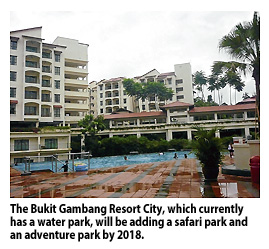
The Bukit Gambang Resort City, which has a gross domestic development value of RM1.8 billion, will be fully developed by 2018, says its developer Sentoria Group Bhd.
The resort city, which opened its doors two years ago, currently has a water theme park but more attractions are expected to be added soon.
"We are looking at adding a safari park, an aquaria and an adventure park, " said Sentoria Group Bhd joint managing director Datuk Gan Kim Leong after securing a grant of RM6.9 million to develop the second phase of the Bukit Gambang resort city yesterday.
He said the company was looking at starting work on the Bukit Gambang Safari Park as well as additional development under the Arabian Bay Resort, which has an estimated investment value of RM140 million.
On Sentoria's initial public offering, he said the company was expected to raise RM51.6 million, of which RM27.7 million would be allocated for working capital, RM11.2 million for repayment of bank borrowings, RM9 million for purchase of properties, plant and equipment and the balance RM3.7 million to defray listing expenses.
Applications for Sentoria's IPO will be closed at 5pm today and the company is expected to be listed on the Main Board in the first quarter of the year.
By Business Times
The resort city, which opened its doors two years ago, currently has a water theme park but more attractions are expected to be added soon.
"We are looking at adding a safari park, an aquaria and an adventure park, " said Sentoria Group Bhd joint managing director Datuk Gan Kim Leong after securing a grant of RM6.9 million to develop the second phase of the Bukit Gambang resort city yesterday.
He said the company was looking at starting work on the Bukit Gambang Safari Park as well as additional development under the Arabian Bay Resort, which has an estimated investment value of RM140 million.
On Sentoria's initial public offering, he said the company was expected to raise RM51.6 million, of which RM27.7 million would be allocated for working capital, RM11.2 million for repayment of bank borrowings, RM9 million for purchase of properties, plant and equipment and the balance RM3.7 million to defray listing expenses.
Applications for Sentoria's IPO will be closed at 5pm today and the company is expected to be listed on the Main Board in the first quarter of the year.
By Business Times
Labels:
Resort Property
The Wharf set to transform former light industrial area into mini metropolis
Big and bold: The Wharf Residence entrance.
CONVERTING and redeveloping an ageing light industrial area into an upmarket resort-inspired residential and commercial enclave is an arduous task, but not an impossible one.
Bolton Berhad, one of Malaysia’s oldest property developers, has proven in its transformation of the 140ha Taman Tasik Prima Puchong over the last 10 years. Taman Tasik Prima has emerged as one of the preferred townships in Puchong on the strength of Bolton’s meticulous planning and innovative product offerings.
The commercial component of the township, The Wharf — a fusion of modern architecture, green and water elements — is set to be the showpiece of suburban Kuala Lumpur. This integrated 3-in-1 commercial development is located at the fringes of a tranquil 81ha lake.
Comprising lakeview apartments, boutique showroom offices and a lifestyle mall inter-connected by intricate, contemporary and environmentally-driven architecture and design, The Wharf is set to transform the former light industrial area into a vibrant mini metropolis and live up to its promise of being the “Neighbourhood Lifestyle Des-tination”.
Bolton’s versatility and innovation has already received international recognition as The Wharf won an award for the Best Mixed Use category for Malaysia at the Asia Pacific Property Awards 2011.
An important factor leading to the impressive take-up rates at Taman Tasik Prima is Bolton’s track record in creating value and capital appreciation for its customers.
When Bolton began developing Taman Tasik Prima, the plan was to achieve RM500mil in gross development value (GDV).
Today, Taman Tasik Prima’s GDV is in excess of RM1bil, with The Wharf commercial development itself being valued at more than RM500mil.
The Wharf is sited on a 6ha tract of commercial land fronting Tasik Prima Puchong and flanked by existing prime landed properties as well as the Bizhub shopoffices.
The project was officially launched on Aug 20, 2010, with the BizWalk comprising 32 units of three-storey boutique showroom offices being the first product to be offered. With a minimum price tag of RM2.2mil and a GDV of RM81mil, BizWalk which boasted a unique design of 25ft wide frontage and each floor being a ground floor, was sold out almost immediately.
Its second product offering, The Wharf Residence was launched on Nov 12 last year.
Tower 8, the first block comprising 334 units offering built-up areas ranging from 795sq ft to 1,173sq ft, was designed with practicality and functionality in mind.
The lakeview apartments offer stylish and comfortable living spaces within a distinctive environment which offer full condominium facilities.
Well maintained: The swimming pool is one of the many facilities available at the Wharf Residence.
One of its unique features is the large external storage room for each unit, located on the respective floors, which is something that has not been offered before in the Puchong area.
Tower 8, which has GDV of RM120mil, is now 85% sold. The second tower, Tower 18, is now open for registration.
Due to the tremendous response of BizWalk, Bolton launched an innovative 2-in-1 commercial offering called “Flexi Suites” located on Levels 4 and 5 of BizWalk.
The 64 units strata offering is designed to suit the business and lifestyle needs of its intended market, where the owners have the flexibility of renting out, occupying or doing both, hence the 2-in-1 tagline. With an entrance foyer for every unit, and linked to the multi-storey car park giving each unit the feel of being a ground floor unit, the Flexi Suites are also receiving a tremendous response.
The upcoming The Wharf Retail Mall will further strengthen the appeal of The Wharf Residence, BizWalk and Flexi Suites.
The mall, which has 1,296 parking bays, is expected to be completed by 2013. There would be a link bridge from the apartments to the mall, providing integrated convenience to residents.
The Wharf Retail Mall is one of very few malls fronting a lake, and there is ample promenade space for events and alfresco dining.
The mall has already received many enquiries from potential anchor tenants.
This year, the company also plans to launch “Summerhomes”, its last landed lakeview residential development which comprises 58 units of three-storey townhouses and four units of 2½ semi-detached houses with a GDV of more than RM45mil.
Developments around shopping centres tend to appreciate in value due to the convenience, and by virtue of it being located next to The Wharf, Summerhomes is expected to be another hit for Bolton.
By The Star
CONVERTING and redeveloping an ageing light industrial area into an upmarket resort-inspired residential and commercial enclave is an arduous task, but not an impossible one.
Bolton Berhad, one of Malaysia’s oldest property developers, has proven in its transformation of the 140ha Taman Tasik Prima Puchong over the last 10 years. Taman Tasik Prima has emerged as one of the preferred townships in Puchong on the strength of Bolton’s meticulous planning and innovative product offerings.
The commercial component of the township, The Wharf — a fusion of modern architecture, green and water elements — is set to be the showpiece of suburban Kuala Lumpur. This integrated 3-in-1 commercial development is located at the fringes of a tranquil 81ha lake.
Comprising lakeview apartments, boutique showroom offices and a lifestyle mall inter-connected by intricate, contemporary and environmentally-driven architecture and design, The Wharf is set to transform the former light industrial area into a vibrant mini metropolis and live up to its promise of being the “Neighbourhood Lifestyle Des-tination”.
Bolton’s versatility and innovation has already received international recognition as The Wharf won an award for the Best Mixed Use category for Malaysia at the Asia Pacific Property Awards 2011.
An important factor leading to the impressive take-up rates at Taman Tasik Prima is Bolton’s track record in creating value and capital appreciation for its customers.
When Bolton began developing Taman Tasik Prima, the plan was to achieve RM500mil in gross development value (GDV).
Today, Taman Tasik Prima’s GDV is in excess of RM1bil, with The Wharf commercial development itself being valued at more than RM500mil.
The Wharf is sited on a 6ha tract of commercial land fronting Tasik Prima Puchong and flanked by existing prime landed properties as well as the Bizhub shopoffices.
The project was officially launched on Aug 20, 2010, with the BizWalk comprising 32 units of three-storey boutique showroom offices being the first product to be offered. With a minimum price tag of RM2.2mil and a GDV of RM81mil, BizWalk which boasted a unique design of 25ft wide frontage and each floor being a ground floor, was sold out almost immediately.
Its second product offering, The Wharf Residence was launched on Nov 12 last year.
Tower 8, the first block comprising 334 units offering built-up areas ranging from 795sq ft to 1,173sq ft, was designed with practicality and functionality in mind.
The lakeview apartments offer stylish and comfortable living spaces within a distinctive environment which offer full condominium facilities.
Well maintained: The swimming pool is one of the many facilities available at the Wharf Residence.
One of its unique features is the large external storage room for each unit, located on the respective floors, which is something that has not been offered before in the Puchong area.
Tower 8, which has GDV of RM120mil, is now 85% sold. The second tower, Tower 18, is now open for registration.
Due to the tremendous response of BizWalk, Bolton launched an innovative 2-in-1 commercial offering called “Flexi Suites” located on Levels 4 and 5 of BizWalk.
The 64 units strata offering is designed to suit the business and lifestyle needs of its intended market, where the owners have the flexibility of renting out, occupying or doing both, hence the 2-in-1 tagline. With an entrance foyer for every unit, and linked to the multi-storey car park giving each unit the feel of being a ground floor unit, the Flexi Suites are also receiving a tremendous response.
The upcoming The Wharf Retail Mall will further strengthen the appeal of The Wharf Residence, BizWalk and Flexi Suites.
The mall, which has 1,296 parking bays, is expected to be completed by 2013. There would be a link bridge from the apartments to the mall, providing integrated convenience to residents.
The Wharf Retail Mall is one of very few malls fronting a lake, and there is ample promenade space for events and alfresco dining.
The mall has already received many enquiries from potential anchor tenants.
This year, the company also plans to launch “Summerhomes”, its last landed lakeview residential development which comprises 58 units of three-storey townhouses and four units of 2½ semi-detached houses with a GDV of more than RM45mil.
Developments around shopping centres tend to appreciate in value due to the convenience, and by virtue of it being located next to The Wharf, Summerhomes is expected to be another hit for Bolton.
By The Star
Johor in RM80bil joint venture with Lim to build waterfront city
JOHOR BARU: Johor Baru's coastline fronting Singapore is in for a major transformation that will have a gross development value (GDV) of some RM80bil and led by a joint venture between the Johor state and businessman Datuk Lim Kang Hoo.
A new vehicle called Iskandar Waterfront Holdings Bhd (IWH) is being created and it would be injected with massive landbank hitherto mainly owned by the Johor state and Lim. As a result of these injections, Lim would have 60% of IWH while the Johor state, through its vehicle Kumpulan Prasarana Rakyat Johor (KPRJ), would hold the remaining 40%.
The straight-talking Lim, who granted StarBiz an interview after numerous calls were made to his office, also didn't rule out the listing of IWH.
“We are still preparing for it ... One day it will be listed,” he said at his modest office in downtown Johor Baru.
StarBiz interview with Lim: ‘The partnership we have entered into is driven to enhance the development of the southern tip of Johor which is the gateway to Malaysia from Singapore.’ – By ABDUL RAHMAN EMBONG/Starpic
He said the development would be undertaken over several years and would become a major economic engine of growth for the state.
IWH will oversee the development of the valuable landbank stretching 3,000 acres from west to east of southern Johor Baru to be transformed into an integrated waterfront city.
One of the assets being acquired by IWH was a 33.15% stake in Tebrau Teguh Bhd held by KPRJ. This led to concerns that the state was hiving off its assets to Lim.
“It's a misperception. This is a consolidation exercise to put all the landbank into the holding company. In the end, what KPRJ will have is joint ownership of a much larger pie than what it had before,” he said.
“We and KPRJ are the master developers and we will take charge of the development of Danga Bay, Iskandar Waterfront, Tebrau Coast and the central business district development in Johor.
“To have a project of this size, the need for a strategic partnership with the state is necessary,” Lim said.
The entire waterfront project is part of flagship A of the massive Iskandar Malaysia development, which is spearheaded by Khazanah Nasional Bhd.
“The partnership we have entered into is driven to enhance the development of the southern tip of Johor which is the gateway to Malaysia from Singapore,” Lim said.
A key component of the project is for IWH to attract established world class developers to undertake different parcels. These parties are also expected to part fund the entire development, bringing in the much needed foreign direct investment, said Lim.
“We are aggressively trying to attract more local and foreign developers to invest in Johor. We are not into building townships but we want property developers to be our clients to develop the landbank we have,” he said.
The company has attracted developers such as Dijaya Corp Bhd, Singapore's Azea Residences, Plazzo Hotels & Service, Waz Lian Group, Tune Hotel and Australia's Walker Group.
It has been reported that Dijaya has committed to invest RM3.8bil to build a high-end mixed development while Singapore's Azea Residences will work on four blocks of high-end apartments at a cost of over RM500mil. Australia's Walker Group has also partnered with IWH to develop Senibong Cove into a high-end residential development modelled after the Hope Island project in Australia's Gold Coast.
Lim said the project had received enquiries almost on a daily basis from both local and foreign developers.
“The interest level we see now is nothing like what we have seen in the past 15 years. We are swamped with serious enquiries and over the past year we have seen every developer from Malaysia going to Johor Baru and also some very big names from abroad,” he said.
By The Star
A new vehicle called Iskandar Waterfront Holdings Bhd (IWH) is being created and it would be injected with massive landbank hitherto mainly owned by the Johor state and Lim. As a result of these injections, Lim would have 60% of IWH while the Johor state, through its vehicle Kumpulan Prasarana Rakyat Johor (KPRJ), would hold the remaining 40%.
The straight-talking Lim, who granted StarBiz an interview after numerous calls were made to his office, also didn't rule out the listing of IWH.
“We are still preparing for it ... One day it will be listed,” he said at his modest office in downtown Johor Baru.
StarBiz interview with Lim: ‘The partnership we have entered into is driven to enhance the development of the southern tip of Johor which is the gateway to Malaysia from Singapore.’ – By ABDUL RAHMAN EMBONG/Starpic
He said the development would be undertaken over several years and would become a major economic engine of growth for the state.
IWH will oversee the development of the valuable landbank stretching 3,000 acres from west to east of southern Johor Baru to be transformed into an integrated waterfront city.
One of the assets being acquired by IWH was a 33.15% stake in Tebrau Teguh Bhd held by KPRJ. This led to concerns that the state was hiving off its assets to Lim.
“It's a misperception. This is a consolidation exercise to put all the landbank into the holding company. In the end, what KPRJ will have is joint ownership of a much larger pie than what it had before,” he said.
“We and KPRJ are the master developers and we will take charge of the development of Danga Bay, Iskandar Waterfront, Tebrau Coast and the central business district development in Johor.
“To have a project of this size, the need for a strategic partnership with the state is necessary,” Lim said.
The entire waterfront project is part of flagship A of the massive Iskandar Malaysia development, which is spearheaded by Khazanah Nasional Bhd.
“The partnership we have entered into is driven to enhance the development of the southern tip of Johor which is the gateway to Malaysia from Singapore,” Lim said.
A key component of the project is for IWH to attract established world class developers to undertake different parcels. These parties are also expected to part fund the entire development, bringing in the much needed foreign direct investment, said Lim.
“We are aggressively trying to attract more local and foreign developers to invest in Johor. We are not into building townships but we want property developers to be our clients to develop the landbank we have,” he said.
The company has attracted developers such as Dijaya Corp Bhd, Singapore's Azea Residences, Plazzo Hotels & Service, Waz Lian Group, Tune Hotel and Australia's Walker Group.
It has been reported that Dijaya has committed to invest RM3.8bil to build a high-end mixed development while Singapore's Azea Residences will work on four blocks of high-end apartments at a cost of over RM500mil. Australia's Walker Group has also partnered with IWH to develop Senibong Cove into a high-end residential development modelled after the Hope Island project in Australia's Gold Coast.
Lim said the project had received enquiries almost on a daily basis from both local and foreign developers.
“The interest level we see now is nothing like what we have seen in the past 15 years. We are swamped with serious enquiries and over the past year we have seen every developer from Malaysia going to Johor Baru and also some very big names from abroad,” he said.
By The Star
Labels:
Johor Bahru,
Mixed Development
Hua Yang to set aside RM100mil to expand landbank
PETALING JAYA: Property developer Hua Yang Bhd is setting aside RM100mil to go on a landbank acquisition spree for its financial year ending March 31, 2013, and is aiming to develop projects worth RM800mil to RM1bil in gross developmental value from the land acquired.
“We have set aside RM30mil of our own internal resources as capital expenditure, and is planning to raise another RM100mil to support our plans for land acquisition,” said Hua Yang chief executive officer Ho Wen Yan. However, he said the company had not decided on the specific exercise to raise the amount needed.
Ho said the company spent only about RM56mil last year to expand its landbank as land sales were difficult to complete as bullish market sentiments held back buyers who were holding out for a better price.
Ho: ‘Investors can expect better dividends this year.’
“I hope to secure more land this year, and the money we intend to raise would definitely be done by 2013,” he said.
Besides targeting more land in Penang and Perak, the company is also eyeing land in east Malaysia, especially Kota Kinabalu, Sabah.
Currently, the company has a total landbank of 787 acres worth a gross development value of RM2.4bil.
Speaking on the outlook of the property market, Ho said the affordable housing sector would still remain strong driven by demand of for properties ranging RM400,000 and below. “While other segments of the market might experience some softening especially high end areas in the Kuala Lumpur city centre, and also pockets in the Klang Valley where prices had gone up quicker than the others,” he said.
For its nine-month period ended Dec 31, 2011, the company achieved a net profit of RM39.9mil, an increase of 136% from RM16.9mil when compared with the previous corresponding period. Revenue grew by 82% to RM222.1mil from RM122.1mil previously.
The company is set to deliver another record year as its financial performance for its nine-month period had surpassed what was achieved for the full financial year of 2011.
“Investors can expect better dividends than last year, as based on current results, 2012 will be better than the previous year,” he said.
By The Star
“We have set aside RM30mil of our own internal resources as capital expenditure, and is planning to raise another RM100mil to support our plans for land acquisition,” said Hua Yang chief executive officer Ho Wen Yan. However, he said the company had not decided on the specific exercise to raise the amount needed.
Ho said the company spent only about RM56mil last year to expand its landbank as land sales were difficult to complete as bullish market sentiments held back buyers who were holding out for a better price.
Ho: ‘Investors can expect better dividends this year.’
“I hope to secure more land this year, and the money we intend to raise would definitely be done by 2013,” he said.
Besides targeting more land in Penang and Perak, the company is also eyeing land in east Malaysia, especially Kota Kinabalu, Sabah.
Currently, the company has a total landbank of 787 acres worth a gross development value of RM2.4bil.
Speaking on the outlook of the property market, Ho said the affordable housing sector would still remain strong driven by demand of for properties ranging RM400,000 and below. “While other segments of the market might experience some softening especially high end areas in the Kuala Lumpur city centre, and also pockets in the Klang Valley where prices had gone up quicker than the others,” he said.
For its nine-month period ended Dec 31, 2011, the company achieved a net profit of RM39.9mil, an increase of 136% from RM16.9mil when compared with the previous corresponding period. Revenue grew by 82% to RM222.1mil from RM122.1mil previously.
The company is set to deliver another record year as its financial performance for its nine-month period had surpassed what was achieved for the full financial year of 2011.
“Investors can expect better dividends than last year, as based on current results, 2012 will be better than the previous year,” he said.
By The Star
Labels:
Land,
Property Market
Thursday, February 9, 2012
Dream homes remain a dream
Stalled: In the past years, these only visible sign of development were the concrete beams for Casa Gemilang in Sg Pusu, Gombak.
For the property buyers of Alam Perdana Court in Ijok and Casa Gemilang in Gombak, their dream home is still far from reality.
They have laboured through many years to resolve the issues surrounding the projects.
The buyers were caught by surprise that the land in both development was marked for agricultural purpose instead of residential, and this status has left them in limbo until today.
The Casa Gemilang project consists of Desa Gemilang double-storey terrace houses and Casa Gemilang service apartments and townhouses launched in 2003.
Phase 1 of Desa Gemilang ran into trouble over the environmental impact as it was sited next to a slope and encroaching into a forest reserve.
A stop-work order was issued by Selayang Municipal Council in 2006.
Casa Gemilang buyers committee chairman Jaafar Ismail said the developer faced many issues, hence the project dragged on for many years as the company failed to comply with safety standards.
“Unfortunately, according to the Housing Development Act 1966, townhouse comes under commercial development, therefore it does not fall under the purview of the Housing and Local Government Ministry (KPKT) before 2007.
“However, our main question is how did the developer manage to develop a project on agricultural land,” he asked.
Jaafar said 40% of disbursement had been paid out by the bank, which came up to about RM6mil, but there is no construction at the site for Casa Gemilang.
“The project was marked as abandoned by KPKT on Jan 9, 2009 and the ministry had been unable to help us.
“ We want to know what happened to our money totalling RM6mil paid via disbursement, because the project does not seem like it will ever take off based on what we have seen so far,” he said.
“We staged a protest in front of the developer’s office on Jan 18, 2011 as patience was running thin.
“At the time, the developer agreed to return the deposit and payments made for those whose sale and purchase agreement was still valid.
“But the developer tried to get buyers to sign the Deed of Rescission and Revocation that was never referred to the bank and was biased so we advised the buyers not to sign anything,” he added.
For Dr Roslina Ab Wahid, chairman of the Alam Perdana Court bungalow lot purchasers group, her woes began in 2002 when she purchased a lot and the developer failed to pay the premium to develop the land.
The project consisted of bungalows, single-storey and double-storey houses spread over 400ha of land, affecting some 400 buyers. Although part of the development had been completed, the project was abandoned.
“I had purchased a bungalow package worth almost RM100,000 only to find out that it does not belong to me.
“The land was confiscated by the state government in November last year. Now the state government is trying to revive the project and make it livable as it is full of defects.
“The state government said the houses will be delivered in March while the plight of the lot purchasers woudl be looked into after the infrastructure on site is fixed,” said Roslina.
At a recent meeting with the buyers, Selangor Mentri Besar Tan Sri Khalid Ibrahim said the state had paid RM147mil to acquire the land for the stalled Taman Alam Perdana development from developer Ladang Bukit Cherakah Nominees Sdn Bhd (LCBN), so that construction of the houses could resume.
An additional RM40mil was allocated to complete the infrastructure for the project last year.
The Association for Abandoned Building Owners Malaysia (Victims) chairman Dr Mohamed Rafick Khan Abdul Rahman said the root of this problem was the weakness of the Housing Development Act as well as the lack of regulation and enforcement by the authorities.
He said it was a common practice by developers back then to develop land without conversion, leaving that process till later when construction work was ongoing.
“Since land is a state matter, the state government can impose a deposit payment on developers as a condition if they want to develop any land. The state can determine the value of the land before development commences; should the developer fail, the money can be used for the project.
“In the case of Alam Perdana Court, the state government could have taken legal steps jointly with the buyers or resolved the issue of the bungalow lots immediately by getting the buyers to pay the premium and issue the title,” he said.
By The Star
For the property buyers of Alam Perdana Court in Ijok and Casa Gemilang in Gombak, their dream home is still far from reality.
They have laboured through many years to resolve the issues surrounding the projects.
The buyers were caught by surprise that the land in both development was marked for agricultural purpose instead of residential, and this status has left them in limbo until today.
The Casa Gemilang project consists of Desa Gemilang double-storey terrace houses and Casa Gemilang service apartments and townhouses launched in 2003.
Phase 1 of Desa Gemilang ran into trouble over the environmental impact as it was sited next to a slope and encroaching into a forest reserve.
A stop-work order was issued by Selayang Municipal Council in 2006.
Casa Gemilang buyers committee chairman Jaafar Ismail said the developer faced many issues, hence the project dragged on for many years as the company failed to comply with safety standards.
“Unfortunately, according to the Housing Development Act 1966, townhouse comes under commercial development, therefore it does not fall under the purview of the Housing and Local Government Ministry (KPKT) before 2007.
“However, our main question is how did the developer manage to develop a project on agricultural land,” he asked.
Jaafar said 40% of disbursement had been paid out by the bank, which came up to about RM6mil, but there is no construction at the site for Casa Gemilang.
“The project was marked as abandoned by KPKT on Jan 9, 2009 and the ministry had been unable to help us.
“ We want to know what happened to our money totalling RM6mil paid via disbursement, because the project does not seem like it will ever take off based on what we have seen so far,” he said.
“We staged a protest in front of the developer’s office on Jan 18, 2011 as patience was running thin.
“At the time, the developer agreed to return the deposit and payments made for those whose sale and purchase agreement was still valid.
“But the developer tried to get buyers to sign the Deed of Rescission and Revocation that was never referred to the bank and was biased so we advised the buyers not to sign anything,” he added.
For Dr Roslina Ab Wahid, chairman of the Alam Perdana Court bungalow lot purchasers group, her woes began in 2002 when she purchased a lot and the developer failed to pay the premium to develop the land.
The project consisted of bungalows, single-storey and double-storey houses spread over 400ha of land, affecting some 400 buyers. Although part of the development had been completed, the project was abandoned.
“I had purchased a bungalow package worth almost RM100,000 only to find out that it does not belong to me.
“The land was confiscated by the state government in November last year. Now the state government is trying to revive the project and make it livable as it is full of defects.
“The state government said the houses will be delivered in March while the plight of the lot purchasers woudl be looked into after the infrastructure on site is fixed,” said Roslina.
At a recent meeting with the buyers, Selangor Mentri Besar Tan Sri Khalid Ibrahim said the state had paid RM147mil to acquire the land for the stalled Taman Alam Perdana development from developer Ladang Bukit Cherakah Nominees Sdn Bhd (LCBN), so that construction of the houses could resume.
An additional RM40mil was allocated to complete the infrastructure for the project last year.
The Association for Abandoned Building Owners Malaysia (Victims) chairman Dr Mohamed Rafick Khan Abdul Rahman said the root of this problem was the weakness of the Housing Development Act as well as the lack of regulation and enforcement by the authorities.
He said it was a common practice by developers back then to develop land without conversion, leaving that process till later when construction work was ongoing.
“Since land is a state matter, the state government can impose a deposit payment on developers as a condition if they want to develop any land. The state can determine the value of the land before development commences; should the developer fail, the money can be used for the project.
“In the case of Alam Perdana Court, the state government could have taken legal steps jointly with the buyers or resolved the issue of the bungalow lots immediately by getting the buyers to pay the premium and issue the title,” he said.
By The Star
Labels:
Property Market
100% loans but few homebuyers
KOTA KINABALU: Sabahans have yet to tap into the Government’s My First Home scheme that enables young Malaysians to own a home.
The response to the scheme has been lukewarm despite potential buyers being offered 100% loans, Deputy Housing and Local Government Minister Datuk Lajim Ukin said.
He said at the Federal level, the scheme was coordinated by the Finance Ministry through an appointed agency while at state level, it was handled by the state government.
“I am sure the state government has taken proactive steps to get the scheme rolling in Sabah and also impart information about it to the younger generation through various departments and agencies in the state,” he said after attending a ground-breaking ceremony for a mosque in Kampung Melabau, Beaufort, yesterday.
Lajim said under the 2012 Budget, the Federal Government had increased the eligibility of buyers earning from RM3,000 to RM6,000 and also increased the value of houses from RM200,000 to RM400,000.
He said the new eligibility under the scheme had been effective since Jan 1.
He said the scheme was to help the younger generation entering the job market to buy an affordable house.
By The Star
The response to the scheme has been lukewarm despite potential buyers being offered 100% loans, Deputy Housing and Local Government Minister Datuk Lajim Ukin said.
He said at the Federal level, the scheme was coordinated by the Finance Ministry through an appointed agency while at state level, it was handled by the state government.
“I am sure the state government has taken proactive steps to get the scheme rolling in Sabah and also impart information about it to the younger generation through various departments and agencies in the state,” he said after attending a ground-breaking ceremony for a mosque in Kampung Melabau, Beaufort, yesterday.
Lajim said under the 2012 Budget, the Federal Government had increased the eligibility of buyers earning from RM3,000 to RM6,000 and also increased the value of houses from RM200,000 to RM400,000.
He said the new eligibility under the scheme had been effective since Jan 1.
He said the scheme was to help the younger generation entering the job market to buy an affordable house.
By The Star
Labels:
Home Financing
Developer: We have been victimised by state policy
The developer of Casa Gemilang in Sungai Pusu, Gombak said they have been victimised by the policy of state government, resulting in the project being delayed.
Gemilang Excel Holdings Sdn Bhd administrative manager Azman Rosdi said the company was stuck between a rock and a hard place.
He said the state government had approved the development but it was also one that contributed to the delay factor, thus causing the chain of events.
In July 2006, the developer was slapped with a stop-work order following a landslide in Kampung Pasir.
The order was issued to all development near hillsides, which affected Desa Gemilang and Casa Gemilang.
“We held a series of meeting with the state because we had to meet our deadline by 2008 for the project, but the state upheld its policy. We told them that we buyers are bound by an agreement to about 200 but in the end we had to comply with the order.
“In 2009, we made an appeal and the stop-work order was revoked. We resumed work on the site but the banks did not want to pay the progress claims because of the economic crisis and they said the project was not viable.
“We could not resume construction without any payment, so we had issued a notice to terminate the sale and purchase agreement (S&P) to some of the property buyers.
“The 40% of disbursement money had already been used for site clearing, earthworks and piling. We are still here trying to find a solution to this,” he added.
Azman said the buyers were offered a refund for the project but they had to terminate the earlier S&P.
“We contacted the buyers to sign the Deed of Rescission, which some signed, and the money will be reimbursed within 24 months. We have not received any offer from the state government or agencies pertaining to the project; they told us to just fix the problem,” he said.
Azman also clarified the issue of building on agricultural land, stating that they had filed an application simultaneously to change the land status to residential and bordering under the Land Code Section 124A for Gombak district to the Selangor Land Office in October 2005.
He said if people conducted a search on the status now, the land would still be classified as agricultural because the change would be applicable only when individual titles were given out.
“We have paid the premium for the land and the state government then had approved the change of land usage on Nov 29, 2004. Everything has been done according to the law.
“As for the encroachment into the buffer zone, that was for us to carry out slope-stabilising work and the developer’s land and the reserve were bordering each other.
“We had written to the Forestry Department for permission but no response was ever given even after nine months of waiting, so we went ahead with the works as it was the monsoon season,” he said.
At present, Azman said the company was looking for interested parties who wanted to buy over the project but it had to be done accordingly.
By The Star
Gemilang Excel Holdings Sdn Bhd administrative manager Azman Rosdi said the company was stuck between a rock and a hard place.
He said the state government had approved the development but it was also one that contributed to the delay factor, thus causing the chain of events.
In July 2006, the developer was slapped with a stop-work order following a landslide in Kampung Pasir.
The order was issued to all development near hillsides, which affected Desa Gemilang and Casa Gemilang.
“We held a series of meeting with the state because we had to meet our deadline by 2008 for the project, but the state upheld its policy. We told them that we buyers are bound by an agreement to about 200 but in the end we had to comply with the order.
“In 2009, we made an appeal and the stop-work order was revoked. We resumed work on the site but the banks did not want to pay the progress claims because of the economic crisis and they said the project was not viable.
“We could not resume construction without any payment, so we had issued a notice to terminate the sale and purchase agreement (S&P) to some of the property buyers.
“The 40% of disbursement money had already been used for site clearing, earthworks and piling. We are still here trying to find a solution to this,” he added.
Azman said the buyers were offered a refund for the project but they had to terminate the earlier S&P.
“We contacted the buyers to sign the Deed of Rescission, which some signed, and the money will be reimbursed within 24 months. We have not received any offer from the state government or agencies pertaining to the project; they told us to just fix the problem,” he said.
Azman also clarified the issue of building on agricultural land, stating that they had filed an application simultaneously to change the land status to residential and bordering under the Land Code Section 124A for Gombak district to the Selangor Land Office in October 2005.
He said if people conducted a search on the status now, the land would still be classified as agricultural because the change would be applicable only when individual titles were given out.
“We have paid the premium for the land and the state government then had approved the change of land usage on Nov 29, 2004. Everything has been done according to the law.
“As for the encroachment into the buffer zone, that was for us to carry out slope-stabilising work and the developer’s land and the reserve were bordering each other.
“We had written to the Forestry Department for permission but no response was ever given even after nine months of waiting, so we went ahead with the works as it was the monsoon season,” he said.
At present, Azman said the company was looking for interested parties who wanted to buy over the project but it had to be done accordingly.
By The Star
Labels:
Miscellaneous
Pavilion REIT posts RM12.4m Q4 net profit
KUALA LUMPUR: Pavilion Real Estate Investment Trust (REIT) posted a net profit of RM12.4mil for the fourth quarter ended Dec 31, 2011 on revenue of RM22.5mil.
Pavilion REIT was listed on Bursa Malaysia on Dec 7, 2011.
In the notes accompanying its results, Pavilion REIT said gross revenue for the period totalled RM22.5mil and net property income was RM16.3mil.
Management fees and borrowing costs incurred during the period were RM1.2mil and RM2.3mil respectively resulting in income before taxation of RM12.4mil.
Its distributable income for the period under review amounted to RM13.1mil, or 0.44 sen per unit, consisting of realised income of RM12.4mil and non-cash adjustments of depreciation, amortisation of borrowings transaction cost of RM100,000 and surplus cash arising from 50% of manager's management fee payable in units of RM600,000.
By The Star
Pavilion REIT was listed on Bursa Malaysia on Dec 7, 2011.
In the notes accompanying its results, Pavilion REIT said gross revenue for the period totalled RM22.5mil and net property income was RM16.3mil.
Management fees and borrowing costs incurred during the period were RM1.2mil and RM2.3mil respectively resulting in income before taxation of RM12.4mil.
Its distributable income for the period under review amounted to RM13.1mil, or 0.44 sen per unit, consisting of realised income of RM12.4mil and non-cash adjustments of depreciation, amortisation of borrowings transaction cost of RM100,000 and surplus cash arising from 50% of manager's management fee payable in units of RM600,000.
By The Star
Labels:
REIT / Property Investment
Wednesday, February 8, 2012
Plan for RM13b Danga Bay waterfront project
JOHOR BARU: Businessman Datuk Lim Kang Hoo, who recently made a privatisation bid for developer Tebrau Teguh Bhd, is planning a more than RM13 billion project at Danga Bay here.
The soon-to-be-launched project is billed as the most exclusive and unique waterfront development in Iskandar Malaysia southern economic corridor over the next five years.
It will spread over 120 hectares at the estuaries of three rivers at the Danga Bay.
The Danga Bay waterfront development is an important component in one of the flagship developments in Iskandar Malaysia.
The site of the mega development is at two small peninsulas opposite the Danga Bay. The peninsulas are almost parallel to Sungai Sku-dai, Sungai Danga and Sungai Melayu.
Five commercial epicentres have been planned for the riverine development combining the best of the east and west cultural heritage which is set to become the jewel in the economic region.
The total project cost for the five epicentres, named The Venice, The Gateway, The Rivera, The Bund and The Fisherman Wharf, are estimated at RM13.4 billion.
The 120ha project is part of the 800ha earmarked for the Danga Bay waterfront development.
The development will be handled by Iskandar Waterfront Holdings Sdn Bhd (IWH).
Lim, who is IWH chief executive officer, said the projects are conceived to inject life into the integrated waterfront development, aiming to attract both tourists and investors.
"We welcome investors to take part in the development, either through joint venture with us, or on their own but based on our masterplan.
"Our products will be totally different from what you would find in Singapore, as our purpose is not to compete with them, but to complement them by offering something which are truly unique so as to attract their interest," Lim told the Business Times at his office here recently.
From what the names suggest, one does not need to travel far to Venice and Shanghai Bund to see the tourist destinations as both will be as near as the doorstep in future.
The Venice is one of the most interesting features in the waterfront developments as it will simulate the real topography and architectural design of the Italian city, which are canals running across rows of Venetian-style buildings.
Among the features in The Venice, which will be turned into a sleepless city, are a riverside promenade, a lifestyle street mall with a waterfront alfresco and entertainment outlets, a lifestyle street mall, hotels, apartments, among others.
The Venice will incorporate several watergates to control water level and quality.
Meanwhile, The Bund will showcase a lifestyle cultural village with water alfresco and entertainment outlets, apartments, hotels, among others.
The Fisherman Wharf is the most expensive project, costing RM3.9 billion and is aimed at complementing the existing tourism products available at the Johor Straits, which are kelongs (offshore fish cages).
Phase one of the project will see the development of apartments and sky villa while phase two will have a maritime museum, a riverfront boardwalk and wharf, and a fish auction plaza, together with hotels and thematic retail shops.
The development will simulate the setting of the fishermen wharfs in Cape Town, Norway and San Francisco, but in a modern architectural setting to reflect the localised culture.
Both The Gateway and the Rivera will have apartments, retail shoplots and hotels at the waterfront.
By Business Times
The soon-to-be-launched project is billed as the most exclusive and unique waterfront development in Iskandar Malaysia southern economic corridor over the next five years.
It will spread over 120 hectares at the estuaries of three rivers at the Danga Bay.
The Danga Bay waterfront development is an important component in one of the flagship developments in Iskandar Malaysia.
The site of the mega development is at two small peninsulas opposite the Danga Bay. The peninsulas are almost parallel to Sungai Sku-dai, Sungai Danga and Sungai Melayu.
Five commercial epicentres have been planned for the riverine development combining the best of the east and west cultural heritage which is set to become the jewel in the economic region.
The total project cost for the five epicentres, named The Venice, The Gateway, The Rivera, The Bund and The Fisherman Wharf, are estimated at RM13.4 billion.
The 120ha project is part of the 800ha earmarked for the Danga Bay waterfront development.
The development will be handled by Iskandar Waterfront Holdings Sdn Bhd (IWH).
Lim, who is IWH chief executive officer, said the projects are conceived to inject life into the integrated waterfront development, aiming to attract both tourists and investors.
"We welcome investors to take part in the development, either through joint venture with us, or on their own but based on our masterplan.
"Our products will be totally different from what you would find in Singapore, as our purpose is not to compete with them, but to complement them by offering something which are truly unique so as to attract their interest," Lim told the Business Times at his office here recently.
From what the names suggest, one does not need to travel far to Venice and Shanghai Bund to see the tourist destinations as both will be as near as the doorstep in future.
The Venice is one of the most interesting features in the waterfront developments as it will simulate the real topography and architectural design of the Italian city, which are canals running across rows of Venetian-style buildings.
Among the features in The Venice, which will be turned into a sleepless city, are a riverside promenade, a lifestyle street mall with a waterfront alfresco and entertainment outlets, a lifestyle street mall, hotels, apartments, among others.
The Venice will incorporate several watergates to control water level and quality.
Meanwhile, The Bund will showcase a lifestyle cultural village with water alfresco and entertainment outlets, apartments, hotels, among others.
The Fisherman Wharf is the most expensive project, costing RM3.9 billion and is aimed at complementing the existing tourism products available at the Johor Straits, which are kelongs (offshore fish cages).
Phase one of the project will see the development of apartments and sky villa while phase two will have a maritime museum, a riverfront boardwalk and wharf, and a fish auction plaza, together with hotels and thematic retail shops.
The development will simulate the setting of the fishermen wharfs in Cape Town, Norway and San Francisco, but in a modern architectural setting to reflect the localised culture.
Both The Gateway and the Rivera will have apartments, retail shoplots and hotels at the waterfront.
By Business Times
Seri Chenang Resort draws strong response
SERI Chenang Resort & Spa Langkawi will be the newest addition to the Island of Legends when it opens this Labour Day and if forward bookings are anything to go by, this luxury boutique hotel has proven to be quite popular.
It has managed to secure full occupancy for the months of May, June and July 2012.
This 13-room hotel will be operated by brother and sister team Mohammad Shukor and Norlin Zainal Abidin.
The resort is being developed by SCRL Properties Sdn Bhd on the land belonging to the duo's father Datuk Zainal Abidin.
In 2009, Norlin then aged 35 and her brother 28 took on the challenge to develop and manage the hotel, instead of leaving the land undeveloped.
Norlin, who has only a shopping complex management experience, had then decided to be a hotelier.
Located on a 0.53ha of land on Kuala Chenang River next to the popular Chenang Beach, the investment into the hotel and land is to the tune of RM5 million.
Seri Chenang will comprise of six villas, each designed like traditional Malay houses from different states including Negeri Sembilan, Terengganu, Kedah, Pahang, Malacca and Selangor.
The smallest villa, a one-bedroom unit, measures about 113 sq m for a studio villa and the largest, a five bedroom unit, measures 393 sq m.
"It's set in a traditional style but equipped with modern amenities," she said.
The resort is for anyone who appreciates tradition in today's modern luxury living.
It will be marketed in Europe, Australia, Japan and Korea.
The resort's focus will be on personalised service from pre-arrival to post-departure.
"The general manager will greet each guest at the airport," she said.
Despite an encouraging response in the first three months of operations, Norlin prefers to be cautious about performance in the first year of operations.
"In the first year, we expect to achieve over 50 per cent occupancy and average room rate of RM1,700. In the second year, we are looking at an average occupancy of 70 per cent and an ARR of RM1,900," she said.
The hotel is expected to run at a gross operating profit (GOP) of 50 per cent. The GOP is the cost of doing business or gross revenue (from rooms, food and beverage, laundry or business centre) minus cost of operations (wages, electricity and amenities).
Accordingly, Norlin expects return on investment could take between five and seven years.
In keeping with the Seri Chenang theme, the resort will have a spa, Kayangan Spa, which provides traditional treatments.
While the hotel does not have a beach front, it is a mere five minutes away and there is free shuttle service to and from the beach.
By Business Times
It has managed to secure full occupancy for the months of May, June and July 2012.
This 13-room hotel will be operated by brother and sister team Mohammad Shukor and Norlin Zainal Abidin.
The resort is being developed by SCRL Properties Sdn Bhd on the land belonging to the duo's father Datuk Zainal Abidin.
In 2009, Norlin then aged 35 and her brother 28 took on the challenge to develop and manage the hotel, instead of leaving the land undeveloped.
Norlin, who has only a shopping complex management experience, had then decided to be a hotelier.
Located on a 0.53ha of land on Kuala Chenang River next to the popular Chenang Beach, the investment into the hotel and land is to the tune of RM5 million.
Seri Chenang will comprise of six villas, each designed like traditional Malay houses from different states including Negeri Sembilan, Terengganu, Kedah, Pahang, Malacca and Selangor.
The smallest villa, a one-bedroom unit, measures about 113 sq m for a studio villa and the largest, a five bedroom unit, measures 393 sq m.
"It's set in a traditional style but equipped with modern amenities," she said.
The resort is for anyone who appreciates tradition in today's modern luxury living.
It will be marketed in Europe, Australia, Japan and Korea.
The resort's focus will be on personalised service from pre-arrival to post-departure.
"The general manager will greet each guest at the airport," she said.
Despite an encouraging response in the first three months of operations, Norlin prefers to be cautious about performance in the first year of operations.
"In the first year, we expect to achieve over 50 per cent occupancy and average room rate of RM1,700. In the second year, we are looking at an average occupancy of 70 per cent and an ARR of RM1,900," she said.
The hotel is expected to run at a gross operating profit (GOP) of 50 per cent. The GOP is the cost of doing business or gross revenue (from rooms, food and beverage, laundry or business centre) minus cost of operations (wages, electricity and amenities).
Accordingly, Norlin expects return on investment could take between five and seven years.
In keeping with the Seri Chenang theme, the resort will have a spa, Kayangan Spa, which provides traditional treatments.
While the hotel does not have a beach front, it is a mere five minutes away and there is free shuttle service to and from the beach.
By Business Times
Labels:
Kedah,
Langkawi,
Resort Property
Johor Premium Outlets attract more brands into Johor Baru
New concept: Shoppers walking past some stores at the Johor Premium Outlets.
JOHOR BARU: The opening of the Johor Premium Outlets (JPO) late last year has created much interest among many Malaysian shoppers who are still new to the shopping concept.
Southern region representative of the Malaysian Association for Shopping and High Rise Complex Management Jenny Chan said since it was a new shopping format, it would take time for shoppers to adapt and adopt.
She said the luxury premium brand outlet format might not be new for Malaysians who had visited similar outlets overseas, but not for those who had never patronised such outlets before. “JPO is targeting at a specific group of shoppers hunting for reasonably priced quality and branded items,'' Chan said in an interview with StarBiz.
JPO is the only such outlet in South-East Asia, while 58 other outlets are in the United States, one in Puerto Rico, one in Mexico, eight in Japan and two in South Korea.
Among the brands avaialable at JPO are Armani, Burberry, Canali, Coach, Ermenegildo Zegna, Guess, Michael Kors, Ralph Lauren and Salvatore Ferragamo.
The outlet is a 50:50 joint venture between Genting Bhd's subsidiary Genting Plantations Bhd and Premium Outlets, the retail outlet division of Simon Property Group Inc.
Under the second phase of its development, Genting plans to spend RM100mil to increase the number of stores from the present 70 to 130.
The company is also expected to invest up to RM1bil to develop the area, including constructing a 2,000-room hotel together with a water-theme park and a meeting, incentive, conference and exhibition centre.
Chan said unlike in the Klang Valley and Singapore where customers were spoilt for choices when it came to branded fashion items available from shopping complexes, it was not the case in Johor Baru.
She said for many years, Johoreans living in the city would either travel to Kuala Lumpur or cross over to Singapore if they were looking for branded fashion items.
She said the opening of JPO saw many brands making their debut in the Johor Baru retail sector and offered to Johoreans a wider range of brands.
Chan added the format would work well with tourists and Malaysians from other states as well Singaporeans coming to shop at the outlet as it offered attractive bargains and discounts.
She said shoppers would be pampered with original discounted goods with good quality and she hoped that consumers would support genuine luxury products instead of imitation goods.
Asked whether the location of JPO was too remote, Chan said it was typical for Premium Outlets worldwide to operate away from the city centre.
“However, you must remember that this format is destination-bound'; therefore, shoppers will drive there for a different shopping experience,'' she said, adding: “It's better than travelling all the way to Premium Outlets in the United States, Japan or South Korea.”
Chan said Johor's close proximity with Singapore would allow the outlet to tap tourists including those from Australasia, China, India, Europe and Middle East visiting the republic.
Similarly Chan said JPO's presence would not affect other shopping mall business as its product range was totally different from normal shopping malls.
She added that shopping mall tenant mix was based on the target audience needs, especially within 5km radius or up to 10km radius.
By The Star
JOHOR BARU: The opening of the Johor Premium Outlets (JPO) late last year has created much interest among many Malaysian shoppers who are still new to the shopping concept.
Southern region representative of the Malaysian Association for Shopping and High Rise Complex Management Jenny Chan said since it was a new shopping format, it would take time for shoppers to adapt and adopt.
She said the luxury premium brand outlet format might not be new for Malaysians who had visited similar outlets overseas, but not for those who had never patronised such outlets before. “JPO is targeting at a specific group of shoppers hunting for reasonably priced quality and branded items,'' Chan said in an interview with StarBiz.
JPO is the only such outlet in South-East Asia, while 58 other outlets are in the United States, one in Puerto Rico, one in Mexico, eight in Japan and two in South Korea.
Among the brands avaialable at JPO are Armani, Burberry, Canali, Coach, Ermenegildo Zegna, Guess, Michael Kors, Ralph Lauren and Salvatore Ferragamo.
The outlet is a 50:50 joint venture between Genting Bhd's subsidiary Genting Plantations Bhd and Premium Outlets, the retail outlet division of Simon Property Group Inc.
Under the second phase of its development, Genting plans to spend RM100mil to increase the number of stores from the present 70 to 130.
The company is also expected to invest up to RM1bil to develop the area, including constructing a 2,000-room hotel together with a water-theme park and a meeting, incentive, conference and exhibition centre.
Chan said unlike in the Klang Valley and Singapore where customers were spoilt for choices when it came to branded fashion items available from shopping complexes, it was not the case in Johor Baru.
She said for many years, Johoreans living in the city would either travel to Kuala Lumpur or cross over to Singapore if they were looking for branded fashion items.
She said the opening of JPO saw many brands making their debut in the Johor Baru retail sector and offered to Johoreans a wider range of brands.
Chan added the format would work well with tourists and Malaysians from other states as well Singaporeans coming to shop at the outlet as it offered attractive bargains and discounts.
She said shoppers would be pampered with original discounted goods with good quality and she hoped that consumers would support genuine luxury products instead of imitation goods.
Asked whether the location of JPO was too remote, Chan said it was typical for Premium Outlets worldwide to operate away from the city centre.
“However, you must remember that this format is destination-bound'; therefore, shoppers will drive there for a different shopping experience,'' she said, adding: “It's better than travelling all the way to Premium Outlets in the United States, Japan or South Korea.”
Chan said Johor's close proximity with Singapore would allow the outlet to tap tourists including those from Australasia, China, India, Europe and Middle East visiting the republic.
Similarly Chan said JPO's presence would not affect other shopping mall business as its product range was totally different from normal shopping malls.
She added that shopping mall tenant mix was based on the target audience needs, especially within 5km radius or up to 10km radius.
By The Star
Labels:
Johor Bahru,
Shopping Mall
Tuesday, February 7, 2012
E&O expects to launch wellness-based township in Iskandar early next year
Eastern & Oriental Bhd deputy managing director Eric Chan
PETALING JAYA: Despite the unending controversies that have beleaguered Eastern & Oriental Bhd (E&O) since last year, the niche property developer is forging ahead with its next flagship development in Iskandar Malaysia.
The Penang-based company is looking southwards to Johor's new growth region to build a wellness-themed township called Medini Integrated Wellness Capital.
Deputy managing director Eric Chan told StarBiz that the project, which is still in its early stages, could be launched as early as next year.
The Wellness Capital, with a gross development value of RM3bil, will occupy 210 acres in Medini, one of the clusters in Iskandar. The land was bought for RM350mil in mid-2011.
Chan said this would be E&O's maiden foray into Johor, and the first of its kind wellness-based township in the region.
“We believe the market is moving in this direction,” he said of the rationale for the focus on wellness, adding that the idea was first mooted by Khazanah Nasional Bhd.
According to Chan, this was not an entirely new concept as there have been similar developments in Canada and other countries.
The project will be undertaken by Nuri Merdu Sdn Bhd, which is a 50:50 joint-venture (JV) between Galaxy Prestige Sdn Bhd, a wholly-owned subsidiary of E&O, and Pulau Indah Ventures Sdn Bhd.
Pulau Indah Ventures is a 50:50 JV between Teluk Rubiah Ventures Sdn Bhd, a wholly-owned subsidiary of Khazanah Nasional, and Aneto Investments Pte Ltd, an indirect wholly-owned subsidiary of Temasek Holdings (Pte) Ltd.
E&O is responsible for the overall project management as well as sales and marketing.
As its partners are the sovereign wealth funds of both Malaysia and Singapore, a working model of the project was presented to the respective countries' Prime Ministers during their leaders retreat in Putrajaya in January.
The Wellness Capital will comprise two main portions the Medini Estate, which is the overall development, and the Medini Sanctuary, its 12.5 acre core. The township is fringed by a natural mangrove forest.
Chan said an operator would be brought in to run the Sanctuary by the end of the year.
“It is too early to throw out their names. We have not identified anyone yet but a few names have come forward. We will do the rounds to visit their facilities after Chinese New Year.
“Of course, Khanazah and Temasek can use their network to help us get the best team on board,” he said.
He added that the residential side would comprise 96 bungalows, 68 semi-detached homes, 445 terrace houses, 1,415 condominium units and one block of serviced apartments. Some 18 acres have been earmarked for commercial property.
However, this was a work-in-progress and the final numbers were subject to change, he pointed out.
In keeping with the wellness theme, Chan said the township might allocate 20 acres for food planting and fish farming.
On its target customers, Chan explained that they would be locals and foreigners above 40 years of age and from the middle-income group.
“Why 40 and above? Because they have typically acquired some capital by that age and can understand the need to spend money to prolong one's quality and active years,” he said.
He stressed that the development would not cater specifically for the “super-rich” and would be affordable to regular wage-earners.
In terms of returns, Chan said the development was expected to generate a 20% to 25% profit margin in two or three years, similar to E&O's previous projects, and begin contributing to earnings two years after its launch.
By The Star
PETALING JAYA: Despite the unending controversies that have beleaguered Eastern & Oriental Bhd (E&O) since last year, the niche property developer is forging ahead with its next flagship development in Iskandar Malaysia.
The Penang-based company is looking southwards to Johor's new growth region to build a wellness-themed township called Medini Integrated Wellness Capital.
Deputy managing director Eric Chan told StarBiz that the project, which is still in its early stages, could be launched as early as next year.
The Wellness Capital, with a gross development value of RM3bil, will occupy 210 acres in Medini, one of the clusters in Iskandar. The land was bought for RM350mil in mid-2011.
Chan said this would be E&O's maiden foray into Johor, and the first of its kind wellness-based township in the region.
“We believe the market is moving in this direction,” he said of the rationale for the focus on wellness, adding that the idea was first mooted by Khazanah Nasional Bhd.
According to Chan, this was not an entirely new concept as there have been similar developments in Canada and other countries.
The project will be undertaken by Nuri Merdu Sdn Bhd, which is a 50:50 joint-venture (JV) between Galaxy Prestige Sdn Bhd, a wholly-owned subsidiary of E&O, and Pulau Indah Ventures Sdn Bhd.
Pulau Indah Ventures is a 50:50 JV between Teluk Rubiah Ventures Sdn Bhd, a wholly-owned subsidiary of Khazanah Nasional, and Aneto Investments Pte Ltd, an indirect wholly-owned subsidiary of Temasek Holdings (Pte) Ltd.
E&O is responsible for the overall project management as well as sales and marketing.
As its partners are the sovereign wealth funds of both Malaysia and Singapore, a working model of the project was presented to the respective countries' Prime Ministers during their leaders retreat in Putrajaya in January.
The Wellness Capital will comprise two main portions the Medini Estate, which is the overall development, and the Medini Sanctuary, its 12.5 acre core. The township is fringed by a natural mangrove forest.
Chan said an operator would be brought in to run the Sanctuary by the end of the year.
“It is too early to throw out their names. We have not identified anyone yet but a few names have come forward. We will do the rounds to visit their facilities after Chinese New Year.
“Of course, Khanazah and Temasek can use their network to help us get the best team on board,” he said.
He added that the residential side would comprise 96 bungalows, 68 semi-detached homes, 445 terrace houses, 1,415 condominium units and one block of serviced apartments. Some 18 acres have been earmarked for commercial property.
However, this was a work-in-progress and the final numbers were subject to change, he pointed out.
In keeping with the wellness theme, Chan said the township might allocate 20 acres for food planting and fish farming.
On its target customers, Chan explained that they would be locals and foreigners above 40 years of age and from the middle-income group.
“Why 40 and above? Because they have typically acquired some capital by that age and can understand the need to spend money to prolong one's quality and active years,” he said.
He stressed that the development would not cater specifically for the “super-rich” and would be affordable to regular wage-earners.
In terms of returns, Chan said the development was expected to generate a 20% to 25% profit margin in two or three years, similar to E&O's previous projects, and begin contributing to earnings two years after its launch.
By The Star
Asian retail property expected to remain bullish
Firm demand: Pacific Star expects the long-term Asian consumption story to be ‘as strong as ever.’
PETALING JAYA: The Asian retail property sector is expected to remain bullish this year with eager international retailers seeking expansion in Asia, lured by the region's growing wealth and tourism potential.
In the biannual Asian Property Outlook and Strategy report, real estate investment house Pacific Star noted that Asian governments had been focusing on developing domestic demand from a structural perspective, which should bode well for the retail sector.
“The long-term Asian consumption story remains as strong as ever. While we have seen the short-term outlook affected by the uncertainties in the global economy, the growth potential for the region remains.
“This is evident in the comments made by global fashion groups with regards to their expansion plans and the growth in earnings from the region,” said Pacific Star research and strategic planning vice president Lam Chern Woon in a statement recently.
He expects this trend to continue and with it, the demand for innovative retail properties to meet the appetite of the growing Asian consumer.
Pacific Star continues to rate the retail property markets in Singapore, Hong Kong, Kuala Lumpur as Tier 1, given healthy labour market conditions, strong tourism throughput and interest from international retailers.
Markets classified as Tier 1 merit serious investment consideration over the coming six to 12 months, while Tier 2 markets are generally attractive although the risks could be considerably higher due to macroeconomic or supply issues.
“While economic uncertainties will exert downward pressure on prime rents in the near term, the correction is expected to be limited, given the favourable supply outlook and buoyant domestic spending in these markets.
“Retail spending has also held up in Asia due to tight labour market conditions and a buoyant tourism sector,” he said.
He said consumers in this part of the world continue to be more optimistic than their counterparts in the United States and Europe as a result of healthy employment.
While the office sector is expected to be impacted by hiring headwinds due to the fallout from the European debt crisis, the group still rates the Singapore office market as Tier 1 for its attractiveness.
“Pre-commitments have been healthy and the city state remains highly favoured as a global and regional business hub due to its political stability and pro-business environment.
“The cyclical nature of the Singapore office market suggests that it could also recover quickly when global conditions turn around,” he said.
On the Malaysian perspective, the group said the office leasing market in Kuala Lumpur was relatively stable with net absorption improving in the second half of 2011, with relatively healthy economy growth this year expected to support office demand.
However, it said rentals would likely remain soft in the near term with supply outpacing demand, and capital values were expected to remain stable as owners were not under pressure to lower their price expectations.
“Over the medium term, we are cautiously optimistic that governmental initiatives to attract multinational corporations to set up their regional headquarters in Kuala Lumpur will help absorb the new supply and support the office market,” he said.
Meanwhile on the residential front, the group expects policy tightening to tail off where in most Asian residential markets, the effects of earlier property cooling measures have begun to adversely impact sales.
“This has translated into lower home prices in Hong Kong and some Chinese cities.
“Mortgage rates across Asia have also started to creep up over the past few months with a detrimental impact on housing affordability,” he said.
By The Star
PETALING JAYA: The Asian retail property sector is expected to remain bullish this year with eager international retailers seeking expansion in Asia, lured by the region's growing wealth and tourism potential.
In the biannual Asian Property Outlook and Strategy report, real estate investment house Pacific Star noted that Asian governments had been focusing on developing domestic demand from a structural perspective, which should bode well for the retail sector.
“The long-term Asian consumption story remains as strong as ever. While we have seen the short-term outlook affected by the uncertainties in the global economy, the growth potential for the region remains.
“This is evident in the comments made by global fashion groups with regards to their expansion plans and the growth in earnings from the region,” said Pacific Star research and strategic planning vice president Lam Chern Woon in a statement recently.
He expects this trend to continue and with it, the demand for innovative retail properties to meet the appetite of the growing Asian consumer.
Pacific Star continues to rate the retail property markets in Singapore, Hong Kong, Kuala Lumpur as Tier 1, given healthy labour market conditions, strong tourism throughput and interest from international retailers.
Markets classified as Tier 1 merit serious investment consideration over the coming six to 12 months, while Tier 2 markets are generally attractive although the risks could be considerably higher due to macroeconomic or supply issues.
“While economic uncertainties will exert downward pressure on prime rents in the near term, the correction is expected to be limited, given the favourable supply outlook and buoyant domestic spending in these markets.
“Retail spending has also held up in Asia due to tight labour market conditions and a buoyant tourism sector,” he said.
He said consumers in this part of the world continue to be more optimistic than their counterparts in the United States and Europe as a result of healthy employment.
While the office sector is expected to be impacted by hiring headwinds due to the fallout from the European debt crisis, the group still rates the Singapore office market as Tier 1 for its attractiveness.
“Pre-commitments have been healthy and the city state remains highly favoured as a global and regional business hub due to its political stability and pro-business environment.
“The cyclical nature of the Singapore office market suggests that it could also recover quickly when global conditions turn around,” he said.
On the Malaysian perspective, the group said the office leasing market in Kuala Lumpur was relatively stable with net absorption improving in the second half of 2011, with relatively healthy economy growth this year expected to support office demand.
However, it said rentals would likely remain soft in the near term with supply outpacing demand, and capital values were expected to remain stable as owners were not under pressure to lower their price expectations.
“Over the medium term, we are cautiously optimistic that governmental initiatives to attract multinational corporations to set up their regional headquarters in Kuala Lumpur will help absorb the new supply and support the office market,” he said.
Meanwhile on the residential front, the group expects policy tightening to tail off where in most Asian residential markets, the effects of earlier property cooling measures have begun to adversely impact sales.
“This has translated into lower home prices in Hong Kong and some Chinese cities.
“Mortgage rates across Asia have also started to creep up over the past few months with a detrimental impact on housing affordability,” he said.
By The Star
Labels:
Commercial Property,
Property Market,
Retail
Emkay sees Belum resort as future profit driver
GRIK (PERAK): Emkay Group, controlled by property magnate Tan Sri Mustapha Kamal Abu Bakar, expects its Belum Rainforest Resort (BRR) in Pulau Banding to be a profit churner for the group in the future.
The BRR project, which is currently being developed, is expected to be fully completed within the next 10 to 15 years.
"This place would be the next profit centre for us in the future," said Mustapha Kamal, who is the group chairman.
The overall development of BRR involves four phases on over 600ha in Malaysia's 130 million-year-old Belum-Temengor rainforest and will boast a gross development value (GDV) of RM639 million.
Emkay has so far completed the first phase in June 2009, while the second phase is under progress and expected to be completed in March next year.
Mustapha Kamal, who founded Emkay Group, said the group has invested about RM100 million for the two phases.
The first phase of the BRR project was built specifically to attract foreign visitors, while the second phase is aimed at attracting more local visitors, he told a news conference last Wednesday.
The Emkay group has allocated some RM29 million for the development of the second phase.
Under the second phase of development, the resort will have a total of 113 rooms, including six kampung-style houses, and new facilities like spa rooms and swimming pool to cater to the growing number of visitors.
By Business Times
The BRR project, which is currently being developed, is expected to be fully completed within the next 10 to 15 years.
"This place would be the next profit centre for us in the future," said Mustapha Kamal, who is the group chairman.
The overall development of BRR involves four phases on over 600ha in Malaysia's 130 million-year-old Belum-Temengor rainforest and will boast a gross development value (GDV) of RM639 million.
Emkay has so far completed the first phase in June 2009, while the second phase is under progress and expected to be completed in March next year.
Mustapha Kamal, who founded Emkay Group, said the group has invested about RM100 million for the two phases.
The first phase of the BRR project was built specifically to attract foreign visitors, while the second phase is aimed at attracting more local visitors, he told a news conference last Wednesday.
The Emkay group has allocated some RM29 million for the development of the second phase.
Under the second phase of development, the resort will have a total of 113 rooms, including six kampung-style houses, and new facilities like spa rooms and swimming pool to cater to the growing number of visitors.
By Business Times
Labels:
Perak,
Resort Property
Builders look forward to busy year
The domestic construction sector is expected to perform better this year with large infrastructure projects and housing construction activities expected to underpin growth.
Industry observers said builders would welcome the Year of the Dragon with open arms knowing that the sector is likely to perk up after the impending elections at the end of the first quarter of this year.
In the last budget announcement, the government has made known of its intention to boost the construction sector's growth by seven per cent to drive the national economy this year.
It is an ambitious target, especially when the Malaysian construction industry is set to grow by a bullish RM92 billion this year from RM85 billion last year.
Growth declined for the most part of 2011, expanding by only three per cent in the third quarter of as most large scale projects mooted by the government were deferred.
"This (the slowdown in 2011) is attributable to the slower-than-expected rollout of projects. New domestic contracts in the first nine months of 2011 only amounted to RM49.4 billion, which is only 58 per cent of 2010's full year total of RM85.2 billion and 2007 to 2010 average of RM84.7 billion," said Malaysian Rating Corp Bhd (MARC) vice president of ratings Rajan Paramesran.
This, he said, was unlike 2010 which was boosted by the announcement on the Economic Transformation Programme (ETP) and led the construction sector to rebound to 5.6 per cent.
However, the industry is expected to see a fourth quarter boost in construction activities as seen in previous years to elevate the full-year industry growth to around four per cent in 2011.
Hence, economists believe that timely awards and implementation of projects as per the 10th Malaysia Plan (10MP) and the ETP from now will contribute positively to the growth in 2012 as the projects require gestation period in order to generate impact to the economy.
According to Rajan, various packages for the construction of the Greater KL Mass Rail Transit (MRT) line project that have already been tendered out will contribute to the construction sector's performance.
Tender for the largest package, the tunnel works, worth RM8 billion will close by this month and the award is expected to be finalised by middle of this year.
In addition, government funded rural infrastructure development projects, the KLIA 2 project, the Kuala Lumpur International Financial District, and development of he government's Sungai Buloh rubber land, and the Sungai Besi Kuala Lumpur Air Base will provide momentum to the sector, he added.
RAM Holdings Bhd group chief economist Yeah Kim Leng said although the Malaysian economy is expected to moderate this year because of the ongoing eurozone debt crisis, the construction industry is expected to remain well supported by continuing infrastructure-related and property development projects.
"Key pillars will continue to be construction projects earmarked under the five development corridors and the 12 National Key Economic Areas (NKEA), especially the various transportation infrastructure and property-related mega projects planned under the Greater Kuala Lumpur NKEA," he said.
Yeah said the commencement of the mega MRT project and extension of light-rail transit (LRT) systems together with major investments in the oil and gas sector by Petronas, the national petroleum company, in Peninsular Malaysia, Sabah and Sarawak, are expected to boost construction order books.
Entry point projects such as the River of Life project and other iconic projects planned under the Greater Kuala Lumpur NKEA as well as large infrastructure and utilities projects such as the Gemas-Johor Baru electrified double-tracking project are expected to sustain the country's construction activities.
"Start-ups of affordable housing projects under the aegis of the government, continuing medium and high-end housing construction as well as commercial property development projects in the nation's capital as well as in other major cities are anticipated to lend support to the moderately strong pace of construction industry growth anticipated this year," he added.
Apart from the Gemas-Johor Baru double tracking rail project, other new projects that will kick off this year include several highway projects to be implemented under the Second Rolling Plan (RP2).
Among the projects are the Lebuhraya Pantai Timur Jabor-Kuala Terengganu, Lebuhraya Pantai Barat Banting-Taiping, Lebuhraya Segamat-Tangkak and Lebuhraya Central Spine as well as the construction of Kota Marudu-Ranau road.
The RP2 is the government initiative under the 10th Malaysian Plan (10MP) to boost investment with an allocation of RM98.4 billion for 2012 and 2013.
According to Yeah, a further RM978 million would be allocated to accelerate the development in five regional corridors this year.
Among the projects to be implemented are the construction of Johor Baru-Nusa Jaya coastal highway in Iskandar, Johor, heritage tourism development in Taiping in the Northern Corridor, agropolitan scheme in Besut in the East Coast Economic Region, palm oil industrial cluster project in Lahad Datu in Sabah Development Corridor, and Samalaju water supply in the Sarawak Corridor of Renewable Energy.
In the 10MP, the government allocated RM20 billion under the public-private partnerships (PPP) Facilitation Fund that provides a tipping point to assist the private sector develop projects with strategic value.
Of this total, RM18 billion is for high-impact projects, while the remaining RM2 billion is for projects involving bumiputera entrepreneurs.
This year, the government will allocate RM2.5 billion under the fund and an estimated RM300 million is for bumiputera entrepreneurs.
Rajan noted that the private sector will likely play a significant role in construction growth in 2012.
"Furthermore, the government has been emphasising private participation to drive the economic transformation agenda," he added.
A total of 52 projects worth RM62.7 billion have been identified under the new PPP initiative.
The PPP concept would include leases, joint ventures and sale of government land for development, and the normal build-operate-transfer mode.
Project bankability, he said, depends largely on the PPP terms as the private sector has to finance the construction or development and take on the project risks.
Among these PPP projects are seven tolled highways worth RM19 billion, comprising the West Coast Expressway, Guthrie Damansara Expressway, Sungai Juru Expressway and Paroi-Senawang-KLIA Expressway.
Also included are two coal electricity generating plants (RM7 billion) and 1,335 hectares of development in Sungai Buloh (RM10 billion).
However, while the government is banking on the momentum of private investment to enhance the economy in 2012, Rajan said, foreign direct investment (FDI) inflows may be susceptible to the challenging global economic conditions.
Yeah, meanwhile, said that given the one to two years gestation period for FDI projects, the strong pickup in inflows recorded over 2010 and 2011 will translate into start-up of construction activities this year, especially for greenfield projects involving construction of industrial buildings and facilities.
"For 2012, locally owned corporations such as UDA Holdings Bhd and Gamuda-MMC consortium are more likely to be the ones undertaking the major projects," he added.
By Business Times
Industry observers said builders would welcome the Year of the Dragon with open arms knowing that the sector is likely to perk up after the impending elections at the end of the first quarter of this year.
In the last budget announcement, the government has made known of its intention to boost the construction sector's growth by seven per cent to drive the national economy this year.
It is an ambitious target, especially when the Malaysian construction industry is set to grow by a bullish RM92 billion this year from RM85 billion last year.
Growth declined for the most part of 2011, expanding by only three per cent in the third quarter of as most large scale projects mooted by the government were deferred.
"This (the slowdown in 2011) is attributable to the slower-than-expected rollout of projects. New domestic contracts in the first nine months of 2011 only amounted to RM49.4 billion, which is only 58 per cent of 2010's full year total of RM85.2 billion and 2007 to 2010 average of RM84.7 billion," said Malaysian Rating Corp Bhd (MARC) vice president of ratings Rajan Paramesran.
This, he said, was unlike 2010 which was boosted by the announcement on the Economic Transformation Programme (ETP) and led the construction sector to rebound to 5.6 per cent.
However, the industry is expected to see a fourth quarter boost in construction activities as seen in previous years to elevate the full-year industry growth to around four per cent in 2011.
Hence, economists believe that timely awards and implementation of projects as per the 10th Malaysia Plan (10MP) and the ETP from now will contribute positively to the growth in 2012 as the projects require gestation period in order to generate impact to the economy.
According to Rajan, various packages for the construction of the Greater KL Mass Rail Transit (MRT) line project that have already been tendered out will contribute to the construction sector's performance.
Tender for the largest package, the tunnel works, worth RM8 billion will close by this month and the award is expected to be finalised by middle of this year.
In addition, government funded rural infrastructure development projects, the KLIA 2 project, the Kuala Lumpur International Financial District, and development of he government's Sungai Buloh rubber land, and the Sungai Besi Kuala Lumpur Air Base will provide momentum to the sector, he added.
RAM Holdings Bhd group chief economist Yeah Kim Leng said although the Malaysian economy is expected to moderate this year because of the ongoing eurozone debt crisis, the construction industry is expected to remain well supported by continuing infrastructure-related and property development projects.
"Key pillars will continue to be construction projects earmarked under the five development corridors and the 12 National Key Economic Areas (NKEA), especially the various transportation infrastructure and property-related mega projects planned under the Greater Kuala Lumpur NKEA," he said.
Yeah said the commencement of the mega MRT project and extension of light-rail transit (LRT) systems together with major investments in the oil and gas sector by Petronas, the national petroleum company, in Peninsular Malaysia, Sabah and Sarawak, are expected to boost construction order books.
Entry point projects such as the River of Life project and other iconic projects planned under the Greater Kuala Lumpur NKEA as well as large infrastructure and utilities projects such as the Gemas-Johor Baru electrified double-tracking project are expected to sustain the country's construction activities.
"Start-ups of affordable housing projects under the aegis of the government, continuing medium and high-end housing construction as well as commercial property development projects in the nation's capital as well as in other major cities are anticipated to lend support to the moderately strong pace of construction industry growth anticipated this year," he added.
Apart from the Gemas-Johor Baru double tracking rail project, other new projects that will kick off this year include several highway projects to be implemented under the Second Rolling Plan (RP2).
Among the projects are the Lebuhraya Pantai Timur Jabor-Kuala Terengganu, Lebuhraya Pantai Barat Banting-Taiping, Lebuhraya Segamat-Tangkak and Lebuhraya Central Spine as well as the construction of Kota Marudu-Ranau road.
The RP2 is the government initiative under the 10th Malaysian Plan (10MP) to boost investment with an allocation of RM98.4 billion for 2012 and 2013.
According to Yeah, a further RM978 million would be allocated to accelerate the development in five regional corridors this year.
Among the projects to be implemented are the construction of Johor Baru-Nusa Jaya coastal highway in Iskandar, Johor, heritage tourism development in Taiping in the Northern Corridor, agropolitan scheme in Besut in the East Coast Economic Region, palm oil industrial cluster project in Lahad Datu in Sabah Development Corridor, and Samalaju water supply in the Sarawak Corridor of Renewable Energy.
In the 10MP, the government allocated RM20 billion under the public-private partnerships (PPP) Facilitation Fund that provides a tipping point to assist the private sector develop projects with strategic value.
Of this total, RM18 billion is for high-impact projects, while the remaining RM2 billion is for projects involving bumiputera entrepreneurs.
This year, the government will allocate RM2.5 billion under the fund and an estimated RM300 million is for bumiputera entrepreneurs.
Rajan noted that the private sector will likely play a significant role in construction growth in 2012.
"Furthermore, the government has been emphasising private participation to drive the economic transformation agenda," he added.
A total of 52 projects worth RM62.7 billion have been identified under the new PPP initiative.
The PPP concept would include leases, joint ventures and sale of government land for development, and the normal build-operate-transfer mode.
Project bankability, he said, depends largely on the PPP terms as the private sector has to finance the construction or development and take on the project risks.
Among these PPP projects are seven tolled highways worth RM19 billion, comprising the West Coast Expressway, Guthrie Damansara Expressway, Sungai Juru Expressway and Paroi-Senawang-KLIA Expressway.
Also included are two coal electricity generating plants (RM7 billion) and 1,335 hectares of development in Sungai Buloh (RM10 billion).
However, while the government is banking on the momentum of private investment to enhance the economy in 2012, Rajan said, foreign direct investment (FDI) inflows may be susceptible to the challenging global economic conditions.
Yeah, meanwhile, said that given the one to two years gestation period for FDI projects, the strong pickup in inflows recorded over 2010 and 2011 will translate into start-up of construction activities this year, especially for greenfield projects involving construction of industrial buildings and facilities.
"For 2012, locally owned corporations such as UDA Holdings Bhd and Gamuda-MMC consortium are more likely to be the ones undertaking the major projects," he added.
By Business Times
Labels:
Builder and Construction
Subscribe to:
Posts (Atom)